Table of Contents
CHAPTER 1: The Sight
The August heat pressed down on the asphalt like a wet blanket.
Arthur Mercer loosened his blue tie.
He had just left a long meeting.
His shoulders ached.
His mind was full of quarterly reports.
He walked toward the subway.
Pedestrians rushed past him.
A woman with a stroller.
A teenager on a phone.
A man selling hot dogs from a cart.
Arthur barely saw them.
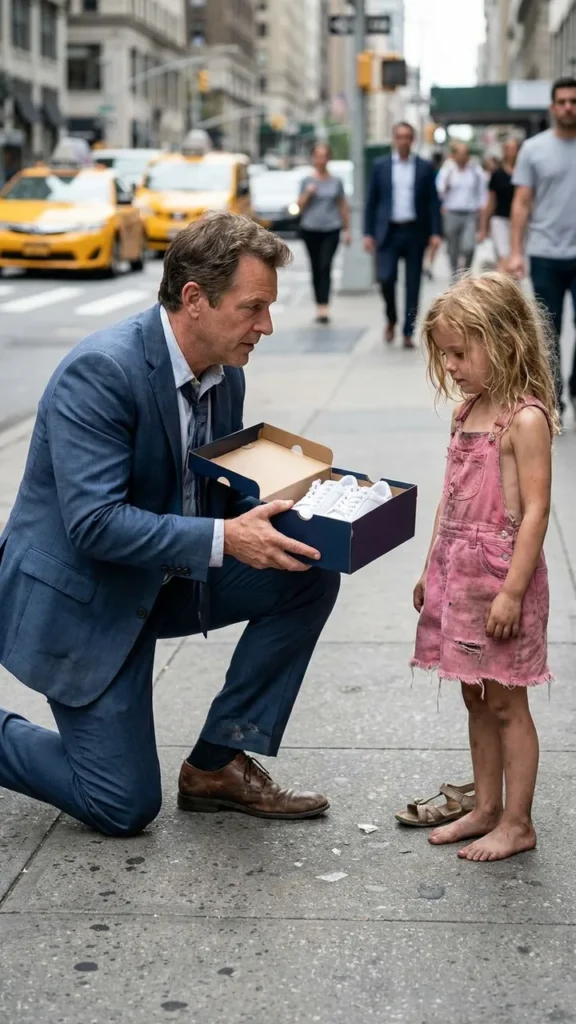
Then he noticed the bench.
It was a plain metal bench under a dying elm tree.
On it sat a small figure.
A girl.
She was six, maybe seven.
Her blonde hair was tangled.
It stuck to her cheeks.
She wore a faded pink denim dress.
The hem was frayed.
The fabric thin.
Her sandals were broken.
The left strap had snapped.
The right sole was peeling away from the leather.
She had taken them off.
Her bare feet dangled over the edge.
The concrete was hot.
Arthur stopped.
He stared.
He didn’t mean to.
But his eyes locked on her feet.
The soles were dirty.
Tiny cuts on her heels.
She must have walked a long way.
She wasn’t crying.
She was just sitting.
Her hands folded in her lap.
He looked around.
No adult nearby.
No one watching her.
His throat tightened.
He thought of his own daughter.
Sarah.
She would be twenty-three now.
But she was gone.
A car accident.
Twelve years ago.
He swallowed.
The girl looked up.
Their eyes met.
He saw wariness in her gaze.
A sharp intelligence.
She had learned to be careful.
He took a step forward.
“Hi,” he said.
His voice was warm.
Gentle.
He tried to smile.
She didn’t smile back.
She clutched the edges of the bench.
Her knuckles whitened.
“I’m Arthur,” he said. “I’m not going to hurt you.”
She studied him.
Her eyes moved over his suit.
His tie.
His clean-shaven face.
“Are you lost?” he asked.
She shook her head.
“Where are your parents?”
She looked down at her feet.
He knelt.
He was a tall man.
Kneeling brought him to her level.
The pavement burned through his dress pants.
“My mom is at work,” she said.
Her voice was soft.
A little timid.
But earnest.
“She works late.
I’m supposed to wait here.”
Arthur nodded.
“What’s your name?”
“Lily.”
“Lily.
That’s a beautiful name.”
She didn’t react.
He looked at her sandals again.
The broken strap hung like a dead vine.
“Does it hurt?” he asked.
“No.”
“Your feet must be hot.”
She shrugged.
He reached into his pocket.
She flinched.
He stopped.
“It’s just my wallet,” he said slowly. “I want to show you something.”
He pulled out a business card.
The corner was bent.
He held it up so she could see.
“I work nearby.
I’m not a bad man.”
She stared at the card.
Then at his face.
“Why do you care?” she asked.
The question hit him like a fist.
He didn’t have an answer.
Not one that made sense.
He looked at her broken sandals.
Her bare, dirty feet.
The way she sat so still, like she was used to waiting.
“Because someone should,” he said.
She blinked.
A bus rumbled by.
A woman laughed loudly on a phone.
The city noise swallowed his words.
But Lily heard him.
She studied his face for a long moment.
Then she looked at her feet.
“My sandals broke this morning,” she said. “I tried to fix them with tape.
But it came off.”
Arthur’s chest ached.
“There’s a shoe store two blocks away,” he said. “I could buy you new ones.”
Her eyes widened.
Then she shook her head.
“I can’t take things from strangers.”
“I’m Arthur.
Not a stranger anymore.”
She almost smiled.
“That’s not how it works.”
He sat back on his heels.
The heat made his shirt stick to his skin.
“I know,” he said. “But I’d like to help.”
She was quiet.
A pigeon landed near her feet.
It pecked at a dropped fry.
She watched it.
“Mom says people who give things want something back.”
Arthur felt a cold weight in his stomach.
“What does your mom do?”
“She cleans hotel rooms.
She’s tired all the time.”
He nodded.
He could have walked away.
He should have walked away.
That’s what smart people did.
They didn’t get involved with strange children on hot city streets.
But he stayed.
“I don’t want anything, Lily,” he said. “I just see that you need shoes.
And I can help.”
She looked up at him again.
“You promise?”
“I promise.”
She bit her lower lip.
“Then okay,” she said. “But I’ll pay you back someday.”
Her voice was firm.
He opened his mouth to argue.
Then he saw her eyes.
They were serious.
She needed this promise.
“Okay,” he said. “Someday.”
She slid off the bench.
Her bare feet touched the pavement.
She winced.
Arthur stood.
“Come on,” he said. “It’s not far.”
She fell into step beside him.
Her hand brushed against his.
He didn’t take it.
He let her walk on her own.
The crowd parted around them.
No one noticed.
The sidewalk was a river of strangers.
Arthur walked slowly.
He adjusted his pace to match Lily’s small steps.
She moved carefully.
Her toes curled away from hot grates.
He pointed ahead.
“It’s just past the coffee shop.
See the blue awning?”
She nodded.
She didn’t say anything.
He glanced at her.
Her head was down.
Her hands were clasped in front of her.
The pink dress had a small tear near the collar.
“How old are you, Lily?”
“Seven.”
“Seven.
That’s a good age.”
She looked up at him. “Is it?”
He smiled. “It can be.”
She didn’t respond.
They passed a street musician playing a saxophone.
The notes were low and sad.
A man in a torn jacket was dancing.
Coins jingled in a cup.
Arthur stopped for a moment.
He reached into his pocket and dropped a five-dollar bill into the cup.
Lily watched him.
“You give money to strangers a lot?” she asked.
“Sometimes.”
“Why?”
He thought about it.
“Because I can.
And it makes me feel less alone.”
She considered that.
They kept walking.
The shoe store was small.
It sat between a dry cleaner and a deli.
The awning was faded blue.
The windows were dusty.
Arthur held the door open.
Lily hesitated.
“It’s okay,” he said.
She stepped inside.
The air smelled like rubber and leather.
Rows of shoes lined the walls.
A young man behind the counter looked up.
He wore a red apron.
His eyes narrowed when he saw Arthur and Lily.
“Can I help you?” His tone was flat.
Arthur ignored the suspicion.
“We need a pair of shoes for the girl.”
The clerk looked at Lily’s bare feet.
Then back at Arthur.
He raised an eyebrow.
“Store policy,” he said. “No trying on without socks.
Health code.”
Arthur’s jaw tightened.
“We’ll buy socks too.”
He found a rack of cheap white socks.
He handed a pair to Lily.
“Put these on.”
She took them.
She sat on a small bench near the wall.
She pulled on the socks slowly.
Her fingers were careful.
Arthur turned to the shelves.
He picked out a pair of simple white sneakers.
Sturdy.
Velcro straps.
No laces.
“These look your size,” he said.
Lily stood.
She took the sneakers.
She sat down again and slid her feet inside.
They fit.
She tied the Velcro straps.
Then she stood.
She took a step.
Then another.
She looked down at her feet.
Her expression was unreadable.
“How do they feel?” Arthur asked.
“Good,” she said. “Soft.”
He nodded.
“We’ll take them,” he said to the clerk.
The clerk rang them up.
The total was twenty-three dollars.
Arthur handed over a credit card.
The clerk swiped it.
His eyes still held judgment.
Arthur didn’t care.
He took the bag with her old sandals.
He handed it to her.
“You can throw those away if you want.”
Lily clutched the bag.
Then she looked up at him.
“Thank you,” she said.
Her voice was small.
But it carried weight.
They walked out of the store.
The sun was lower now.
The shadows stretched long.
The crowd had thinned.
They stood on the sidewalk.
Arthur’s heart was heavy.
He didn’t want to leave her.
“I need to get back to your bench,” she said. “Mom will be there in an hour.”
“I’ll walk you.”
They started walking.
The new sneakers squeaked on the concrete.
She looked at her feet as she walked.
“I never had new shoes before,” she said. “Only hand-me-downs.”
“Everyone deserves new shoes.”
She was quiet.
Then she stopped.
Arthur stopped too.
She turned to face him.
Her blue eyes were serious.
“I meant what I said,” she told him. “I will pay you back.
I don’t know how yet.
But I will.”
Arthur felt a lump in his throat.
“You don’t have to.”
“I know,” she said. “But I want to.”
She reached into the pocket of her dress.
She pulled out the business card he had shown her earlier.
It was crumpled.
“You gave me this,” she said. “I kept it.”
He hadn’t even noticed her take it.
“I’ll find you someday,” she said. “When I’m older.
And I’ll pay you back.”
Arthur knelt down again.
He put his hand on her shoulder.
Lightly.
She didn’t pull away.
“Lily,” he said. “You don’t owe me anything.
But if you want to remember me, that’s fine.
When you’re grown up, if you ever need help, I hope you’ll call.”
She shook her head.
“No.
I’ll call when I can help you.”
He smiled.
It was a sad smile.
A weary smile.
“Okay,” he said. “I’ll wait.”
They reached the bench.
She sat down.
Her new sneakers dangled.
Arthur stood there for a moment.
“Goodbye, Lily.”
“Goodbye, Mr. Arthur.”
He turned and walked away.
He did not look back.
But he heard her voice, soft behind him:
“I promise.”
‘The sun bled orange over the city.
Lily walked home.
The new sneakers felt strange.
Light.
Clean.
She kept looking down at them.
She turned down a narrow street.
The buildings were cracked.
Trash cans overflowed.
A man sat on a stoop, smoking.
He didn’t look at her.
She climbed three flights of stairs.
The light in the hallway was broken.
She felt her way by memory.
Apartment 4B.
She opened the door.
The smell hit her first.
Cheap vodka.
Stale cigarette smoke.
Empty pizza boxes on the floor.
Her mother was on the couch.
She was slumped sideways.
Her blouse was unbuttoned.
Her hair was matted.
A bottle dangled from her hand.
“Mom?”
No answer.
Just a low snore.
Lily closed the door softly.
She locked the chain.
She walked to the small bedroom she shared with her mother.
The mattress was on the floor.
The sheets were gray.
She took off the new sneakers.
She held them in her hands.
The rubber soles were still clean.
The white fabric was bright.
She couldn’t keep them in sight.
She knew what her mother would do when she woke up.
She’d see them.
She’d sell them.
Or break them.
Or scream about where they came from.
Lily looked around the room.
She found a loose floorboard near the wall.
She pried it up with her fingers.
Dust puffed out.
She folded the sneakers together.
She shoved them into the dark space.
Then she put the board back.
She slid her broken sandals into a corner.
They looked like dead animals.
She sat on the mattress.
She pulled her knees to her chest.
Her mother groaned in the other room.
Lily didn’t cry.
She had learned not to.
She reached into her dress pocket.
The business card was still there.
Mr. Arthur Mercer.
A phone number.
An address.
She read it in the dim light.
“I’ll find you,” she whispered.
She tucked the card into her underwear drawer.
Beneath the single pair of clean socks.
She lay down.
The building creaked.
Someone yelled on the street.
A car honked.
She closed her eyes.
She thought of the man’s warm voice.
His kind eyes.
She thought of the new sneakers under the floorboard.
She felt something she hadn’t felt in a long time.
Hope.
But it tasted bitter.
Because she knew tomorrow would be the same.
Her mother would wake up.
She would be angry.
She would hit.
Lily pressed her face into the dirty pillow.
She made herself small.
She waited for morning.
Weeks passed.
August turned to September.
The heat softened.
The leaves began to brown.
Arthur Mercer went back to work.
He sat in meetings.
He stared at spreadsheets.
He nodded at the right times.
But his mind drifted.
He saw her face.
The way she had looked at him.
Wary.
Brave.
He saw her bare feet on the hot pavement.
He found himself walking past that bench every day.
He told himself it was coincidence.
He needed the fresh air.
The route was faster.
But he knew the truth.
He was looking for her.
She never came.
The bench was always empty.
Sometimes a pigeon.
Sometimes a homeless man.
Never a small girl in a pink dress.
He thought about calling the number on his card.
But he had given it to her.
He didn’t have hers.
He didn’t even know her last name.
He tried to remember her mother’s workplace.
Hotel rooms.
Which hotel?
He had no idea.
One afternoon, he stood at the bench.
He put his hand on the cold metal.
“Where are you?” he whispered.
A woman with a stroller passed him.
She gave him a strange look.
He stepped away.
He walked to the shoe store.
The same clerk was behind the counter.
“You again,” the clerk said.
“The girl I was with.
Has she come back?”
The clerk shrugged. “I don’t keep track of kids.”
Arthur left.
He went back to his office.
He sat at his desk.
He opened a drawer.
Inside was a photo of his daughter Sarah.
She was twelve in the picture.
Smiling.
Missing a front tooth.
He hadn’t looked at it in years.
He picked it up.
His hand shook.
“I tried,” he said to the photo. “I tried to help her.
Like I couldn’t help you.”
The photo said nothing.
He put it back.
He closed the drawer.
He went home.
His house was too big.
He lived alone now.
His wife had left him five years ago.
She said he was a ghost.
Living in the past.
She was right.
He cooked dinner.
He ate alone.
He watched the news.
He went to bed.
Every day was the same.
He stopped going to the bench after three months.
The card he had given Lily was gone.
He had lost it somewhere.
In his wallet.
On the subway.
He didn’t know.
He felt a quiet grief.
A hollow space where the memory of her lived.
Life moved on.
Quarterly reports.
Tax season.
A new colleague at work.
A cold that lasted two weeks.
He forgot her face.
Not completely.
But the sharp edges blurred.
He turned fifty-two.
He retired.
He sold the big house.
He moved to a smaller apartment near the park.
He bought a coffee every morning at the same café.
He read the newspaper.
He watched the young mothers push strollers.
He was alone.
He accepted it.
He did not know that on the other side of the city, a girl was growing up.
She kept a business card hidden in a drawer.
She promised.
She never forgot.
CHAPTER 2: The Loss
‘Autumn bled into a bitter winter.
Arthur stood at his office window.
Snow fell over the city.
Gray sky.
Gray streets.
He had stopped looking for her.
It hurt too much.
He pulled the photo of Sarah from his drawer.
He traced her face with his finger.
“I failed you,” he whispered.
His assistant knocked. “Mr. Mercer?
Your two o’clock is here.”
He put the photo away.
He went through the motions.
Handshakes.
Projections.
Revenue targets.
His desk phone rang at four.
“Arthur.” It was his ex-wife, Carol. “Did you forget?”
“Forget what?”
“Sarah’s birthday.”
He closed his eyes.
“I didn’t forget,” he said.
“You did last year.”
“I won’t this year.”
She paused. “You always say that.”
The line went dead.
He stood up.
He walked to the window.
The snow fell harder.
He thought of Lily.
He thought of how she had looked at him.
Like he was the first adult who hadn’t hurt her.
He had given her his card.
He had told her to call.
She never did.
Maybe she lost it.
Maybe her mother threw it away.
Maybe she was hurt.
Maybe she was dead.
He couldn’t know.
He grabbed his coat.
He walked to the subway.
He rode three stops past his apartment.
He got off at her neighborhood.
The streets were icy.
The buildings looked harsher in the cold.
Trash frozen to the ground.
He found the building.
Apartment 4B.
He stood outside.
His breath fogged the air.
He knocked on the downstairs door.
A woman opened it.
She was older.
Gray hair.
Suspicious eyes.
“Yeah?”
“I’m looking for a family.
A mother and a little girl.
Blonde hair.
About seven years old.”
The woman squinted. “You a cop?”
“No.
I helped her.
I want to make sure she’s okay.”
The woman laughed.
A dry, ugly sound.
“They moved.
Month ago.
Landlord kicked ’em out.”
Arthur’s chest tightened.
“Do you know where?”
“No.
And I don’t care.
That woman was trouble.
Kid probably is too.”
She slammed the door.
Arthur stood there.
The wind bit through his suit.
He walked home.
He didn’t sleep that night.
He called the number on his own card the next morning.
The one he had given Lily.
He dialed it from his office phone.
A recorded voice answered.
“The number you have dialed is no longer in service.”
He hung up.
He felt it then.
The weight of it.
The finality.
He had lost her.
He didn’t know her last name.
He didn’t know her school.
He didn’t know her mother’s name.
She was a ghost.
He put the photo of Sarah back in the drawer.
He locked it.
Three months later, he retired.
The company gave him a party.
A plaque.
A handshake.
He went home.
He sat in his empty house.
He was fifty-three years old.
Alone.
He sold the house.
He bought a small apartment near the park.
He bought a coffee every morning at the same café.
He watched the world move.
He did not look for her anymore.
But sometimes, in the quiet mornings, he felt a hand in his.
Small.
Warm.
He felt her look up at him.
He heard her voice.
“I’ll find you.”
He shook his head.
He poured his coffee.
He read the paper.
Life moved on.
Ten years.
Ten winters.
Ten springs.
Lily grew.
She survived.
The apartment changed.
New city.
New school.
New bruises.
Her mother drank harder.
The hits came more often.
Lily learned to be small.
She learned to hide.
But she never lost the card.
She kept it in a sock.
She kept the sock in a shoebox.
She kept the shoebox under her bed.
She moved it with her every time.
Three times in ten years.
Three different apartments.
Three different schools.
The card stayed.
She read it at night.
By the light of her phone.
Mr. Arthur Mercer.
She whispered his name.
She promised.
She was fifteen when her mother died.
Cirrhosis of the liver.
The doctors said it was quick.
It wasn’t.
She watched her die in a hospital bed.
Yellow skin.
Shallow breath.
The last thing her mother said was, “You were a mistake.”
Lily said nothing.
She walked out of the hospital.
She was alone.
The state put her in foster care.
Two years.
Three homes.
She ran once.
They brought her back.
She aged out at eighteen.
She got a job.
A diner.
Night shifts.
Grease in her hair.
She saved every cent.
She applied to community college.
She got in.
She studied business.
She didn’t know why.
She only knew she wanted to be someone.
Someone that man would be proud of.
She found him.
It took six months of searching.
She used the library computers.
She searched his name.
Arthur Mercer.
Nothing at first.
Then an old article.
Arthur Mercer, former regional director, retires after 28 years.
The article had a photo.
Older.
Grayer.
But his eyes were the same.
Warm.
Kind.
She cried.
She found his address through public records.
A small apartment on Oak Street.
She wrote him a letter.
Dear Mr. Mercer, You gave me shoes when I was seven.
I told you I would repay you.
I am ready now.
She mailed it.
She waited.
Two weeks.
No reply.
She called the number listed for him.
No answer.
She took the train to his city.
She found the café he visited.
The one near his apartment.
She waited.
She watched the entrance.
Her hands shook.
She was nineteen now.
Slender.
Still blonde.
Still wary.
She wore a simple dress.
Blue.
Clean.
She carried an envelope.
Inside was cash.
Seven hundred dollars.
Every cent she had saved.
She saw the door open.
He walked in.
He was stooped now.
His hair was white.
His suit was gone.
He wore a sweater.
Worn at the elbows.
He ordered coffee.
Black.
He sat at a table by the window.
She took a breath.
She walked toward him.
She stopped at his table.
He looked up.
His eyes widened.
“Hello, Mr. Mercer,” she said.
Her voice shook.
He stared at her.
He saw it.
The eyes.
The same wary, brave eyes.
He stood up.
“Lily?” he whispered.
She nodded.
“I told you I’d find you,” she said.
She placed the envelope on the table.
He looked at it.
He looked at her.
“What is this?” he said.
“Seven hundred dollars,” she said. “I saved it.
For the shoes.
For everything.”
He shook his head.
“I don’t want your money, Lily.”
“You have to take it.
I promised.”
His hand reached out.
Not for the envelope.
For her hand.
He held it.
“You were seven years old,” he said. “You didn’t owe me anything.”
“I owed you everything.”
His eyes filled.
“The real payment,” he said, “was your trust.”
She cried.
He pulled her into a hug.
She was taller than him now.
But she felt small in his arms.
“I never forgot you,” he said.
“Me neither,” she said.
They stood there.
The café was quiet.
Outside, the city moved.
But they stood still.
“Sit,” he said.
She sat.
He pushed the envelope back toward her.
“Use this for school,” he said.
“I did it without you,” she said.
“I know.”
She smiled.
A small, fragile thing.
“I’m going to graduate,” she said. “I’m going to be somebody.”
“You already are,” he said.
She looked at him.
“Will you come?” she asked. “To my graduation?”
He nodded.
His voice cracked.
“I wouldn’t miss it.”
They walked out of the café together.
The sun was bright.
The air was warm.
For the first time in ten years, Arthur didn’t feel alone.
And for the first time in her life, Lily felt found.
‘The apartment door creaked open.
Lily stepped inside.
The smell hit her first.
Stale beer.
Cigarette ash.
Sweat.
The living room was dark.
A single lamp flickered on the floor.
Its shade was torn.
Her mother sat on the couch.
Slumped.
A bottle in her hand.
“Where the hell were you?”
Lily froze. “I was playing.
By the fountain.”
“Liar.”
Her mother’s voice slurred.
She lifted her head.
Eyes bloodshot.
“I saw you.
With some man.”
Lily’s heart stopped. “No.
I was alone.”
“Don’t lie to me.” Her mother stood.
Unsteady.
The bottle clattered to the floor.
She staggered forward. “Who was he?
What did you do?”
Lily stepped back.
Her back hit the door.
“Nothing.
He just-he gave me shoes.”
She clutched the paper bag in her hands.
The new sneakers inside.
Her mother laughed.
A raw, broken sound. “Shoes?
A stranger gives you shoes?
You think he wants nothing in return?”
“He was nice.”
“Nice men don’t talk to little girls.”
Her mother grabbed Lily’s arm.
Fingers digging in. “Show me.”
Lily opened the bag.
Her mother pulled out the sneakers.
White.
Cheap canvas.
She stared at them.
Her face twisted.
“You stole these.”
“No.
He bought them.”
“You think I believe that?”
She threw the shoes across the room.
They hit the wall.
Bounced onto the floor.
Lily’s eyes welled. “Please.
I just wanted something that fit.”
Her mother raised her hand.
The slap came fast.
Hard across Lily’s cheek.
“You take nothing from strangers.
You hear me?”
Lily nodded.
Tears spilled.
“Go to your room.
Don’t let me see those again.”
Lily ran.
Down the narrow hall.
Past the moldy wallpaper.
Into the closet she called a bedroom.
She knelt.
Her cheek burned.
She found the shoebox under the bed.
Empty.
She crept back to the living room.
Her mother was passed out on the couch.
The sneakers lay near the wall.
Lily grabbed them.
She ran back.
She shoved them into the shoebox.
She pushed it deep under the bed.
Then she pulled out her sock drawer.
She took the card Mr. Mercer had given her.
She held it to her chest.
“I’ll find you,” she whispered. “I promise.”
She hid the card inside the shoebox.
Under the shoes.
She lay down on the thin mattress.
The springs bit into her back.
She heard her mother snore.
She touched her cheek.
It was swollen.
She closed her eyes.
She thought of his voice.
Warm.
Gentle.
She thought of her new shoes.
She smiled.
Then she cried.
She didn’t know if she cried from pain or hope.
Maybe both.
Weeks passed.
Arthur found himself walking past that corner every morning.
He told himself it was coincidence.
He knew it wasn’t.
He stood by the fountain.
Coffee in hand.
Briefcase at his side.
He scanned the crowd.
No blonde hair.
No frayed pink dress.
He checked his watch. 8:15.
He had to get to the office.
He didn’t move.
A woman brushed past him. “Excuse me.”
He stepped aside. “Sorry.”
He stared at the bench where she had sat.
Empty.
He walked to work.
He did the same thing the next day.
And the next.
His assistant noticed. “You’re late again, Mr. Mercer.”
“Sorry.
Traffic.”
She raised an eyebrow. “You walk.”
He said nothing.
Week two.
He stood at the fountain longer now.
Thirty minutes.
An hour.
He asked a street vendor. “Have you seen a little girl?
Blonde.
Worn sandals.”
The vendor shrugged. “Lots of kids.
I don’t watch.”
Arthur nodded.
He gave the vendor twenty dollars. “If you see her, call me.”
He wrote his number on a napkin.
The vendor took it.
Pocketed it.
Never called.
Week three.
Arthur went to the police station.
He waited in a plastic chair for two hours.
A detective finally saw him.
Middle-aged.
Tired eyes.
“What’s this about?”
“A missing child.”
The detective leaned back. “Name?”
“I don’t know her last name.
She’s about seven.
Blonde.
Lives in a bad area.”
“You have a photo?”
“No.”
“Address?”
“Apartment 4B on Grant Street.
But she might have moved.”
The detective sighed. “We can’t do much without a name.
File a report if you want.”
Arthur filed a report.
Nothing came of it.
Week four.
He stood in the rain.
Umbrella over his head.
Suit damp at the cuffs.
He watched the crowd.
People rushed past.
Huddled under awnings.
No one stopped.
He stayed until the rain stopped.
Then he walked home.
He sat in his apartment.
Dark.
Quiet.
He pulled out his wallet.
The card was still there.
He read it again.
Arthur Mercer. 555-0199.
He dialed the number from a payphone the next day.
A woman answered. “Hello?”
“Is this Lily’s home?”
“Who?”
“Lily.
The little girl.
I gave her shoes.”
“Wrong number.”
Click.
He tried again.
Same number.
Same voice.
“Please.
I’m not trying to-”
“I said wrong number.
Stop calling.”
She hung up.
He stood there.
The receiver buzzed in his hand.
He put it back.
He never went to the corner again.
He told himself it was over.
He told himself she was safe.
But he didn’t believe it.
He buried the card in his desk drawer.
Under old tax returns.
He tried to forget.
He couldn’t.
Months later, he heard a child laugh on the street.
He turned.
It wasn’t her.
It was never her.
He walked on.
The city swallowed his footsteps.
Life moved on.
CHAPTER 3: The Walk
‘He remembered the walk.
It had been a bright afternoon.
The sun cut between buildings like a blade.
Arthur stood near the fountain.
Lily clutched the paper bag with her old sandals inside.
She looked up at him.
Her eyes were cautious.
“The store is two blocks that way,” Arthur said.
He pointed east.
Lily nodded.
She didn’t move.
“Are you okay?” he asked.
“My feet hurt.”
He looked down.
Her toes were raw.
Cuts and blisters covered her heels.
“I’m sorry,” he said. “I should have noticed sooner.”
“It’s not your fault.” Her voice was soft.
Earnest.
She stepped forward.
A sharp wince crossed her face.
Her left foot landed awkwardly on a crack in the pavement.
She gasped.
Arthur reached out.
He stopped before touching her.
“May I help you?”
She shook her head. “I can do it.”
She took another step.
Her jaw tightened.
Arthur slowed his pace.
He matched her rhythm.
He walked beside her, not ahead.
The crowd rushed past.
A man in a blue jacket bumped her shoulder.
She stumbled.
Arthur put his hand out.
Steadying her without grabbing.
“Sorry,” the man muttered, not looking back.
Lily steadied herself.
She looked at Arthur. “Do you have kids?”
The question caught him off guard. “No.
I don’t.”
“Why not?”
“I never found the right person to have them with.”
She nodded as if she understood. “My mom says I was an accident.”
Arthur’s throat tightened.
He didn’t know what to say.
They passed a bus stop.
An old woman sat on the bench.
She watched them.
Her eyes narrow.
Lily’s sandals made a scraping sound on the concrete.
The left heel was completely gone.
A car horn blared.
A taxi swerved.
Lily flinched.
Arthur stepped closer.
He put himself between her and the street.
“We’re almost there,” he said.
“How do you know I won’t run?”
He looked at her. “Will you?”
“No.” She paused. “I gave my word.”
He smiled.
It was a tired smile. “That means something to you?”
“Everything.”
They passed a brick wall covered in graffiti.
A liquor store.
A barber shop with a faded red pole.
A dog barked from a fenced yard.
Lily jumped.
“It’s okay,” Arthur said. “Just a dog.”
“I’m not scared of dogs.” She looked at the ground. “I’m scared of loud noises.”
“Why?”
“My dad.
He used to slam doors.
Mom says he’s gone.”
Arthur felt a weight in his chest.
He said nothing.
They reached a crosswalk.
The light was red.
Cars rushed by.
Lily stood on the curb.
Her toes curled over the edge.
Arthur looked at her.
Her dress was faded.
The hem frayed.
One strap had been safety-pinned.
She shivered.
The afternoon breeze was cool.
Arthur took off his jacket.
He held it out.
“Here.”
She shook her head. “I’m fine.”
“You’re cold.”
“I’m used to it.”
He didn’t push.
He put the jacket back on.
The light turned green.
They crossed.
Her limp was worse now.
She dragged her left foot.
Arthur wanted to carry her.
He knew better.
He just walked slower.
Two teenage boys passed.
One laughed. “Look at the rich guy with the street kid.”
The other snorted. “Probably his daughter.”
Lily’s face went red.
She looked down.
Arthur’s jaw clenched.
He didn’t respond.
They turned a corner.
A small shoe store sat between a laundromat and a pawn shop.
The sign read “Shoes for Less.” The neon “o” was burned out.
Arthur held the door open. “After you.”
Lily hesitated.
She looked at the store.
Then at him.
“You don’t have to do this,” she said.
“I know.”
“Why are you?”
He knelt down to her level.
His eyes were gentle.
“Because everyone deserves to walk without pain.”
She stared at him.
Her lip trembled.
Then she stepped inside.
The store smelled like cheap leather and dust.
Fluorescent lights hummed overhead.
The floor was cracked linoleum.
Racks of shoes lined the walls.
A single clerk stood behind the counter.
He was in his fifties.
Thin.
Wearing a stained apron.
He looked up as Arthur and Lily entered.
His eyes went to Arthur first.
The dark suit.
The blue tie.
Then to Lily.
The frayed dress.
The bare, dirty feet.
His lip curled.
“Can I help you?” The clerk’s voice was flat.
Arthur stepped forward. “We need a pair of sneakers for this young lady.”
The clerk stared at Lily. “She with you?”
“Yes.”
“You her father?”
“No.”
The clerk snorted.
He folded his arms. “We don’t do charity here.
Cash only.”
Arthur reached into his pocket.
He pulled out a worn leather wallet. “I can pay.”
The clerk’s eyes flicked to the wallet.
Then back to Lily.
“You sure she ain’t gonna run off with them?” He smirked.
Arthur’s face hardened. “She’s a child.
Show her the shoes.”
Lily stood very still.
Her hands were at her sides.
Fists clenched.
The clerk shrugged.
He pointed to a rack in the back. “Kids’ section.
All on sale.”
Arthur led Lily toward the back.
She walked slowly.
Her bare feet left small prints on the dusty floor.
They passed a rack of pink sandals.
Lily glanced at them.
“Those are pretty,” she whispered.
“Do you want those?”
She shook her head. “I need sneakers.”
They reached the kids’ section.
Rows of canvas sneakers.
White.
Blue.
Black.
All cheap.
Lily ran her fingers over a pair of white ones.
Size three.
“Those look good,” Arthur said.
She picked them up.
Turned them over. “They don’t have holes.”
He smiled. “That’s the idea.”
She sat down on a small bench.
She tried to put the sneaker on her left foot.
Her hands were shaking.
Arthur knelt in front of her. “May I help?”
She hesitated.
Then nodded.
He took the sneaker.
Gently.
He held her foot.
It was cold.
The sole was calloused.
He slid the sneaker on.
It fit.
She looked at him.
Her eyes were wide.
“Now the other one,” he said.
He repeated the motion.
The right sneaker slipped on easily.
Lily stood up.
She took a step.
Then another.
Her face changed.
A small smile broke through.
“They don’t hurt.”
“Good.”
She walked to a mirror near the rack.
She looked at her feet.
The white canvas.
The cheap rubber soles.
She touched the side of the sneaker.
A tear slid down her cheek.
Arthur stayed behind.
He gave her space.
The clerk watched from the counter.
He muttered something under his breath.
Arthur walked to the register. “I’ll take these.”
The clerk rang them up. “Fifteen ninety-nine.”
Arthur handed him a twenty.
The clerk stared at the bill.
Then at Lily. “You know what you’re doing, mister?”
Arthur’s voice was low. “Yes.”
“There’s shelters.
You don’t have to buy shoes for strangers.”
“I’m not buying them for a stranger.
I’m buying them for her.”
The clerk’s eyes narrowed. “Suit yourself.”
He gave Arthur the change.
Four dollars and one penny.
Arthur pocketed the coins.
He turned to Lily.
She was still looking at her feet.
“Ready?” he asked.
She looked up.
A tear hung on her chin.
“Thank you,” she whispered.
He nodded.
They walked to the door.
The clerk called out. “Don’t come back.”
Arthur ignored him.
Outside, the air was fresh.
The sun was lower now.
Shadows stretched long.
Lily stood in her new sneakers.
She didn’t limp.
She hugged the paper bag with her old sandals against her chest.
Then she reached into her pocket.
She pulled out the card he had given her earlier.
“I won’t lose this,” she said.
“Keep it safe.”
“I will.” Her voice cracked. “I promise I’ll pay you back.”
Arthur put a hand on her shoulder.
Lightly.
“The only payment I need is that you keep walking forward.”
She nodded.
She turned.
She started walking toward the corner.
Arthur watched her go.
She stopped.
Looked back. “Mr. Mercer?”
“Yes?”
“I’m going to find you again.”
He smiled.
It was a sad smile.
“I hope you do.”
She disappeared into the crowd.
Arthur stood there a long time.
Then he walked home.
He didn’t know it yet, but he was already changed.
‘The door swung shut behind them.
The afternoon sun hit Lily’s face.
She blinked.
Her new sneakers felt strange.
Solid.
Clean.
Arthur stood beside her.
He smoothed his tie.
Lily looked up at him.
Her eyes were dry now.
Serious.
“I mean it,” she said. “I’ll find you.”
Arthur’s mouth twitched. “You don’t have to.”
“I want to.”
He reached into his jacket pocket.
His fingers found a small white card.
He pulled it out.
His business card.
Arthur Mercer, Regional Manager, Meridian Insurance.
A phone number.
An email.
He held it out.
“Take this,” he said. “Call if you ever need anything.”
She took it.
Her fingers were dirty.
The card was clean.
She stared at it.
Then she tucked it into the front pocket of her faded pink dress.
She pressed her hand against the fabric.
“I won’t lose it,” she said.
“Good.”
She looked down at her feet.
The white sneakers were already smudged from the dusty sidewalk.
“They’re really mine?”
“They’re yours.”
She shifted her weight.
The paper bag with her old sandals rustled in her hand.
“Why did you pick me?” she asked. “There are other kids.
Beggars.
Worse off.”
Arthur knelt.
His knees cracked.
He didn’t care.
“Because you were sitting alone,” he said. “And you weren’t asking for anything.”
She held his gaze.
Her chin trembled.
“My mom says people only give when they want something back.”
“Your mom is wrong.”
“How do I know?”
Arthur sighed.
He looked at the busy street.
A bus rumbled past.
A woman pushed a stroller.
No one watched them.
“You don’t,” he said. “Not yet.
But you can choose to trust me.
Just this once.”
Lily bit her lip.
She looked at the card again.
“I’ll call,” she said. “When I’m older.
When I can pay you.”
“I don’t want your money.”
“Then what?”
He stood up.
He straightened his suit jacket.
“I want you to remember that someone was kind.
That’s enough.”
A man in a grey hoodie bumped into them. “Watch it,” he muttered.
Lily stepped closer to Arthur.
She grabbed the edge of his sleeve.
“Can I ask you something else?” she said.
“Anything.”
“Do you think I’ll make it?”
Arthur’s throat tightened. “Make what?”
“Out.
Away from my mom.
Away from this.”
He looked at her.
Really looked.
The messy hair.
The frayed dress.
The raw determination in her young face.
“Yes,” he said. “I think you’ll make it.”
Her eyes glistened.
She blinked hard.
“Thank you,” she whispered. “For the shoes.
For believing.”
Arthur nodded.
He couldn’t speak.
She stepped back.
She clutched the paper bag with one hand.
The other hand rested over her pocket.
Over the card.
“I’ll find you,” she said again. “I promise.”
Then she turned.
She walked toward the corner.
Her new sneakers made soft sounds on the pavement.
Arthur watched.
She didn’t look back.
She reached the corner.
A group of teenagers passed.
They jostled her.
She didn’t fall.
She kept walking.
Arthur’s hands were in his pockets.
His fingers touched a loose penny.
He squeezed it.
The crowd swallowed her.
She was gone.
Arthur stood alone.
The street had grown louder.
Taxis honked.
A street musician played a sad guitar.
The smell of hot dogs from a cart drifted past.
He didn’t move.
His eyes stayed fixed on the corner where she had disappeared.
A woman in a red coat bumped his shoulder. “Sorry,” she said, not stopping.
Arthur blinked.
He looked down at his hands.
They were empty.
He felt a strange ache in his chest.
A hollow space.
He didn’t know her.
He didn’t know her last name.
He didn’t know where she lived.
He only knew her feet were raw.
Her dress was torn.
And her eyes held a fire he hadn’t seen in years.
“Sir?
You okay?”
A young man in a delivery uniform stopped.
He tilted his head.
Arthur nodded. “Fine.
Thank you.”
The young man shrugged and moved on.
Arthur turned toward the opposite direction.
His office was six blocks away.
He was late for a meeting.
He didn’t care.
He started walking.
His steps were slow.
Heavy.
He passed the same laundromat.
The pawn shop.
The barber with the faded red pole.
A dog barked from the fenced yard.
He barely heard it.
His phone buzzed.
A reminder: Conference call, 3:00 PM.
He silenced it.
He reached the crosswalk where they had waited earlier.
The light was red.
He stood there.
A child’s laughter came from somewhere.
He turned.
A little boy chased a balloon.
His mother called him.
Arthur’s throat tightened.
He thought of Lily.
Her small hand gripping the paper bag.
Her promise.
“I’ll find you.”
He didn’t know why it mattered.
He had helped strangers before.
Donated to charities.
Gave spare change.
This felt different.
He crossed the street.
His leather shoes tapped the asphalt.
He reached the other side.
A bench sat under a tree.
The same bench where he had first seen her.
He sat down.
The wood was warm.
The shade dappled his face.
He looked at the spot on the pavement where her broken sandals had been.
A pigeon landed near his foot.
It pecked at a crumb.
Arthur watched it.
“What now?” he muttered.
The pigeon flew away.
He stayed on the bench for twenty minutes.
Men in suits passed.
Women with shopping bags.
A teenager on a skateboard.
No one looked at him.
Finally, he stood.
He walked toward his office.
Each step felt heavier than the last.
He didn’t know that she would keep his card.
That it would fade and tear in a damp pocket.
He didn’t know that she would whisper his name in the dark.
That she would use it as a talisman against the cold.
He didn’t know that ten years later, she would find him.
He just knew that something had shifted inside him.
A crack in the armor.
And the ache would not leave for days.
When he reached his office building, he paused.
He put his hand in his pocket.
He felt the penny.
He thought of her eyes.
Then he walked inside.
The glass doors closed behind him.
CHAPTER 4: The Night
‘The bus dropped her four blocks from home.
Lily walked.
The new sneakers felt tight.
Clean.
She kept looking down.
The streetlights flickered.
A dog growled behind a chain-link fence.
She crossed to the other side.
Her apartment building stood at the end of the block.
Gray bricks.
A broken window on the second floor.
Laundry hung from a fire escape.
She stopped at the door.
Her hand went to her pocket.
The card was still there.
She pressed it.
She opened the door.
The hallway smelled like cabbage and bleach.
A single bulb buzzed overhead.
The stairs creaked.
She climbed to the third floor.
Apartment 3C.
She paused.
She could hear music.
Country.
Loud.
Her mother’s favorite.
She unlocked the door.
The living room was dim.
A lamp on the floor cast yellow light.
Empty bottles lined the coffee table.
Vodka.
Cheap wine.
Her mother sat on the couch.
Her hair was matted.
She wore a stained robe.
“Lily.”
The voice was slurred.
Thick.
“Hi, Mom.”
“Where you been?” The woman squinted. “You’re late.”
“Just… walking.”
Lily clutched the paper bag.
The old sandals inside.
She held it behind her back.
Her mother reached for a cigarette.
Her hand shook.
She lit it.
“Get me some water.”
Lily nodded.
She walked to the kitchen.
Her new sneakers squeaked on the linoleum.
Her mother’s head turned. “New shoes?”
Lily froze.
“Where’d you get those?”
“Someone gave them to me.”
“Who?”
“A man.”
Her mother’s eyes narrowed.
She sat up.
The cigarette dropped ash on the carpet.
“A man.
You got shoes from a man.”
“He was nice.
He-”
“Nice?” Her mother laughed.
A bitter, wet sound. “Men ain’t nice, Lily.
They want things.”
“He didn’t want anything.”
“Everyone wants something.” She stood.
Unsteady.
Her hand gripped the wall. “Let me see.”
Lily stepped back. “I need to use the bathroom.”
“Let me see the shoes.”
Her mother stumbled toward her.
The robe gaped.
Her breath smelled sour.
Lily backed into the kitchen counter.
“Mom, please.”
“Show me.”
Her mother grabbed her arm.
Fingers dug in.
Lily winced.
She pushed Lily against the counter.
She looked down at the sneakers.
“White.
New.” She spat the words. “You think you’re better than me?”
“No.”
“Some man gives you shoes, and you think you’re special?”
Lily shook her head.
Tears burned.
Her mother released her.
She swayed.
“Take ’em off.”
“What?”
“Take off the shoes.
They’re not yours.”
Lily’s chest tightened. “He gave them to me.”
“He gave them to you for a reason.
You’ll pay later.
You’ll see.”
Her mother turned.
She walked back to the couch.
She collapsed onto it.
Lily stood still.
Her hands trembled.
She didn’t take off the shoes.
She walked to her room.
The door had no lock.
She closed it anyway.
The room was small.
A mattress on the floor.
A pile of clothes.
A cracked mirror.
She sat down.
She pulled off the sneakers.
She held them.
Then she stood.
She pushed aside a loose floorboard near the wall.
She placed the sneakers in the dark space.
She put the paper bag with the sandals on top.
She pushed the board back.
She sat on the mattress.
She pulled her knees to her chest.
Her hand went to her pocket.
The card was still there.
She pulled it out.
She read the name in the dim light.
Arthur Mercer.
She whispered it.
“I’ll find you.”
She tucked the card back.
She lay down.
From the living room, her mother coughed.
Then the music went silent.
Lily stared at the ceiling.
A crack ran across it.
Like a river.
She thought of his eyes.
Warm.
Sad.
She closed her own.
The night was long.
Weeks passed.
Arthur walked the same route every morning.
Sixth Avenue to Forty-Second Street.
The same coffee cart.
The same newspaper stand.
He never took a different street.
He told himself it was habit.
But every day, as he passed that corner, he slowed.
He looked at the bench.
It was always empty.
A businessman read his phone.
A woman fed pigeons.
A teenager napped with a backpack.
No little girl with messy hair.
No faded pink dress.
Arthur would stand there for thirty seconds.
Then he would move on.
His colleagues noticed.
“You okay, Arthur?
You’ve been zoning out.”
His assistant, Marie, handed him a stack of reports.
She studied his face.
He blinked. “Fine.
Just tired.”
“You’ve been tired for a month.”
“I’m fine.”
She didn’t push.
But she watched him.
One Tuesday, he skipped lunch.
He walked to the shoe store.
The same shop.
The same clerk behind the counter.
A middle-aged man with a mustache.
Arthur entered.
The bell rang.
The clerk looked up.
Recognition flickered.
“You’re the guy.
Bought sneakers for that girl.”
“Yes.”
“Something wrong?”
Arthur shook his head. “No.
I was just… checking.”
The clerk frowned. “She okay?”
“I don’t know.”
“You don’t know?” The clerk leaned on the counter. “You bought her shoes.
You didn’t get her name?”
Arthur’s jaw tightened. “She said she’d find me.”
The clerk laughed. “Kids say that.
They don’t mean it.”
“She meant it.”
“Sure.” The clerk shrugged. “You want another pair?
Got a sale.”
Arthur left.
He walked back to the corner.
He sat on the bench.
The sun was high.
People rushed past.
A cab honked.
A siren wailed in the distance.
He looked at his watch. 1:15 PM.
He waited.
Twenty minutes.
A woman sat next to him.
She was old.
She carried a grocery bag.
“Waiting for someone?” she asked.
Arthur hesitated. “A friend.”
“She coming?”
“I don’t know.”
The old woman nodded. “I wait for my son every Tuesday.
He never shows.”
Arthur looked at her. “Why do you wait?”
“Because one day, he will.”
She stood.
She walked away.
Arthur stayed.
The afternoon faded.
The shadows grew long.
No one came.
He stood.
His legs were stiff.
He walked back to the office.
Marie was at her desk.
She looked up.
“You missed a meeting.”
“I know.”
She handed him a note. “Client called.
Wants to reschedule.”
Arthur took it.
His hand was steady, but inside, something twisted.
He sat at his desk.
He opened his drawer.
He took out the pen he had found on the street that day.
A cheap blue pen.
He didn’t know why he kept it.
He put it back.
He stared at the wall.
Three weeks later, he went again.
Then a month.
Then two.
Each time, the bench was empty.
Each time, he left a little slower.
He started eating lunch at a diner near that corner.
A greasy spoon called Frank’s.
He ordered the same thing.
Coffee.
A grilled cheese.
The waitress, Doris, learned his face.
“You waiting for someone?”
“No.”
“You keep looking at that window.
That corner.”
Arthur said nothing.
Doris refilled his coffee. “I once waited for a man who never came.
It takes time to stop.”
Arthur looked at his cup.
“I’m not waiting,” he said.
“Okay.”
She walked away.
Arthur turned.
He looked out the window.
The bench was visible from his seat.
A child sat there.
A boy.
He was tying his shoe.
Arthur’s heart skipped.
The boy stood.
He ran to his mother.
Arthur exhaled.
He pushed his coffee aside.
He left a ten-dollar bill on the table.
He walked out.
The street was cold.
Wind blew trash along the curb.
He stopped at the bench.
He touched the wood.
Then he turned.
He walked back to his office.
He didn’t look back.
‘Arthur sat at his desk.
The afternoon light slanted through the blinds.
He opened his wallet.
The card was gone.
He checked again.
The slot where he kept it was empty.
He pulled out every compartment.
Receipts.
Credit cards.
A folded photo of his late wife.
No card.
His chest tightened.
He stood.
He checked his coat pockets.
His briefcase.
His desk drawer.
Nothing.
Marie appeared at the door. “Arthur?
You okay?”
“I lost something.”
“What?”
“A card.” He ran a hand through his hair. “A business card.
Someone gave it to me.”
Marie stepped closer. “From a client?”
“No.” He shook his head. “A little girl.
I gave her my card.
She said she’d find me.”
Marie’s face softened. “The one you told me about.
The shoes.”
“Yes.”
“You kept her card?”
“She didn’t have one.” His voice cracked. “I gave her mine.
I kept hers.” He paused. “It wasn’t a card.
It was a piece of paper.
She wrote her name on it.”
Marie said nothing.
Arthur searched again.
He emptied his briefcase onto the floor.
Papers scattered.
He knelt.
He patted every pocket.
Nothing.
“Maybe it fell out on the train,” Marie said.
“Maybe.”
But he knew.
He had felt it that morning.
A strange emptiness.
He had ignored it.
He sat on the edge of his desk.
His hands were still.
“I should have asked her more,” he said. “Where she lived.
Her mother’s name.
Something.”
“You did what you could.”
“I did nothing.”
Marie crossed her arms. “You bought her shoes.
That’s not nothing.”
Arthur looked at the floor.
The papers lay in a heap.
He didn’t pick them up.
“She said she’d find me,” he whispered. “But I lost her name.”
Weeks passed.
He stopped going to the corner.
He ate lunch in the office.
He took different routes.
He stopped looking at benches.
His wife’s death had been two years ago.
This felt different.
Smaller.
But it cut the same way.
He aged.
His hair grayed.
His shoulders slumped.
He retired at sixty.
He sold the house.
He moved to a smaller apartment.
He threw away old papers.
He cleaned out drawers.
He never found the card.
Some nights, he sat by the window.
He watched the street below.
Children ran past.
They laughed.
They wore new sneakers.
He closed his eyes.
He remembered her face.
The way she held the shoebox.
The way she said, “I’ll find you.”
He opened his eyes.
The street was empty.
He turned away.
Life moved on.
CHAPTER 5: The Growth
Ten years.
Lily sat on her dorm room bed.
The room was small.
A desk cluttered with textbooks.
A lamp with a broken shade.
She held the card in her hands.
It was faded.
The edges were torn.
The ink had smudged.
Arthur Mercer.
The number was barely readable.
The area code was old.
Three-one-two.
Chicago.
She was in Chicago now.
Twenty years old.
A sophomore at Northwestern.
She had kept the card under the floorboard for years.
When she left home at sixteen, she took it with her.
She had hidden it in a book.
Then in a wallet.
Then in a shoebox.
Now she held it.
Her roommate, Jenna, walked in.
She dropped her bag. “What’s that?”
“Something old.”
Jenna peered over. “A business card?
That thing’s ancient.”
Lily smiled. “A man gave it to me.
When I was eight.”
“A man?” Jenna’s eyebrows rose.
“He bought me shoes.”
Jenna sat on the bed. “Wait.
The story you told me?
The one about the guy on the street?”
Lily nodded.
“You still have his card?”
“I promised I’d find him.”
Jenna looked at the card. “The number’s probably dead.”
“Maybe.”
“You going to try?”
Lily stood.
She walked to her desk.
She pulled out her laptop.
She typed Arthur Mercer Chicago into the search bar.
Nothing useful.
A dentist in Evanston.
A lawyer in the Loop.
She tried Arthur Mercer retired.
A LinkedIn profile appeared.
A man in his seventies.
No photo.
She clicked.
Former executive.
Currently retired.
Lives in Lincoln Park.
The name matched.
She stared at the screen.
“Could be him,” Jenna said.
“Could be.”
Lily picked up her phone.
She dialed the number from the profile.
It rang.
A woman answered. “Hello?”
“Is this the Mercer residence?”
“Yes.
Who’s calling?”
Lily’s throat tightened. “I’m looking for Arthur Mercer.”
“He’s my father.
He’s not here right now.
Can I take a message?”
Lily hesitated. “I knew him.
A long time ago.
He helped me.”
“Helped you how?”
“He bought me shoes.”
Silence.
“You’re the little girl?”
Lily’s eyes burned. “Yes.”
“He talked about you.
For years.”
“Can I see him?”
Another pause. “He’s at a café.
The one on Armitage.
He goes every morning.”
Lily wrote down the address.
She hung up.
She looked at Jenna.
“I’m going.”
She grabbed her coat.
She tucked the card into her pocket.
The old words were still there.
I’ll find you.
She walked out the door.
‘The café smelled of old coffee and baked bread.
Lily stood at the entrance.
Her hands trembled.
She shoved them into her coat pockets.
The card pressed against her palm.
She scanned the room.
A few tables.
An elderly man reading a newspaper.
Two women talking.
A couple on a laptop.
Then she saw him.
He sat by the window.
Alone.
A cup of coffee in front of him.
Steam curled upward.
His hair was white now.
Thinner.
His face was lined.
Deep grooves around his mouth.
His shoulders were narrow.
He wore a cardigan over a button-up shirt.
No tie.
He looked up.
Their eyes met.
He didn’t recognize her.
Of course not.
She was no longer eight years old.
She walked toward him.
Her legs felt weak.
Her throat was dry.
She stopped at his table.
“Mr. Mercer?”
His eyes narrowed.
He tilted his head.
“Yes?”
She pulled out the card.
Held it up.
The edges frayed.
The ink faded.
He stared at it.
His mouth opened slightly.
“I’m Lily.” Her voice cracked. “You bought me shoes.
On State Street.
Ten years ago.”
His hand went to the table.
He gripped the edge.
“Lily?” His voice was hoarse. “The little girl?”
She nodded.
He stood slowly.
His knees popped.
He looked at her face.
Her blonde hair.
Her green eyes.
“You found me.”
“I promised.”
He gestured to the seat across from him. “Please.
Sit.”
She sat.
He sat back down.
His hand shook as he lifted his coffee cup.
“I thought I’d never see you again,” he said. “I lost your card.
I searched for months.”
“I kept yours.” She placed the card on the table. “Under my floorboard.
Then in a book.
Then in my wallet.”
He picked it up.
His fingers traced the torn edge.
“It’s faded,” he whispered.
“I know.”
He looked at her. “You’re a woman now.”
“I’m twenty.”
“College?”
“Northwestern.
Sophomore.”
He nodded slowly.
A faint smile touched his lips.
“Your mother?
Is she…?”
“She died.
Three years ago.
Liver failure.”
His face tightened. “I’m sorry.”
“It’s okay.
She was never the same after I left.”
“You left home?”
“At sixteen.
Foster care for a while.
Then a scholarship.”
He set the card down.
He studied her.
“Why did you come?”
“I told you I would find you.”
“That was a child’s promise.”
“It wasn’t.” She leaned forward. “I kept the card.
I remembered your face.
The way you knelt down.
The way you didn’t treat me like a beggar.”
His eyes glistened.
“I think about that day a lot,” she said. “You changed my life.”
He shook his head. “I just bought you shoes.”
“No.” Her voice was firm. “You saw me.
No one saw me.”
The café buzzed around them.
A spoon clinked.
A chair scraped.
Arthur wiped his eyes with the back of his hand.
“I’m not the same man,” he said. “I lost my wife.
I retired early.
I spend my days here.
Drinking coffee.
Reading the paper.”
“That’s okay.”
“Is it?”
“You’re still here.” She smiled. “That’s enough.”
He looked at the card again. “I never forgot your face.
The torn dress.
The way you limped.”
“I still have the shoes.”
“You do?”
“In a box.
I keep them under my bed.
They’re worn out.
I can’t wear them anymore.
But I keep them.”
He let out a long breath.
“What now?” he asked.
She reached into her bag.
Pulled out an envelope.
Beige.
Sealed.
She placed it on the table.
Arthur looked at the envelope.
Then at Lily.
“What’s this?”
“Open it.”
He hesitated.
Then he picked it up.
He slid his finger under the seal.
Pulled out a check.
His eyes widened.
“This is for ten thousand dollars.”
“I saved it.
Every summer job.
Every birthday gift.
Every scholarship refund.”
“Lily.
I can’t take this.”
“You have to.”
He pushed the envelope back toward her. “No.”
“I promised I would repay you.”
“You don’t owe me anything.”
“Yes I do.” Her voice rose.
A woman at the next table glanced over.
Lily lowered her voice. “You gave me more than shoes.
You gave me hope.
You made me believe someone cared.
I held onto that.
When my mother drank.
When the foster homes failed.
When I felt invisible.
I remembered you.”
Arthur’s hands trembled.
He set the check on the table.
“I don’t want your money,” he said.
“Then what do you want?”
He looked at her.
His eyes were wet.
“I want to know you’re okay.”
“I’m okay.”
“Are you?”
She paused.
Then she nodded. “I am now.”
He reached across the table.
His hand hovered near hers.
She took it.
“The real payment,” he said, “was your trust.
That day.
You were eight years old.
Afraid.
And you trusted me.”
“You earned it.”
“I was a stranger.
You had every reason to run.”
“I saw your face.
I saw you weren’t like the others.”
He squeezed her hand. “That’s what I carried.
Not the shoes.
Not the money.
Your trust.
It was the most valuable thing anyone ever gave me.”
She blinked.
A tear rolled down her cheek.
“I didn’t know,” she whispered.
“How could you?”
She looked at the check.
Then at him.
“So this is yours,” she said. “I don’t need it back.”
“Donate it.
Start a fund.
Help another kid like you.”
She picked up the check.
She stared at it.
“Are you sure?”
“I’m sure.”
She folded it.
Put it in her bag.
They sat in silence.
The café hummed around them.
Arthur cleared his throat. “Can I buy you breakfast?”
She laughed.
A small, broken laugh.
“I’d like that.”
“Pancakes?”
“Blueberry.”
He signaled the waiter.
Ordered two plates.
Coffee refills.
When the food came, they ate slowly.
They talked about small things.
Her classes.
His garden.
The weather.
But the big things hung in the air.
He looked at her across the table.
Her hair was messy.
Her eyes were bright.
She was no longer the barefoot girl.
But he still saw her.
“Thank you,” he said.
“For what?”
“For finding me.”
She smiled. “I told you I would.”
They finished their coffee.
He stood.
She stood.
“Can I see you again?” he asked.
“I’d like that.”
“Next week?
Same place?”
“Same time.”
He nodded.
He reached into his pocket.
Pulled out a pen.
Took a napkin.
He wrote his number.
Handed it to her.
“Don’t lose this one.”
She folded it carefully.
Put it in her pocket.
Next to the card.
“I won’t.”
They walked out of the café together.
The sun was warm.
The sidewalk was crowded.
People rushed past.
Oblivious.
Arthur stopped at the corner.
“I never thought I’d feel this again,” he said.
“Feel what?”
“Connected.
To someone.”
She looked at him.
“You’re not alone,” she said. “Neither am I.”
He smiled.
A real smile.
The first one in years.
She hugged him.
He hugged her back.
They didn’t let go for a long time.
Then she pulled back.
Wiped her eyes.
“See you next week,” she said.
“Next week.”
She turned.
Walked into the crowd.
He watched her go.
This time, he knew her name.
He knew where she was.
He turned the other way.
But his steps were lighter.
The old words were still true.
Some favors never end.
‘
