Table of Contents
CHAPTER 1: The Unfolding Disaster
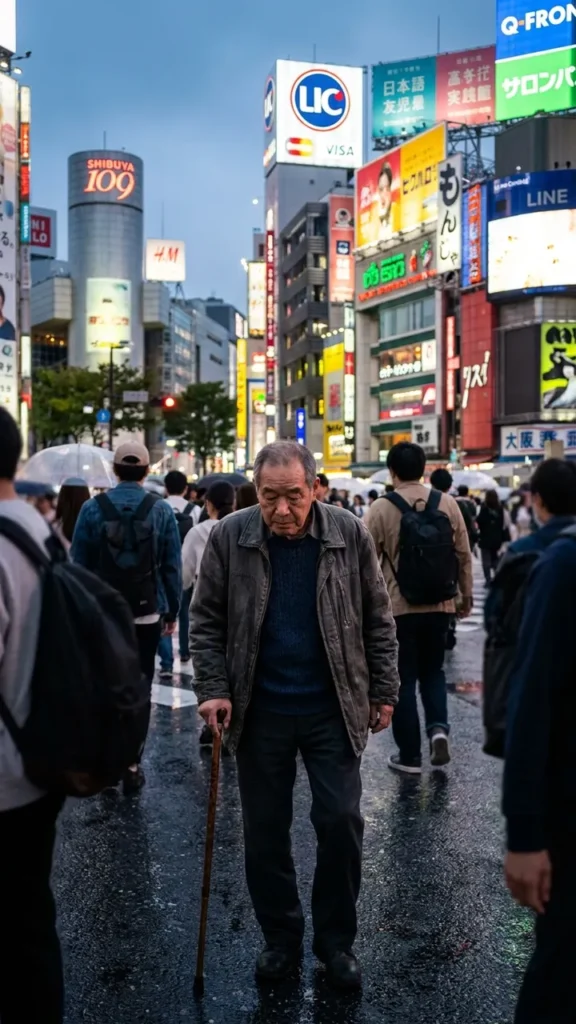
The Shibuya Scramble.
A relentless river of humanity flowed across the asphalt arteries of Tokyo.
A cacophony of hurried footsteps and the vibrant hum of digital billboards filled the air.
Amidst this surging tide, an elderly man, Mr. Hiroshi, navigated the controlled chaos.
His steps were slow, deliberate.
Each movement a quiet testament to the passage of seventy, perhaps eighty years.
His worn, dark grey jacket was pulled taut over a dark blue sweater.
Dark trousers and dark shoes completed his ensemble.
A sturdy cane tapped a steady rhythm on the ground.
He moved with a quiet dignity, a lone elder in the youthful rush.
Suddenly, his footing faltered.
A collective gasp, sharp and sudden, ripped through the throng.
Mr. Hiroshi pitched forward.
His cane skittered away, a metallic clatter against the concrete.
He landed hard.
His frail body splayed across the striped zebra crossing, an island of vulnerability in the relentless flow of the crowd.
Across the vast expanse of the intersection, Kenji froze.
His light blonde hair, meticulously styled, was a stark contrast to the muted urban palette surrounding him.
His eyes, wide with a sudden, sharp shock, first registered the fall.
Then, the imminent danger.
A black SUV, its engine a low, predatory growl, was barreling towards the crossing.
Its trajectory was a terrifying, direct line aimed squarely at the fallen figure of Mr. Hiroshi.
“What are you doing?” Kenji’s voice, raw and accusatory, sliced through the air.
It wasn’t directed at Mr. Hiroshi.
It was a raw outburst at the situation.
At the speeding car.
At the cruel twist of fate that had placed the old man in such mortal peril.
His fists clenched.
His jaw tightened.
The noise of the intersection seemed to recede.
He didn’t wait for an answer.
Instinct, primal and swift, took over.
Kenji sprinted.
Across the asphalt he flew, his light blue denim jacket a blur against the grey backdrop.
He reached Mr. Hiroshi.
His hands immediately shot out, finding the old man’s shoulders.
“What are you doing?” Kenji repeated, his tone now a desperate plea, laced with an urgent, raw fear, not blame.
He pulled.
His slim frame strained against Mr. Hiroshi’s weight.
His muscles screamed with the effort.
A bystander, a young man in a light blue t-shirt, his face a mask of alarm, saw Kenji’s struggle.
He didn’t hesitate.
He rushed forward. “Here, let me help!” he shouted, his voice tight with adrenaline.
Together, they heaved.
Their combined strength was a surge against the inertia of the moment.
Mr. Hiroshi, still dazed and disoriented from the fall, coughed.
A shallow, rattling sound.
The black SUV loomed.
Its grill was a menacing silhouette, mere inches from Mr. Hiroshi’s fragile legs.
The driver, perhaps finally jolted from their trajectory by the growing panic in the surrounding crowd, slammed on the brakes.
A ear-splitting screech of tires ripped through the air.
It was a final, desperate punctuation mark to a near-catastrophe.
Kenji and the other man finally managed to haul Mr. Hiroshi to his feet.
They held him steady, his knees trembling violently.
The elderly man, his face a pale canvas of shock, but his eyes surprisingly clear, looked from Kenji, to the stopped SUV, then back to Kenji, his gaze locking onto the young man’s face.
He reached out a trembling hand.
His fingers, thin and papery, brushed Kenji’s arm.
A slow smile spread across his deeply wrinkled face.
It was a smile that held the immense weight of a life narrowly spared.
A smile that radiated a profound, soul-deep relief.
“You saved my life,” Mr. Hiroshi whispered.
His voice was thick, choked with raw emotion.
The words hung in the suddenly quiet air, a profound acknowledgment of a stranger’s selfless, lightning-fast act.
The usual cacophony of Shibuya seemed to fade for a beat, replaced by the quiet, potent gratitude shared between two souls on a chaotic, crowded street.
The potential tragedy, so stark and terrifying moments before, had been averted.
Replaced by a powerful, undeniable testament to simple, vital human kindness.
Mr. Hiroshi swayed, leaning heavily on Kenji, his breathing shallow.
The smell of hot asphalt and exhaust fumes filled the air.
‘The surrounding crowd, moments ago a silent, horrified tableau, began to stir.
A wave of murmurs swept through them. “He was so close!” someone gasped.
Another voice, tinged with disbelief, “I thought… I thought that was it.” Eyes, previously fixed on the unfolding disaster, now darted between the rescued elder and his young rescuer.
A few individuals edged closer, their faces etched with a mixture of shock and dawning relief.
A woman in a red scarf wrung her hands, her lips moving in silent prayer.
The sharp scent of ozone from the SUV’s braking hung heavy in the air, mingling with the usual urban perfume of exhaust and street food.
Kenji, his body still buzzing with adrenaline, felt the frantic energy begin to subside.
His grip on Mr. Hiroshi loosened slightly, though he maintained his support.
He looked down at the old man, his initial surge of anger and panic now softening into a palpable concern.
Mr. Hiroshi’s face was still ashen, his breathing ragged.
The fine tremors in his hands, which had reached out to Kenji, were noticeable.
Kenji’s own hands, moments ago tight fists, now felt strangely empty, yet still tingled with the phantom sensation of contact.
“Are you alright, Mr…?” Kenji began, his voice losing its sharp edge, replaced by a genuine, almost paternal, concern.
He realized he didn’t even know the man’s name.
The accusatory glare he’d directed at the universe, at the car, had completely vanished, replaced by a soft, steady gaze.
He saw the deep furrows on Mr. Hiroshi’s forehead, the delicate network of wrinkles around his eyes, the way his sparse grey hair clung to his scalp.
It was a stark reminder of the vulnerability he had just witnessed, and, in part, facilitated the saving of.
Mr. Hiroshi nodded slowly, his eyes still wide but now holding a profound depth of emotion. “Hiroshi,” he rasped, his voice barely audible above the reawakening hum of the Scramble. “My name is Hiroshi.” He coughed again, a dry, hacking sound.
He tried to take a step on his own, but his legs buckled slightly.
Kenji instinctively tightened his hold, preventing another fall.
The denim of Kenji’s jacket felt rough against Mr. Hiroshi’s frail sweater.
“Take it easy, Mr. Hiroshi,” Kenji said softly, his blonde hair catching the bright Tokyo sunlight.
He looked around, spotting the bystander who had helped him. “Thank you.
You were a lifesaver too.” The other young man, his face still flushed, nodded gratefully. “Glad I could help.
That was too close.” A few other bystanders offered words of encouragement. “You’re lucky, sir,” one man called out. “Very lucky.” The sheer, raw fear that had gripped everyone moments before was giving way to a collective exhale of relief.
The SUV driver, a middle-aged woman with a panicked expression, had gotten out of her car and was wringing her hands, mouthing apologies to Mr. Hiroshi.
The sharp, metallic tang of fear was slowly dissipating.
Mr. Hiroshi, still leaning heavily on Kenji, managed a weak smile. “I… I saw the car,” he whispered, his voice trembling. “I thought… I thought this was it.” His eyes flickered towards the SUV, then back to Kenji.
The dark grey of his jacket seemed to absorb the light, making his frailty even more apparent.
He looked like a gust of wind could topple him.
The sheer contrast between his fragile form and the violent forces he had just narrowly escaped was striking.
The world felt different now, sharper, more precious.
Kenji continued to support Mr. Hiroshi, his strong young arms a bulwark against the elder’s trembling weakness.
He could feel the unsteady rhythm of Mr. Hiroshi’s shallow breaths against his own chest.
The old man’s grip on his arm was surprisingly strong, a desperate anchor.
The fine, almost transparent skin of Mr. Hiroshi’s hand felt papery and fragile beneath Kenji’s fingers.
His joints were swollen, his knuckles prominent, a testament to years of life etched into bone.
It was a stark physical manifestation of the vulnerability Kenji had just intervened to protect.
“Let me help you to the side, Mr. Hiroshi,” Kenji said, his voice gentle.
He carefully guided the elderly man away from the flow of pedestrian traffic, towards the relative safety of the sidewalk bordering the intersection.
The other bystander stayed close, offering silent support, his presence a quiet reassurance.
The SUV driver, still pale, approached tentatively. “I am so, so sorry,” she stammered, her voice cracking. “I didn’t see you.
It happened so fast.” Her eyes were filled with genuine remorse.
Mr. Hiroshi turned his head slowly to look at her.
His expression was not one of anger, but of profound weariness.
The near-death experience had drained him, leaving him hollowed. “It is… it is alright,” he managed to say, his voice weak. “No harm done.” He looked back at Kenji, his gaze holding an intense, almost luminous gratitude.
His eyes, though rheumy with age, seemed to shine with a renewed appreciation for existence.
The harsh neon lights of the surrounding buildings seemed to dim for a moment, focusing on this intimate exchange.
Kenji met Mr. Hiroshi’s gaze.
In that shared look, a silent conversation passed between them.
It was a dialogue without words, an unspoken acknowledgment of the profound fragility of life.
Kenji saw not just an old man, but a life, a history, a person whose journey had almost been cut short by a moment of inattention.
He understood the sheer luck, the improbable chance, that had brought him to this spot, to this moment.
The intensity of his initial outburst, the accusatory shout, now seemed like a distant echo, replaced by a quiet understanding of shared humanity.
He felt a strange sense of peace, a quiet satisfaction that transcended the adrenaline.
Mr. Hiroshi slowly straightened himself, still leaning on Kenji.
He took a deep, shaky breath.
The chaotic roar of Shibuya began to reassert itself around them – the blare of horns, the chatter of crowds, the ceaseless hum of the city.
But for a few suspended moments, the world had narrowed to this quiet, vital connection.
The sharp edges of fear and panic had been smoothed away, leaving behind the raw, pure emotion of gratitude and relief.
Mr. Hiroshi patted Kenji’s arm again, his touch light but firm. “Thank you,” he repeated, his voice a little stronger this time. “You gave me back my life.” The weight of those words settled on Kenji, a profound reminder of the impact a single, selfless act could have.
The near-tragedy had left an indelible mark, not just on Mr. Hiroshi, but on Kenji himself.
A silent understanding had formed, a bond forged in the heart of chaos.
CHAPTER 2: The Silent Understanding and the Return to Normalcy
‘Kenji continued to be Mr. Hiroshi’s anchor.
The elderly man’s grip on Kenji’s arm was like a vise, a desperate grasp for stability.
Kenji could feel the tremors run through Mr. Hiroshi’s frail body, a physical manifestation of his brush with death.
The papery thin skin of Mr. Hiroshi’s hand felt almost brittle under Kenji’s steadying touch.
His knuckles were prominent, swollen with age, a roadmap of a life lived, now potentially cut short.
The contrast between Kenji’s youthful strength and Mr. Hiroshi’s profound vulnerability was stark, almost jarring.
It was a visual representation of the very essence of the precariousness of existence.
“Let me get you to the side, Mr. Hiroshi,” Kenji said, his voice a low, calm rumble.
He carefully maneuvered the elder away from the main flow of the bustling Scramble, guiding him towards the relative quiet of the sidewalk.
The other young man who had helped, his face still pale, stayed close, a silent sentinel.
The SUV driver, a woman with wide, panicked eyes, approached hesitantly, her hands clasped together as if in prayer. “I’m so, so sorry,” she choked out, her voice barely a whisper. “I didn’t see you.
It happened so fast.” Her remorse was palpable, etched onto her face.
Mr. Hiroshi turned his head slowly to face her.
His eyes, though clouded with age, held no accusation, only a deep, bone-weary exhaustion.
The near-death experience had stripped him bare, leaving him exposed. “It is… it is alright,” he rasped, his voice thin. “No harm done.” He then turned his gaze back to Kenji.
In that look, an intense, luminous gratitude blazed.
It was a profound thank you, spoken without a single word.
The garish neon lights of the surrounding buildings seemed to dim, the entire world momentarily focusing on this intimate exchange.
Kenji met Mr. Hiroshi’s searching gaze.
In that silent communion, a profound understanding passed between them.
It was a dialogue of souls, an unspoken acknowledgment of life’s utter fragility.
Kenji saw not just an old man, but a lifetime, a tapestry of experiences, a precious existence nearly extinguished by a moment’s lapse.
He grasped the sheer, unadulterated luck that had placed him at that exact spot, at that exact second.
His initial sharp outburst, the accusatory yell, now felt like a faint echo from another life.
A quiet sense of peace settled over him, a profound satisfaction that dwarfed the lingering adrenaline.
Mr. Hiroshi slowly regained his composure, still leaning heavily on Kenji.
He drew a deep, shaky breath.
The cacophony of Shibuya, the relentless roar of traffic, the incessant chatter of the crowd, began to seep back into their awareness.
But for those suspended moments, the world had contracted to this single, vital connection.
The sharp edges of fear and panic had been blunted, replaced by the raw, unadulterated emotions of gratitude and relief.
Mr. Hiroshi’s hand patted Kenji’s arm again, the touch lighter now, but firm. “Thank you,” he repeated, his voice gaining a sliver of strength. “You gave me back my life.” The weight of those words landed squarely on Kenji, a powerful reminder of the impact a single, selfless act could possess.
The averted tragedy had left an indelible mark, not just on Mr. Hiroshi, but on Kenji himself.
A silent understanding had been forged, a bond born in the heart of urban chaos.
The roar of Shibuya Scramble was a beast that refused to be tamed for long.
The symphony of honking taxis, hurried footsteps, and distant sirens reasserted its dominance.
But for Mr. Hiroshi, the world had irrevocably shifted.
He stood between Kenji and the other helper, his breath still coming in shallow gasps, his frail frame trembling with the aftershocks of terror.
The bright, unforgiving daylight seemed to highlight every wrinkle, every line on his face, making his vulnerability even more pronounced.
His dark grey jacket, once a simple garment, now seemed like a shroud against his ashen skin.
“Are you sure you’re okay, Mr. Hiroshi?” Kenji asked again, his voice laced with genuine concern.
He gently squeezed the old man’s arm, offering silent reassurance.
Mr. Hiroshi nodded, his eyes distant, still processing the near-death experience.
The memory of the speeding SUV, the terrifying lurch of his own body, the feeling of helplessness, played on a loop behind his rheumy eyes.
The sheer, raw terror of it all had left an imprint.
He looked at Kenji, truly seeing him now, not just as a young man who had intervened, but as the reason he was still breathing.
“I need to… I need to call my family,” Mr. Hiroshi murmured, his voice raspy.
He fumbled in his jacket pocket, his trembling fingers struggling with the fabric.
Kenji immediately offered his own phone. “Here, use mine, Mr. Hiroshi.
It’s fully charged.” The contrast was palpable: the elder’s age-worn frailty and the younger man’s easy, modern convenience.
The phone’s sleek, metallic surface felt alien in Mr. Hiroshi’s gnarled hand.
As Kenji watched, Mr. Hiroshi dialed, his lips moving in a silent prayer before he spoke. “Hello?
It’s me… Yes, it’s me.
I… I had a bit of an accident.
But I’m alright.
I’m alright.
A young man… he saved me.”
The other bystander, his initial shock now replaced by a quiet, thoughtful demeanor, stepped back slightly, allowing Mr. Hiroshi his privacy.
He offered a small, respectful nod to Kenji. “Glad I could be there,” he said softly, then melted back into the crowd.
He too had been touched by the event, by the sheer drama and the profound relief.
The incident had been a stark reminder of how quickly life could change, of how a mundane crossing could become a death trap.
Kenji remained by Mr. Hiroshi’s side, a silent guardian.
The initial accusation in his voice had completely evaporated.
It had been replaced by a quiet, almost profound sense of responsibility.
He watched Mr. Hiroshi speak to his family, his voice still shaking but holding a note of newfound appreciation for his own existence.
He saw the way Mr. Hiroshi clutched the phone, his knuckles white, as if holding onto his lifeline.
Kenji felt a strange stillness within himself.
The chaos of the Scramble no longer felt overwhelming, but rather like a distant hum.
He realized, with a clarity that surprised him, the true value of a life.
He understood, in that moment, that his own actions, however impulsive, had made a monumental difference.
The blonde hair that Kenji styled with such care now seemed to catch the sunlight differently, as if illuminated by a newfound understanding.
He looked at his hands, the hands that had pulled Mr. Hiroshi to safety, and felt a quiet, potent sense of purpose.
The world, he mused, was a fragile thing, and sometimes, all it took was a stranger’s quick thinking and a helping hand to preserve it.
‘The roar of Shibuya Scramble was a beast that refused to be tamed for long.
The symphony of honking taxis, hurried footsteps, and distant sirens reasserted its dominance.
But for Mr. Hiroshi, the world had irrevocably shifted.
He stood between Kenji and the other helper, his breath still coming in shallow gasps, his frail frame trembling with the aftershocks of terror.
The bright, unforgiving daylight seemed to highlight every wrinkle, every line on his face, making his vulnerability even more pronounced.
His dark grey jacket, once a simple garment, now seemed like a shroud against his ashen skin.
“Are you sure you’re okay, Mr. Hiroshi?” Kenji asked again, his voice laced with genuine concern.
He gently squeezed the old man’s arm, offering silent reassurance.
Mr. Hiroshi nodded, his eyes distant, still processing the near-death experience.
The memory of the speeding SUV, the terrifying lurch of his own body, the feeling of helplessness, played on a loop behind his rheumy eyes.
The sheer, raw terror of it all had left an imprint.
He looked at Kenji, truly seeing him now, not just as a young man who had intervened, but as the reason he was still breathing.
“I need to… I need to call my family,” Mr. Hiroshi murmured, his voice raspy.
He fumbled in his jacket pocket, his trembling fingers struggling with the fabric.
Kenji immediately offered his own phone. “Here, use mine, Mr. Hiroshi.
It’s fully charged.” The contrast was palpable: the elder’s age-worn frailty and the younger man’s easy, modern convenience.
The phone’s sleek, metallic surface felt alien in Mr. Hiroshi’s gnarled hand.
As Kenji watched, Mr. Hiroshi dialed, his lips moving in a silent prayer before he spoke. “Hello?
It’s me… Yes, it’s me.
I… I had a bit of an accident.
But I’m alright.
I’m alright.
A young man… he saved me.”
The other bystander, his initial shock now replaced by a quiet, thoughtful demeanor, stepped back slightly, allowing Mr. Hiroshi his privacy.
He offered a small, respectful nod to Kenji. “Glad I could be there,” he said softly, then melted back into the crowd.
He too had been touched by the event, by the sheer drama and the profound relief.
The incident had been a stark reminder of how quickly life could change, of how a mundane crossing could become a death trap.
Kenji remained by Mr. Hiroshi’s side, a silent guardian.
The initial accusation in his voice had completely evaporated.
It had been replaced by a quiet, almost profound sense of responsibility.
He watched Mr. Hiroshi speak to his family, his voice still shaking but holding a note of newfound appreciation for his own existence.
He saw the way Mr. Hiroshi clutched the phone, his knuckles white, as if holding onto his lifeline.
Kenji felt a strange stillness within himself.
The chaos of the Scramble no longer felt overwhelming, but rather like a distant hum.
He realized, with a clarity that surprised him, the true value of a life.
He understood, in that moment, that his own actions, however impulsive, had made a monumental difference.
The blonde hair that Kenji styled with such care now seemed to catch the sunlight differently, as if illuminated by a newfound understanding.
He looked at his hands, the hands that had pulled Mr. Hiroshi to safety, and felt a quiet, potent sense of purpose.
The world, he mused, was a fragile thing, and sometimes, all it took was a stranger’s quick thinking and a helping hand to preserve it.
Mr. Hiroshi ended his call, his shoulders slumping with relief.
He handed Kenji’s phone back, his hand still unsteady. “Thank you, young man,” he said, his voice gaining a touch more strength. “Thank you for everything.
You have no idea.” He looked directly at Kenji, his gaze intense, searching.
The vulnerability was still there, but now it was laced with a fierce determination to appreciate the seconds he had been given back.
Kenji felt a flush creep up his neck.
He wasn’t used to this kind of raw, unadulterated gratitude. “It was nothing, Mr. Hiroshi,” he said, though he knew it wasn’t.
He saw the lingering fear in the old man’s eyes, the tremor that hadn’t quite subsided. “You’re safe.
That’s what matters.”
“Nothing?” Mr. Hiroshi chuckled, a dry, brittle sound. “My life is nothing?
That SUV… it was so close.
I could feel the heat from the engine.
I thought that was it.
The end.” His voice cracked, and he had to pause, swallowing hard. “And you… you just ran.
You didn’t think.
You just acted.
That kind of courage is rare.
Especially from someone your age.
Most people just watch.
They film.
They don’t do anything.” He met Kenji’s eyes again. “You didn’t just save my life, Kenji.
You restored my faith in people.”
The SUV driver, a woman named Ms. Tanaka, approached them cautiously.
Her face was still etched with horror.
She clutched a damp tissue in her hand. “Mr. Hiroshi, I am truly so, so sorry,” she stammered, her voice thick with tears. “There are no words.
I was distracted for just a second.
Just a second.
And then… it was so close.” She looked at Kenji, her eyes filled with a mixture of shame and awe. “Thank you, young man.
You’re a hero.”
Kenji shifted uncomfortably. “I just did what anyone would do,” he mumbled, avoiding her gaze.
He felt a strange disconnect from his earlier aggression.
That impulsive outburst felt like a lifetime ago.
He had been so angry at the perceived carelessness, the danger.
Now, he saw the panic in Ms. Tanaka’s eyes, the genuine remorse.
He understood that life was a complex web of moments, mistakes, and unexpected grace.
Mr. Hiroshi placed a hand on Ms. Tanaka’s arm. “It’s alright,” he said, his voice surprisingly gentle. “We’re all human.
We all make mistakes.
The important thing is that no one was hurt.” He turned back to Kenji. “But you,” he repeated, his voice firm, “you are more than human.
You are an angel in disguise.” He then looked at the other young man who had helped. “And you too.
Thank you both.”
Kenji felt a wave of warmth spread through him.
He met Mr. Hiroshi’s gaze, a silent understanding passing between them.
The neon lights of Shibuya seemed to blur, the distant sounds of the city fading.
In this small bubble of shared experience, a profound connection had been forged.
The elderly man’s frail grip on Kenji’s arm had been replaced by a steadying presence, and Kenji, the young man who had once reacted with anger, now felt a deep, quiet pride.
He had witnessed, and participated in, something truly significant.
The fragility of existence had been laid bare, and in its wake, the enduring strength of human compassion had shone through.
The weight of Mr. Hiroshi’s gratitude was a heavy, yet incredibly welcome, burden.
CHAPTER 3: The Lingering Echoes and Public Scrutiny
‘The immediate aftermath of the near-tragedy in Shibuya Scramble hummed with a nervous energy.
Mr. Hiroshi, leaning heavily on Kenji, still seemed to be processing the abrupt shift from life to near-death.
His knuckles were white where he gripped Kenji’s arm, a physical anchor in the swirling chaos.
Ms. Tanaka, the SUV driver, wrung her hands, her face a mask of shame and relief.
The crowd, which had moments before been a blur of indifferent movement, now formed a hesitant semi-circle, their eyes fixed on the tableau.
Whispers began to circulate, a low murmur that grew in intensity.
“Did you see that?
He just jumped out!”
“That car… it would have crushed him.”
“Who is that young man?
He’s incredible.”
Mr. Hiroshi, his voice still raspy, looked from Ms. Tanaka to Kenji. “This is… this is too much,” he murmured, his gaze sweeping over the onlookers. “The attention.”
Ms. Tanaka took a tentative step forward. “Mr. Hiroshi, I can’t apologize enough.
I… I was checking my GPS for a split second.
My phone buzzed.
It was a text from my daughter about school.
It’s no excuse, I know, but I just looked away for a moment.
A terrible, unforgivable moment.” Her voice broke, and she fumbled for a tissue again, dabbing at her eyes.
Kenji felt a strange prickle of unease.
The accolades, the gazes, the hushed gossip – it was all becoming overwhelming.
He was accustomed to anonymity, to blending in.
This sudden spotlight felt… exposed.
He glanced at his blonde hair, the denim jacket, the white sneakers – the very things that had made him stand out. “It’s okay, Ms. Tanaka,” he said, trying to project a calm he didn’t entirely feel. “Accidents happen.
The important thing is no one was hurt.” He squeezed Mr. Hiroshi’s arm reassuringly. “Are you sure you don’t need a doctor, Mr. Hiroshi?
Or perhaps I should help you get home?”
Mr. Hiroshi shook his head, a flicker of his earlier resolve returning. “No, no doctor.
Just… need a moment.
But you,” he turned his intense gaze back to Kenji, “you are remarkable.
Truly.
Not just the bravery, but your demeanor now.
You’re not boasting.
You’re not seeking attention.
That’s… that’s rare.” He paused, his eyes narrowing slightly as he observed the shifting expressions of the crowd. “People can be so quick to judge.
They’ll see this and already be making up stories.”
A woman in the crowd, her voice sharp and clear, piped up, “He’s right.
I saw it all.
That young man there, he’s a real hero.
And you, ma’am,” she pointed at Ms. Tanaka, “you need to be more careful.
This isn’t a game.”
Ms. Tanaka flinched. “I understand,” she whispered, her voice barely audible.
She looked utterly defeated.
Kenji stepped slightly in front of Mr. Hiroshi, his protective instinct kicking in.
The initial accusation in his voice had been a flash, a reaction to imminent danger.
Now, a different kind of anger simmered – a protective anger for the vulnerable.
He met the accusatory gaze of the woman in the crowd. “She’s already said she’s sorry.
She’s clearly upset.
What more do you want?” His voice was firm, but the accusatory edge was gone, replaced by a steely defense.
“I want her to understand the gravity of what she almost did!” the woman retorted. “And I want everyone to see who the real hero is in all this!” She gestured emphatically towards Kenji.
Mr. Hiroshi let out a small, weary sigh. “Please,” he said, his voice carrying surprising authority. “Let us not add more drama to this.
I am safe.
That is the only thing that matters.” He looked at Kenji, his eyes conveying a silent gratitude that went beyond words. “My family will be here soon.
My grandson is coming to pick me up.
Perhaps,” he added, a faint smile touching his lips, “he can help us all navigate this… attention.” He patted Kenji’s hand, a gesture of deep appreciation.
The weight of the crowd’s scrutiny felt heavy, but Kenji’s presence was a solid counterpoint.
The immediate rush of adrenaline began to recede, leaving behind a peculiar exhaustion.
Mr. Hiroshi’s grandson, a polite young man named Kenzo, arrived soon after, his initial shock quickly replaced by a wave of relief and deep gratitude upon hearing the details.
He thanked Kenji profusely, his own voice thick with emotion.
“I don’t know how to repay you,” Kenzo said, his hand shaking slightly as he helped his grandfather into a waiting taxi. “You saved his life.
You truly did.”
Kenji, still feeling a bit shell-shocked by the intensity of the event and the subsequent attention, managed a weak smile. “Just glad I could help, Kenzo.
Your grandfather is a strong man.”
Mr. Hiroshi, now settled in the back seat, his frail form looking even smaller against the plush upholstery, leaned forward. “Kenji,” he called out, his voice clear and steady. “Do not underestimate the impact of your actions.
Today, you were more than just a rescuer.
You were a reminder.
A reminder that amidst all this… this rush,” he gestured vaguely towards the continuing flow of people, “there is still good.
Still courage.
Still compassion.” He looked at Kenji with an unwavering gaze. “You gave me back my life, yes.
But you also gave me something more.
You gave me hope.”
Ms. Tanaka, standing by her car, her face still pale, approached the taxi hesitantly. “Mr. Hiroshi,” she began, her voice trembling, “I… I will be seeing a therapist.
I need to understand how this happened.
And I will be reporting myself.
I deserve whatever consequences come my way.”
Mr. Hiroshi nodded, his expression softening. “And that is the right thing to do, Ms. Tanaka.
Taking responsibility.
That is also a form of courage.” He turned his gaze back to Kenji. “You see?
Life is complex.
We are all flawed.
But we can also rise to the occasion.”
As the taxi pulled away, Kenji watched it disappear into the stream of traffic.
The roar of Shibuya Scramble, which had seemed so deafening earlier, now felt like a distant hum.
He looked at his hands.
They still felt a little shaky, but not from fear.
It was a tremor of… something else.
A realization.
The blonde hair that Kenji meticulously styled each morning now felt less like a fashion statement and more like a symbol of his youth, a youth that had, for a brief, terrifying moment, been faced with the stark reality of mortality.
He had reacted with anger, with a surge of adrenaline.
But he had also acted with a profound, instinctive kindness.
The intense gratitude in Mr. Hiroshi’s eyes was a heavy, yet strangely comforting, weight.
He understood now that his life, like Mr. Hiroshi’s, was a series of moments, and some moments demanded everything.
He turned away from the crossing, the sensory overload of Shibuya fading into a more personal, internal reflection.
The echo of the screeching tires, the old man’s shaky breath, and the raw emotion in his whispered thanks would stay with him, a permanent imprint on the fabric of his own unfolding story.
He felt a quiet sense of purpose, a newfound understanding of the fragile, interconnected dance of human existence.
‘The air around Kenji still thrummed with the residual shock of the incident.
The crowd, initially a sea of concerned faces, now seemed to morph into a tribunal.
Whispers, once hushed murmurs of shock, began to carry a sharper, more judgmental edge.
Kenji felt their eyes like a physical weight, dissecting his every move, his every breath.
He instinctively pulled the collar of his denim jacket a little higher, a futile attempt to shield himself from their scrutiny.
“Did you see him though?
Just bolted out there,” a man near the edge of the crowd muttered, loud enough for Kenji to hear.
“Look at him.
All styled hair and designer jacket.
Probably thought it was a movie scene,” a woman chimed in, her voice dripping with disdain.
Kenji’s jaw tightened.
The protective instinct that had surged moments before was now being tested by a new, insidious force: public perception.
He could feel the accusation in their words, a mirroring of his own initial outburst, but now directed at him, the supposed “hero.”
Mr. Hiroshi, still leaning on Kenzo, his gaze sharp and observant, caught Kenji’s discomfort.
He nudged Kenzo, a subtle signal.
Kenzo, catching his grandfather’s meaning, stepped forward, his voice clear and steady, cutting through the rising tide of gossip.
“Excuse me,” Kenzo said, addressing the woman who had spoken. “My grandfather is safe, and that is what matters.
This young man,” he gestured to Kenji, his eyes holding a fierce protectiveness, “acted with incredible bravery.
He didn’t hesitate for a second.
He saved my grandfather’s life.”
The woman scoffed. “Bravery?
Or recklessness?
He could have been killed too.
And what about the driver?
She’s clearly distraught.” She pointed a finger at Ms. Tanaka, who stood huddled by her SUV, a picture of misery. “She’s the one who almost killed someone!”
Ms. Tanaka flinched, tears welling in her eyes again. “I know.
I know.
It was a terrible mistake.
I’m so, so sorry.”
Kenji felt a surge of frustration, but he forced himself to remain calm.
He remembered Mr. Hiroshi’s words about complexity.
He looked at Ms. Tanaka, her distress palpable.
Then he looked back at the critical eyes of the crowd.
“She’s already taken responsibility,” Kenji said, his voice firm but devoid of the earlier accusatory edge. “She’s shaken up.
We all are.
What’s done is done.
My concern is for Mr. Hiroshi.” He turned to his grandfather, who offered a reassuring smile.
“He’s right,” Mr. Hiroshi said, his voice gaining strength. “The focus should be on what happened, and how we move forward.
Not on assigning blame or judging motives.
You,” he addressed the woman who had been so vocal, “saw a moment of danger.
Kenji saw a life in peril.
We all react differently.
But the outcome is what counts.”
A few people in the crowd shifted uncomfortably, their critical gazes faltering under Mr. Hiroshi’s calm pronouncements.
Kenji felt a flicker of relief, a sense that his act of genuine heroism wasn’t being entirely drowned out by the noise of public opinion.
“But it’s so easy to point fingers,” the woman retorted, her voice still sharp. “Especially when someone like him,” she gestured at Kenji again, “seems so… put together.
Like he doesn’t make mistakes.”
Kenji’s gaze met hers directly. “You think I don’t make mistakes?
You think I’m not scared right now?” His voice was quiet, but it held an intensity that made the woman take a small step back. “I was terrified.
My heart was pounding out of my chest.
I just knew I had to do something.
That’s all.” He felt a slight tremor in his hands, a physical manifestation of the lingering fear.
Mr. Hiroshi watched Kenji, a look of deep understanding in his eyes.
He saw the young man grappling not just with the near-death experience, but with the unexpected burden of public attention and judgment.
He saw the vulnerability beneath the stylish exterior, a vulnerability that Kenji himself was struggling to acknowledge, even to himself.
The murmuring crowd slowly began to dissipate, the intensity of their collective gaze finally receding.
The harsh fluorescent lights of the Shibuya signage seemed to soften, casting a more muted glow over the scene.
Ms. Tanaka, still looking pale, offered Kenzo a small, grateful nod before retreating to her car.
Kenzo, his arm still firmly around his grandfather, guided Mr. Hiroshi towards a waiting taxi, the one that had been called earlier.
Kenji watched them go, a strange sense of quiet descending upon him.
The adrenaline had fully ebbed, leaving behind a profound weariness, but also a deep, almost unsettling peace.
He looked at his hands again.
They were steady now, the tremor replaced by a calm awareness.
The blonde hair that he’d spent so much time perfecting that morning now felt unimportant, a superficial detail in the face of what had just transpired.
Kenzo returned, his expression a mixture of relief and profound gratitude.
He clasped Kenji’s hands, his own grip firm and sincere. “Thank you,” he said, his voice thick with emotion. “Truly.
I owe you.
My grandfather owes you.
My whole family owes you.”
Kenji managed a faint smile. “Please, Kenzo.
It was nothing.
I’m just glad he’s okay.
He’s a strong man.”
“You are the strength he needed in that moment,” Kenzo replied, his gaze unwavering. “I heard what some people were saying.
It’s easy for them to judge from the sidelines.
They don’t understand the split-second decisions.
The instinct.” He paused, his eyes scanning the still-bustling intersection, a stark contrast to the intimate drama that had just unfolded. “My grandfather, he sees things.
He sees the good in people.
And he saw that in you today.”
Mr. Hiroshi, from the open taxi door, called out, his voice clear and resonant, “Kenji.
Come here for a moment.”
Kenji walked over, a sense of anticipation mixed with a hint of apprehension.
What could the old man possibly want to say now, after all the chaos?
Mr. Hiroshi looked at Kenji, his eyes holding a deep, unwavering kindness. “You know, Kenji,” he began, his voice a gentle rasp, “that young woman, Ms. Tanaka.
She made a mistake.
A terrible one.
But she is also here, taking responsibility.
And you,” he gestured with a frail hand towards Kenji, “you reacted with courage, not with judgment.
That is what truly matters.
We are all human.
We all falter.
But it is in how we rise, how we help others rise, that defines us.”
He reached out and patted Kenji’s arm, a gesture of deep respect and connection. “You did not seek glory.
You sought to save a life.
That is a rare and beautiful thing in this world.
Never forget the power of that simple act.
It can change everything.
For the person you save, and for yourself.”
Kenji felt a lump form in his throat.
Mr. Hiroshi’s words resonated deeply, chipping away at the lingering unease and self-doubt.
He looked at the old man, his frail body a testament to a life lived, now safe and sound, thanks to a moment of instinctual bravery.
“I… I won’t forget, Mr. Hiroshi,” Kenji managed to say, his voice barely a whisper.
He met Mr. Hiroshi’s gaze, and in that exchange, a silent understanding passed between them.
It was more than just gratitude; it was a recognition of shared humanity, of the profound impact one person could have on another.
As the taxi pulled away, its taillights disappearing into the endless flow of Tokyo traffic, Kenji stood on the curb, the roar of Shibuya Scramble a distant echo.
He felt a shift within him, a quiet certainty that the events of the day had planted a seed of change, a deeper understanding of himself and the world around him.
CHAPTER 4: The Lingering Scars and the Unseen Battle
‘Kenji watched the taxi carrying Mr. Hiroshi and Kenzo disappear into the pulsing veins of Shibuya.
The streetlights seemed to cast longer, more distorted shadows now.
The casual observer might have seen a young man, perhaps contemplating his next move, but Kenji felt a deep, internal tremor that had nothing to do with the near-death experience on the crossing.
It was the echo of the crowd’s judgment, the sharp sting of their whispered accusations.
He ran a hand through his now slightly disheveled blonde hair, a gesture born from a lifetime of needing to maintain an image, an image that the Shibuya Scramble had nearly shattered.
“You okay, man?” A voice, rough and tinged with curiosity, broke through his reverie.
It belonged to a young man, not much older than Kenji, with a weathered face and eyes that had seen too much.
He was wearing a stained work uniform, a stark contrast to Kenji’s own attire.
He stood a few feet away, leaning against a lamppost, his gaze steady.
Kenji blinked, jolting back to the present. “Yeah.
I’m fine,” he replied, forcing a casual tone, but his voice was tighter than he intended.
The man nodded slowly, his expression unreadable.
He wasn’t part of the judgmental throng; there was a quiet empathy in his gaze.
“That was something else,” the worker continued, his voice low. “Almost lost him.
You were quick.
Real quick.”
“Just reacted,” Kenji mumbled, looking down at his pristine white sneakers, now marred by the grim realities of the street.
He hated this feeling.
The feeling of being scrutinized, of having his motives questioned.
He was a businessman, meticulously building his career, his reputation.
This one impulsive act, born from pure instinct, had opened him up to a level of public exposure he’d never anticipated, and frankly, never wanted.
“People get it wrong,” the worker said, as if reading Kenji’s mind. “They see the flashy hair, the nice clothes.
They think they know you.
But they don’t see the stuff behind it.
The pressure.
The things you gotta do to survive.” He pushed himself off the lamppost. “This city… it grinds you down.
You gotta be tough.
But sometimes, being tough means being human, too.
Like you were today.” He offered a small, almost imperceptible nod. “Take care, man.” With that, he turned and melted back into the stream of pedestrians, leaving Kenji alone with his thoughts.
Kenji watched him go.
Human.
He’d always prided himself on being strategic, controlled.
But today, a raw, unadulterated human emotion had dictated his actions.
And it had exposed him.
He felt a knot tighten in his stomach.
He pictured Ms. Tanaka, the driver, her face a mask of horror and shame.
He remembered his own initial burst of anger, his sharp accusation.
He had been so quick to judge, just like the crowd he now resented.
But Mr. Hiroshi’s words about complexity, about not assigning blame, replayed in his mind.
It was a lesson he was still struggling to internalize, especially when the judgment was directed at him.
He pulled out his phone, the sleek device feeling foreign in his hand.
He scrolled through his contacts, his thumb hovering over his boss’s name.
He couldn’t call him.
Not yet.
Not while this gnawed at him.
He thought of his apartment, sterile and silent, a stark contrast to the vibrant, chaotic energy of Shibuya.
He wasn’t ready to go home.
Not yet.
He needed to process this.
He needed to understand why the kindness he’d shown felt so hollow under the weight of public opinion.
He walked aimlessly, letting the current of the crowd carry him.
The neon signs blurred, the cacophony of sounds a dull roar.
He felt a deep weariness settle in his bones, a weariness that went beyond physical exhaustion.
It was the weariness of carrying an unseen burden, the burden of a good deed tainted by perception.
He wondered if he would ever truly shake off the judgment of those few who had seen only the surface, and not the desperate act of a human being trying to save another.
The scars of this encounter, he suspected, would be more internal than visible.
Kenji found himself in a small, dimly lit izakaya, the air thick with the scent of grilled yakitori and sake.
He sat alone at a counter, nursing a drink he barely tasted.
The hushed conversations around him seemed to amplify his own inner turmoil.
He had come here seeking anonymity, a brief respite from the echoing whispers of Shibuya.
But even here, the incident felt like a phantom presence, a shadow that clung to him.
He caught his reflection in the polished surface of the bar.
The blonde hair, the designer jacket – they felt like a costume now, a disguise that had backfired spectacularly.
He saw the flicker of unease in his own eyes, a vulnerability he rarely allowed himself to display.
He thought of Kenzo, his grandfather’s unwavering faith in his actions.
He thought of Mr. Hiroshi, his wise words, his gentle touch.
Their belief was a balm, but it couldn’t entirely erase the sting of the crowd’s condemnation.
A woman with bright, inquisitive eyes and a vibrant scarf approached him.
She was a regular, he recognized her from previous visits. “Kenji, isn’t it?” she asked, her voice warm and friendly. “You look like you’ve seen a ghost.
Or maybe you’ve been a ghost today?” She chuckled lightly, trying to draw him out.
Kenji managed a weak smile. “Something like that,” he replied, his gaze drifting back to his drink. “Just a long day.”
“I heard about what happened at Shibuya,” she said, her tone softening. “Terrible.
But you were amazing.
My cousin saw it.
She said you didn’t hesitate for a second.” Her words were genuine, a stark contrast to the judgmental murmurs he’d endured.
A flicker of hope ignited within him.
Perhaps not everyone saw him as the reckless, attention-seeking youth they’d painted him to be. “It was just instinct,” he said, the words feeling less like an excuse and more like a simple truth.
“Sometimes, instinct is the bravest thing there is,” she replied, pulling up a stool beside him. “Especially when others are just watching.
Or worse, judging.” She caught the bartender’s eye and ordered another drink, then turned back to Kenji. “You know, people are quick to criticize.
They forget that life isn’t a movie.
It’s messy.
People make mistakes.
Drivers get distracted.
Old men stumble.
And sometimes, strangers have to step in.
That’s not recklessness.
That’s humanity.”
Her words hit him like a jolt.
He looked at her, really looked at her, and saw a reflection of the empathy he craved.
She understood.
She saw the bigger picture, the complex tapestry of human interaction.
He felt a wave of relief wash over him, a loosening of the tight knot in his chest.
“I… I was scared,” Kenji admitted, the confession a surprising release. “Terrified.
My heart was pounding so hard.
I thought… I thought he was going to die.
And then I thought about what people would say if I didn’t do anything.”
The woman nodded, her gaze understanding. “That’s the trap, isn’t it?
The fear of judgment can paralyze you.
But you pushed past it.
You chose action.
And that’s what matters.
The driver, Ms. Tanaka, I know her.
She’s a good person.
She’ll be haunted by this.
But you, Kenji, you’re going to be haunted by the fact that you saved a life.
And that’s a much better ghost to have.”
Kenji took a slow sip of his drink.
The taste finally registered, sharp and warming.
He looked at his hands, no longer trembling.
The blonde hair felt less like a burden and more like a part of his story, a story that was still being written.
The external judgment had begun to recede, replaced by the quiet affirmation of someone who saw beyond the superficial.
The threads of perception were unraveling, revealing a deeper, more complex truth about the day, and about himself.
‘Kenji traced the condensation ring his glass left on the bar.
The woman, whose name he hadn’t even asked, smiled a knowing smile. “It’s a heavy burden, isn’t it?
Being good when everyone expects you to be something else.”
“I don’t want to be a hero,” Kenji admitted, his voice barely a whisper. “I just… I couldn’t watch.
That’s all.” He felt a surge of resentment.
He was trapped.
The act itself had felt clean, pure.
But the aftermath, the endless dissection of his motives, the assumption of ulterior motives – that was the real battle.
“And that’s why it matters,” she countered, her eyes holding his. “Because it wasn’t for the cameras, was it?
It wasn’t for applause.
It was because a human being was in danger.
People forget that, Kenji.
They see the blonde hair, the designer jacket, and they project their own insecurities onto you.
They can’t fathom a complex person.
It’s easier to hate what they don’t understand.”
Her words resonated deep within him.
He thought of his father, a man who had built his empire through sheer force of will, but who had also instilled in him a rigid code of conduct. “My father always said… you build your reputation with every action.
One slip, and it’s all gone.” Kenji’s hand clenched. “I thought that one moment at Shibuya would be the slip.
The thing that would make him see me as… irresponsible.
Reckless.”
The woman chuckled softly. “And your grandfather?
Mr. Hiroshi?
What did he say?”
Kenji’s expression softened. “He just… he saw it.
He saw me.
He didn’t need explanations.
He understood the feeling, the fear.
He said life isn’t about avoiding mistakes, but about learning to navigate them.
And that sometimes, the most profound lessons come from the most unexpected moments.” He sighed, a heavy sound in the quiet izakaya. “But my father… he’s not Mr. Hiroshi.
He’s a man who sees the world in black and white.
And I think he’ll see that day in Shibuya as a blemish.
A public display of… impulsiveness.”
“Then maybe,” the woman said, her tone serious now, “you need to show him that the blemish is actually a badge.
A sign that you’re more than just your appearance.
That you have a conscience.
That you’re capable of selfless acts, even when it’s inconvenient.
Even when it puts you in a vulnerable position.”
Kenji felt a shift.
It wasn’t about proving anything to the anonymous crowd anymore.
It was about something more personal.
His father.
His legacy.
His own self-perception. “Vulnerable,” he repeated, the word tasting strange.
He had always strived for control, for an impenetrable facade.
This entire ordeal had stripped that away. “I hate feeling vulnerable.”
“But that’s where the real strength lies, Kenji,” she said gently. “In facing that vulnerability.
In not letting the fear of judgment dictate your actions.
You saved a life.
That’s a powerful thing.
Don’t let anyone, not even your father, diminish that.” She stood, gathering her purse. “I have to go.
But remember this: the next time you feel the
CHAPTER 5:
‘Kenji sat in the dim, smoky izakaya, the woman’s words echoing in his mind. “The next time you feel the…” She had left him with an unfinished thought, a dangling thread of wisdom that snagged his attention.
Vulnerability.
He hated it.
He hated the raw exposure, the possibility of being seen as weak.
His father, a man carved from granite and ambition, had always demanded strength.
Unwavering, unassailable strength.
The woman’s words about his father’s black-and-white worldview gnawed at him.
He pictured his father’s stern face, his unwavering gaze that always seemed to dissect Kenji’s every move, searching for flaws.
The Shibuya incident, the heroic rescue, the public adoration – it had all been a double-edged sword.
His father wouldn’t see the heroism.
He would see recklessness.
He would see an uncontrolled impulse.
“He’s not Mr. Hiroshi,” Kenji mumbled, swirling the condensation on his glass.
Mr. Hiroshi, his grandfather, had understood.
He had seen the genuine fear and the instinctive need to act.
He had seen the boy, not the public spectacle.
But his father… his father saw only outcomes, consequences, and the potential for scandal.
Kenji’s phone buzzed on the table.
A message.
From his father.
His gut twisted.
He hesitated, his thumb hovering over the screen.
The woman’s words, “Don’t let anyone, not even your father, diminish that,” resurfaced.
This was it.
The moment of truth.
The chance to prove that the Shibuya incident wasn’t a blemish, but a defining moment of character.
He opened the message.
It was brief.
Cold. “Meet me at the office.
Tomorrow. 9 AM sharp.
We need to discuss your recent… public entanglement.
This can’t happen again.” No acknowledgement of the rescue.
No hint of concern.
Just a demand for control, a clear message that Kenji’s actions had created an inconvenience.
Kenji’s jaw tightened.
The carefully constructed facade he maintained for his father felt like it was cracking.
He had always lived in the shadow of expectation, the heir apparent expected to be a perfect replica of his powerful father.
But the Shibuya Scramble had exposed a different Kenji.
A Kenji who acted on instinct, on empathy.
He looked at his reflection in the dark window of the izakaya.
The blonde hair, the carefully styled appearance, it felt like a costume.
The woman had seen past it.
Mr. Hiroshi had seen past it.
But his father?
His father was blinded by it.
He saw a spoiled rich kid who had acted out.
A wave of anger, hot and sharp, coursed through Kenji.
He was tired of the judgment.
Tired of the assumptions.
He wanted to scream that he was more than just his looks, more than just his family name.
He had a conscience.
He had acted on it.
And it had nearly cost him his father’s approval.
He picked up his phone again.
He typed a reply, then deleted it.
He typed another, his fingers flying across the screen.
Finally, he sent it.
A single sentence. “I’ll be there.
And I’ll explain myself.” It was a small act of defiance, but it felt monumental.
He was no longer willing to be defined by his father’s narrow perception.
He had saved a life.
That fact, he decided, was more important than any corporate reprimand or familial disappointment.
He would face his father, not as the apologetic son, but as the man who had made a difficult choice, a courageous choice.
The vulnerability he loathed was becoming his unexpected source of courage.
The sterile, impersonal office of Kenji’s father was a stark contrast to the vibrant chaos of Shibuya.
The air hummed with unspoken tension.
Kenji sat opposite his father, Mr. Tanaka, a man whose presence seemed to fill the entire room, his sharp suit and sharper gaze projecting an aura of absolute authority.
Kenji’s hands, usually steady, trembled slightly on his lap.
He felt the familiar knot of anxiety tighten in his stomach.
“So, Kenji,” Mr. Tanaka began, his voice a low, resonant rumble. “The Shibuya incident.
A rather… dramatic public display.” He paused, letting the words hang in the air. “Your mother has been fielding calls.
People I’d rather not associate with, frankly.
Associating our name with… street heroism.”
Kenji’s breath hitched. “Father, it wasn’t about… associating our name.
An elderly man fell.
A car was about to hit him.”
Mr. Tanaka steepled his fingers, his eyes narrowing. “And your reaction?
A reckless dash into traffic.
You could have been killed.
Ruined our reputation.
Think about that for a moment.
The damage control has already been extensive.”
“Damage control?” Kenji’s voice rose, cracking slightly. “A man’s life was at stake!
I saw him fall.
I saw the car.
I acted.
It was instinct.”
“Instinct,” Mr. Tanaka scoffed, a dismissive wave of his hand. “Instinct is what animals have, Kenji.
We are civilized.
We have protocols.
You have a name to uphold.
A legacy to inherit.” He leaned forward, his voice dropping to a dangerous whisper. “Did you enjoy the attention, Kenji?
The cameras flashing?
Was that the thrill you were seeking?”
The accusation hit Kenji like a physical blow.
He felt a burning in his chest. “No!
I hated it.
I just… I couldn’t stand by and do nothing.
Mr. Hiroshi – my grandfather – he understands.
He said…” Kenji’s voice faltered.
He thought of his grandfather’s quiet wisdom, his acceptance. “He said that sometimes, the most profound lessons come from the most unexpected moments.”
Mr. Tanaka’s lips curled into a humorless smile. “Your grandfather is a sentimental old man.
He sees the world through rose-tinted spectacles.
I see it as it is.
Harsh.
Unforgiving.
And you, my son, have proven to be too soft, too easily swayed by emotion.” He stood, pacing the room. “This isn’t who you are supposed to be.
This isn’t the heir I have groomed.”
Kenji felt a surge of defiance.
He stood too, his voice stronger now, laced with a newfound conviction. “Maybe you haven’t been grooming the person I am, Father.
Maybe you’ve been grooming the person you want me to be.
But that day in Shibuya, I wasn’t thinking about you.
I wasn’t thinking about our reputation.
I was thinking about Mr. Hiroshi.
About another human being.
And I would do it again.”
He met his father’s gaze, unblinking.
The vulnerability he had feared was now his shield. “You talk about a legacy.
But what kind of legacy is built on not helping someone when they’re in danger?
Mr. Hiroshi saved my life too, you know.
Not with his hands, but with his words.
He taught me that true strength isn’t about never falling, but about helping others up when they do.”
Mr. Tanaka stopped pacing, his face a mask of disbelief and something akin to grudging respect.
The accusations died on his lips.
For the first time, he seemed to see not a reckless son, but a man who had made a choice, a difficult, human choice.
The air in the room shifted, the heavy tension beginning to dissipate, replaced by an uncertain quiet.
The battle wasn’t won, but Kenji had finally stood his ground, a testament to the profound impact of a single act of courage.
‘
