Table of Contents
CHAPTER 1: The Mess Hall Intrusion
The air in the mess hall was thick.
Stale coffee.
Disinfectant.
A heavy, functional smell.
Sergeant Mason sat.
A woman.
Her face was a road map.
Deep lines from past battles.
She was quiet.
But her intensity was a palpable thing.
Her uniform was crisp. “MASON” over “SEAL RENLE.” Years of service.
Scars bloomed on her cheek.
A silent history.
Then, a roar.
Guttural.
Aggressive.
It tore through the midday quiet.
Another Mason.
A man.
Built like a bulldozer.
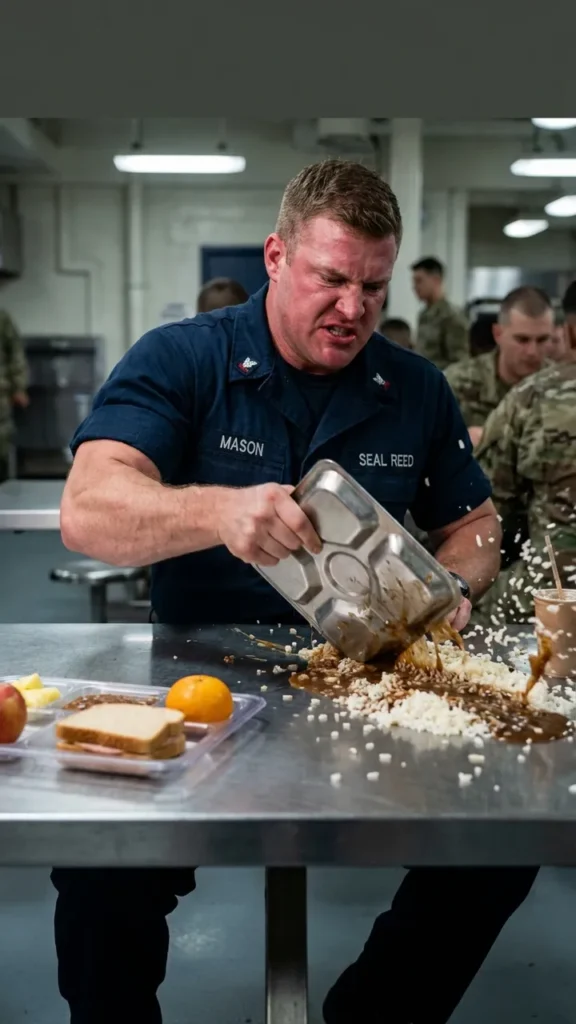
His uniform read: “MASON” over “SEAL REED.” His face was pure fury.
He stalked towards a table.
Slammed his tray down.
Rice.
A dark, viscous liquid.
It exploded outwards.
Splashed across the table.
Drenched an untouched meal.
“Stand up,” he bellowed.
His voice was a thunderclap.
A young soldier flinched.
He held his own tray.
Mason, the man, advanced.
His eyes burned.
“That meal belongs to me.”
Sergeant Mason watched.
She did not flinch.
Her gaze locked onto his.
Unyielding.
“This seat,” she stated.
Her voice cut through his rage. “Belongs to people who bled.”
A ripple went through the mess hall.
Other soldiers froze.
Their meals forgotten.
They watched.
Unease.
Curiosity.
Mason, the man, leaned in.
His knuckles were white.
Gripping the table’s edge.
“Real blood,” he spat.
His chest heaved.
The implication hung heavy.
A challenge.
A claim.
Not by rank.
By sacrifice.
The young soldier looked lost.
Caught between these two forces.
Sergeant Mason’s face was unreadable.
Then, a subtle shift.
Her eyes narrowed.
A dangerous flicker.
She picked up a napkin.
Unfolded it.
Deliberately slow.
“Are you certain,” she asked.
Her voice was dangerously calm. “Those are the words you want remembered?”
The question hung.
Sharp.
Pointed.
Not a plea.
A threat.
It hinted at depth.
A capacity for retribution.
Mason, the man, seemed to have forgotten.
In his outburst.
A younger soldier at another table nudged his companion.
His face was etched with concern.
“Sergeant,” he whispered.
Barely audible. “Maybe we should leave her alone.”
The man, Mason, bristled.
Visibly.
He expected intimidation.
His sheer size commanded it.
Or fear.
But Sergeant Mason’s calm authority.
Her measured response.
It unbalanced him.
His rage hadn’t worked.
Not as planned.
The mess hall held its breath.
Silent.
The air thick with unspoken tension.
The spilled meal was a stark symbol.
A messy testament.
To a conflict deeper than a seat.
Or a meal.
It was about earned respect.
Quiet acknowledgment.
Of past sacrifices.
And the arrogance.
Of those who believed their present aggression.
Entitled them.
To what others paid for.
With their very essence.
Sergeant Mason stood there.
Her scars.
Her steady gaze.
She was the embodiment.
Of that cost.
Mason, the man, shifted his weight.
His swagger faltered.
He was used to breaking things.
Not being broken.
“You think you’re special?” he growled.
His voice lower now.
A coiled snake.
Sergeant Mason met his gaze.
Her expression remained steady. “We all served.
Some of us paid more.”
Her words were a quiet hammer blow.
They landed with precision.
Not just on him.
But on the concept he represented.
“I deployed three times.
I lost friends,” Mason, the man, retorted.
His voice cracked slightly.
A rare crack in his façade.
“So did I,” Sergeant Mason replied. “And I came back.
And I still bleed.
My blood is just as real.”
She paused.
Let that sink in.
The others watched.
A silent audience to this raw display.
“You want this seat?” she asked.
Her tone was almost conversational.
But the danger was amplified. “Earn it.
Don’t demand it.”
He took a step back.
Almost imperceptible.
His bravado was visibly draining.
The weight of her words.
Of her presence.
Was immense.
“This isn’t over,” he muttered.
A hollow threat.
Sergeant Mason inclined her head slightly.
A gesture of dismissal. “It is for today.”
He turned.
Stalked away.
His aggressive posture deflating.
The mess hall let out a collective, silent breath.
The young soldier who had his meal ruined.
He looked at Sergeant Mason.
His eyes held a new understanding.
A mix of relief and awe.
Sergeant Mason picked up her napkin.
Cleaned a speck of rice.
From her own untouched tray.
Her scars seemed to deepen.
In the stark fluorescent light.
The fight had been won.
Not with fists.
But with the unassailable truth.
Of lived experience.
And the quiet strength.
It forged.
The mess hall returned to its hushed state.
But nothing felt the same.
The air still held the ghost.
Of that confrontation.
A stark reminder.
Of what truly mattered.
And what didn’t.
‘Mason, the man, turned abruptly.
His shoulders, once squared with defiance, now slumped with a grudging defeat.
He didn’t meet Sergeant Mason’s eyes.
He couldn’t.
The raw, unvarnished truth in her quiet assertion had landed like a physical blow.
He mumbled a barely audible curse, the sound swallowed by the sudden, oppressive silence that had fallen over the mess hall.
He shuffled away, his heavy boots echoing on the linoleum floor, each step a testament to his retreat.
His swagger had evaporated, replaced by a hollowed-out anger that had nowhere to go.
He avoided the gazes of the other soldiers, feeling the weight of their silent judgment.
He was no longer the imposing figure who had stormed in; he was just a man, exposed and diminished.
He headed towards the exit, his broad back hunched, the camouflage of his uniform suddenly seeming to shrink around him.
Sergeant Mason watched him go.
Her expression remained unchanged, a mask of stoic resolve.
She didn’t gloat.
She didn’t offer a triumphant smirk.
Her victory was in the silent affirmation of what she stood for.
She picked up the napkin again, meticulously wiping a stray grain of rice from the edge of her untouched tray.
The movement was deliberate, almost ritualistic.
Her scars, usually a map of past pain, now seemed to glow faintly under the harsh mess hall lights, each one a silent testament to resilience, to survival, to having paid the price she spoke of.
She hadn’t raised her voice.
She hadn’t resorted to physical force.
She had simply held up a mirror to his entitled rage, and in that reflection, he had seen his own emptiness.
The young soldier whose meal had been ruined looked up at Sergeant Mason.
His eyes, wide with a mixture of fear and newfound respect, met hers.
He saw not just a superior officer, but a warrior who understood the true cost of service.
He opened his mouth to speak, but no words came.
He simply nodded, a gesture of profound understanding and gratitude.
Sergeant Mason returned the nod, a subtle acknowledgment of his unspoken sentiment.
The tension in the mess hall began to dissipate, but it left a residue.
A palpable awareness of the undercurrents that ran beneath the surface of their daily routines.
The spilled rice and dark liquid were no longer just food; they were a symbol.
A stark, messy reminder of the invisible battles fought, the sacrifices made, and the quiet dignity of those who bore the scars.
The hum of conversation slowly started to return, but it was softer, more subdued.
A hushed reverence had fallen over the room.
The incident had been a brutal interruption, a sudden, sharp confrontation with the unwritten rules of their shared experience.
Mason, the man, reached the mess hall doors.
He paused for a beat, his hand on the cool metal.
He glanced back, his eyes scanning the room.
He saw Sergeant Mason sitting, calm and unassailable, a silent sentinel of a code he had tried to violate.
A flicker of something unreadable crossed his face – a mixture of lingering anger, a dawning shame, and perhaps, a grudging respect he would never voice.
He pushed the door open and stepped out, the harsh sunlight momentarily blinding him.
The mess hall was not just a place to eat; it was a proving ground, and today, he had failed.
The mess hall gradually returned to its accustomed low murmur.
The clatter of trays, the scraping of chairs, the indistinct drone of conversations.
But the air felt different.
Thinner.
Charged.
The spilled meal, now being efficiently cleaned by a passing mess attendant, was a fresh stain on the floor, a physical marker of the conflict that had just transpired.
The younger soldiers exchanged furtive glances, their eyes darting towards Sergeant Mason, then quickly away.
They had witnessed something significant, a moment that cut through the mundane routine of their military lives.
It was a lesson delivered not through a lecture, but through a quiet, unwavering stare.
Sergeant Mason remained seated, her posture erect, her gaze steady.
She didn’t move to gather her food or leave.
She simply existed in the space she had defended, a living embodiment of earned respect.
The scars on her face seemed to tell a story that words could not.
They spoke of endurance, of pain weathered, of a spirit forged in the crucible of genuine sacrifice.
Her calm was not complacency; it was the profound peace of someone who had faced far greater trials and emerged, not unscathed, but unbroken.
Her silence was a potent force, a constant reminder of the unspoken contract of service, of the deep bonds that held them all together, bonds built on more than just shared uniforms.
Mason, the man, was now a distant figure, swallowed by the corridors of the barracks.
But the echo of his roar, the image of his spilled tray, lingered.
For many, he had represented a dangerous entitlement, a brute force that sought to override the quiet dignity of those who had truly earned their place.
His aggressive outburst had been a jarring dissonance in the symphony of their shared military experience.
Now, there was a subtle shift in how they perceived him, a shadow cast over his imposing physique.
The entitlement he had displayed had been met, not with equal aggression, but with a quiet strength that was far more formidable.
The young soldier whose meal had been ruined discreetly gathered his own tray.
He avoided looking directly at Sergeant Mason, but his movements were more deliberate, more respectful.
He felt a profound sense of gratitude for her intervention.
She had not just defended a seat; she had defended a principle.
She had shown him that true strength wasn’t about making the loudest noise, but about standing firm in the face of aggression, armed with the unassailable truth of experience.
He carried his tray away, the weight of it feeling different, somehow more meaningful.
Sergeant Mason finally rose.
She did so with a quiet grace, her movements economical and precise.
She didn’t acknowledge the lingering gazes of the other soldiers.
Her attention was inward, focused on the quiet satisfaction of a principle upheld.
As she walked towards the mess hall exit, she passed the young soldier.
He looked up, and for the first time, a genuine, open smile touched his lips.
Sergeant Mason offered a slight nod, a flicker of acknowledgment in her steely gaze.
It was a silent communication, a passing of the torch, a subtle acknowledgment that the lesson had been received.
The mess hall, once a scene of raw conflict, now settled into a reflective quiet.
The incident, though brief, had left an indelible mark, a powerful reminder that scars, and the stories they told, spoke louder than any angry demand.
The echoes of the mess hall would resonate, shaping perceptions and reinforcing the understanding that true privilege was not demanded, but earned, one sacrifice at a time.
CHAPTER 2: The Lingering Shadow
‘The mess hall doors swung shut behind Mason, the man, leaving behind an almost palpable silence.
The clatter of cutlery and hushed conversations that had resumed after Sergeant Mason’s quiet victory felt hollow now.
Each soldier in the room was acutely aware of the tension that still hung in the air, a phantom scent of aggression that Mason’s presence had instilled.
He hadn’t just demanded a seat; he had assaulted the unspoken code of respect that bound them.
The spilled rice and dark liquid, now a faint smear on the linoleum, served as a stark visual reminder of his entitlement, a stark contrast to Sergeant Mason’s stoic defense of earned privilege.
Sergeant Mason remained at her table.
She didn’t immediately clear her untouched meal.
Her gaze swept slowly across the room, not accusatorily, but with a quiet assessment.
She saw the lingering unease in the eyes of the younger soldiers, the furtive glances cast her way.
They had witnessed a moment that transcended a simple mess hall dispute.
It was a stark illustration of the difference between demanding what you believe is owed to you and understanding the profound weight of what others have sacrificed to earn their place.
Her scars, usually stoic reminders of past conflict, now seemed to draw the light, each one a silent testament to the battles fought, the prices paid.
The young soldier whose meal Mason had ruined looked down at his tray.
He meticulously rearranged the scattered grains of rice, his movements slow and deliberate.
He could feel the eyes of others on him, but he didn’t flinch.
He met Sergeant Mason’s gaze briefly, a silent acknowledgment passing between them.
It was more than gratitude; it was a nascent understanding of the true currency of service.
He cleared his tray, his actions now imbued with a newfound respect for the principles Sergeant Mason had so calmly defended.
Mason, the man, found himself in the sterile, utilitarian corridor outside the mess hall.
The harsh fluorescent lights seemed to magnify the hollowness he felt.
His aggression, usually his most potent weapon, had been met not with fear, but with a quiet, unyielding authority that had completely disarmed him.
He clenched his fists, the rough fabric of his uniform digging into his palms.
He replayed Sergeant Mason’s words in his mind, “This seat belongs to people who bled.” The implication, the weight of those words, pressed down on him.
He had always focused on the physical demands of service, the outward show of strength.
He hadn’t truly considered the deeper cost, the silent, internal battles that forged the resilience he had just witnessed.
He walked with a heavy gait, the echo of his own footsteps a hollow counterpoint to the lingering memory of Sergeant Mason’s calm, commanding voice.
He passed other soldiers, their faces impassive, their gazes neutral.
But he felt their silent observation.
He could sense the shift in their perception.
The imposing figure who had barged into the mess hall was now just a man nursing a bruised ego.
His entitlement had been exposed, and the revelation was more humbling than any physical defeat.
He reached the barracks, the familiar drab walls offering no comfort.
He sank onto his bunk, the springs groaning beneath his weight.
He stared at the scarred ceiling, the rough texture a stark contrast to the smooth, unblemished surface he preferred to present to the world.
He thought of his own scars, the superficial ones from training accidents, the bravado they represented.
They were nothing compared to the profound, etched lines on Sergeant Mason’s face, each one a chapter in a story he had only just begun to comprehend.
The mess hall incident was not an isolated event; it was a crack in the facade of his self-importance, a shadow that would follow him.
He had made a spectacle of himself, and in doing so, he had inadvertently highlighted the very principles he had tried to dismiss.
The silence that followed his outburst was deafening, and in that silence, he was forced to confront the emptiness of his own actions.
Sergeant Mason finally rose from her seat.
Her movements were economical, devoid of any theatrical flourish.
She gathered her untouched tray with the same quiet efficiency she had displayed throughout the entire confrontation.
The mess attendant, a young man with a perpetually weary expression, approached to collect the tray, his eyes briefly meeting hers.
He offered a small, almost imperceptible nod, a silent acknowledgment of her quiet strength.
He had seen it all, the swagger of Mason, the man, and the unwavering resolve of Sergeant Mason.
He understood that some battles were won not with brute force, but with an unshakeable moral compass.
As Sergeant Mason walked towards the mess hall exit, she passed the young soldier whose meal had been so disrespectfully disrupted.
He looked up, a faint blush on his cheeks, his gaze meeting hers with an earnestness that spoke volumes.
For the first time, a genuine, unforced smile touched his lips.
Sergeant Mason returned the gesture with a slight tilt of her head, a subtle acknowledgment of his understanding.
It was a silent transfer of knowledge, a passing of the torch between those who understood the true cost of their commitment.
The mess hall, moments ago a cauldron of raw tension, began to settle into a more reflective quiet.
The incident had been a brutal interruption, a sharp, clear lesson etched into their collective memory.
Mason, the man, remained in his barracks, the weight of his unmet aggression settling on him like a physical burden.
He had expected a fight, a physical confrontation where his size and strength would prevail.
Instead, he had been disarmed by quiet authority and a profound understanding of sacrifice.
The raw, aggressive entitlement he had displayed had been met with something far more powerful: the unshakeable integrity of someone who had truly earned their position.
He felt a simmering resentment, but beneath it, a dawning realization that his aggression had revealed his own limitations, his own lack of depth.
He had challenged a principle, and in doing so, had exposed his own weakness.
The mess hall was now filled with a low hum of renewed conversation, but it was different.
Softer.
More thoughtful.
The incident had served as a stark reminder of the unspoken contract that bound them all.
It wasn’t just about following orders; it was about mutual respect, about acknowledging the sacrifices of those who had come before, and those who bore the visible and invisible scars of their service.
The spilled meal was no longer just a mess; it was a symbol, a potent reminder of the invisible battles fought and the quiet dignity of those who bore the weight of experience.
Sergeant Mason stepped out of the mess hall, the sunlight momentarily blinding her.
She didn’t look back.
Her focus was forward, on the day ahead, on the duties that awaited.
The scars on her face were not badges of honor to be flaunted, but quiet affirmations of her journey.
They spoke of endurance, of pain weathered, of a spirit forged in the crucible of genuine sacrifice.
Her calm was not complacency; it was the profound peace of someone who had faced far greater trials and emerged, not unscathed, but unbroken.
She carried the quiet certainty of knowing her place, a place earned through sweat, blood, and an unwavering commitment to the values she embodied.
The echoes of the mess hall would resonate, a subtle yet powerful reinforcement that true privilege was not demanded, but earned, one sacrifice at a time.
Mason’s aggressive outburst had been a jarring dissonance, but Sergeant Mason’s response had restored the harmony, leaving a lasting lesson for all who had witnessed it.
‘Mason, the man, sat on the edge of his cot, the rough wool blanket scratching at his bare legs.
The barracks were a symphony of rustling fatigues and the low murmur of men settling in for the evening.
Each sound felt amplified, scrutinizing his retreat.
He stared at his hands, calloused and strong, hands that had never hesitated to shove or grab.
Yet, they felt clumsy now, inadequate.
He picked at a loose thread on his uniform, the cheap fabric an insult after the unspoken disrespect he had endured.
Sergeant Mason’s words replayed in his mind, each syllable a tiny shard of ice. “This seat belongs to people who bled.” He had always dismissed the talk of sacrifice as propaganda, a way to keep recruits in line.
But seeing the scars on her face, the quiet authority in her eyes, had chipped away at his certainty.
He’d always been the big guy, the one who pushed boundaries.
He thrived on the fear he instilled.
But Sergeant Mason hadn’t feared him.
She had simply… looked at him.
And in that gaze, he’d seen not just a refusal, but a judgment.
A younger soldier, Private Davies, approached hesitantly.
Davies was lanky, his uniform always a little too loose, his eyes perpetually wide with a mixture of awe and apprehension.
He’d been at the next table during the mess hall incident.
“Hey, Mason?” Davies’ voice was a reedy squeak.
Mason grunted, not looking up.
“That was… intense.
In there,” Davies continued, shifting his weight from one foot to the other.
He held a worn paperback, its cover creased from countless readings.
Mason finally lifted his head, his expression a hard mask. “What’s it to you, Private?”
Davies flinched visibly. “Nothing, sir.
Just… you know.
Sergeant Mason.
She’s… something else.”
“She’s just another soldier,” Mason growled, the lie tasting sour in his mouth.
He saw Davies’ discomfort, the subtle mirroring of the unease he’d felt in the mess hall.
This was different from his usual interactions.
He usually cowed people into silence, or at least grudging obedience.
Davies was showing him something else – a quiet admiration for the Sergeant, a tacit disapproval of his own behavior.
“I mean, the scars,” Davies pressed on, his voice dropping to a near whisper. “And the way she… didn’t back down.
My uncle, he’s retired Force Recon.
He says the real leaders, the ones who’ve seen it, they don’t need to shout.”
Mason’s jaw tightened.
He felt a hot flush creep up his neck.
He wanted to lash out, to tell Davies to shut his mouth, to dismiss his uncle’s opinions as irrelevant.
But the words wouldn’t come.
The image of Sergeant Mason, calm and unyielding, was too stark.
His own aggression felt cheap, a clumsy imitation of strength.
“Everyone’s got scars, Davies,” Mason said, his voice rougher than he intended. “Yours are just hidden.”
Davies looked down at his own smooth hands. “Maybe,” he conceded softly. “But some scars… they tell a story, don’t they?
Like hers.” He finally took a seat on an adjacent bunk, opening his book but not yet reading.
The silence stretched, filled only by the mundane sounds of the barracks.
Mason felt a prickle of something unfamiliar: humiliation.
His entitlement, so fiercely guarded, had been publicly dismantled by a woman who bore the visible marks of sacrifice.
It was a bitter pill to swallow.
Sergeant Mason walked through the twilight-dusted grounds, the crisp evening air a welcome contrast to the stale atmosphere of the mess hall.
Her pace was measured, her gaze steady, as if her internal landscape mirrored the quiet order of the base.
The encounter with Mason, the man, had been a predictable disruption, a clash between brute entitlement and earned authority.
She had seen his type before – men who mistook physical presence for true strength, who believed aggression was a substitute for substance.
She passed a group of younger soldiers practicing drills, their movements sharp and precise.
They paused their routine as she approached, their faces expectant.
A few offered small salutes, their gestures respectful but not overly familiar.
Sergeant Mason returned each salute with a brief, acknowledging nod.
She recognized the nascent respect in their eyes, the understanding that her authority wasn’t derived from rank alone, but from the lived experience etched into her very being.
One young private, Corporal Davies, a name she vaguely recalled from the mess hall chatter, met her gaze directly.
His expression was one of quiet contemplation, a stark contrast to the usual youthful boisterousness.
He held a battered paperback, his knuckles white as he gripped it.
“Sergeant?” Davies’ voice was hesitant but clear.
Sergeant Mason stopped, her posture relaxed but alert. “Yes, Private?”
“I… I was in the mess hall today,” he began, stumbling over his words slightly. “When… Mason was causing trouble.”
Sergeant Mason waited patiently.
She had learned that letting people find their own voice was often more effective than prompting them.
“I just… wanted to say,” Davies continued, taking a deep breath. “You were… you were right.
About the blood.
And the bleeding.” He looked down at his hands, then back up at her, his gaze earnest. “My grandfather.
He served in Vietnam.
He never talked much about it, but he had this… this quiet way about him.
Like he carried the weight of everything.
You remind me of that.”
A flicker of something akin to warmth touched Sergeant Mason’s stern features.
It wasn’t an overt smile, but a subtle softening around her eyes, a slight tilt of her head. “The weight of service is a heavy one, Private,” she said, her voice calm and resonant. “But it’s a weight that builds character.
It’s what distinguishes those who merely occupy a space from those who have truly earned it.”
Davies’ face lit up with understanding. “That’s it exactly.
Mason, the man… he just wanted a seat.
But you… you were defending the idea of earning it.”
“Privilege is not a birthright, Private,” Sergeant Mason stated, her gaze sweeping across the practice field, encompassing all the young soldiers. “It is earned.
Through dedication, through sacrifice, through the quiet courage to stand for what is right, even when it’s difficult.” She looked back at Davies, her eyes holding a profound depth. “Those scars,” she gestured subtly to her own face, “they are not trophies.
They are reminders of the battles, both seen and unseen, that forge us.”
The other soldiers had stopped their drills, their attention now focused on the conversation.
They listened intently, absorbing the quiet wisdom being imparted.
The incident in the mess hall, initially a moment of raw aggression, had become a powerful, unspoken lesson.
Mason’s blustering entitlement had been exposed for the hollow thing it was, and Sergeant Mason’s quiet strength had illuminated the true meaning of earned respect.
The air crackled not with tension, but with a shared understanding.
The unspoken contract of service had been reinforced, not through orders, but through example.
CHAPTER 3: The Unraveling of Aggression
‘Mason sat alone on his cot, the dim barracks light casting long shadows that mirrored the unease in his gut.
Private Davies’ words about “real leaders” and “hidden scars” echoed in the silence, each syllable a small, sharp needle.
He traced a raised scar above his eyebrow, a relic from a street brawl years ago, not a battlefield.
He’d always prided himself on his physical presence, his ability to make others back down with a glare or a shove.
But Sergeant Mason had deflected it all, her calm authority a shield against his blustering rage.
He felt a simmering frustration, a deep-seated irritation that someone, especially a woman, could undermine him so effectively without raising her voice.
A different soldier, Sergeant Thorne, a man with a perpetual scowl and the rank insignia of an E-7, approached Mason’s bunk.
Thorne was built like a brick wall, his uniform stretched taut across his broad chest.
He stopped a few feet away, arms crossed, his gaze hard.
“Still stewing, Mason?” Thorne’s voice was a low rumble, laced with disdain. “Thought you’d be out working on your ‘earned privilege’ by now.”
Mason bristled, his muscles tensing. “What do you want, Thorne?”
“Just observing the local wildlife,” Thorne sneered, gesturing vaguely with his chin. “Heard you made a bit of a scene in the mess hall.
Causing trouble, looking for a fight you couldn’t win.”
Mason’s jaw clenched. “I was asserting myself.”
“Asserting yourself?” Thorne let out a short, humorless laugh. “You mean bullying a kid for a seat.
That’s not asserting, Mason.
That’s just being an ass.
And then Sergeant Mason shuts you down.
Publicly.
You must be real proud.”
Mason stood up abruptly, knocking over a metal water bottle with a clang.
He towered over Thorne, his fists clenching at his sides. “Watch your mouth, Thorne.”
Thorne didn’t flinch.
He met Mason’s glare with an unnerving calm, a quiet confidence that infuriated Mason more than any shouted threat. “Or what?
You gonna push me around too?
You think those scars make you tough?
They just make you look like you’ve lost more fights than you’ve won.”
“You don’t know anything about me,” Mason growled, his voice dangerously low.
“I know what I saw,” Thorne stated, his eyes unwavering. “And what I saw was a hothead with a chip on his shoulder trying to bully his way through life.
Sergeant Mason, she’s got scars that mean something.
Yours are just… noise.
And right now, you’re just making a lot of noise, and nobody’s listening.”
Mason shoved Thorne hard.
The impact was jarring, but Thorne barely staggered.
He stumbled back a step, then regained his footing, his expression hardening.
“You know what, Mason?” Thorne said, his voice dangerously quiet. “You’re right.
I don’t know you.
But I know Sergeant Mason.
And she’s a damn sight more respected than you’ll ever be.
Maybe you should go find someone else to pick on.
Someone who can’t see right through you.”
Thorne turned and walked away, leaving Mason standing rigid, his chest heaving.
The barracks felt suffocating.
Thorne’s words, like Davies’ earlier, had landed a blow far more effective than any physical strike.
He felt exposed, his aggression revealed as a flimsy facade.
The taste of defeat, sharp and bitter, filled his mouth.
He looked at his hands, no longer tools of dominance, but symbols of his own unraveling.
The entitlement he’d clung to so fiercely was starting to feel like a hollow shell.
Sergeant Mason walked the perimeter fence, the cool night air a balm against the lingering tension of the day.
The mess hall incident had been a stark reminder of the raw, untamed aggression that could fester beneath the surface of military order.
Mason, the man, was a prime example – a man whose strength was loud but shallow, whose entitlement was a poor substitute for earned respect.
She had seen it before.
Men who equated physical dominance with true leadership, who believed that intimidation was a shortcut to authority.
Corporal Davies approached her, his silhouette framed against the pale moonlight.
He held his worn paperback book, its pages dog-eared.
His expression was earnest, a stark contrast to the usual swagger of some of the younger recruits.
“Sergeant Mason?” Davies’ voice was respectful, a quiet ripple in the stillness.
Sergeant Mason stopped, turning to face him.
Her gaze was steady, her posture relaxed yet alert. “Corporal Davies.
Still contemplating the finer points of literature?”
Davies offered a small, shy smile. “Something like that, Sergeant.
I was thinking about what you said.
About the scars.
And earning things.”
“They are often intertwined, Corporal,” Sergeant Mason replied, her voice calm and measured. “Scars are evidence of battles fought, of lessons learned, often at great cost.
They are not to be flaunted, but they are not to be hidden either.
They are part of the story.”
Davies shifted his weight, his eyes meeting hers directly. “In the mess hall today… when you spoke to Mason.
He looked… surprised.
Like he’d never heard anyone talk about sacrifice like that before.”
“Many men mistake noise for substance, Corporal,” Sergeant Mason stated, her gaze drifting towards the distant lights of the base. “They believe aggression is strength.
They confuse their own bravado with the quiet fortitude that true service demands.
Mason’s outburst was born of a deep insecurity, a desperate need to assert a dominance he hadn’t truly earned.”
“But how did you know?” Davies pressed, his curiosity genuine. “How did you know he wasn’t… you know… like you?
That he hadn’t earned that seat?”
Sergeant Mason let out a soft sigh, a sound barely audible above the chirping of crickets. “Because I recognize the difference, Corporal.
I’ve seen men who carry the weight of experience, men whose eyes hold the quiet knowledge of what it truly means to serve.
And I’ve seen men who simply want to take, who believe the world owes them something for simply existing.
Mason was the latter.”
She paused, her gaze returning to the young soldier. “His entitlement was a loud, angry thing.
It screamed for attention, for validation.
But it lacked the foundation of genuine sacrifice.
The seat he demanded wasn’t just a place to sit; it represented a history of dedication, a lineage of service.
He saw a prize, not a legacy.”
“So his anger… it was just a show?” Davies asked, a dawning comprehension on his face.
“A very loud show,” Sergeant Mason confirmed, a faint, almost imperceptible softening in her expression. “But a show nonetheless.
True strength doesn’t need to announce itself.
It simply is.
It endures.
It protects.
And sometimes,” she touched her own cheek, a subtle gesture, “it bears the marks to prove it.” The truth of her words hung in the air, a quiet, powerful counterpoint to the aggression that had erupted earlier.
The mess hall drama had become a profound, if unspoken, lesson for everyone who had witnessed it.
‘Mason sat slumped on his cot, the rough wool scratching against his skin.
Sergeant Thorne’s words clawed at him, each syllable a precisely aimed dart. “Noise.” “Lost more fights than you’ve won.” He balled his fists, the knuckles white.
The adrenaline of his earlier confrontation had long since evaporated, leaving behind a hollow ache of humiliation.
He’d always relied on his size, his readiness to explode.
It was his primary weapon.
But Thorne, and before him, Sergeant Mason, had rendered it useless.
They hadn’t flinched.
They hadn’t backed down.
They’d met his aggression with a quiet, unyielding certainty that felt like a physical blow.
He stared at his hands, calloused and strong, but now they felt clumsy, inadequate.
The scars on his face and arms, once badges of his toughness, now seemed like the marks of a bully, as Thorne had so cuttingly pointed out.
He’d always seen himself as a survivor, a force to be reckoned with.
Now, he felt exposed, his carefully constructed persona crumbling around him.
The image of Sergeant Mason’s steady gaze, her almost imperceptible tightening of the lips as she questioned his words, haunted him.
She hadn’t yelled.
She hadn’t threatened.
She’d simply stated a truth that had disarmed him more effectively than any shout.
A shadow fell across his bunk.
He looked up, his heart sinking.
It was Corporal Davies, the young soldier Mason had initially targeted in the mess hall.
Davies stood there, his expression a peculiar mix of apprehension and something akin to pity.
He clutched his worn paperback, its cover creased.
“Mason?” Davies’ voice was soft, barely audible above the low murmur of the barracks.
Mason grunted, pulling his knees up to his chest. “What do you want, kid?”
Davies took a hesitant step closer. “I… I just wanted to say… that was rough back there.
In the mess hall.”
Mason scoffed, a dry, humorless sound. “Rough?
You think that was rough?
You’re lucky I didn’t decide to make you eat your tray.”
Davies winced, but didn’t retreat. “I know.
But… Sergeant Mason… she was right, wasn’t she?
About the… the bleeding.
And earning things.” His voice trembled slightly. “My dad… he was in the reserves.
Always deployed.
He had scars, too.
Not like… like yours, I guess.
But he never talked about them.
Just did what he had to do.”
Mason felt a surge of resentment.
The kid was lecturing him. “You think you know anything about sacrifice, Davies?
You’ve probably never seen real combat.
You’re a kid with a book.”
“Maybe,” Davies conceded, his gaze unwavering. “But I saw how Sergeant Mason looked at you.
And… and how Thorne looked at you.
It wasn’t just anger.
It was… disappointment.
Like you were something they expected better of.” He fiddled with the corner of his book. “My dad always said true leaders don’t need to yell.
They just… lead.
By example.”
Mason’s jaw tightened.
The words were a bitter echo of Thorne’s earlier assessment.
He wanted to lash out, to shove Davies out of his face, to regain some semblance of control.
But the thought of another confrontation, another public display of his own inadequacy, stopped him.
He remained still, a coiled spring that refused to unleash.
The silence stretched, heavy and suffocating, punctuated only by the distant sounds of the base.
Davies’ quiet earnestness was more infuriating than any taunt.
Sergeant Mason stood by the fence line, the wire mesh cool beneath her gloved fingertips.
The night air carried the scent of damp earth and distant pine.
The mess hall incident had played out in her mind all evening.
Mason, the male soldier, was a raw nerve, an explosion waiting to happen.
His aggression was a shield, a desperate attempt to mask a profound insecurity.
He’d seen a seat, a simple privilege, and believed it was his for the taking, simply because he was physically imposing.
He hadn’t understood that some things, like respect, like authority, weren’t seized; they were earned.
Corporal Davies approached, his usual shy demeanor tinged with a new gravity.
He’d been a witness, not just to the confrontation, but to the raw undercurrent of entitlement Mason had displayed.
Davies’ quiet observations had always been sharp, his perception beyond his years.
“Sergeant?” Davies’ voice was a hushed query in the night.
Sergeant Mason turned, offering a small, almost imperceptible nod. “Davies.
Still out here?”
“Just… thinking, Sergeant,” Davies replied, coming to stand beside her.
He gestured vaguely towards the barracks where Mason was likely stewing. “About Mason.”
“He’s a complicated case,” Sergeant Mason stated, her gaze distant. “A lot of bluster, very little substance.
He mistakes volume for authority.”
“It was like he expected everyone to just… get out of his way,” Davies said, his voice thoughtful. “He was so angry.
But it didn’t feel… earned.
Like you said.
Not like… like the scars you have.” He hesitated, then added, “Thorne was talking to him earlier too.
Saying similar things.
About noise.
And losing fights.”
Sergeant Mason’s expression remained unreadable.
She understood the dynamic.
Mason, the male soldier, likely saw Thorne as another rival, another obstacle.
Thorne, with his own brand of gruff authority, would have seen right through Mason’s posturing.
“Some men,” Sergeant Mason said, her voice low, “believe that by being the loudest, the most aggressive, they can dominate.
They believe their physical presence is enough.
They don’t understand that true strength lies in restraint.
In knowing when not to act.
In understanding the consequences of every action.”
Davies looked at her, his brow furrowed. “But how do you know, Sergeant?
How do you know he’s just… noise?
How do you know he hasn’t earned it, in his own way?”
Sergeant Mason finally turned her full attention to Davies.
The moonlight caught the faint lines around her eyes, lines etched not just by time, but by the unspoken weight of experience. “Because I’ve seen it, Davies.
I’ve seen men who have carried the burden of true sacrifice.
Their scars are not a badge of defiance, but a testament to survival.
They don’t need to announce their presence.
Their presence is the announcement.
Mason’s aggression was a performance.
It was loud, it was messy, and it was ultimately empty.” She touched a subtle scar near her temple. “This,” she said softly, “didn’t come from a fit of pique over a meal.
It came from something that mattered.
Something that required a real cost.”
Davies nodded slowly, absorbing her words.
The mess hall, the spilled food, the aggressive demands – it all seemed like a small, contained storm now, revealing the deeper fault lines of character.
He understood, with a clarity that surprised him, that Mason’s entitlement was a fragile thing, built on a foundation of sand, while Sergeant Mason’s authority was carved from stone.
He looked back towards the barracks, a flicker of unease for Mason mixed with a growing respect for the quiet strength he’d witnessed.
CHAPTER 4: The Unfolding Consequences
‘Corporal Davies stood by Sergeant Mason, the night air a cool balm against his skin.
The scent of pine needles and damp earth was a stark contrast to the stale air of the mess hall.
He replayed the scene in his mind: Mason’s guttural roar, the spilled rice, Sergeant Mason’s unwavering gaze.
It wasn’t just about a seat.
It was about something deeper.
“He seemed… lost, Sergeant,” Davies ventured, his voice barely a whisper. “Like he didn’t know what to do with all that… anger.”
Sergeant Mason’s eyes, reflecting the faint moonlight, held a weariness that belied her steady posture. “Anger can be a powerful weapon, Davies.
But it’s a blunt one.
And it often wounds the wielder most of all.”
She paused, her gaze sweeping across the dark expanse of the base. “Mason acts as if the world owes him.
He believes his physical presence is enough to command respect.
He sees his scars as proof of his toughness, not as a reminder of his recklessness.”
Davies nodded, his brow furrowed in thought.
He recalled his father, a man of quiet strength, his hands weathered but never angry. “My dad used to say that true strength isn’t about how hard you can hit, but about how much you can endure.
And how you treat others when you’re down.”
“Your father sounds like a wise man,” Sergeant Mason said, a hint of a smile touching her lips. “Mason hasn’t learned that lesson.
He thinks shouting makes him powerful.
But it just makes him loud.
And Thorne saw it.
That’s why he was disappointed.”
She touched the faint scar above her eyebrow, a barely visible line. “This scar isn’t from a fight I picked.
It’s from a fight I couldn’t avoid.
A fight where the stakes were higher than a meal.
Where the cost was real.”
Davies felt a chill run down his spine.
He imagined the unspoken stories behind Sergeant Mason’s scars, the silent battles she had fought.
Mason, with his blustering, seemed like a child playing soldier next to her quiet authority.
“He threatened me, Sergeant,” Davies confessed, his voice tight. “In the mess hall.
Before you intervened.”
Sergeant Mason’s head snapped towards him, her steely gaze sharp. “He threatened you?” The calm facade wavered for a fraction of a second.
“Just… implied things,” Davies stammered. “Said I was lucky he didn’t make me eat my tray.
It was… intimidating.”
A cold anger flickered in Sergeant Mason’s eyes.
The entitlement that drove Mason’s actions, the casual disregard for others’ safety and feelings, was something she couldn’t tolerate. “He needs to understand that his actions have consequences, Davies.
Not just for himself, but for everyone around him.”
The tension between them crackled in the night air.
It wasn’t just a physical standoff anymore.
It was a moral one.
The spilled rice and the shouted threats were merely the surface of a deep-seated conflict between respect and aggression, between earned authority and brute force.
Sergeant Mason stood as a silent, resolute witness to the potential fallout of Mason’s unchecked entitlement.
The following morning, the mess hall buzzed with a different kind of energy.
The usual hum of soldiers was replaced by a nervous undercurrent.
Sergeant Mason entered, her presence as calm and commanding as ever.
She took her usual seat, her gaze sweeping across the room.
Mason, the male soldier, was already there, his posture still radiating an aggressive defiance.
But today, his swagger seemed to falter.
He avoided Sergeant Mason’s eyes, his gaze darting around the room.
He clutched his tray, the familiar scent of stale coffee doing little to mask the tension.
Corporal Davies sat at a nearby table, his heart pounding.
He’d told Sergeant Mason everything he remembered, the specifics of Mason’s threats, his aggressive stance.
Sergeant Mason had listened, her face impassive, but Davies had seen the controlled fury in her eyes.
Sergeant Thorne entered then, his presence a heavy counterpoint to Sergeant Mason’s quiet authority.
He walked directly towards Mason’s table.
“Mason,” Thorne’s voice was a low growl, devoid of its usual gruffness, replaced by something colder. “A word.”
Mason looked up, his face paling slightly.
He knew Thorne.
He knew Thorne’s reputation.
Thorne didn’t waste time with pleasantries.
“I heard about your little… display yesterday,” Thorne continued, his eyes never leaving Mason’s. “In the mess hall.
Spilling food.
Threatening junior personnel.”
Mason’s jaw clenched.
He felt a familiar surge of anger, but Thorne’s sheer presence, the unyielding disapproval in his gaze, seemed to drain the fight out of him. “It was just a misunderstanding, Sergeant.”
“Misunderstanding?” Thorne scoffed, a harsh, humorless sound. “From what I gather, you decided you were entitled to someone else’s seat.
And when they didn’t immediately comply, you decided to make a mess.
And then you threatened a corporal who was simply trying to eat his lunch.”
Thorne stepped closer, his shadow falling over Mason. “Sergeant Mason said you claimed the seat ‘belonged to people who bled.’ Is that what you told the kid, Mason?
That your inflated ego gives you rights others don’t have?”
Mason’s eyes darted to Sergeant Mason, who watched the scene unfold with an unreadable expression.
He felt exposed, cornered.
His usual aggression felt hollow and pathetic under Thorne’s stern gaze.
“You think making a scene makes you tough, Mason?” Thorne continued, his voice rising slightly, drawing the attention of the surrounding soldiers. “You think shouting and shoving gets you respect?
You’re wrong.
You’re loud, you’re aggressive, and you’re a liability.
You’ve got scars, yeah.
But you’ve got more anger than sense.
And you’ve got a lot more bluster than backbone.”
Thorne leaned in, his voice dropping to a menacing whisper. “Corporal Davies is a good kid.
He does his job.
He doesn’t cause trouble.
And you, you decided to intimidate him over a damn meal.
That’s not strength, Mason.
That’s weakness.
And it’s embarrassing.”
Sergeant Mason finally spoke, her voice cutting through the tense silence. “Sergeant Thorne is right, Mason.
Your actions yesterday were unacceptable.
Entitlement has no place here.
Respect is earned.
It isn’t taken by force.”
Mason stared at the two sergeants, then at the silent faces of the other soldiers.
He felt a wave of shame, hot and suffocating, wash over him.
His carefully constructed persona, his aggression, his entitlement – it had all crumbled.
He was just a bully, caught in the act.
The mess hall, once a stage for his aggression, now felt like a courtroom where he was being judged, and found wanting.
‘The air in the mess hall hung thick, not with the usual scent of lukewarm food, but with the heavy residue of Thorne’s words.
Mason, his face a mask of stunned humiliation, felt the stares of every soldier pressing in on him.
Thorne stood over him, his presence a physical weight, Sergeant Mason a silent, formidable observer from her table.
“You’ve got scars, yeah,” Thorne repeated, his voice low but carrying to every corner of the room. “But you’ve got more anger than sense.
And you’ve got a lot more bluster than backbone.” He paused, letting the indictment sink in. “You embarrassed yourself, Mason.
You embarrassed this unit.”
Mason finally looked up, his gaze flicking between Thorne and Sergeant Mason.
The fury that had fueled him yesterday was replaced by a dull, sickening ache.
He opened his mouth to retort, to defend himself, but no sound came out.
His throat felt constricted, a knot of shame tightening within him.
“Sergeant Thorne is right, Mason,” Sergeant Mason’s voice cut through the silence, calm but carrying an unassailable authority.
Her eyes met his, and he saw no pity, only a clear, unwavering judgment. “Your actions yesterday were unacceptable.
Entitlement has no place here.
Respect is earned.
It isn’t taken by force.”
She gestured with a slow, deliberate movement towards the spilled rice and the stain on the adjacent tray, still visible despite the hurried clean-up. “That mess you made.
It wasn’t just food.
It was a symbol.
A symbol of someone trying to take what they hadn’t earned.
Someone trying to bully their way to the front of the line.”
Thorne stepped back, a single, decisive move. “You’re on thin ice, Mason.
Thorne’s got a long memory.
And so do I.” He fixed Mason with a hard stare. “You think you’re tough?
Prove it.
Prove it by doing your job.
Prove it by not being a disruptive element.
Prove it by showing some damn humility.”
He then turned his attention to Sergeant Mason. “Sergeant, I’ll leave him to you.
He needs to understand the implications of his behavior.” Thorne nodded curtly and walked away, his exit as impactful as his arrival.
Mason remained seated, frozen.
The weight of Sergeant Mason’s gaze was almost unbearable.
He could feel the residual tension radiating from the other soldiers, the silent judgment.
His carefully constructed image of aggression and dominance had crumbled into dust.
He was just a loudmouth, exposed and defeated.
“Get up, Mason,” Sergeant Mason said, her voice softening slightly, though the command was still clear. “Go and clean that table properly.
Then report to my office.
We’re going to have a long talk about what it means to serve.
And what it means to be a part of something bigger than yourself.”
Mason finally stirred, his movements stiff and robotic.
He pushed himself up from the bench, the scrape of the metal against the floor echoing in the sudden quiet.
He avoided everyone’s eyes, his shoulders slumped.
He felt a profound emptiness, a realization that his aggression had yielded nothing but shame.
He looked at Sergeant Mason, her scars a testament to a life lived with purpose and sacrifice, and for the first time, he understood the vast chasm between his own childish outbursts and her quiet, earned strength.
He began to gather the scattered remnants of his meal, the spilled rice sticking to the worn linoleum like a badge of his failure.
CHAPTER 5: The Echoes of Humiliation
Mason scrubbed at the mess hall table with a vigor born of desperation.
The abrasive cleaner stung his hands, but the physical discomfort was a welcome distraction from the burning humiliation that had settled deep within him.
Every swipe of the cloth felt like another blow to his ego.
The other soldiers, their meals now consumed in a tense silence, began to disperse, their averted gazes a constant reminder of his disgrace.
Sergeant Mason remained at her table, a stoic sentinel.
She didn’t hover, didn’t micromanage, but her quiet presence was a constant pressure.
Corporal Davies, his face a mixture of relief and lingering unease, nodded towards her as he passed, a silent acknowledgment of the justice served.
Mason could feel the invisible threads of the incident weaving through the unit, a cautionary tale whispered in hushed tones.
He finished cleaning the table, leaving it gleaming but feeling no sense of accomplishment.
He walked towards Sergeant Mason’s office, his boots heavy on the linoleum.
The door was slightly ajar.
He knocked softly.
“Enter,” Sergeant Mason’s voice called, calm and measured.
Mason stepped inside.
The office was small, utilitarian, but orderly.
A single desk, a filing cabinet, and a worn cot.
Sergeant Mason sat behind the desk, her gaze steady.
The scars on her face seemed more prominent in the dim light, etched lines that spoke of battles fought and survived, not merely shouted about.
“Sit down, Mason,” she said, gesturing to a chair opposite her.
He sat, his hands clasped tightly in his lap, his knuckles white.
He braced himself for the lecture, the reprimand, the inevitable punishment.
Sergeant Mason leaned forward. “Yesterday, you acted like a child throwing a tantrum.
You thought your size and your volume gave you the right to dominate.
You were wrong.”
She picked up a small, tarnished locket from her desk, turning it over in her fingers. “These scars,” she said, touching the one above her eyebrow, “are from a situation where fighting was the only option.
Where lives were on the line.
They remind me of the cost of duty, the weight of responsibility.
They don’t give me an excuse to be a bully.”
She looked directly at Mason, her eyes intense. “You have a lot of energy, Mason.
A lot of physical strength.
But you’re channeling it all into aggression.
Into entitlement.
You’re not leading.
You’re not protecting.
You’re just making noise.”
“I… I was angry,” Mason finally managed, his voice a rough rasp. “He looked at me like he owned the place.”
Sergeant Mason gave a short, humorless laugh. “And your solution was to make him feel worse?
To spill your food on him?
To threaten him?
That’s not solving a problem, Mason.
That’s creating one.
For yourself and for everyone else.”
She placed the locket back on her desk. “Corporal Davies is a good soldier.
He’s diligent.
He does his job without complaint.
He deserves respect, just like anyone else.
And you, with your outburst, showed him – and everyone else – that you don’t understand that.
You made him feel unsafe, intimidated, over a damn meal.”
“I didn’t mean to scare him,” Mason mumbled, his gaze fixed on the desk.
“Intention doesn’t always matter, Mason,” Sergeant Mason said, her voice firm but not unkind. “Impact does.
You had an impact.
A negative one.
And now, you have to earn back the respect you lost.
You will be on mess duty for the next month.
Every meal.
You will ensure the mess hall is spotless.
And you will learn to serve, not to demand.”
Mason nodded, the words sinking in.
It was more than just cleaning.
It was about humility.
It was about service.
It was about learning that true strength wasn’t in the roar, but in the quiet resilience, the earned respect, the weight of responsibility carried with honor.
The humiliation of the past day was a bitter pill, but it was a necessary one.
The echoes of his shame would linger, a constant reminder of the day he learned that entitlement was a hollow victory, and sacrifice was the true measure of a soldier.
‘Mason scrubbed.
The rough fibers of the cleaning cloth abraded his skin, a dull ache that was preferable to the sharp sting of shame.
Each circular motion across the mess hall table felt like an erasure of his past arrogance.
The smell of disinfectant, usually a clean, sterile scent, now seemed to cling to him like a shroud.
Corporal Davies had already passed, his glance brief, a flicker of something unreadable in his eyes – relief, perhaps, or a lingering wariness.
Mason didn’t dare meet anyone’s gaze.
The other soldiers, their trays cleared, their faces impassive, were a silent jury.
Sergeant Mason remained at her usual table, a figure of quiet, unyielding authority.
Her presence was a constant, subtle pressure, a reminder that this penance was not solitary.
He finished his task, the table gleaming unnaturally under the harsh overhead lights.
No sense of accomplishment bloomed, only a hollow weariness.
He finally pushed himself up, his boots echoing on the linoleum, each step a heavier burden than the last.
He approached Sergeant Mason’s office, the door ajar.
A soft knock.
“Enter,” Sergeant Mason’s voice, steady and devoid of emotion, summoned him.
Mason stepped inside.
The room was stark, functional.
A desk, a filing cabinet, a cot.
Sergeant Mason sat behind the desk, her face illuminated by a small desk lamp.
The scars on her face, usually just marks of experience, now seemed to hold a deeper narrative in the shadowed light, testaments to a life lived in the face of real danger, not manufactured bravado.
“Sit down, Mason,” she instructed, her gesture precise.
He obeyed, sinking into the hard-backed chair.
His hands, rough and red from scrubbing, were clasped tightly in his lap, his knuckles bone-white.
He braced himself for the torrent of words, the inevitable lecture, the formal reprimand that would be logged and filed away.
Sergeant Mason leaned forward, her gaze locking onto his. “Yesterday, you behaved with the maturity of a child throwing a temper tantrum.
You mistook your physical presence, your volume, for power.
You were mistaken.”
She picked up a small, tarnished locket from her desk, her fingers tracing its worn surface. “These marks,” she said, her thumb brushing the scar above her left eyebrow, “are not trophies.
They are reminders.
They are from moments where the only option was to fight, where lives depended on every decision.
They speak of the cost of duty, the crushing weight of responsibility.
They do not grant me license to be a tyrant.”
Her eyes, sharp and penetrating, met his. “You possess a considerable amount of energy, Mason.
Significant physical strength.
Yet, you are squandering it all on aggression.
On an unfounded sense of entitlement.
You aren’t leading.
You aren’t protecting.
You are merely creating chaos.”
“I… I was angry,” Mason finally managed, his voice a raw, broken rasp. “He looked at me like he owned the whole damn place.”
Sergeant Mason let out a short, sharp laugh that held no humor. “And your response was to belittle him further?
To spill your rations onto his untouched meal?
To issue veiled threats?
That is not problem-solving, Mason.
That is a deliberate act of creating problems.
For yourself, and for everyone around you.”
She placed the locket back on the desk, its gentle clink a punctuation mark. “Corporal Davies is a competent soldier.
He performs his duties diligently.
He does not complain.
He deserves respect, just as every other individual in this unit does.
Your outburst yesterday demonstrated a profound lack of understanding of that basic principle.
You made him feel unsafe, intimidated, all over a plate of food.”
“I didn’t mean to scare him,” Mason mumbled, his eyes fixed on the scarred surface of the desk.
“Intentions are often irrelevant, Mason,” Sergeant Mason stated, her tone firm but not unkind. “Impact is what matters.
You had an impact.
A negative one.
Consequently, you must now work to regain the respect you so carelessly forfeited.
For the next month, you will be assigned to mess duty.
Every single meal.
Your responsibility will be to ensure the mess hall is impeccably clean.
Furthermore, you will learn the meaning of service, not the delusion of demand.”
Mason nodded, the words resonating deep within him.
This was more than mere punishment; it was a lesson in humility.
It was a stark lesson in service.
It was a vital realization that true strength resided not in the deafening roar of aggression, but in the quiet fortitude, the earned respect, the honorable bearing of responsibility.
The humiliation of the preceding day was a bitter, unpalatable truth, but an essential one.
The lingering echoes of his shame would serve as a constant, unwavering reminder that entitlement was a hollow victory, and sacrifice was the true and ultimate measure of a soldier.
The days that followed were a blur of scrubbing, mopping, and serving.
Mason moved through the mess hall with a quiet efficiency, his head bowed, his eyes downcast.
The scent of disinfectant had become his constant companion, the abrasive feel of the cleaning cloths a familiar sensation against his skin.
The other soldiers no longer averted their gazes; instead, they observed him with a detached curiosity, their interactions with him polite but distant.
He was no longer Mason, the aggressive force of nature.
He was Mason, the mess hall attendant.
Sergeant Mason watched from a distance, her presence a silent, unwavering presence that neither coddled nor condemned.
She allowed him the space to confront his own mistakes, to internalize the lessons she had so carefully imparted.
There were no further lectures, no pointed remarks, just the quiet observation of his progress.
Mason found himself anticipating the end of his duty, not with the eager anticipation of freedom, but with a quiet hope that he might finally be allowed to prove himself, not through words, but through consistent, humble action.
One evening, as he wiped down the last of the tables, Sergeant Mason approached him.
She didn’t speak immediately, her gaze sweeping over the spotless room.
The air was filled with the lingering aroma of cleaning supplies and the faint scent of dinner.
“You’ve done well, Mason,” she finally said, her voice a low murmur. “You’ve shown dedication.
And humility.”
Mason’s shoulders, habitually slumped, straightened almost imperceptibly.
He met her gaze, a flicker of something new in his eyes – not defiance, but a quiet earnestness. “Thank you, Sergeant.”
She reached into her pocket and withdrew a small, dog-eared notebook. “This unit is built on trust.
On mutual respect.
On understanding that every single person plays a vital role, no matter how small it may seem.
Your aggression yesterday threatened all of that.”
She handed him the notebook. “These are the operational logs.
Every mission, every training exercise, every debrief.
They detail the sacrifices made.
The risks taken.
The reasons we serve.
I want you to read them.
I want you to understand the weight of the uniform you wear.”
Mason took the notebook, his fingers brushing against hers.
The paper felt worn, infused with the history of countless unspoken stories.
The weight of it in his hands was immense.
“You have a long road ahead of you, Mason,” Sergeant Mason continued, her voice gaining a subtle warmth. “But you’ve taken the first, most important steps.
You’ve begun to understand that true strength isn’t about overpowering others, but about lifting them up.
It’s about earning your place, not demanding it.”
She turned to leave, then paused. “Those scars I have?
They’re a reminder of what’s at stake.
They’re a reminder that the fight is real.
But they are also a reminder that we can endure.
We can overcome.
And we can come back stronger.”
Mason watched her go, the notebook clutched tightly in his hand.
The humiliation of the mess hall incident had been a harsh teacher, but it had carved a new understanding into his very being.
He looked at his hands, no longer just tools of aggression, but instruments of service.
The scars on Sergeant Mason’s face, once just marks of violence, now represented resilience, a testament to the enduring spirit.
He knew, with a certainty that settled deep within his bones, that his journey had just begun.
The entitlement was gone, replaced by a burgeoning sense of responsibility.
The roar had been silenced, replaced by the quiet, determined hum of a soldier learning to serve.
The weight of the notebook in his hands was the weight of a future he was finally ready to earn.
‘
