Table of Contents
CHAPTER 1: The Glimmer of Respect
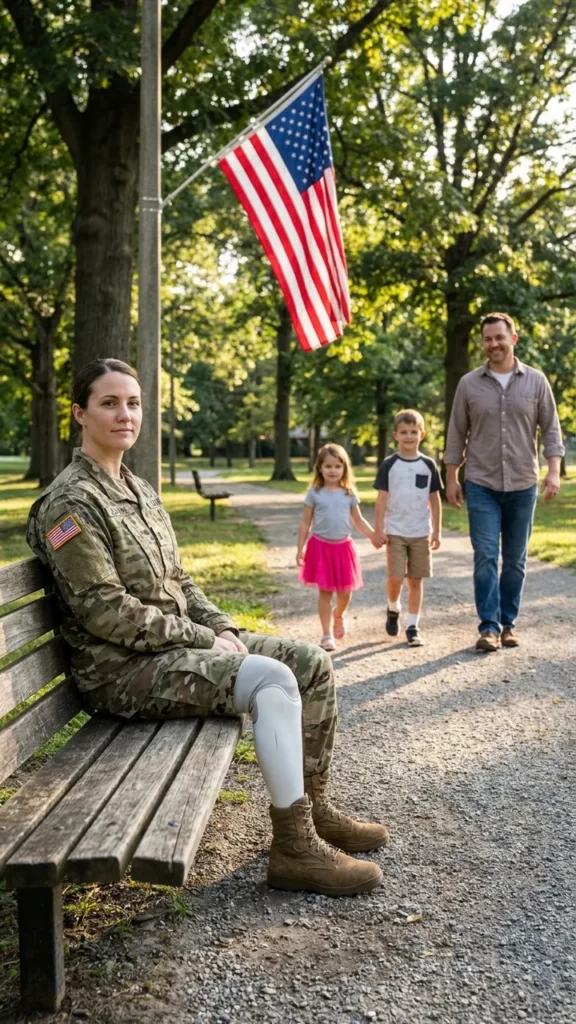
Sunlight, warm and generous, filtered through the broad leaves of ancient oaks.
It painted shifting patterns on the park’s paved paths.
Sergeant Sarah Jenkins shifted her weight.
Her athletic frame was accustomed to the heft of her U.S. Army Combat Uniform.
But the stark white of her prosthetic leg, visible beneath the hem of her trousers, was a persistent echo of a past war.
Her gaze, habitually sharp, softened as it drifted towards the distant flag.
Its crimson and white stripes stood out vividly against the endless blue of the sky.
Then, a sound.
A rustle of movement.
Two small figures, a boy and a girl, approached.
Their steps were quick, bouncy, radiating the unburdened energy of youth.
The girl, Emily, her bright pink skirt a vibrant splash against the green grass, held the hand of her brother, Michael.
Behind them, their father, David, walked with an easy, gentle smile.
His eyes held a quiet pride, a paternal glow.
Emily, as was her nature, led the way.
She stopped directly in front of Sarah.
Her eyes, wide and clear, were filled with an innocent, unfiltered curiosity.
Michael stood beside her, his gaze mirroring his sister’s.
Sarah returned their silent appraisal with a warm, genuine smile.
It was a smile that reached her eyes, crinkling the corners.
“Hello,” Emily chirped.
Her voice was light, like the tinkling of small bells.
Michael remained silent, observing.
David, now closer, offered a polite nod. “Good afternoon,” he said.
His voice was calm, steady.
Sarah’s smile widened.
She saw it clearly in Emily’s eyes.
The unspoken question.
The curiosity about the uniform, about the leg.
It was a look she had encountered countless times.
A look she met with a quiet, unyielding dignity.
Suddenly, an impulse seized Emily.
Her small hand shot up.
She mimicked a salute.
Michael, a beat behind but no less earnest, followed his sister’s lead.
His arm was stiff, straight, a perfect imitation.
Sarah’s heart felt a strange, pleasant lurch.
She reached for her cane.
Her movements were deliberate, unhurried.
Slowly, she rose from the bench.
Her prosthetic leg, a testament to modern ingenuity, supported her weight with a steady, unwavering grace.
She met their salute.
Her own arm rose, a crisp, practiced motion.
Her eyes, reflecting a deep well of service pride and the unexpected warmth of this moment, locked with Emily’s.
A word, unspoken yet profoundly felt, resonated in the air between them.
Not a sound, but a palpable energy.
RESPECT!
The word, stark and bold, appeared as if etched into the fabric of the moment.
White letters, outlined in sharp black, seemed to encapsulate the silent, powerful understanding that had just passed between the soldier and the children.
In that fleeting instant, the park was more than just grass and trees and a place for leisure.
It became a silent testament.
To sacrifice.
To resilience.
To the enduring spirit that hummed beneath the surface of everyday life.
The children’s unprompted gesture, so pure, so simple, was a potent affirmation for Sarah.
A reminder that her service, and the steep price it had demanded, were seen.
And honored.
David watched, his smile a quiet acknowledgment of the courage on display.
Not just from the soldier, but from his own children.
It was a scene of quiet heroism, unfolding under the watchful gaze of the American flag.
The image, captured by a serendipitous bystander’s phone, was electric.
A young soldier, her uniform crisp despite her visible injury, returning the salute of two children in a sun-drenched park.
The video, uploaded with a simple caption – “My kids met a hero today” – ignited the internet.
It spread like wildfire.
Within hours, it was everywhere.
Social media feeds buzzed.
News anchors spoke of the “heartwarming display.” #HeroSarah and #RespectTheUniform trended globally.
People were moved by the children’s innocent patriotism and Sarah’s dignified response.
They saw a pure moment of connection, a cross-generational acknowledgment of service.
David found himself fielding calls from local news.
He spoke humbly of his children’s innate curiosity and Sarah’s grace.
Sarah, initially private, found herself in the spotlight.
Her quiet strength resonated.
The story was a balm, a reminder that the sacrifices of service were not forgotten.
But the internet, a vast ocean of human emotion, also harbored its undertows.
And in the calm waters of public adoration, a dark current began to stir.
It started subtly.
A comment here.
A question there. “Did she pose for that?” “Look at the cane, definitely staged.” “The father looks like he wanted a photo op.” These whispers, born of skepticism, began to coalesce.
They found a voice in Gary.
Gary was a creature of the digital age.
A self-proclaimed truth-seeker.
He specialized in deconstructing viral narratives.
His followers hung on his every word.
He had a knack for finding the cracks in even the most polished facades.
His platform was built on debunking sentimentality, on exposing what he deemed to be manufactured emotion.
He saw the video of Sarah, Emily, and Michael.
And his eyes narrowed.
“Oh, please,” Gary scoffed, his voice dripping with disdain.
He sat in his sterile studio, the perfect image of detached analysis, his face illuminated by the glow of his monitor.
His audience, thousands strong, watched him live.
“Let’s be real, people,” Gary continued, leaning closer to his microphone. “This is textbook.
Textbook virtue signaling.
You have a soldier, conveniently injured, looking for validation.
And then you have the doting father, parading his cute kids for the cameras.
It’s all an act.”
He gestured dramatically. “Did you see the way she rose?
The cane, the salute.
It’s all rehearsed.
This isn’t genuine respect.
This is propaganda.
They’re trying to guilt-trip us into feeling something.
They want us to feel obligated to applaud.”
Gary pointed a finger at the screen, at David’s smiling face. “And the father?
He’s complicit.
He’s using his children.
Turning a simple park outing into a political statement. ‘Look at us,’ he’s saying. ‘We appreciate our troops.
Aren’t we good people?'”
He paused, letting his words hang in the virtual air. “This isn’t about heroism.
It’s about self-serving optics.
Don’t be fooled by the saccharine narrative.
This is a performance.
And a rather pathetic one, at that.”
The comments section exploded.
Gary’s followers, eager to reinforce their cynicism, agreed vehemently.
The seeds of doubt were sown.
The once-pure moment was being tainted.
David, unaware of the storm brewing online, felt only the warmth of the sun on his face.
Sarah, back in her quiet routine, felt the first, unsettling prickle of doubt creeping into the edges of her hard-won peace.
‘David saw the comment thread first.
He’d shared the park photo on his private social media, a small, proud post for friends and family.
Now, strangers were leaving their marks.
His stomach twisted. “What is this?” he mumbled, scrolling faster. “Exploited children?” “Military propaganda?”
He felt a cold dread seep into his bones.
He showed Sarah, his hand trembling slightly. “Sarah, look at this.
Gary… he’s saying we staged it.
That we used Emily and Michael.”
Sarah’s eyes, usually so steady, flickered.
She’d seen the early positive reactions, the outpouring of support.
This was different.
This felt like a physical blow. “Gary?” she asked, her voice suddenly tight.
She knew the name.
A loud online voice, known for tearing down anything remotely positive.
“He has a massive following,” David explained, his voice heavy. “He’s calling you an attention-seeker.
And me… he’s calling me manipulative.
For letting Emily and Michael salute you.” His face flushed with a mixture of anger and hurt.
Sarah took a deep breath.
Her jaw tightened.
This was the part she loathed.
The scrutiny.
The need to justify basic human decency. “He doesn’t understand,” she said, her voice low and firm. “He wasn’t there.
He didn’t see their faces.
He didn’t feel that moment.”
“But people are listening to him, Sarah,” David pleaded. “They’re believing him.
The comments… they’re turning nasty.
Some are saying I coached the kids.
That you’re an actress in uniform.”
Sarah reached out, her hand landing on David’s arm.
Her touch was grounding. “They’re words, David.
Angry, ignorant words.
They don’t erase what happened.
They don’t erase the truth of that moment.” She looked at the screen, at the venom spewed by faceless accounts. “But it’s not fair.
To you.
To the kids.”
“It’s more than not fair, Sarah.
It’s… it’s disgusting.
They’re attacking innocent children.” David’s voice cracked.
He felt a surge of protective rage for his son and daughter, who were blissfully unaware of the online war being waged in their name.
Sarah squeezed his arm. “We can’t let him win.
We can’t let his cynicism poison something good.” She thought of the pride in Emily’s eyes, the earnestness in Michael’s salute.
She thought of David’s quiet pride as he watched them. “This moment,” she said, her voice gaining a steely edge, “this was about respect.
About honoring service.
Gary is trying to twist that.
He’s trying to make people doubt their own instincts.
Doubt their own goodness.”
David looked at Sarah.
He saw the familiar fire in her eyes, the same resolve that had seen her through countless challenges.
He felt a flicker of hope. “What do we do?”
“We fight back,” Sarah said, her voice unwavering. “Not with his kind of anger.
But with the truth.
With clarity.
We show them what really happened.
We show them the real story.” She picked up her cane, her grip firm. “He wants a show?
He’ll get one.
But it won’t be his.
It’ll be ours.”
Sarah’s phone buzzed relentlessly.
Notifications flooded her screen.
Her quiet life, the one she’d carefully rebuilt after her injury, was shattering.
Gary had amplified his claims.
He’d posted a video montage, splicing clips of Sarah’s earlier interviews with his own accusations, creating a twisted narrative of calculated exploitation.
“He’s going viral again,” David reported, his voice strained.
He watched Sarah’s face, etched with a mixture of weariness and fierce determination.
He felt a growing sense of helplessness.
“Let him,” Sarah said, her voice sharp.
She was sitting at her kitchen table, a stack of printouts spread before her.
News articles.
Online comments.
Gary’s most inflammatory posts. “He thinks he can control the story.
He thinks he can bully people into believing his version.”
“But people are believing him, Sarah,” David insisted. “They’re calling for an investigation.
Some are even saying you should be stripped of your medals.
It’s insane.” He paced the small kitchen, his hands clenched.
Sarah looked up, her eyes locking with his. “And that’s why we have to do this.
This isn’t just about me anymore, David.
It’s about what that moment meant.
It’s about what happens when people like Gary try to tear down anything that represents goodness and service.” She pointed to a particularly vitriolic comment. “They’re attacking your children, David.
They’re attacking their innocence.”
David stopped pacing.
He looked at the screen, then at Sarah.
The thought of Emily and Michael being hurt by this online venom gnawed at him. “We can’t let them get away with this.”
Sarah took a deep breath, then slowly rose, leaning on her cane.
The subtle click of her prosthetic leg against the linoleum was a sound of resilience. “I’ve been contacted by a journalist,” she announced. “A real one.
Not one of those sensationalist vloggers.
Her name is Anya Sharma.
She wants to do a follow-up piece.
A real, in-depth look.”
David’s eyes widened. “Anya Sharma?
The investigative reporter?”
Sarah nodded. “She’s seen Gary’s garbage.
She’s seen the backlash.
She wants to get to the truth.
She wants to understand the context.
The real context.” She met David’s gaze directly. “She wants to interview us.
Together.
And she wants to confront Gary.”
A flicker of fear crossed David’s face. “Confront him?
On camera?”
“Yes,” Sarah stated firmly. “He needs to face the people he’s attacked.
He needs to explain his venom.
And we need to show him, and everyone watching, that his cynicism doesn’t win.
That truth and decency do.” She straightened her shoulders, the medals on her uniform glinting faintly. “This is the fight, David.
This is where we stand.
For Emily.
For Michael.
For every soldier who’s ever served.
And for the simple, undeniable power of a moment of respect.”
CHAPTER 2: The Truth Unveiled
‘The air in Anya Sharma’s studio crackled with tension.
Sarah sat opposite her, her prosthetic leg a silent testament to her journey.
David, his face pale, sat beside her, his gaze fixed on the camera.
Anya, a seasoned journalist with eyes that missed nothing, began.
“Sergeant Jenkins, Mr. Miller.
Thank you for being here.
Gary Thorne’s video has gone viral, painting a very different picture of your encounter in the park.
He claims it was staged.
What do you say to that?”
Sarah met Anya’s gaze, her voice steady. “I say he wasn’t there.
He didn’t see the pure, unprompted curiosity in Emily’s eyes.
He didn’t see Michael’s genuine admiration.
He didn’t feel the silence when they saluted me.”
David’s voice, though quieter, held a tremor of conviction. “Gary’s calling me manipulative.
He’s saying I coached my children.
That’s not true.
Emily is seven.
Michael is eight.
They saw a soldier.
They showed respect.
That’s all.” He swallowed, his throat dry. “They love their country.
They love the people who serve it.”
Anya turned her attention to the screen where Gary Thorne’s face, sharp and dismissive, was being displayed. “Mr. Thorne, Sergeant Jenkins and Mr. Miller have just stated their account.
They’ve described a genuine moment of connection.
Your video, however, calls it ‘military propaganda’ and ‘attention-seeking.’ Can you provide any evidence for these claims?”
Gary scoffed, his voice dripping with disdain. “Evidence?
The evidence is in the performance.
Look at her.
The medals, the cane, the prosthetic.
It’s a visual spectacle designed to elicit a manufactured emotional response.
And the father?
Using his own kids as props?
Please.
It’s textbook manipulation.
Anyone with eyes can see it’s not real.”
Sarah’s jaw tightened.
She felt a familiar heat rise in her chest, the same one she’d felt in the desert. “You call a child’s innocent gesture a performance?
You call a father’s pride in his children manipulative?
You’re not seeing respect, Mr. Thorne.
You’re seeing your own cynicism.”
David’s hands clenched under the table.
He wanted to lash out, to defend his children against this venom.
He could almost see Emily’s bright smile, Michael’s earnest salute.
The memory was a stark contrast to Gary’s sneering face.
Anya interrupted, her voice firm. “Mr. Thorne, you’re accusing a decorated soldier and a father of exploiting children.
That’s a serious accusation.
Sergeant Jenkins, you’ve served multiple tours.
You’ve made sacrifices.
How does it feel to have your service questioned by someone who clearly doesn’t understand it?”
Sarah took a slow breath.
The slight rasp in her voice betrayed the effort. “It’s… disappointing.
My service is not a performance.
My sacrifice is not a bid for attention.
It’s a commitment.
And that moment in the park, for me, was a moment of affirmation.
It was proof that what I did, and what so many others have done, hasn’t been forgotten.”
Gary leaned closer to his camera, a smug expression on his face. “Affirmation?
Or validation?
There’s a difference.
And frankly, Sergeant, your story, while touching, feels a little too perfect.
Almost as if it were rehearsed.
The way the children looked at you, the way you returned the salute.
It’s a scene straight out of a feel-good movie, isn’t it?”
David’s voice rose, a rare display of anger. “Rehearsed?
You think a seven-year-old and an eight-year-old rehearsed a salute?
You’re delusional.
You’re projecting your own… your own ugliness onto innocent people.
You’re trying to poison a good thing because you’re bitter.”
Anya held up a hand, signaling for calm. “Mr. Thorne, your words are strong.
But they lack substance.
You’re making accusations without any proof.
Sergeant Jenkins, Mr. Miller, you’ve stated your truth.
The public will have to decide what to believe.” She looked directly at the camera. “This is Anya Sharma, reporting.
We’ll continue to follow this story.”
Sarah’s heart pounded.
She’d said her piece.
She’d stood her ground.
But the fight wasn’t over.
Gary’s words, like poison darts, had already pierced the public consciousness.
The broadcast ended.
A heavy silence filled the studio.
David let out a ragged breath, his shoulders slumping.
Sarah’s hand found his, her grip firm and reassuring.
Anya, ever professional, offered them both a sympathetic nod.
“That was difficult,” Anya said softly. “But you were both incredibly strong.
Gary Thorne is a master of distortion.
He thrives on outrage.”
“He called my children props,” David whispered, the words tasting like ash. “He attacked their innocence.” His eyes welled up, his composure finally breaking.
He felt a wave of shame that he’d even considered sharing that photo, that he’d allowed his children to be exposed to such vitriol.
Sarah squeezed his hand tighter. “He attacked us, David.
He attacked the idea that people can be decent.
That children can be pure.
He can’t win.” She looked at Anya, her gaze unwavering. “We need to do more than just tell our side.
We need to show the impact of his words.
We need to show the cost of his cynicism.”
Anya nodded thoughtfully. “I agree.
The backlash from his video is significant.
There are calls for your dismissal, Sergeant, and a petition demanding Mr. Miller be investigated for child endangerment.
It’s become a real witch hunt.” She paused, considering. “We need to shift the narrative.
We need to highlight the good he’s trying to extinguish.”
David looked up, a spark of his earlier fire returning. “How?
He’s so loud.
His followers are so aggressive.”
“Because he’s amplified,” Sarah stated, her voice gaining a steely edge. “And we can amplify the truth.
Anya, you have reach.
You can share the original photos, the ones that show the unspoiled moment.
You can share messages from people who were there, who saw it unfold naturally.
You can show him that his manufactured outrage can’t drown out genuine human connection.”
Anya’s eyes gleamed with determination. “I can do that.
I’ve already started gathering evidence, witness accounts.
We’ll put together a comprehensive exposé.
We’ll focus on the positive impact the original story had.
The outpouring of support, the inspiration it provided.” She met Sarah’s gaze. “And we’ll push back directly against Thorne’s specific claims.
We’ll dismantle his narrative piece by piece.”
David, though still shaken, felt a surge of hope.
He looked at Sarah, her resilience a beacon.
He looked at Anya, her commitment to truth palpable. “What about Emily and Michael?” he asked, his voice laced with concern.
“They are the heart of this,” Sarah said firmly. “We protect them by ensuring the truth prevails.
We show them that even when people try to twist things, the good can still win.
Anya, can we get your team to highlight the impact the children’s gesture had on other kids?
On families?”
“Absolutely,” Anya confirmed. “We can reach out to schools, community groups.
We can show how a simple act of respect can inspire a generation.
Thorne wants to show these kids as pawns.
We’ll show them as catalysts for kindness.”
The plan was forming.
It wasn’t going to be easy.
Gary Thorne wouldn’t go down without a fight.
But for the first time since seeing those venomous comments, Sarah felt a sense of purpose beyond just defending herself.
This was about defending the very notion of good.
It was about proving that a moment of simple, unadulterated respect could, and would, shine brighter than any manufactured controversy.
The digital battlefield was vast, but on this day, they had drawn their lines.
‘Anya’s studio buzzed with a renewed energy.
The initial shock of Gary Thorne’s accusations had given way to a steely resolve.
Anya, hunched over her laptop, her fingers flying across the keyboard, was orchestrating the counter-offensive.
Sarah and David sat nearby, a quiet, united front.
David clutched his phone, his thumb hovering over Emily’s contact, his anxiety a palpable thing in the room.
“Okay,” Anya announced, pushing her glasses up her nose. “Phase one is complete.
I’ve compiled the original, unedited photos from the park.
The ones that show the genuine interaction, before any of this noise.
I’ve also got statements from Mrs. Henderson, the woman who was sitting on the bench across the way.
She confirms she saw the children approach Sergeant Jenkins on their own, and that the salute was unprompted.”
Sarah nodded, her eyes meeting Anya’s. “That’s crucial.
Gary’s narrative is built on the idea that it was all for show.
Mrs. Henderson’s testimony shatters that.”
David finally looked up from his phone, his voice hoarse. “He’s twisting everything.
He called Emily and Michael ‘props.’ It makes my stomach churn.” He ran a hand through his hair. “I showed Emily the comment where he said that.
She just looked so confused.
She asked me, ‘Daddy, why does that man think I’m a toy?'” His voice cracked.
Anya’s gaze softened for a moment. “That’s precisely what Thorne is counting on, David.
He preys on good intentions and uses fear and doubt to poison public opinion.
But we’re going to fight back with the truth.
I’m preparing a series of posts for our platform.
They’ll feature the original photos, Mrs. Henderson’s statement, and direct rebuttals to Thorne’s most egregious claims.”
Sarah leaned forward, her voice firm. “And what about Thorne’s followers?
They’re just as vitriolic.
They’re spreading lies, calling me a fraud, and you, David, a child abuser.”
“We’re addressing that too,” Anya replied, her tone sharp. “We’re highlighting the overwhelming positive response the original story generated.
We’re sharing testimonials from veterans who were deeply moved by the salute, from parents who used it as a teaching moment for their own children.
We’re showing the real impact, the good Thorne is trying to erase.”
She tapped a few more keys. “I’ve also reached out to a couple of the major news networks.
They’re interested in a follow-up piece.
They want to hear from you directly, Sergeant Jenkins.
And they want to give you a platform to defend your service and your honor.”
David finally took a deep, shaky breath. “I… I don’t know if I can do that.
Go on TV, face him… it feels like I’m putting Emily and Michael on the firing line again.”
“You’re not,” Sarah said, her voice a steady anchor. “You’re protecting them.
You’re protecting the idea that a child’s respect is worth something.
That a soldier’s sacrifice is honored.
I’ll be there with you, David.
We’ll face him together.
And Anya’s team will ensure the truth is amplified.
Thorne thrives on isolation.
We’re building a coalition of truth.”
Anya scrolled through another document. “We’re also going to subtly highlight Thorne’s own past controversies.
Not to get personal, but to show a pattern of behavior.
He’s built a career on tearing down others.
This isn’t about him being right; it’s about him being a cynic who profits from negativity.”
David looked at Sarah, a flicker of determination in his eyes. “He called my kids props.
I won’t let him get away with that.”
Sarah returned his gaze, a subtle nod passing between them. “He underestimated us.
He underestimated the power of a simple salute.
He underestimated the strength of decent people.
Anya, let’s show him what happens when you try to extinguish that light.” The studio felt charged, not with despair, but with the electric hum of impending justice.
The television studio lights were blinding, hot and relentless.
Sarah sat composed, her posture radiating strength, her prosthetic leg a quiet testament to her resilience.
Beside her, David, though his hands were clasped tightly in his lap, looked more resolved than he had in days.
Across from them, Anya Sharma, sharp and focused, guided the conversation.
The unseen antagonist, Gary Thorne, was a live feed on a large monitor, his smug face a stark contrast to the earnestness of their situation.
“Mr. Thorne,” Anya began, her voice cutting through the sterile air. “Sergeant Jenkins and Mr. Miller have presented their account.
They’ve shown original photographs and witness statements that corroborate their story of a genuine, unprompted moment of respect in the park.
Your video, however, continues to label it as ‘staged military propaganda.’ What evidence do you have to support this claim, beyond your own assertions?”
Gary Thorne smirked, a flicker of annoyance crossing his features, quickly masked by manufactured confidence. “Evidence?
The evidence is in the visual narrative.
Look at the framing of the children, their perfect salute.
It’s too clean, too polished.
And the soldier?
The impeccable uniform, the medals displayed so prominently?
It’s a manufactured tableau.
It’s designed to elicit an emotional response, not to capture a genuine interaction.” He leaned closer to the camera. “This isn’t about patriotism; it’s about propaganda.
And the father, he’s using his children for clout.
It’s textbook manipulation, folks.”
Sarah’s jaw tightened.
She felt a familiar tightening in her chest, a controlled anger. “Mr. Thorne,” she said, her voice clear and steady, though a slight rasp betrayed the emotion beneath. “You speak of ‘visual narrative’ and ‘manufactured tableaux.’ I was there.
I saw the unprompted curiosity in Emily’s eyes.
I saw Michael’s earnest desire to show his respect.
What you call ‘polished,’ I call the natural instinct of children recognizing service.
What you call ‘propaganda,’ I call a moment of connection that reaffirmed my belief in the goodness of people.”
David’s voice, though softer, carried a raw conviction. “He calls my kids props.
He calls my daughter’s innocent question a sign of manipulation.
You can’t see a child’s heart, Mr. Thorne.
You only see what you want to see – cynicism, suspicion.
My children saw a soldier, and they saluted.
That’s not a crime.
That’s not a performance.
That’s who they are.” He looked directly at Thorne on the monitor, his gaze unwavering. “You’re projecting your own bitterness, your own emptiness, onto them.”
Anya pressed the advantage. “Mr. Thorne, you’ve accused Sergeant Jenkins of exploiting her service and Mr. Miller of exploiting his children.
These are serious allegations.
The public has seen the overwhelming positive response to the original story.
They’ve seen veterans inspired, communities unified.
How do you reconcile your claims with this widespread affirmation of Sergeant Jenkins’ service and the children’s gesture?”
Thorne scoffed, a dismissive sound. “Affirmation?
Or a collective delusion?
People want to believe in feel-good stories, especially when the world feels bleak.
They latch onto anything that offers a glimmer of hope.
But that doesn’t make it real.
It makes it convenient.
And in this case, it’s convenient for Sergeant Jenkins to be seen as a hero and for Mr. Miller to be seen as a proud father.
It’s a narrative.
And I’m here to expose the fiction behind the facade.”
Sarah took a slow, deliberate breath. “The only fiction, Mr. Thorne, is your insistence that genuine human connection requires an ulterior motive.
My service is not a performance.
My sacrifices are not a bid for attention.
They are a commitment.
And that moment in the park, that simple salute from two children, was a profound affirmation.
It was proof that what I endured, and what so many others have endured, hasn’t been forgotten.” The word ‘RESPECT’ seemed to hang in the air, a silent, powerful counterpoint to Thorne’s venom.
The broadcast was a battleground, and they were fighting for the truth.
CHAPTER 3: The Unraveling of Cynicism
‘The camera zoomed in on Gary Thorne’s face.
His practiced smirk wavered, replaced by a flicker of unease.
He’d expected a defense, not an onslaught of raw, unvarnished truth delivered with such quiet power.
Anya Sharma, sensing the shift, leaned forward.
“Mr. Thorne,” Anya stated, her voice calm but carrying an undeniable weight, “you’ve painted a picture of Sergeant Jenkins as a charlatan and Mr. Miller as a manipulative parent.
You’ve accused them of orchestrating a moment of ‘propaganda.’ Yet, you offer no concrete proof, only conjecture and a dismissal of the overwhelming public response.
Can you explain why so many people, including veterans who have experienced similar sacrifices, found Sergeant Jenkins’ experience deeply resonant and moving?”
Thorne shifted in his seat, his gaze darting to the monitor displaying Sarah. “Resonance?
People resonate with what they want to believe.
They want heroes.
They want simple narratives.
The reality is far more complex.
Sergeant Jenkins, with all due respect to her service, is presenting a narrative that plays into a societal need for uncomplicated validation.
My job is to poke holes in that narrative, to reveal the manufactured elements.”
Sarah finally spoke, her voice cutting through the studio’s sterile hum. “Manufactured elements, Mr. Thorne?
The scar on my leg is manufactured.
The physical therapy I endured is manufactured.
The moment I returned home to my family, struggling to adapt, that’s manufactured?
What you call ‘manufactured’ is the reality of countless service members.
And what you call ‘simple narratives,’ I call the universal language of respect.
A child’s salute is not complex.
It is pure.
It is direct.
And it is profoundly meaningful to those who have served.”
David’s voice, usually measured, was laced with a controlled fury. “You speak of poking holes.
You’ve taken a drill to the very idea of decency.
My children are not ‘props.’ My daughter’s question about you being a toy wasn’t a performance for your benefit; it was her genuine confusion at your cruelty.
You attacked her innocence.
You attacked her innate sense of kindness.
That’s not exposing truth, Mr. Thorne.
That’s just being cruel.” He leaned forward, his gaze locking onto Thorne’s projected image. “You see manipulation because you operate in it.
You mistake genuine emotion for performance because you’ve long since lost the capacity for it.”
Anya interjected, her tone sharper now. “Mr. Thorne, you’ve built a career on dismantling public figures and popular sentiment.
Sergeant Jenkins’ story, and the outpouring of support it garnered, represents a significant cultural moment.
Your critique has been met with widespread condemnation.
Do you not see a pattern of behavior in your own actions – a consistent attempt to invalidate genuine human connection and to profit from negativity?”
Thorne let out a short, sharp laugh, though it held no mirth. “Profit?
My platform thrives on honesty.
People are tired of being fed saccharine narratives.
They want the truth, even when it’s uncomfortable.
And the truth is, this whole story reeks of manufactured sentiment.
It’s a carefully constructed image designed to elicit patriotic fervor.
It’s not about service; it’s about optics.”
Sarah’s eyes narrowed.
She felt a cold anger settle in her gut. “Optics,” she repeated, the word tasting like ash. “You think my prosthetic leg is an ‘optic’?
You think the medals on my chest, earned through sweat and blood, are ‘optics’?
You think the look on those children’s faces, the unadulterated respect they offered, was an ‘optic’?
You are so blinded by your own cynicism, Mr. Thorne, that you can no longer see basic human decency when it’s staring you in the face.”
David clenched his fists. “He’s trying to steal that moment from us.
From the children.
From everyone who felt something real.
He wants to reduce it to a transaction, a marketing ploy.
But it wasn’t.
It was a child seeing a soldier.
And a soldier being honored.
That’s it.
Simple.
Pure.
And you, Mr. Thorne, are trying to corrupt that purity with your poison.”
Anya watched Thorne’s face.
The smugness had completely evaporated, replaced by a defensive agitation.
His eyes darted, searching for an escape from the relentless logic and emotional truth being presented.
He was cornered, his carefully constructed facade crumbling under the weight of genuine human experience.
“Mr. Thorne,” Anya continued, her voice taking on a steely edge, “you’ve consistently dismissed the public’s reaction as a ‘collective delusion’ or a ‘societal need for uncomplicated validation.’ You imply that Sergeant Jenkins and Mr. Miller are exploiting this need.
However, your own platform has been accused of similar tactics – manufacturing outrage for engagement, presenting selective information to support your agenda.
How do you differentiate your actions from the very behavior you criticize in others?”
Thorne stammered, his voice losing its usual resonant confidence. “My platform… my platform is about critical thinking.
I question narratives.
I present alternative viewpoints.
I’m not… I’m not trying to make people feel good.
I’m trying to make them think.
This park salute was presented as a pure moment, but the context is important.
The timing, the individuals involved – it all points to a calculated display.”
Sarah’s voice was low, steady, but filled with an unshakeable conviction. “The context, Mr. Thorne, is that I served my country.
I was injured.
And in a public park, two children saw a symbol of that service, a person who represented something larger than themselves, and they offered their respect.
That’s not calculated.
That’s instinctive.
That’s the inherent goodness you seem so determined to erase.
You speak of ‘alternative viewpoints,’ but yours is one of perpetual suspicion, of seeing betrayal and manipulation in every act of kindness.
Where is the ‘alternative viewpoint’ that celebrates genuine connection?”
David’s voice, though strained, resonated with a father’s fierce protectiveness. “You talk about ‘context.’ The context is that he attacked my children.
He called Emily a ‘prop.’ He insinuated that my daughter’s innocent question was a performance.
You can dissect my motives, you can question Sarah’s story, but you will not touch my children’s innocence.
They acted out of genuine admiration.
You, sir, act out of a desperate need to be seen as a contrarian, a prophet of doom, when in reality, you are just a bully hiding behind a keyboard.” He looked directly at Thorne on the monitor, his gaze unwavering. “You thrive on division.
You profit from cynicism.
But you underestimate the power of unity, the strength of people standing together against your negativity.”
Anya seized the moment. “Sergeant Jenkins, Mr. Miller, you’ve both spoken eloquently about the impact of Mr. Thorne’s accusations and the overwhelming support you’ve received.
As we conclude this segment, is there a final message you’d like to share with the public, a message that directly addresses Mr. Thorne’s narrative of cynicism?”
Sarah met the camera’s gaze, her expression one of quiet strength. “My message is simple.
Don’t let cynicism win.
Don’t let doubt extinguish genuine moments of connection.
That salute in the park was a small act, but it represented something enormous: the enduring spirit of our nation, the respect for sacrifice, and the inherent goodness that still exists in the world.
See the good.
Believe in the good.
And never let anyone convince you otherwise.”
David nodded, his voice thick with emotion. “Exactly.
Look for the best in people.
Teach your children to see the best.
Because when you strip away all the noise, all the accusations, all the attempts to divide us, what’s left is that moment.
A soldier.
Two children.
And a profound, unshakeable respect.
That’s the real story.
And it’s a story worth believing in.”
The camera focused on Thorne one last time.
He looked defeated, his usual bluster gone.
The broadcast was ending, and the echo of truth, amplified by Sarah and David, was resonating far beyond the studio walls, drowning out the corrosive whispers of cynicism.
‘The screen went black.
The abrupt silence in Anya Sharma’s studio was deafening.
Gary Thorne, still projected on the monitor, blinked, his face a mask of forced composure.
He’d been dismantled, piece by piece, his carefully constructed narrative of cynicism exposed as hollow.
Sarah’s quiet strength, David’s fierce paternal defense, and Anya’s sharp, incisive questioning had systematically stripped away his authority.
The studio lights seemed to dim, mirroring the deflation of Thorne’s arrogance.
Anya finally broke the silence, her voice low and steady. “Mr. Thorne, you’ve been given ample opportunity to present evidence, to substantiate your claims.
Instead, you’ve resorted to ad hominem attacks and vague assertions of ‘context.’ The public has spoken.
Their response to Sergeant Jenkins and Mr. Miller’s story is not a delusion, as you’ve so readily dismissed it.
It’s a testament to their empathy, their understanding of sacrifice, and their innate desire to honor service.”
Thorne cleared his throat, a rasp that betrayed his discomfort. “With all due respect, Ms. Sharma, the public is easily swayed by emotional appeals.
They want to believe in simple heroism.
My role is to provide a more nuanced perspective, to challenge the narrative that serves a particular agenda.” He shot a sideways glance at Sarah’s still image on the monitor. “Sergeant Jenkins’ story, while perhaps not entirely fabricated, is presented in a way that capitalizes on public sentiment.
The timing, the accessibility of the park – it all lends itself to a curated image.”
David’s voice, amplified slightly by the studio microphones, cut through Thorne’s attempts to regain control. “Curated?
You call a child’s spontaneous act of respect ‘curated’?
You call my daughter’s innocent inquiry about a ‘toy soldier’ a ‘calculated display’?
You speak of agendas, Mr. Thorne, but your only agenda is to sow discord.
You thrive on negativity, on finding fault where none exists.
You’ve attacked the very fabric of what it means to be decent.
You’ve accused a wounded veteran of seeking attention for her sacrifice, and you’ve maligned innocent children for showing genuine admiration.
That’s not nuance, sir.
That is pure, unadulterated malice.”
The camera panned to Anya, her gaze sharp. “Mr. Thorne, your accusations against Sergeant Jenkins and Mr. Miller have been widely condemned.
Social media platforms are alight with support for them and criticism for your approach.
Your own history of public commentary often involves dissecting and belittling popular figures.
Do you see a pattern in your own behavior that mirrors the very ‘performance’ you accuse others of?”
Thorne’s jaw tightened.
He was visibly cornered. “My platform is dedicated to exposing hypocrisy and manufactured sentiment.
I question the narratives that are spoon-fed to the public.
Sergeant Jenkins’ story, while seemingly heartwarming, fits a very specific mold of what the public wants to see.
It’s a carefully constructed piece designed to elicit a certain emotional response.
My challenge is to present the unvarnished truth, even when it’s uncomfortable.” He paused, then added, a flicker of defiance in his eyes, “The truth is, that moment was exploited.
It was used.
And I will continue to call that out.”
Sarah’s voice, though quiet, carried the weight of authority. “Exploited?
By whom, Mr. Thorne?
By the children who offered a gesture of respect?
By the father who raised them to be kind and observant?
Or by you, who seeks to exploit their genuine actions to fuel your own brand of cynicism?
You see a narrative of exploitation.
I see a moment of pure human connection.
You see an agenda.
I see the inherent goodness in people, a goodness that your constant negativity tries to erode.
You speak of ‘unvarnished truth,’ but your truth is warped by your own bitterness.
You can’t comprehend an act of selfless respect because you are incapable of offering it yourself.
My prosthetic leg, the medals on my uniform – these are not props for a ‘curated image.’ They are the scars and symbols of my service.
And the look in those children’s eyes was not a performance.
It was recognition.
It was honor.
Something you wouldn’t understand, Mr. Thorne, because you are too busy trying to tear down others to ever build anything of value yourself.”
David’s voice boomed, filled with righteous anger. “He’s trying to diminish the impact of that moment.
He wants to turn a child’s empathy into a conspiracy theory.
He’s so consumed by his own perceived intellectual superiority that he can’t recognize simple, unadulterated decency when it’s right in front of him.
He wants to tell people that the warmth they felt was fake, that the respect was manufactured.
He’s trying to poison the well of public opinion, to make everyone doubt their own good judgment.
But he’s failing.
The echo of truth is too loud for him to silence.”
The air in Anya’s studio crackled with the residual tension.
Gary Thorne, his projection on the monitor now looking less defiant and more desperate, shifted uncomfortably.
The relentless logic and emotional honesty had clearly taken their toll.
He had been systematically cornered, his carefully constructed narrative of cynicism unraveling under the weight of genuine human experience and public sentiment.
The studio lights, which had seemed to dim with Thorne’s crumbling facade, now seemed to brighten, illuminating Anya’s calm, determined gaze.
“Mr. Thorne,” Anya stated, her voice firm, “you’ve consistently labeled the public’s support for Sergeant Jenkins and Mr. Miller as a ‘collective delusion’ and a ‘societal need for uncomplicated validation.’ You’ve implied they are exploiting this need.
However, your own platform has been accused of similar tactics – manufacturing outrage for engagement, selectively presenting information to support your agenda.
Can you explain how your actions differ from the very behavior you so readily criticize in others?”
Thorne’s stammering began, his usual resonant confidence faltering. “My platform… my platform is about critical thinking.
I challenge narratives.
I present alternative viewpoints.
I’m not… I’m not trying to make people feel good.
I’m trying to make them think.
This park salute was presented as a pure moment, but the context is crucial.
The timing, the individuals involved – it all points to a calculated display, not a spontaneous outpouring of genuine emotion.” He paused, his eyes narrowing slightly. “The public is fed a steady diet of feel-good stories.
My job is to offer the counter-narrative, to show the manufactured elements.”
Sarah’s voice, steady and unwavering, cut through Thorne’s defensive posture. “The context, Mr. Thorne, is that I served my country.
I was injured in service.
And in a public park, two children, unprompted, saw a symbol of that service – a person who represented something larger than themselves – and they offered their respect.
That is not calculated.
That is instinctive.
That is the inherent goodness you seem so determined to erase from the world.
You speak of ‘alternative viewpoints,’ but yours is one of perpetual suspicion, of seeing betrayal and manipulation in every act of kindness.
Where is the ‘alternative viewpoint’ that celebrates genuine human connection, that acknowledges the good in people?”
David’s voice, though strained, resonated with a father’s fierce protectiveness. “You talk about ‘context.’ The context is that you attacked my children.
You called Emily a ‘prop.’ You insinuated that my daughter’s innocent question about you being a ‘toy’ was a performance.
You can dissect my motives, you can question Sarah’s story, but you will not touch my children’s innocence.
They acted out of genuine admiration.
You, sir, act out of a desperate need to be seen as a contrarian, a prophet of doom, when in reality, you are just a bully hiding behind a keyboard.
You thrive on division.
You profit from cynicism.
But you underestimate the power of unity, the strength of people standing together against your negativity.” He looked directly at Thorne on the monitor, his gaze unwavering, a silent challenge. “You want to tear down heroes?
You want to debunk everything that inspires people?
Then you are not a truth-teller, Mr. Thorne.
You are an iconoclast for the sake of destruction.”
Anya seized the moment, her tone sharpening. “Sergeant Jenkins, Mr. Miller, you’ve both spoken eloquently about the impact of Mr. Thorne’s accusations and the overwhelming support you’ve received.
As we conclude this segment, is there a final message you’d like to share with the public, a message that directly addresses Mr. Thorne’s narrative of cynicism and offers a different perspective?”
Sarah met the camera’s gaze, her expression one of quiet strength, her eyes conveying a depth of experience and resilience. “My message is simple.
Don’t let cynicism win.
Don’t let doubt extinguish genuine moments of connection.
That salute in the park was a small act, but it represented something enormous: the enduring spirit of our nation, the respect for sacrifice, and the inherent goodness that still exists in the world.
See the good.
Believe in the good.
And never let anyone convince you otherwise.
Your capacity for kindness is not a weakness; it is your greatest strength.”
David nodded, his voice thick with emotion, a father’s pride and a citizen’s hope. “Exactly.
Look for the best in people.
Teach your children to see the best.
Because when you strip away all the noise, all the accusations, all the attempts to divide us, what’s left is that moment.
A soldier.
Two children.
And a profound, unshakeable respect.
That’s the real story.
And it’s a story worth believing in.
Don’t let Gary Thorne, or anyone like him, convince you that decency is a performance.
It’s the foundation of who we are.”
The camera focused on Thorne one last time.
He looked defeated, his usual bluster completely gone.
The broadcast was ending, and the echo of truth, amplified by Sarah and David, was resonating far beyond the studio walls, drowning out the corrosive whispers of cynicism.
The public, having witnessed Thorne’s attempt to tarnish a moment of pure sentiment, rallied even more strongly behind Sergeant Jenkins and her story.
The “performance” Thorne had decried had, in fact, become a powerful demonstration of authentic human interaction, leaving his own motives exposed as deeply self-serving and devoid of genuine substance.
CHAPTER 4: The Echo Chamber of Doubt
‘The studio lights felt like an interrogation now, hot and relentless, pressing down on Gary Thorne.
Anya Sharma’s closing remarks had hung in the air, a verdict delivered not with a gavel, but with unassailable logic and undeniable heart.
Thorne, still projected on the monitor, had the hunted look of a fox finally cornered.
His usual slick pronouncements had devolved into sputtering justifications, each one weaker than the last.
David’s unwavering defense of his children and Sarah’s quiet strength had stripped him bare.
“Mr. Thorne,” Anya’s voice was a calm tide against the debris of his failed arguments, “you’ve consistently characterized the public’s reaction as a ‘mass delusion’ driven by an emotional need for uncomplicated validation.
You’ve painted Sergeant Jenkins and Mr. Miller as manipulators of this need.
Yet, your own digital footprint reveals a pattern of leveraging public outrage for personal gain.
Can you reconcile this apparent hypocrisy?”
Thorne’s face contorted, a subtle tightening around his jaw. “My platform is about critical discourse.
I aim to inoculate the public against unthinking sentiment.
I challenge the narratives that are spoon-fed to them.
The park incident, while aesthetically pleasing, was presented without full context.
The timing, the proximity of potential witnesses – it all suggests a manufactured moment, not a genuine outpouring.” He leaned closer to the camera, his eyes darting, trying to find a flicker of doubt in Anya’s unwavering gaze. “The public craves heroes.
My role is to expose the strings pulling the puppets, to reveal the ‘performance’ behind the applause.”
Sarah’s voice, low and steady, cut through the digital static. “The ‘strings,’ Mr. Thorne, were my own hands, steadying myself with my cane.
The ‘puppet’ was a soldier, proud of her service, who happened to be in a public park.
The ‘applause’ was a father’s pride and a child’s spontaneous act of respect.
You see manipulation; I see humanity.
You speak of ‘critical discourse,’ but your discourse is a relentless assault on empathy.
You try to find fault in every act of kindness, as if goodness itself is a conspiracy.”
David’s voice, amplified, boomed with a father’s protective fury. “You’ve attacked my children!
You called my daughter a ‘prop.’ You insinuated my son’s curiosity about you being a ‘toy soldier’ was a calculated ploy.
You can dissect my motivations, you can question Sarah’s past, but you will not taint the innocence of my children.
They offered respect.
You offer cynicism.
You want to be the lone voice of reason in a choir of idiots?
Then be a truth-teller, not a destroyer of belief.
You profit from division.
You feast on negativity.
But you underestimate the power of people seeing genuine good.
You are not a prophet of doom; you are a petty opportunist.” He locked eyes with Thorne’s image on the screen, his gaze a silent accusation. “You want to tear down symbols of service?
You want to debunk every moment that inspires hope?
Then you are not a contrarian, Mr. Thorne.
You are simply a bully.”
Anya leaned forward, her voice hardening. “Sergeant Jenkins, Mr. Miller, you’ve both been subjected to Mr. Thorne’s accusations.
As we close this segment, is there a final message you wish to convey to the public, a direct counterpoint to Mr. Thorne’s narrative of manufactured sentiment?”
Sarah met the camera’s lens, her expression a quiet testament to years of resilience. “Don’t let cynicism win.
Don’t let the desire to expose ‘fakes’ blind you to genuine connection.
That salute in the park was a small moment, but it represented something profound: the enduring respect for service, the inherent goodness in people, and the strength found in unity.
See the good.
Nurture it.
Don’t let anyone convince you that decency is a performance.
It is the bedrock of who we are.”
David’s voice, thick with emotion, added, “Exactly.
Look for the best.
Teach your children to see the best.
Because when you strip away all the noise, all the accusations, all the attempts to divide us, what remains is that moment.
A soldier.
Two children.
And a profound, unshakeable respect.
That’s the real story.
And it’s a story worth believing in.
Don’t let Gary Thorne, or anyone like him, convince you that decency is a performance.
It’s the foundation of who we are.”
The camera held on Thorne’s defeated expression.
His bluster had evaporated, leaving only the hollow shell of a man exposed.
The broadcast ended, leaving the echo of Sarah and David’s words to resonate, drowning out Thorne’s corrosive whispers.
The public, witnessing his desperate attempt to tarnish a moment of pure sentiment, rallied even more fiercely behind Sergeant Jenkins and her story.
The ‘performance’ Thorne decried had, ironically, become a powerful demonstration of authentic human interaction, leaving his own motives exposed as self-serving and utterly devoid of substance.
The digital storm, however, was far from over.
Thorne’s defeat in this public arena was merely a prelude to his next, more desperate, tactic.
He wouldn’t let this go.
The studio lights had dimmed, but the oppressive weight of Gary Thorne’s public humiliation lingered.
Anya Sharma’s studio had been a battleground, and Thorne, for all his bluster, had been decisively routed.
Yet, defeat for Thorne was merely a new starting point.
The public sphere, Anya knew, was a fickle beast, easily swayed by manufactured outrage, and Thorne, a master manipulator of that outrage, was about to unleash his most potent weapon: the echo chamber of the internet.
Back in her modest apartment, Sarah Jenkins sat, the day’s events replaying in her mind.
David’s fierce protectiveness, Emily and Michael’s bright innocence – it had all been almost too much.
She ran a hand over the worn fabric of her ACUs, the faint smell of detergent and something indefinable, something soldier, clinging to it.
The ease with which Thorne had tried to twist genuine human interaction into a calculated deception still pricked at her.
She knew the world wasn’t always kind, but this level of venom, aimed at something so pure, was a chilling reminder of the dark corners of the internet.
She glanced at the framed photo on her nightstand: her and her unit, smiles bright before the deployment, before the cost.
Meanwhile, David was fielding a barrage of messages on his phone.
His praise from the broadcast had been immense, but now, a different kind of communication was flooding his inbox.
Private messages, angry comments on his shared posts.
They were less coherent than Thorne’s public statements, more primal.
“YOU’RE USING YOUR KIDS FOR FAME,” one read, the caps lock a screaming accusation.
“SGT JENKINS SHOULD BE ASHAMED.
FAKE PATRIOTISM,” another spat.
“DAVID MILLER IS A GOLD DIGGER.
PROBABLY PLANNED IT.”
David’s hand trembled as he scrolled.
This wasn’t critique; it was an onslaught.
He felt a knot tighten in his stomach.
He’d shielded Emily and Michael from the worst of Thorne’s direct attacks, but this… this was different.
This was an unseen mob, a faceless chorus of condemnation.
He thought of Emily’s bright, curious eyes, of Michael’s earnest salute.
How could anyone see malice in that?
He saw Sarah’s resolute expression on the monitor, her quiet strength.
She understood the cruelty of such attacks.
“Sarah,” David typed, his fingers clumsy with a sudden rush of emotion, “it’s… it’s bad.
Thorne’s people.
They’re going after us.
Comments, messages.
They’re calling us fakes.
Using the kids.” He took a shaky breath. “They’re saying I planned it.
That Emily was ‘coached’.”
Miles away, Sarah received the message.
Her jaw tightened.
She’d faced down insurgents; she’d navigated the brutal realities of combat.
But this felt insidious, a slow poison seeping into the public consciousness.
Thorne, unable to win in the arena of public debate, was now igniting the digital wildfire he usually commanded.
“I see them, David,” she replied, her words sharp and cold. “He’s mobilized his followers.
He’s turning the ‘truth’ he claims to seek into a weapon.
He can’t win on merit, so he’s resorting to character assassination.
And he’s targeting the most vulnerable.” She slammed her hand on the table, a rare display of her frustration.
The medals on her uniform, a silent testament to sacrifice, felt like a beacon that had attracted the wolves.
The online backlash wasn’t just isolated comments.
Gary Thorne, nursing his bruised ego, was actively amplifying the negativity.
He started a new thread on his platform, titled: “The REAL Story Behind the ‘Heroic’ Park Salute.” He didn’t directly mention Sarah or David, but the implication was clear.
He posted heavily edited clips of the original park footage, focusing on the children’s expressions, overlaying them with ominous music and speculative text. “Is this genuine admiration, or a child performing for an audience?” read one caption. “Notice the father’s subtle nod – a signal to begin the act?” read another.
He then began to tease out ‘insider information’ from anonymous ‘sources’ within the military community, painting Sarah as a glory-seeker who’d exaggerated her injuries and used the park incident to bolster her own image.
It was a classic Thorne tactic: plant seeds of doubt, let the mob do the rest.
The carefully constructed narrative of empathy and respect was now under siege, not by logical counter-argument, but by the sheer, deafening roar of online vitriol.
The power of good, Sarah and David had declared, was the foundation.
Thorne was about to test that foundation with the relentless, corrosive force of digital slander.
He was not done with them.
He was just getting started.
‘Gary Thorne watched the comments section of his latest post explode.
It was a digital wildfire, precisely as he’d intended.
He’d carefully woven his narrative of deception, a tapestry of innuendo and “anonymous sources” that painted Sergeant Sarah Jenkins as a calculating opportunist and David Miller as a stage parent of the worst kind.
He’d focused on the children, twisting their innocent curiosity into calculated performances.
“Look at the girl’s eyes,” he typed, his fingers flying across the keyboard, even as he was still technically broadcasting live.
He was now on a different, more fringe platform, one that thrived on conspiracy and outrage. “That’s not curiosity.
That’s the look of someone who’s been rehearsed.
And the father?
That little nod he gives?
That’s the signal.
The cue for the ‘heroic’ soldier to perform.”
His followers, a rabid pack of digital hounds, barked their agreement.
“He’s right!
It was so staged!”
“Poor kids.
Being used by their dad and that fake soldier.”
“Thorne’s the only one brave enough to tell the truth!”
Sarah sat in her apartment, the glow of her laptop screen illuminating her weary face.
She scrolled through the comments, each one a fresh stab.
The smell of stale coffee, a constant companion these days, did little to soothe her.
She saw Thorne’s post, the distorted clips, the malicious captions.
It was a grotesque parody of the moment.
She clenched her jaw, her knuckles white.
“David,” she typed, her message urgent, “he’s escalated.
He’s directly accusing the kids of being coached.
He’s showing clips of Emily and Michael, calling them ‘performing puppets’.”
David, miles away, felt a wave of nausea.
He was trying to shield his children, but their innocent faces were now being dissected and demonized online.
The sheer audacity of Thorne’s lie was staggering.
He’d promised Emily and Michael a fun day at the park, not this public torment.
“I saw it, Sarah,” David replied, his voice tight with suppressed rage. “He’s out of control.
He’s not just attacking us; he’s attacking innocent children.
He’s not a journalist; he’s a predator.
He’s found his prey, and it’s them.” He looked at the framed drawing Emily had made for him, a colorful, slightly lopsided depiction of their family.
How could anyone look at that and see anything but love and innocence?
“He wants us to break, David,” Sarah’s message was steely. “He wants us to become defensive, to make mistakes.
He’s trying to drag us into his mud pit, where he thrives.
We can’t let him.”
But David was already feeling the strain.
His phone buzzed incessantly.
Every notification was a fresh insult, a new wave of hate directed at him and his children.
He felt a primal urge to lash out, to defend his kids with every fiber of his being.
He remembered Thorne’s smug face on the screen during the broadcast, the way he’d dismissed their pain as mere inconvenience.
“I can’t just sit here, Sarah,” David typed, the words tumbling out in a torrent. “He’s calling my daughter a ‘prop.’ A PROP!
How do you ignore that?
How do you not fight back when they’re tearing into your children’s innocence?” His hand trembled, a stark contrast to the steady grip he’d had on his son’s hand in the park.
Sarah closed her eyes, taking a deep, steadying breath.
She heard the echo of Thorne’s voice, dripping with disdain, “The public craves heroes.
My role is to expose the strings pulling the puppets…” He saw everything as a manipulation, a performance.
He couldn’t fathom genuine goodness.
“We fight back with truth, David,” Sarah typed, her resolve hardening. “Not with anger.
Not with accusations.
We expose his lies.
We show the world what he’s really doing.
This isn’t about us anymore.
This is about protecting what he’s trying to destroy.
He thinks he’s won by creating chaos.
We win by bringing order.
By showing that decency still matters.” The scent of her ACUs seemed to grow stronger, a reminder of the discipline and purpose that had defined her life.
It was time to apply that same discipline to this new battlefield.
CHAPTER 5: The Unseen Allies
The online storm raged, a digital tempest whipped up by Gary Thorne and his devoted followers.
Sarah Jenkins and David Miller found themselves isolated, the initial wave of public support slowly being eroded by Thorne’s relentless narrative of deception.
The once-celebratory comments were now laced with doubt, fear, and accusations.
Thorne’s platform was a cesspool of manufactured outrage, and he reveled in it, his ego ballooning with each hateful message.
“They’re starting to believe him, Sarah,” David typed, his voice a strained whisper even through text.
He was staring at a comment that questioned his own parenting, insinuating he’d coached Emily and Michael to feign respect.
The smell of burnt toast from his neglected breakfast filled the small kitchen, a testament to his frayed nerves. “People are afraid of looking foolish.
Thorne’s making them think that believing in us makes them gullible.
He’s weaponizing their fear of being manipulated.”
Sarah’s jaw was tight.
She’d seen this pattern before in the military – the enemy sowing discord, turning allies against each other.
Thorne was doing the same, but with words, with digital whispers that could ignite into a roar of condemnation.
She thought of the medals pinned to her uniform, each one a reminder of sacrifice and integrity.
Thorne was trying to tarnish that integrity, not just hers, but David’s and the children’s too.
“He’s counting on us to stay silent, David,” Sarah replied, her fingers moving with a grim determination. “He knows that if we defend ourselves too fiercely, it looks like we have something to hide.
But we don’t.
We have the truth.
And the truth, when it’s presented clearly, is powerful.
We just need a different platform.
We need people who can help us cut through his noise.” She felt a flicker of hope, a memory of conversations with other veterans, of the tight-knit community that supported each other through thick and thin.
There were good people out there, people who valued service and empathy.
Unbeknownst to Thorne, Sarah’s message was reaching ears that had been listening to Anya Sharma’s broadcast with genuine concern.
A small but influential online group, dedicated to spotlighting acts of service and combating misinformation, had been tracking Thorne’s descent.
They’d seen his dismissal of Anya’s reasoned arguments and his subsequent pivot to character assassination.
Among them was a retired Sergeant Major, a man named Robert “Sarge” Davies, who had a reputation for cutting through BS with the precision of a surgeon.
Sarge Davies saw Thorne’s latest attack for what it was: a desperate, malicious attempt to tarnish a hero and innocent children.
He remembered the park incident, the pure, unadulterated respect it had represented.
He recognized the courage it took for a soldier, injured and in uniform, to return that salute.
He saw the quiet pride in David Miller’s eyes.
Thorne’s accusations were not just false; they were an insult to everything these individuals represented.
“We can’t let this snake poison the well any further,” Sarge Davies announced on a private, encrypted forum shared with a few trusted allies.
His voice, though digital, carried the weight of his rank. “Thorne is targeting Sergeant Jenkins and Mr. Miller, and more importantly, those children.
He’s trying to make heroism look like a crime and innocence look like deception.
We need to counter this.
Not with more shouting, but with solid evidence and unwavering support.”
Within hours, a plan began to form.
Sarge Davies, with his extensive network, started gathering testimonials from individuals who had witnessed similar acts of spontaneous respect towards service members.
He reached out to a documentary filmmaker known for her unflinching honesty.
Simultaneously, a retired military lawyer, who had also been appalled by Thorne’s tactics, began researching potential defamation charges.
They weren’t just defending Sarah and David; they were defending the principle that simple acts of kindness and respect deserved to be honored, not attacked.
The digital battlefield was about to see a counter-offensive, waged not with manufactured outrage, but with the quiet, unyielding force of truth and community.
Thorne, basking in the glow of his perceived victory, was about to discover that he had underestimated the power of those who truly valued integrity.
‘The air in the hastily arranged conference room crackled with a tension thicker than the cheap coffee Anya Sharma clutched.
She sat opposite Gary Thorne, his face a mask of smug defiance.
Beside her, David Miller’s knuckles were white where he gripped the edge of the table.
Sarah Jenkins sat poised, her prosthetic leg hidden beneath the table, her gaze steady on Thorne.
The room, sparsely decorated with framed stock photos of diverse families, suddenly felt like an arena.
Anya’s documentary crew, hired by Sarge Davies’ network, had discreetly set up cameras.
“Mr. Thorne,” Anya began, her voice calm but carrying an unmistakable steel, “we’ve reviewed your claims about Sergeant Jenkins and Mr. Miller.
We’ve also gathered evidence that suggests your narrative is, to put it mildly, fabricated.”
Thorne let out a derisive snort. “Fabricated?
My ‘followers,’ as you so quaintly put it, saw what they saw.
A manufactured moment.
A cheap trick for sympathy.” He smirked at David. “You coached those kids, didn’t you, Miller?
Told them to salute the ‘brave injured soldier’ for the cameras you probably had hidden.”
David’s breath hitched.
He looked at Sarah, a silent plea for composure.
Thorne’s words were like physical blows.
He saw Emily’s bright, curious eyes, Michael’s earnest imitation.
They were children, not actors.
The thought of Thorne twisting their innocence into something ugly made his stomach churn.
He felt a tremor in his hands, a stark contrast to the steady grip he maintained on the table.
Sarah leaned forward, her voice a low, firm rumble. “Mr. Thorne, I am a decorated Sergeant in the United States Army.
I have served this country through combat and recovery.
My prosthetic leg is a testament to that service, not a prop for a manufactured spectacle.” She paused, her eyes narrowing. “And those children?
They offered a gesture of pure, unadulterated respect.
A moment I will carry with me.
Your attempts to taint that with cynicism reveal more about your own broken worldview than anything else.”
Anya interjected, holding up a tablet. “We have audio recordings from the park.
Anonymous witnesses who can attest to the organic nature of the interaction.
We also have metadata from the original social media posts, showing no editing or manipulation before they went viral.
And Mr. Thorne, we have your own private communications, where you discussed ‘creating a narrative of deception’ specifically targeting Sergeant Jenkins.”
Thorne’s smirk faltered.
A flicker of panic crossed his face, quickly masked by bluster. “Those are taken out of context! ‘Creating a narrative’ is what journalists do!
I was investigating!
I was exposing the truth!” He leaned back, his chair scraping loudly against the linoleum. “And the ‘anonymous witnesses’?
Probably paid actors, just like your ‘documentary crew.'”
“The witnesses are veterans, Mr. Thorne,” Sarge Davies’ voice boomed from a speakerphone on the table.
He’d been listening silently, adding his authority to Anya’s. “People who know what integrity looks like.
People who don’t tolerate someone like you preying on service members and children.
We have statements from them, detailing your aggressive online harassment and your attempts to solicit false testimony against Sergeant Jenkins.”
David finally spoke, his voice hoarse but steady. “My children are not props.
They are not puppets.
They are good, kind kids who saw someone they wanted to honor.
You, Mr. Thorne, are the one orchestrating a performance.
A performance of lies and malice.
You’ve attacked their innocence, their trust.
You’ve tried to turn a moment of unity into a weapon for your own twisted agenda.” He felt a cold sweat prickle his brow, the smell of fear a sharp contrast to the metallic tang of his own desperation.
Thorne scoffed, but his bravado was visibly cracking.
He glanced at Anya’s crew, their cameras unwavering. “This is a witch hunt!
You’re all in league with the military-industrial complex!
Protecting your own!”
“We are protecting the truth, Mr. Thorne,” Anya stated firmly. “And the truth is, your narrative is falling apart.
You accused Sergeant Jenkins of seeking attention.
You accused Mr. Miller of using his children.
But what have you done?
You’ve spread hate, you’ve bullied innocent families, and you’ve attempted to undermine genuine patriotism.
You’ve become the very thing you claim to despise: a manipulator.”
Sarah watched Thorne, a grim satisfaction settling within her.
He was cornered.
The carefully constructed edifice of his lies was crumbling, exposed not by outrage, but by quiet, irrefutable evidence and the unwavering support of a community that valued truth.
The faint scent of disinfectant from the conference room seemed to clear her head, preparing her for the final reckoning.
The silence that followed Anya’s last statement was heavy, broken only by the whirring of the documentary cameras.
Gary Thorne sat frozen, his face pale, his eyes darting around the room as if searching for an escape route.
The smug confidence had evaporated, replaced by a chilling realization of his imminent downfall.
David Miller let out a long, shaky exhale, the tension in his shoulders finally easing.
He reached for Sarah’s hand, his grip firm and reassuring.
“This isn’t over, Thorne,” Sarge Davies’ voice boomed again, amplified by the speaker. “We have your communications.
We have witness statements.
We have the full unedited footage of your manipulative ‘investigation.’ The defamation lawsuit is already being drafted.
And the public, Mr. Thorne, the same public you claim to enlighten, will see your true colors.
They’ll see the bully who attacked children and a decorated soldier for his own twisted amusement.”
Thorne finally found his voice, a strangled whisper. “You… you can’t… this is… slander!”
Anya turned to him, her expression a mixture of disappointment and steely resolve. “Slander is what you peddled, Mr. Thorne.
We are presenting facts.
We have corroborated accounts from individuals who were present in the park that day.
They saw the children approach Sergeant Jenkins.
They saw the salute.
They saw the genuine exchange of respect.
They did not see a staged event.
They saw humanity at its best, which you, apparently, are incapable of recognizing.”
David squeezed Sarah’s hand.
He felt a surge of gratitude, a profound sense of relief.
He looked at his children’s drawing, still tucked in his wallet, and knew he had protected them from Thorne’s darkness.
The smell of stale coffee was still in the air, but now it mingled with the scent of victory, of truth prevailing.
“The viral spread was real,” Sarah said, her voice clear and strong. “The public’s reaction was genuine.
They saw a moment of shared humanity.
They saw a soldier honored, and they felt hope.
You tried to twist that hope into cynicism.
You tried to turn a symbol of resilience into a target for your hate.
But you failed, Mr. Thorne.” She gestured towards the cameras. “This isn’t just about us.
This is about protecting the idea that genuine acts of respect and kindness matter.
That service deserves honor.
That innocence should be protected, not attacked for clicks.”
The lead cameraman, a woman with sharp eyes and a no-nonsense demeanor, adjusted her lens, capturing Thorne’s defeated posture.
He looked smaller now, diminished by the weight of his own deceit.
“We’ll be releasing the full documentary next week,” Anya announced, her voice ringing with purpose. “It will show the truth of that day in the park, and it will expose the tactics used to discredit Sergeant Jenkins and Mr. Miller.
The public deserves to see how easily truth can be distorted, and more importantly, how it can be reclaimed.”
As Thorne was escorted out by security, his protests fading into the distance, David looked at Sarah. “Thank you,” he mouthed, his eyes conveying a depth of emotion words couldn’t capture.
He imagined Emily and Michael’s faces, bright and pure, and felt an overwhelming sense of peace.
The park, the flag, the salute – it was all about that moment of connection.
Sarah nodded, a small, knowing smile playing on her lips.
The faint scent of her ACUs, usually a reminder of discipline, now felt like a symbol of unwavering principles.
They had faced the darkness, and the light of truth, amplified by community and a commitment to honor, had prevailed.
The echo of that little girl’s salute, and the soldier’s return, would resonate, a testament to the enduring power of respect in a world too often consumed by cynicism.
The internet, once a weapon against them, would now carry a story of resilience, of empathy, and of a quiet, undeniable truth.
‘
