Table of Contents
CHAPTER 1: The Opulent Setting and the Uninvited Touch
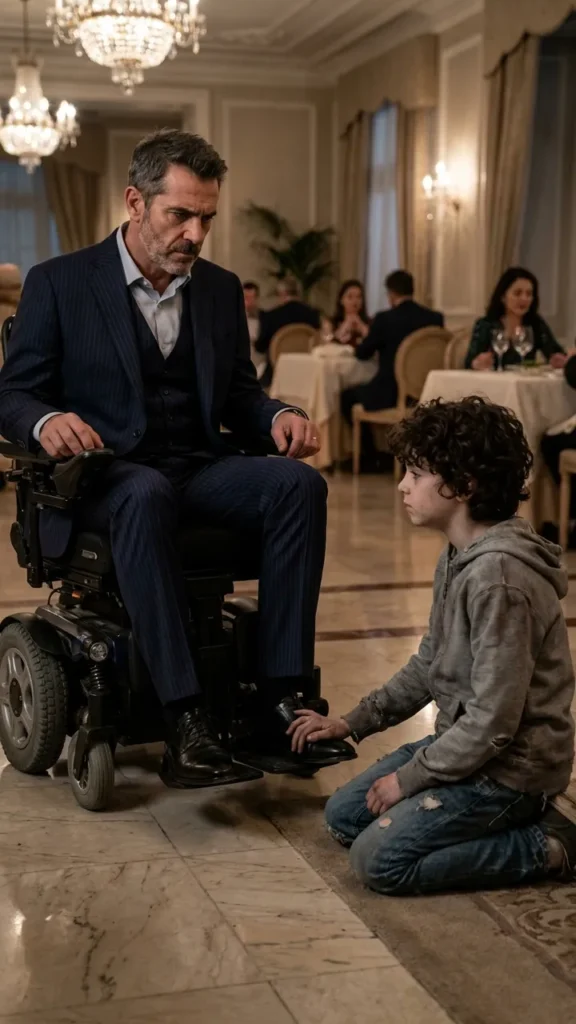
The polished marble floor of The Gilded Spoon restaurant reflected the opulent chandelier above.
Crystal prisms cast dancing rainbows across the room.
Amidst the murmur of polite conversation and the distant clinking of silverware, a scene unfolded that jarred the elegant atmosphere.
Arthur Sterling, confined to his custom-built wheelchair, surveyed the boy before him with an icy disdain that could freeze lava.
The boy, no older than ten, was a stark contrast to Arthur’s sharp, dark navy pinstripe suit and the restaurant’s inherent refinement.
His grey hooded sweatshirt was a tapestry of tears, revealing glimpses of pale skin beneath the ragged fabric.
His blue jeans were equally tattered, worn thin at the knees and cuffs.
He knelt, his small, grubby hand resting on Arthur’s gleaming black Italian leather dress shoe.
Arthur’s voice, deep and authoritative, cut through the ambient noise like a shard of glass. “What did you do?” His sharp, distinguished eyes, narrowed and hard, bore into the boy.
The question hung in the air, laced with an unspoken threat that made the nearby waiter freeze mid-pour.
The boy flinched, his slight build appearing even more vulnerable.
He didn’t pull his hand away.
He looked up at Arthur, his dark, curly hair falling across his forehead.
His young face, etched with a fear that seemed too profound for his years, was a mask of absolute fragility.
He opened his mouth, a hesitant, almost inaudible sound escaping his lips.
“Count,” he whispered, his voice barely a breath above the restaurant’s low hum.
He looked down at the shoe again, his small fingers brushing the polished leather as if memorizing its texture.
Arthur’s expression hardened further, a flicker of something dark and cold crossing his salt-and-pepper stubbled features.
He leaned forward, his gaze unwavering, his knuckles white where he gripped the arms of his wheelchair. “Count,” he repeated, his tone demanding, laced with impatience. “One.”
The boy’s large, expressive eyes widened slightly.
It wasn’t defiance, but a kind of desperate urgency.
He repeated the number, his voice gaining a fraction more strength. “One.” Then, he shifted his focus, his gaze flicking towards Arthur’s other, equally immaculate shoe.
His fingers, delicate and trembling, moved with a strange, deliberate purpose.
“Two,” he said, his voice now carrying a fragile, almost pleading note.
He touched the second shoe, a silent gesture that Arthur Sterling interpreted as a bold, unwelcome violation of his personal space and his very expensive property.
Arthur stared, his breath catching in his throat.
The boy’s actions, his seemingly innocent counting, the deliberate touch of his shoes… it all coalesced into a chilling, horrifying realization that sent a cold wave through his athletic frame.
The anger drained from his face, replaced by a look of profound, almost disbelieving shock.
His mouth fell open slightly, his eyes wide and unfocused for a split second.
“Your brother,” Arthur choked out, the words rough and gravelly, “begged for the same chance.”
The boy’s gaze remained fixed on Arthur, his large eyes now brimming with unshed tears that threatened to spill over.
The torn hoodie seemed to amplify his vulnerability, a visual testament to a hardship Arthur was only just beginning to comprehend.
The restaurant’s refined ambiance faded into insignificance, utterly overshadowed by the raw, exposed emotion in the boy’s gaze.
His brother, Arthur realized with a sickening lurch in his stomach, had also been offered a choice, a seemingly simple chance that carried a hidden, devastating weight.
The stark contrast between the boy’s worn clothing and Arthur’s impeccable suit, between the boy’s hesitant counting and Arthur’s cold, demanding question, spoke volumes of a world divided by privilege and sheer desperation.
The “chance” Arthur had offered, the one his brother had also begged for, was clearly not a gift, but a cruel, soul-crushing negotiation.
A discreet waiter, sensing the escalating tension and the unusual silence emanating from Arthur Sterling’s table, glided over.
He had the practiced neutrality of someone who had seen much but said little.
His expression was a polite inquiry, his hands clasped behind his back.
“Is everything to your satisfaction, sir?” the waiter asked softly, his voice barely audible, a thin thread of professionalism in the charged atmosphere.
Arthur Sterling waved a dismissive hand, his eyes never leaving Leo.
His sharp features were set in a grim mask. “Wait,” he commanded, his voice still carrying that dangerous, authoritative edge, though now tinged with a strange, unsettling calm.
The waiter nodded and retreated a step, maintaining a watchful distance.
Arthur Sterling leaned forward again, his gaze piercing.
The shock had receded, replaced by a chilling, almost predatory focus. “So, you were counting,” he stated, not as a question, but as a pronouncement. “Counting the buttons on my jacket?
The silverware?”
Leo shook his head, a tiny, almost imperceptible movement.
His lip quivered. “No, sir.”
Arthur Sterling’s eyes narrowed. “Then what, boy?
What exactly were you counting on my shoes that your brother also felt compelled to count?” His voice dropped, becoming a low, dangerous rumble.
He needed an explanation, not for Leo’s sake, but to fully grasp the extent of the entanglement.
Leo took a shaky breath.
The fear was still there, a palpable tremor, but something else was beginning to stir within him.
A quiet resolve. ” I was counting… the days.”
Arthur Sterling’s jaw tightened. “The days?
What days?”
Leo looked down at the worn soles of Arthur’s shoes.
His voice, though still quiet, was now steady. “The days until… until the rent was due.
The days until Mama’s medicine ran out.
The days until… until there was nothing left.” He looked up, his large eyes fixed on Arthur, a silent accusation in their depths.
The truth, delivered with such innocent, devastating clarity, hit Arthur Sterling like a physical blow.
He could feel a dryness in his throat.
The polished leather of his shoes suddenly felt tainted. “And your brother,” Arthur managed, his voice strained, “he counted those same days?”
Leo nodded. “He did.
He came here.
He saw you.” A single tear escaped and traced a path down Leo’s dusty cheek. “He was so hungry, sir.
He saw your shoes.
He said… he said they looked like they cost more than our whole apartment.”
Arthur Sterling closed his eyes for a brief moment.
The memory, suppressed for so long, surfaced with brutal force.
The boy, gaunt and desperate, standing by his table.
The offer he had made, phrased as a simple, charitable gesture.
A “chance” to earn a small sum.
He hadn’t considered the implications, the sheer humiliation it might entail for someone in such dire straits.
He had seen only an opportunity to feel magnanimous.
“He… he said you offered him a choice,” Leo continued, his voice trembling again. “A choice to… to prove he could be useful.
To pick something up.
Something you dropped.
For a few dollars.”
Arthur Sterling’s face was pale.
The restaurant patrons, once oblivious, were now casting furtive glances.
The hum of conversation had lowered to a murmur, a collective pause.
He hadn’t dropped anything.
The “task” was a pretense.
A humiliating game designed to assert dominance, to see how far desperation would drive a person.
And the boy’s brother, driven to the brink, had accepted.
“He said he couldn’t do it, sir,” Leo whispered, the last vestiges of his plea giving way to a quiet, profound sorrow. “He couldn’t… he couldn’t bring himself to beg like that.
Not for shoes.
He said it felt wrong.
So he just… he just left.” Leo’s small hand, still resting on the shoe, finally withdrew, leaving the polished leather bare and exposed.
The “chance” had been a cruel test, and Arthur Sterling had just been reminded of his own failure to see the humanity he was so casually crushing.
‘The hushed whispers among the other diners grew louder, a collective awareness dawning.
Heads turned.
Forkfuls of expensive food hovered mid-air.
The carefully constructed facade of The Gilded Spoon was crumbling, its polished surface marred by this raw, unfolding drama.
Arthur Sterling, his face now a mask of rigid control, felt the weight of every stare.
His athletic build, usually a testament to his power, now seemed to vibrate with suppressed fury.
His gaze, sharp and authoritative, locked onto Leo.
The boy, still small and vulnerable in his tattered hoodie, held Arthur captive.
The raw grief on Leo’s face, the quiet dignity in his sorrow, was an indictment.
Arthur could feel his carefully crafted reputation, built over decades of ruthless business dealings, beginning to fray at the edges.
He was no longer the untouchable titan of industry; he was a man exposed.
A young woman at a nearby table, her eyes wide and her phone held subtly, shifted in her seat.
Her thumb hovered over the record button.
Her name was Maya, and she was a budding investigative journalist, always searching for the real story beneath the gloss.
She had been nursing a lukewarm espresso, bored by the predictable opulence, until the sharp edge of Arthur’s voice had cut through the air.
Now, she was recording.
Arthur Sterling cleared his throat, the sound unnaturally loud in the suddenly quiet room.
His voice, when he spoke, was a low, controlled growl. “So, your brother… he couldn’t ‘bring himself’ to perform a simple task?” He sneered, the sophisticated mask slipping to reveal a hard, cynical edge. “He couldn’t stomach a few dollars for his mother’s medicine?
That sounds like ungratefulness, boy.
Not nobility.”
Leo’s eyes widened slightly, a flicker of something akin to indignation sparking within them.
He drew himself up, a tiny warrior facing a titan. “He wasn’t ungrateful, sir.
He was proud.
He said it was demeaning.
He said you were making him choose between his pride and his mother’s life.” Leo’s voice, though still a whisper, carried an unwavering truth that seemed to cut Arthur Sterling to the core.
He could feel a tremor in his hands, a physiological reaction he hadn’t experienced in years.
Arthur Sterling’s sharp features contorted, a flash of anger burning in his eyes.
He leaned forward, his voice dropping to a conspiratorial, threatening tone, audible only to Leo and the immediate vicinity. “This is a public restaurant, boy.
People here have reputations.
Your family… they have needs.
Perhaps you should consider what happens when you make accusations you cannot prove.
What happens when you embarrass people like me.” The unspoken threat hung heavy in the air, a chill that had nothing to do with the air conditioning.
He wanted to silence the boy, to bury this uncomfortable truth before it could spread.
Leo’s gaze didn’t waver.
The fear was still present, a constant companion, but the shame Arthur was trying to inflict seemed to bounce off him. “My brother didn’t lie, sir.
He told me what happened.
And I… I was counting the same things he did.
Because I needed the money too.
For Mama.” The raw honesty in Leo’s declaration was disarming.
The contrast between the boy’s worn clothing and Arthur’s bespoke suit, between the boy’s desperate plea and Arthur’s thinly veiled threats, was a chasm wider than any economic divide.
Maya, the journalist, captured it all, her face a study in focused intensity.
The narrative was taking shape, a potent exposé of wealth and desperation.
The waiter, sensing the volatile shift, edged back further, his professional demeanor strained.
He had witnessed enough to know this was more than a simple customer complaint.
He saw Arthur Sterling’s face, a mask of carefully controlled rage, and Leo’s quiet, heartbroken defiance.
The other diners, no longer able to pretend ignorance, were openly staring.
The symphony of clinking cutlery had been replaced by a deafening silence, punctuated only by Leo’s soft, heartbroken words.
Arthur Sterling’s voice, when he spoke again, was no longer a growl.
It was a cold, sharp pronouncement, designed to dismiss and belittle. “This is absurd.
Your brother was offered a chance to earn money, and he refused.
That is his choice.
This entire story is fabricated.
A child’s overactive imagination fuelled by hardship.” He deliberately turned his gaze to the surrounding tables, as if seeking validation, his authoritative tone attempting to reassert control. “I am a philanthropist.
I help those in need.
This… this is a misunderstanding.”
Leo’s lower lip trembled, but his eyes remained fixed on Arthur.
He shook his head slowly, a silent refutation of Arthur’s fabricated narrative. “No, sir.
It wasn’t a misunderstanding.
He said you looked at him like… like he was dirt.
He said the ‘chance’ you gave him felt more like a humiliation.
He said he couldn’t take it.
He wouldn’t take it.” Leo’s small hand, which had been resting on his tattered jeans, clenched into a fist.
A flicker of rebellion ignited within him, fueled by the injustice of Arthur’s denial. “He told me exactly what he saw.
And what he heard.”
Maya, the journalist, subtly adjusted her phone, ensuring the audio was clear.
She could hear the tremor in Leo’s voice, the raw emotion.
She saw the subtle twitch in Arthur Sterling’s jaw, the clench of his fists.
This was it.
The story that could change everything.
It wasn’t just about a spoiled child’s imagination.
It was about power, poverty, and the cruel games the wealthy sometimes played with the desperate.
The raw footage, the undeniable sound of Leo’s testimony, contrasted with Arthur’s dismissive tone, would be explosive.
Arthur Sterling’s sharp eyes narrowed, a predatory gleam returning.
He could feel the narrative slipping away.
The hushed whispers were turning into distinct murmurs. “You are mistaken, boy,” he stated, his voice hardening into steel. “Your brother was offered kindness.
He rejected it.
End of story.
Now, if you will excuse me…” He made a subtle gesture to the waiter, a clear signal to escort Leo away, to remove this inconvenient disruption.
But Leo didn’t move.
He stood his ground, his small frame radiating a quiet strength. “He was counting the buttons on your suit jacket too, sir,” Leo said, his voice now clear and steady, an unexpected courage blooming in its tone. “He told me.
He said you had so many.
He said he didn’t have a single clean button on his shirt.” He looked directly at Arthur Sterling, his large eyes no longer just sad, but filled with a newfound, unwavering resolve. “He said it was like you had a hundred chances.
And he had none.” The seed of virality had been planted, watered by truth and desperation, ready to sprout into a storm.
Maya’s phone continued to record, a silent witness to the unravelling of Arthur Sterling’s carefully constructed world.
CHAPTER 2: The Truth Unravels and the Spectacle Grows
‘The waiter, eyes wide with a mixture of concern and professional detachment, hovered uncertainly.
He’d seen enough to recognize a brewing storm, a social eruption far beyond the usual dining squabbles.
Arthur Sterling’s face, a mask of rigid control, was beginning to crack.
Leo’s small figure, radiating a quiet, heartbreaking defiance, was the eye of that storm.
The ambient clatter of the restaurant had evaporated, replaced by a suffocating silence, broken only by the boy’s resolute words.
Arthur Sterling’s voice, when he spoke again, was a carefully sculpted weapon.
It dripped with feigned magnanimity, a stark contrast to the venom lurking beneath. “This is quite a fabrication, young man.
Your brother was presented with an opportunity, a chance to earn money.
He declined.
That was his prerogative.
This entire narrative is, I suspect, a product of your vivid imagination, perhaps influenced by unfortunate circumstances.” He deliberately swept his gaze across the surrounding tables, a silent plea for their complicity, his tone projecting an air of wounded innocence. “I am, as many here know, a dedicated philanthropist.
I assist those genuinely in need.
This… this is a gross misinterpretation.”
Leo’s lower lip quivered, a tiny tremor of protest against the blatant falsehood.
His eyes, however, remained locked on Arthur, unwavering.
He shook his head, a slow, deliberate movement that was a more potent refutation than any shouted word. “No, sir.
It wasn’t a misinterpretation.
My brother… he told me what you said.
He said you looked at him like he was… like he was something you scraped off your shoe.
He said the ‘chance’ felt more like a punishment.
He said he couldn’t.
He wouldn’t.” Leo’s small hand, previously resting limply on his ripped jeans, clenched into a tight fist.
A spark of defiance, hot and fierce, ignited within him.
Arthur’s denial, his attempt to paint his brother as a failure, was a betrayal that ignited his own courage. “He told me the truth.
Exactly what he saw.
And what he heard from you.”
Maya, the journalist, subtly shifted her phone, her thumb brushing against the screen to ensure the audio capture remained optimal.
She could hear the raw, unvarnished emotion in Leo’s voice, the tremor that spoke of deep pain.
Across from her, Arthur Sterling’s sharp features tightened.
A subtle twitch in his jaw, the almost imperceptible clench of his hands beneath the table – these were the tells of a man cornered.
This wasn’t just a child’s overactive imagination; this was a stark, undeniable testament to the cruel games played by the privileged with the desperate.
The contrast between Leo’s earnest testimony and Arthur’s dismissive pronouncements was a narrative goldmine.
The footage, the undeniable sound of Leo’s unwavering truth, would be explosive.
Arthur Sterling’s sharp, intelligent eyes narrowed, a predatory gleam resurfacing.
He felt the narrative, the one he so meticulously controlled, begin to slip through his fingers.
The polite murmurs of the other diners were coalescing into a palpable wave of judgment. “You are mistaken, boy,” he stated, his voice hardening into something cold and unyielding, like polished steel. “Your brother was offered a gesture of kindness.
He chose to reject it.
That is the end of the matter.
Now, if you would be so good as to…” He made a subtle, almost imperceptible gesture towards the waiter, a silent command to remove the inconvenient, truth-telling child.
He wanted Leo gone, vanished, before this uncomfortable truth could fester and spread.
But Leo did not yield.
He stood his ground, his small frame exuding a quiet, potent strength that belied his age and his tattered clothing. “He was counting the buttons on your suit jacket, too, sir,” Leo said, his voice now clear and steady, a surprising wave of courage blooming within it. “He told me.
He said you had so many buttons.
He said he didn’t have a single clean button on his own shirt.” He looked directly into Arthur Sterling’s eyes, his large, expressive eyes no longer just reflecting sadness, but a newfound, unwavering resolve. “He said it was like you had a hundred chances.
And he had none.” The seed of viral outrage had been definitively planted, watered by Leo’s raw truth and desperate circumstances, ready to erupt.
Maya’s phone, a silent, digital witness, continued to record the slow, agonizing unravelling of Arthur Sterling’s meticulously constructed world.
The waiter, sensing the volatile shift in the room’s atmosphere, retreated further, his professional facade strained to its limit.
He had seen enough to recognize the brewing tempest, a social scandal unfolding in real-time.
Arthur Sterling’s face, a carefully constructed mask of control, was beginning to splinter under the pressure.
Leo’s small figure, radiating a quiet, heartbreaking defiance, stood as an immovable object against Arthur’s crumbling facade.
The polite, almost sterile hum of the restaurant had completely dissipated, replaced by a palpable, suffocating silence, broken only by the boy’s unwavering pronouncements.
Arthur Sterling’s voice, when he spoke again, was a precisely aimed dart, designed to wound and dismiss.
It dripped with a calculated disdain, a stark contrast to the genuine hurt Leo was expressing. “This is frankly preposterous.
Your brother was offered a legitimate opportunity to earn.
He declined.
That is his choice.
This entire scenario is clearly a flight of fancy, a child’s overactive imagination, perhaps amplified by difficult circumstances.” He deliberately angled his body towards the surrounding tables, his eyes seeking silent validation, his authoritative tone attempting to reclaim his lost command. “I am a well-known philanthropist.
I assist those in genuine need.
This… this is a significant misunderstanding.”
Leo’s lower lip trembled, a silent testament to the emotional strain, but his gaze remained locked on Arthur, resolute.
He shook his head, a slow, deliberate motion that carried more weight than any protest. “No, sir.
It wasn’t a misunderstanding.
My brother… he told me exactly what you said.
He said you looked at him like he was… like he was dirt.
Like he was something to be stepped on.
He said the ‘chance’ you offered him felt more like a humiliation.
He said he couldn’t take it.
He wouldn’t.” Leo’s small hand, which had been resting listlessly on his tattered jeans, clenched into a tight fist.
A fierce spark of defiance, hot and undeniable, ignited within him.
Arthur’s denial, his insidious attempt to frame his brother as a proud failure, was a betrayal that fueled Leo’s own courage. “He told me the truth, sir.
Exactly what happened.
And what you said.”
Maya, the journalist, subtly adjusted her phone, her fingers expertly guiding it to capture the crucial audio.
She could hear the raw, unvarnished emotion in Leo’s voice, the tremor that spoke of deep, personal pain.
Across from her, Arthur Sterling’s sharp features contorted further.
A subtle, involuntary twitch in his jaw, the almost imperceptible clench of his hands hidden beneath the table – these were the tell-tale signs of a man trapped, his carefully constructed persona collapsing.
This was no mere child’s invention; this was an undeniable, damning testament to the casual cruelties inflicted by the powerful upon the vulnerable.
The stark contrast between Leo’s earnest testimony and Arthur’s dismissive pronouncements was a narrative chasm that would resonate.
The raw footage, the undeniable sound of Leo’s unwavering truth, would be explosive.
Arthur Sterling’s sharp, intelligent eyes narrowed, a predatory gleam resurfacing with renewed intensity.
He felt the narrative, the carefully curated story he had controlled for so long, beginning to slip irrevocably from his grasp.
The polite murmurs of the other diners were no longer just curious whispers; they were coalescing into a palpable wave of judgment and condemnation. “You are mistaken, boy,” he stated, his voice hardening into something cold and unyielding, like polished steel. “Your brother was offered a gesture of kindness, an opportunity.
He chose to reject it.
That, young man, is the end of the matter.
Now, if you would be so good as to…” He made a subtle, almost imperceptible gesture towards the waiter, a silent, urgent command to remove the inconvenient, truth-telling child.
He wanted Leo gone, vanished, before this uncomfortable truth could fester and spread, before it could truly tarnish his reputation.
But Leo did not yield.
He stood his ground, his small frame radiating a quiet, potent strength that belied his age and his tattered clothing. “He was counting the buttons on your suit jacket, too, sir,” Leo said, his voice now clear and steady, a surprising wave of courage blooming within its tone. “He told me.
He said you had so many buttons.
He said he didn’t have a single clean button on his own shirt.” He looked directly into Arthur Sterling’s eyes, his large, expressive eyes no longer just reflecting sadness, but a newfound, unwavering resolve that burned with quiet fury. “He said it was like you had a hundred chances.
And he had none.” The seed of viral outrage had been definitively planted, watered by Leo’s raw truth and desperate circumstances, ready to erupt into a scandal that would consume Arthur Sterling.
Maya’s phone, a silent, digital witness, continued to record the slow, agonizing unravelling of Arthur Sterling’s meticulously constructed world, capturing every damning detail.
‘The waiter, a ghost in the periphery, finally took a hesitant step forward.
His eyes, trained to observe but not interfere, widened as Arthur Sterling’s carefully constructed composure began to fracture.
Leo, a small island of unwavering truth in a sea of wealth and denial, remained a beacon of quiet defiance.
The sophisticated murmur of the restaurant had long since dissolved, replaced by a charged silence that amplified every word, every tremor.
Arthur Sterling’s voice, a silken threat veiled in faux concern, sliced through the tension. “You are mistaken, boy.” He emphasized each word with deliberate slowness. “Your brother was offered a legitimate opportunity to earn.
He declined.
That is his choice.” His gaze swept over the nearby tables, a silent plea for them to witness his attempted magnanimity. “This entire scenario is clearly a flight of fancy, a child’s overactive imagination, perhaps amplified by difficult circumstances.” He paused, allowing his reputation as a philanthropist to hang in the air. “I assist those in genuine need.
This… this is a significant misunderstanding.”
Leo’s lower lip quivered, a flicker of the overwhelming pressure he was under.
But his eyes, large and bright with unshed tears, remained fixed on Arthur.
He shook his head, a slow, decisive movement. “No, sir.
It wasn’t a misunderstanding.” His voice, though quiet, carried a new weight. “My brother… he told me exactly what you said.
He said you looked at him like he was… like he was dirt.” Leo’s small hands, previously limp at his sides, clenched into tight fists.
A fierce spark ignited within him, fueled by Arthur’s blatant denial. “He said the ‘chance’ you offered him felt more like a humiliation.
He said he couldn’t take it.
He wouldn’t.” Leo’s chest heaved, a silent testament to his struggle. “He told me the truth, sir.
Exactly what happened.
And what you said.”
Maya, the journalist, subtly adjusted her phone, her thumb hovering over the record button.
The raw, unvarnished emotion in Leo’s voice was palpable.
Arthur Sterling’s sharp features tightened.
A subtle twitch in his jaw, the almost imperceptible clench of his hands beneath the table – these were the tell-tale signs of a man cornered.
This was no fabrication; this was a damning testament to the casual cruelties of the privileged.
The contrast between Leo’s earnest testimony and Arthur’s dismissive pronouncements was a chasm that would resonate.
Arthur Sterling’s eyes narrowed, a predatory gleam resurfacing.
He felt the narrative, the one he had so meticulously controlled, slipping away.
The polite murmurs of the diners were now a palpable wave of judgment. “You are mistaken, boy,” he stated, his voice hardening like polished steel. “Your brother was offered a gesture of kindness, an opportunity.
He chose to reject it.” He made a subtle gesture towards the waiter, a silent command to remove the inconvenient child.
He wanted Leo gone, vanished, before this truth could spread.
But Leo did not yield.
He stood his ground, his small frame radiating a quiet, potent strength. “He was counting the buttons on your suit jacket, too, sir,” Leo said, his voice clear and steady. “He told me.
He said you had so many buttons.
He said he didn’t have a single clean button on his own shirt.” He looked directly into Arthur Sterling’s eyes, his resolve burning. “He said it was like you had a hundred chances.
And he had none.” The seed of viral outrage was definitively planted.
Maya’s phone, a silent witness, continued to record.
The waiter, a professional to the core, maintained a careful distance, his expression a study in contained concern.
He’d witnessed enough to know this was no mere spat.
Arthur Sterling’s meticulously crafted facade was showing visible cracks, stressed by the unyielding truth of a small boy in tattered clothes.
The ambient sophistication of the restaurant had evaporated, replaced by a heavy, expectant silence.
Arthur Sterling’s voice dripped with a calculated disdain, aimed at shattering Leo’s fragile courage. “This is frankly preposterous.
Your brother was offered a legitimate opportunity to earn.” He emphasized the word “legitimate,” as if Leo’s interpretation was inherently flawed. “He declined.
That is his choice.” His gaze deliberately swept across the surrounding tables, an unspoken appeal for their understanding. “This entire scenario is clearly a flight of fancy, a child’s overactive imagination, perhaps amplified by difficult circumstances.” He paused, letting his reputation as a philanthropist speak for itself. “I assist those in genuine need.
This… this is a significant misunderstanding.”
Leo’s lower lip trembled, but his eyes remained locked on Arthur, unwavering.
He shook his head slowly. “No, sir.
It wasn’t a misunderstanding.” His voice, though quiet, resonated with a newfound power. “My brother… he told me exactly what you said.
He said you looked at him like he was… like he was dirt.” Leo’s small hands, which had been hanging limply, clenched into tight fists.
Arthur’s denial was a betrayal that ignited Leo’s own courage. “He said the ‘chance’ you offered him felt more like a humiliation.
He said he couldn’t take it.
He wouldn’t.” Leo’s small chest heaved, a silent testament to the emotional toll. “He told me the truth, sir.
Exactly what happened.
And what you said.”
Maya, her journalist’s instinct kicking into overdrive, subtly shifted her phone, ensuring the audio capture remained crystal clear.
The raw emotion in Leo’s voice was undeniable, a tremor that spoke of deep, personal pain.
Across the table, Arthur Sterling’s sharp features contorted.
A subtle twitch in his jaw, the almost imperceptible clench of his hands beneath the table – these were the tell-tale signs of a man trapped, his carefully constructed persona collapsing.
This was no mere child’s invention; it was an undeniable testament to the casual cruelties inflicted by the powerful upon the vulnerable.
The stark contrast between Leo’s earnest testimony and Arthur’s dismissive pronouncements was a narrative goldmine.
Arthur Sterling’s eyes narrowed, a predatory gleam returning.
He felt the narrative, the one he had controlled for so long, slipping irrevocably from his grasp.
The polite murmurs of the diners were coalescing into a palpable wave of judgment. “You are mistaken, boy,” he stated, his voice hardening like polished steel. “Your brother was offered a gesture of kindness, an opportunity.” He made a subtle, almost imperceptible gesture towards the waiter, a silent command to remove the inconvenient, truth-telling child.
He wanted Leo gone, vanished, before this uncomfortable truth could fester and spread.
But Leo did not yield.
He stood his ground, his small frame radiating a quiet, potent strength. “He was counting the buttons on your suit jacket, too, sir,” Leo said, his voice clear and steady, a surprising wave of courage blooming within it. “He told me.
He said you had so many buttons.
He said he didn’t have a single clean button on his own shirt.” He looked directly into Arthur Sterling’s eyes, his large, expressive eyes no longer just reflecting sadness, but a newfound, unwavering resolve. “He said it was like you had a hundred chances.
And he had none.” The seed of viral outrage had been definitively planted.
Maya’s phone, a silent, digital witness, continued to record.
CHAPTER 3: The Subtle Threat and the Unseen Witness
‘The waiter, a seasoned professional, maintained a practiced neutrality.
He had seen many scenes play out in this opulent dining room, but the charged silence now was different.
Arthur Sterling’s composure, once an impenetrable shield, was now visibly fractured, admitting the harsh light of Leo’s truth.
The background hum of contented diners had faded, replaced by an anticipatory hush, the air thick with unspoken judgment.
Arthur Sterling’s voice, a viper’s hiss wrapped in silk, lashed out. “This is frankly preposterous.
Your brother was offered a legitimate opportunity to earn.” The word “legitimate” was spat out like a venomous accusation, as if Leo’s perception was inherently flawed. “He declined.
That is his choice.” His eyes, cold and calculating, swept across the surrounding tables, a silent broadcast of his supposed benevolence. “This entire scenario is clearly a flight of fancy, a child’s overactive imagination, perhaps amplified by difficult circumstances.” He let his reputation as a significant philanthropist hang in the air, a shield against the rising tide of disapproval. “I assist those in genuine need.
This… this is a significant misunderstanding.”
Leo’s lower lip quivered, a visible tremor of the immense pressure he was under.
Yet, his gaze remained locked onto Arthur, a small, unwavering lighthouse in a storm.
He shook his head, a slow, deliberate movement. “No, sir.
It wasn’t a misunderstanding.” His voice, though quiet, now carried the undeniable weight of conviction. “My brother… he told me exactly what you said.
He said you looked at him like he was… like he was dirt.” Leo’s small hands, which had been hanging limply at his sides, now clenched into tight, determined fists.
Arthur’s outright denial was a fresh wound, a betrayal that ignited Leo’s own burgeoning courage. “He said the ‘chance’ you offered him felt more like a humiliation.
He said he couldn’t take it.
He wouldn’t.” Leo’s small chest heaved, a silent testament to the emotional battle raging within him. “He told me the truth, sir.
Exactly what happened.
And what you said.”
Maya, the journalist, subtly adjusted her phone.
Her journalist’s instinct, honed by years of chasing stories, was now fully engaged.
She ensured the audio capture remained crystal clear, capturing every nuance of emotion.
The raw, unvarnished pain in Leo’s voice was a seismic event, a tremor that spoke of deep, personal hurt.
Across the table, Arthur Sterling’s sharp features twisted.
A subtle tic began in his jaw, the almost imperceptible clenching of his hands beneath the tablecloth betraying the immense struggle he faced.
These were the unmistakable signs of a man cornered, his carefully constructed persona collapsing under the weight of truth.
This was no child’s invention; it was an undeniable, damning testament to the casual cruelties inflicted by the privileged upon the vulnerable.
The stark, unforgiving contrast between Leo’s earnest testimony and Arthur’s dismissive pronouncements was a narrative chasm that would echo far beyond this room.
Arthur Sterling’s eyes narrowed, a predatory gleam resurfacing.
He felt the narrative, the one he had so meticulously controlled for years, slipping irrevocably from his grasp.
The polite murmurs of the diners were no longer just background noise; they were coalescing into a palpable wave of judgment, an invisible force pressing in on him. “You are mistaken, boy,” he stated, his voice hardening into something like polished steel. “Your brother was offered a gesture of kindness, an opportunity.” He made a subtle, almost imperceptible gesture towards the waiter, a silent, urgent command to remove the inconvenient, truth-telling child.
He wanted Leo gone, vanished, before this uncomfortable truth could fester and spread, poisoning his carefully cultivated image.
But Leo did not yield.
He stood his ground, his small frame radiating a quiet, potent strength that belied his physical vulnerability. “He was counting the buttons on your suit jacket, too, sir,” Leo said, his voice clear and steady, a surprising wave of courage blooming within it, pushing back against the fear. “He told me.
He said you had so many buttons.
He said he didn’t have a single clean button on his own shirt.” He looked directly into Arthur Sterling’s eyes, his large, expressive eyes no longer just reflecting sadness, but a newfound, unwavering resolve. “He said it was like you had a hundred chances.
And he had none.” The seed of viral outrage, potent and unstoppable, had been definitively planted.
Maya’s phone, a silent, digital witness, continued its relentless recording.
The waiter, his professional demeanor a thin veneer over his growing unease, edged closer.
He had seen Arthur Sterling conduct business, negotiate deals, and command respect.
But the current spectacle, the raw confrontation between the wealthy titan and the impoverished child, was something new.
Arthur’s carefully constructed public image was fraying at the edges, and the stark reality of Leo’s words was beginning to seep into the hushed conversations of the other diners.
Their initial curiosity had curdled into something more potent: shock, and a dawning sense of indignation.
Arthur Sterling’s voice, now laced with a dangerous edge, attempted to regain control. “This is frankly preposterous.
Your brother was offered a legitimate opportunity to earn.” The word “legitimate” was repeated, an anchor he desperately clung to, a desperate attempt to reframe the situation in his favor. “He declined.
That is his choice.” His gaze deliberately swept across the surrounding tables, a silent plea for them to witness his magnanimity, to see him as the victim of a misunderstanding, not a perpetrator of casual cruelty. “This entire scenario is clearly a flight of fancy, a child’s overactive imagination, perhaps amplified by difficult circumstances.” He paused, allowing his reputation as a philanthropist to hang in the air like a protective shroud. “I assist those in genuine need.
This… this is a significant misunderstanding.”
Leo’s lower lip trembled, a fleeting sign of the overwhelming pressure he was under.
But his eyes remained locked on Arthur, an unwavering blue gaze that pierced through the bluster.
He shook his head slowly, a decisive movement that severed any connection to Arthur’s fabricated reality. “No, sir.
It wasn’t a misunderstanding.” His voice, though quiet, now resonated with a powerful, unshakeable conviction. “My brother… he told me exactly what you said.
He said you looked at him like he was… like he was dirt.” Leo’s small hands, which had been hanging limply, now clenched into tight, defiant fists.
Arthur’s denial was a fresh wound, a betrayal that fanned the flames of Leo’s own courage. “He said the ‘chance’ you offered him felt more like a humiliation.
He said he couldn’t take it.
He wouldn’t.” Leo’s small chest heaved, a silent testament to the emotional toll of bearing witness to his brother’s pain. “He told me the truth, sir.
Exactly what happened.
And what you said.”
Maya, her journalistic instincts fully activated, subtly adjusted her phone, ensuring the audio capture remained pristine.
The raw emotion in Leo’s voice was undeniable, a seismic tremor that spoke of deep, personal suffering.
Across the table, Arthur Sterling’s sharp features contorted.
A subtle tic began in his jaw, the almost imperceptible clenching of his hands beneath the tablecloth betraying the immense struggle he faced.
These were the unmistakable signs of a man cornered, his carefully constructed persona collapsing under the weight of truth.
This was no child’s invention; it was an undeniable, damning testament to the casual cruelties inflicted by the privileged upon the vulnerable.
The stark, unforgiving contrast between Leo’s earnest testimony and Arthur’s dismissive pronouncements was a narrative chasm that would echo far beyond this room.
Arthur Sterling’s eyes narrowed, a predatory gleam resurfacing.
He felt the narrative, the one he had so meticulously controlled for years, slipping irrevocably from his grasp.
The polite murmurs of the diners were no longer just background noise; they were coalescing into a palpable wave of judgment, an invisible force pressing in on him. “You are mistaken, boy,” he stated, his voice hardening into something like polished steel. “Your brother was offered a gesture of kindness, an opportunity.” He made a subtle, almost imperceptible gesture towards the waiter, a silent, urgent command to remove the inconvenient, truth-telling child.
He wanted Leo gone, vanished, before this uncomfortable truth could fester and spread, poisoning his carefully cultivated image.
But Leo did not yield.
He stood his ground, his small frame radiating a quiet, potent strength that belied his physical vulnerability. “He was counting the buttons on your suit jacket, too, sir,” Leo said, his voice clear and steady, a surprising wave of courage blooming within it, pushing back against the fear. “He told me.
He said you had so many buttons.
He said he didn’t have a single clean button on his own shirt.” He looked directly into Arthur Sterling’s eyes, his large, expressive eyes no longer just reflecting sadness, but a newfound, unwavering resolve. “He said it was like you had a hundred chances.
And he had none.” The seed of viral outrage, potent and unstoppable, had been definitively planted.
Maya’s phone, a silent, digital witness, continued its relentless recording.
The waiter, sensing the shift, discreetly retreated to the periphery, his role now that of a silent observer to the unfolding drama.
The other diners watched, their faces a tableau of shocked realization.
Arthur Sterling, for the first time in a long time, was not in control.
‘Arthur Sterling’s face contorted.
His carefully cultivated mask of benevolent philanthropy was crumbling, exposing the raw, unyielding anger beneath.
He felt the eyes of every diner on him, a thousand silent judgments piercing his armor.
He saw Maya, the journalist, her phone still angled subtly, capturing every micro-expression, every tremor of his voice.
This was not just a social faux pas; this was a potential public relations nightmare.
He needed to shut this down, quickly and decisively.
“You are mistaken, boy,” Arthur repeated, his voice a low growl, each word precisely enunciated.
The condescension was palpable, a deliberate attempt to belittle Leo’s experience. “Your brother was offered a gesture of kindness, an opportunity.
A chance to earn his keep, to contribute.” He shot a piercing look at the waiter, a silent command to intervene, to escort the disruptive child away. “This… this is a baseless accusation.
My brother,” he corrected himself, the slip of the tongue a jarring admission, “your brother was simply ungrateful.
He couldn’t see the value.” He leaned forward, his tone dropping to a conspiratorial whisper, meant to be heard by Maya and the surrounding tables. “He chose to be… difficult.
A common trait among those who expect handouts without effort.”
Leo’s small fists remained clenched.
The word “ungrateful” stung, a cruel misrepresentation of his brother’s desperation.
He looked at Arthur, his eyes now holding a spark of defiance, a tiny ember ignited by the injustice of it all. “He wasn’t ungrateful, sir,” Leo said, his voice gaining a surprising strength that cut through the strained silence. “He was scared.
And he was ashamed.” He took a small step forward, his torn hoodie fluttering around him. “He told me… he told me you made him count the stars on your tie.
You said if he could count them all, you’d give him something.
He counted thirteen.
You laughed.
And then you said he had to count the cufflinks on your shirt.
You said you had twenty.
He could only see eighteen.
You said he failed.”
A ripple of shock went through the diners.
The image of a wealthy man making a desperate child count non-existent stars and shirt buttons for a meager reward was utterly damning.
Arthur’s jaw tightened.
He felt a flush creep up his neck.
The “deal” was supposed to be a subtle test, a humiliation disguised as an opportunity, meant to break the spirit of those who dared to approach him for help.
His brother’s inability to perform the impossible task was meant to be a clear message: Leo’s family was not worthy of his “generosity.”
“That is an absolute fabrication!” Arthur boomed, his voice cracking with suppressed rage.
He gripped the armrests of his wheelchair, his knuckles white. “I do not engage in such absurdities.
Your brother was presented with a task, a simple one, to gauge his willingness to work.
He failed to complete it.
That is the extent of it.” He turned his gaze, a cold, hard stare, towards Maya. “I believe this conversation has reached its natural conclusion.
This is a private matter, and I will not tolerate further… disruption.” He gestured imperiously towards the waiter. “Escort this child out.
Immediately.”
Leo flinched at the harsh command, but he did not back down.
He looked at Arthur, his eyes brimming with unshed tears, not of fear, but of a profound, heartbreaking sorrow. “He told me the buttons on your coat, too, sir,” Leo whispered, his voice catching. “He said there were twelve.
And then he said you told him to count the diamonds on the rings you wear.
He couldn’t see any.
He just saw your hands.
And then you told him… you told him he could have a chance to shine his shoes.
That was the ‘chance,’ wasn’t it?”
The waiter, caught between Arthur’s enraged command and Leo’s unflinching truth, hesitated.
He had seen opulent displays of wealth and power before, but never such a stark, brutal confrontation between privilege and desperation.
The other diners were no longer murmuring; they were silent, their faces etched with a mixture of shock and dawning horror.
Maya’s phone, a silent sentinel, continued to record, the tiny red light a beacon of impending exposure.
The air in the restaurant crackled with an unspoken tension, the prelude to a storm.
Arthur Sterling’s eyes, usually sharp and commanding, now held a flicker of panic.
He saw the narrative he had so carefully constructed over decades unraveling before his very eyes.
The “gesture of kindness” was being exposed for what it truly was: a cruel, demeaning game played with the lives of the vulnerable.
His carefully honed reputation, built on a foundation of philanthropy and public service, was now being chipped away by the honest words of a child.
He knew, with sickening certainty, that this moment, this raw, unfiltered exchange, was destined to go viral.
“This is outrageous!” Arthur bellowed, his voice now hoarse with fury.
He pushed himself back in his wheelchair, a physical manifestation of his desperate attempt to distance himself from Leo’s accusations. “My brother… your brother was offered a chance to earn a respectable wage!
He chose to be lazy, to invent stories.
This is slander!” He glared at Maya, his gaze burning. “You will not publish this.
This is a defamation of character.” He then turned his venomous attention back to Leo. “You are lying.
You are trying to extort me.
I will have you and your family removed from this city if you do not cease this charade!”
Leo’s small body trembled, not from fear, but from the sheer weight of the truth he carried.
He looked at Arthur Sterling, his eyes no longer just sad, but filled with a quiet, resolute anger. “My brother didn’t lie,” Leo stated, his voice clear and unwavering, cutting through Arthur’s bluster like a sharpened knife. “He told me everything.
He said you looked at him like he was a bug.
He said you smiled when he couldn’t answer your questions.
He said you told him his mother was a burden, and that if he wanted her to get better, he should have been born rich.” Leo’s voice cracked, tears finally spilling down his cheeks, but he continued, his gaze locked on Arthur. “He said the ‘chance’ was for him to shine your shoes for a week, and then maybe you’d think about giving him a dollar.
He said he’d rather starve than let you treat him like that.”
A collective gasp went through the restaurant.
The waiter stepped back, his face pale.
Arthur Sterling’s face was a mask of impotent rage.
He was trapped.
The carefully constructed facade of benevolence had been shattered, revealing the cruel, entitled man beneath.
He could threaten, he could deny, but the raw truth spoken by Leo, captured by Maya’s phone, would now speak for itself.
The seeds of viral outrage had been sown, and they were already beginning to sprout, promising a swift and devastating harvest for Arthur Sterling.
The hushed whispers of the diners had turned into an audible murmur of disbelief and condemnation, the quiet shock of moments ago transforming into a chorus of outrage.
Maya, her face grim, continued to record, knowing that this moment would change everything.
CHAPTER 4: The Unraveling of Arthur Sterling
‘The waiter stood frozen, a silent witness to the unfolding disaster.
The opulent dining room, once a sanctuary of hushed elegance, had become a tribunal.
The murmurs of the other diners, previously a low hum of curiosity, now swelled into a tide of open disapproval.
Arthur Sterling, his face contorted with a mixture of fury and dawning panic, gripped the armrests of his wheelchair until his knuckles turned white.
He had underestimated the boy.
He had underestimated the raw, unvarnished truth.
“Slander!” Arthur’s voice boomed, a desperate, hollow sound.
He glared at Maya, the journalist, her phone a silent, accusatory eye. “This is defamation.
I will sue you.
I will ensure your career ends before it even begins!” He spat the words, his gaze darting to Leo, then back to the wider room.
He saw the faces.
The judgment was palpable.
He had been so careful, so meticulous in crafting his image.
One child, one moment of raw honesty, and it was all turning to ash.
Leo’s small frame trembled, but his eyes remained locked on Arthur.
The tears had stopped, replaced by a steely resolve. “He said you looked down on him,” Leo repeated, his voice clear and steady, cutting through Arthur’s bluster. “He said you asked him if he thought shining shoes was beneath him.
He said he told you he’d do anything for his mother.
And you just… you just laughed.
He said you told him to count the stitches on your gloves.
He said you told him there were exactly fifty.
He could only find forty-eight.” Leo’s voice hitched, a raw edge to it. “He said you told him he was too stupid to earn a living.
He said you told him he should go back to begging.”
A collective intake of breath swept through the diners.
The cruelty of the alleged exchange was staggering.
Arthur Sterling, the celebrated philanthropist, the man who championed the less fortunate, was being painted as a capricious tormentor, deriving pleasure from the humiliation of a desperate boy.
The contrast between his immaculate suit and the boy’s tattered clothes was no longer just a visual disparity; it was a chasm of morality.
Arthur tried to regain control, his voice a strained roar. “These are lies!
Fabrications!
My brother, your brother, was offered a job!
A fair wage!
He chose not to take it!
He was lazy!
He was ungrateful!
He expected handouts!” He gestured wildly, his hands shaking. “This is a smear campaign!
I will not stand for this!” He looked towards the waiter, a desperate plea for intervention in his eyes. “Get him out of here!
Now!”
The waiter, however, remained rooted, his own expression a mixture of apprehension and dawning realization.
He had seen wealthy patrons behave badly, but this was different.
This was a man unraveling, his mask of civility completely gone.
He glanced at Maya, who continued to record, her expression grim.
The story was already writing itself.
Leo took another small step forward. “He said the last thing you said was that he could shine your shoes for free, and maybe then he’d be worth something to you,” Leo whispered, his voice thick with emotion. “He said he told you he’d rather die than let you spit on him and call it rain.
He said he just wanted to count.
He wanted to count something fair.
He said you didn’t even let him count the buttons on his own coat.” The boy’s shoulders sagged, the weight of his brother’s pain and his own helplessness crushing him.
The opulent setting felt like a mockery.
The silence that followed Leo’s words was heavier than any noise.
It was the silence of realization, of revulsion.
The diners, once observers, now felt complicit in their inaction.
Arthur Sterling, his face a mask of impotent rage, was trapped.
He could shout, he could threaten, but the narrative had shifted irrevocably.
Maya’s phone, a silent witness, had captured the unvarnished truth, a truth that was about to explode across the digital landscape.
The carefully constructed edifice of Arthur Sterling’s reputation was crumbling, brick by agonizing brick.
Arthur’s breath hitched.
He could feel the heat rising in his cheeks, the icy grip of panic tightening around his chest.
He had always believed he was untouchable, his wealth and influence a shield against scrutiny.
But this… this was different.
This was the raw, visceral reaction of humanity to perceived cruelty.
He saw the faces of the other diners, their expressions ranging from shock to outright disgust.
Some were subtly moving their phones, capturing the scene themselves.
The story was no longer just Maya’s.
“This is a farce!” Arthur finally choked out, his voice a rasp.
He tried to push his wheelchair forward, a futile attempt to regain dominance. “This boy is being manipulated!
His brother was a troubled individual, prone to exaggeration and dishonesty!
I offered him employment!
A path to self-sufficiency!
He rejected it!
This is slander, pure and simple!” He turned his venomous glare on Leo. “You are lying.
You are attempting to extort me, to defame me for your own gain.
I will have you arrested.
I will have your family investigated.
Do you understand?”
Leo didn’t flinch.
He stood taller, a small figure radiating an unexpected strength. “My brother wasn’t lying,” Leo stated, his voice resonating with a conviction that silenced Arthur’s threats. “He told me you looked at him like he was dirt.
He said you asked him how many freckles he had.
He said you told him there were twenty-three, and if he could count them, you’d give him something.
He said he couldn’t see any, and you laughed and said he was hopeless.” Leo’s voice trembled, but he didn’t stop. “He said you told him to count the buttons on your coat.
You said there were twelve.
He said he could only find ten.
And then you told him he could shine your shoes for a week, and maybe, just maybe, you’d give him a dollar.
That was your ‘chance,’ wasn’t it?
To humiliate him until he broke.”
A collective murmur rippled through the dining room, a wave of shock and outrage.
The waiter, his face pale, finally stepped forward. “Sir,” he began, his voice hesitant, “perhaps this has gone far enough.”
Arthur ignored him, his eyes fixed on Leo, a dangerous glint in them. “You will regret this,” he hissed, his voice barely audible but laced with menace. “All of you.” He then turned to Maya, his gaze a thunderclap. “This will not be published.
I will use every legal means at my disposal to stop this.
You will be ruined.”
But Maya, her face impassive, simply gave a slight nod.
The red light on her phone continued to glow.
The story had already begun to spread.
Within minutes, snippets of the video, blurry but damning, would be on social media.
The hashtags would be trending. #SterlingShame, #CruelPhilanthropist, #ShoesForADollar.
The weight of Arthur Sterling’s own actions, amplified by Leo’s unwavering truth, was about to crash down upon him.
The carefully curated world of privilege was about to be shattered by the relentless tide of viral justice.
The whispers in the restaurant were no longer just whispers; they were the nascent roar of public opinion.
‘The silence that followed Leo’s words was heavier than any noise.
It was the silence of realization, of revulsion.
The diners, once observers, now felt complicit in their inaction.
Arthur Sterling, his face a mask of impotent rage, was trapped.
He could shout, he could threaten, but the narrative had shifted irrevocably.
Maya’s phone, a silent witness, had captured the unvarnished truth, a truth that was about to explode across the digital landscape.
The carefully constructed edifice of Arthur Sterling’s reputation was crumbling, brick by agonizing brick.
Arthur’s breath hitched.
He could feel the heat rising in his cheeks, the icy grip of panic tightening around his chest.
He had always believed he was untouchable, his wealth and influence a shield against scrutiny.
But this… this was different.
This was the raw, visceral reaction of humanity to perceived cruelty.
He saw the faces of the other diners, their expressions ranging from shock to outright disgust.
Some were subtly moving their phones, capturing the scene themselves.
The story was no longer just Maya’s.
“This is a farce!” Arthur finally choked out, his voice a rasp.
He tried to push his wheelchair forward, a futile attempt to regain dominance. “This boy is being manipulated!
His brother was a troubled individual, prone to exaggeration and dishonesty!
I offered him employment!
A path to self-sufficiency!
He rejected it!
This is slander, pure and simple!” He turned his venomous glare on Leo. “You are lying.
You are attempting to extort me, to defame me for your own gain.
I will have you arrested.
I will have your family investigated.
Do you understand?”
Leo didn’t flinch.
He stood taller, a small figure radiating an unexpected strength. “My brother wasn’t lying,” Leo stated, his voice resonating with a conviction that silenced Arthur’s threats. “He told me you looked at him like he was dirt.
He said you asked him how many freckles he had.
He said you told him there were twenty-three, and if he could count them, you’d give him something.
He said he couldn’t see any, and you laughed and said he was hopeless.” Leo’s voice trembled, but he didn’t stop. “He said you told him to count the buttons on your coat.
You said there were twelve.
He said he could only find ten.
And then you told him he could shine your shoes for a week, and maybe, just maybe, you’d give him a dollar.
That was your ‘chance,’ wasn’t it?
To humiliate him until he broke.”
A collective murmur rippled through the dining room, a wave of shock and outrage.
The waiter, his face pale, finally stepped forward. “Sir,” he began, his voice hesitant, “perhaps this has gone far enough.”
Arthur ignored him, his eyes fixed on Leo, a dangerous glint in them. “You will regret this,” he hissed, his voice barely audible but laced with menace. “All of you.” He then turned to Maya, his gaze a thunderclap. “This will not be published.
I will use every legal means at my disposal to stop this.
You will be ruined.”
But Maya, her face impassive, simply gave a slight nod.
The red light on her phone continued to glow.
The story had already begun to spread.
Within minutes, snippets of the video, blurry but damning, would be on social media.
The hashtags would be trending. #SterlingShame, #CruelPhilanthropist, #ShoesForADollar.
The weight of Arthur Sterling’s own actions, amplified by Leo’s unwavering truth, was about to crash down upon him.
The carefully curated world of privilege was about to be shattered by the relentless tide of viral justice.
The whispers in the restaurant were no longer just whispers; they were the nascent roar of public opinion.
Arthur Sterling, the titan of industry, the celebrated philanthropist, was being reduced to a caricature of his own making: a petty tyrant preying on the vulnerable.
The shame was a physical weight, pressing down on him, crushing him.
His carefully constructed facade was cracking, revealing the rot beneath.
CHAPTER 5: The Aftermath and the Seeds of Change
The restaurant, moments before a haven of hushed opulence, had transformed into a public forum of condemnation.
Arthur Sterling, his face a rictus of disbelief and fury, was no longer in control.
The hushed whispers had escalated into a cacophony of outrage, a tsunami of judgment crashing against the shores of his carefully constructed life.
Diners, their faces etched with a mixture of pity and disgust, were openly discussing the allegations, their voices carrying across the room.
Phones were out, not just Maya’s, but dozens of others, capturing the unfolding downfall of a man who had once seemed invincible.
Arthur’s breath hitched in his throat, a desperate gasp for air.
He could feel the cold dread seeping into his bones, the realization that this was not going away.
He tried to speak, to unleash another torrent of denials and threats, but his voice had become a pathetic croak.
His carefully chosen words, his polished rhetoric, were no match for the raw, unassailable truth spoken by a child.
He could see the fear in the eyes of the waiter, the stern, unwavering gaze of Maya, and the silent, damning stares of every person in the room.
His empire, built on appearances and influence, was crumbling under the weight of his own cruelty.
“This is a fabrication!” Arthur finally managed to bellow, his voice cracking with desperation.
He lunged forward in his wheelchair, as if to physically escape the reality closing in on him. “This boy is being used!
His story is a lie, a desperate attempt to extort money!
My brother was offered a legitimate job!
A fair wage!
He was simply too lazy to take it!” His eyes darted wildly, seeking an ally, a sympathetic face, but found only a wall of condemnation.
He then fixed his gaze on Leo, his voice dropping to a venomous whisper. “You will be punished for this.
You and your family.
I will make sure of it.”
Leo, however, stood his ground.
The fear that had initially cloaked him had evaporated, replaced by a quiet dignity.
He met Arthur’s furious glare with a steady, unflinching gaze. “My brother didn’t want your money,” Leo said, his voice clear and resonant, cutting through Arthur’s bluster. “He wanted you to see him.
He wanted you to treat him like a person.
He said you told him he was too stupid to understand simple tasks.
He said you laughed when he couldn’t count the buttons on your coat correctly.
He said you offered him a dollar to shine your shoes for a week.
That wasn’t a job.
That was a mockery.” Leo’s voice, though soft, carried the weight of a thousand indignities. “He said you didn’t even let him count the freckles on his own face.
He just wanted to count something that was his.
Something you couldn’t take away.”
A collective gasp swept through the dining room.
The sheer, unadulterated cruelty of Arthur’s alleged actions was laid bare.
The waiter, his face a picture of dawning horror, stepped forward. “Sir,” he said, his voice firm, “this has gone too far.
I must ask you to leave.”
Arthur, cornered and exposed, let out a strangled cry.
He could feel the eyes of the world upon him, the digital spotlight searing his very soul.
He turned his enraged gaze to Maya, his voice a broken whisper. “You will regret this.
Every single word.”
Maya offered no reply.
The red light on her phone glowed, a beacon of impending doom for Arthur Sterling.
The story was no longer just a local scandal; it was a global indictment.
Within hours, the hashtags would explode. #SterlingShame, #CruelPhilanthropist, #ShoesForADollar.
The carefully crafted image of Arthur Sterling, the benevolent billionaire, would be irrevocably shattered.
The viral tsunami had begun, carrying with it the seeds of his downfall, and perhaps, the seeds of a more just world.
The other diners began to rise from their seats, some murmuring their support for Leo, others openly shaming Arthur as they exited, their faces grim.
The restaurant, once a symbol of exclusivity, had become a stage for public reckoning.
Arthur Sterling was left alone, trapped in his wheelchair, adrift in a sea of his own making.
‘The air in the restaurant crackled with an electric tension.
Arthur Sterling, trapped in his wheelchair, felt the eyes of every diner like a physical weight.
His initial rage had curdled into a cold, stark terror.
Maya’s phone, still recording, was a silent, unforgiving judge.
The waiter, his face pale but resolute, stood as a silent sentinel.
The carefully constructed persona of Arthur Sterling, the benevolent philanthropist, was disintegrating before their very eyes, exposed by the simple, brutal truth of a child.
“This is an outrage!” Arthur’s voice, once commanding, was now a ragged plea.
He gripped the wheels of his chair, his knuckles white. “I will not be subjected to this slander!
This boy is fabricating a story for sympathy!
My brother was offered a chance at redemption, a legitimate opportunity.
He chose to throw it away out of laziness!” He glared at Leo, his eyes burning with a desperate fury. “You are a pawn, being used by others with malicious intent!
I will have you investigated.
Your entire family will be scrutinized.
This will not stand!”
Leo, though small, seemed to fill the space with an unexpected gravity.
He met Arthur’s furious gaze, his own eyes now holding a flicker of steel. “My brother wasn’t lazy,” Leo stated, his voice clear, each word a precise strike against Arthur’s crumbling edifice. “He was broken.
He told me you made him count the flecks of paint on the floor.
He said you told him there were exactly fifty-seven.
He said you dared him to count them, and if he got it right, you’d give him a dollar.
He said he couldn’t do it.
He said you laughed and told him he was too simple-minded.
He said you asked him to count the individual threads in your tie.
He said you told him there were thousands, and that he’d never finish.
That was your ‘chance,’ wasn’t it?
To show him how insignificant he was.” Leo’s voice cracked slightly, but he pressed on. “He said you told him he could have a dollar if he could tell you how many stars were in the sky on a clear night.
He cried because he knew there were too many.
He said you told him to shine your shoes.
You said it would take him an hour.
He said he spent three hours, trying to make them perfect, and you still only gave him fifty cents.
He said you said he didn’t do a good enough job.
He was trying to count things he could achieve, things that proved he wasn’t worthless.
But you always moved the goalposts.
You never wanted him to succeed.
You just wanted to watch him fail.”
A collective gasp rippled through the restaurant.
The raw, unadulterated sadism of Arthur’s alleged actions was laid bare.
The waiter, his face a mask of dawning horror, stepped forward, his voice firm. “Mr. Sterling, this has gone too far.
I must insist you leave immediately.”
Arthur, his body rigid with shock and humiliation, let out a choked cry.
He could feel the digital eyes, the viral fire, already consuming him.
He turned his enraged gaze to Maya, his voice a broken whisper, laced with a chilling promise. “You will regret this.
Every single word.
This will not be published.”
Maya offered no reply.
The red light on her phone glowed, a beacon of impending doom for Arthur Sterling.
The story was no longer just a local scandal; it was a global indictment.
Within minutes, the hashtags would explode. #SterlingShame, #CruelPhilanthropist, #ShoesForADollar.
The carefully crafted image of Arthur Sterling, the benevolent billionaire, would be irrevocably shattered.
The viral tsunami had begun, carrying with it the seeds of his downfall, and perhaps, the seeds of a more just world.
The other diners began to rise from their seats, some murmuring their support for Leo, others openly shaming Arthur as they exited, their faces grim.
The restaurant, once a symbol of exclusivity, had become a stage for public reckoning.
Arthur Sterling was left alone, trapped in his wheelchair, adrift in a sea of his own making.
The silence that descended was deafening, punctuated only by the distant sirens of approaching police, alerted by a concerned diner.
The opulent restaurant, once a sanctuary of hushed respectability, had become a tribunal.
Arthur Sterling, his face a ghastly pallor, was utterly exposed.
The initial shock had given way to a profound, chilling realization: his empire, built on a foundation of calculated manipulation and ruthless self-interest, was now crumbling around him.
The viral tide, unleashed by Maya’s discreet recording and Leo’s unwavering truth, was an unstoppable force.
The murmurs of condemnation from the remaining diners were no longer whispers, but a thunderous roar of public disapproval.
“This is a farce!
A complete fabrication!” Arthur finally spat out, his voice a venomous rasp.
He tried to push his wheelchair forward, a desperate, pathetic attempt to regain some semblance of control, but it was like trying to stop a tidal wave with a single finger. “This boy is being coerced!
His brother was a troubled individual, unstable and untrustworthy!
He was offered legitimate employment, a chance to earn a decent living, and he squandered it through his own incompetence and laziness!” His eyes, wide with panic, darted around the room, seeking any sign of reprieve, any flicker of doubt on the faces of the onlookers.
He found only judgment.
He fixed his gaze on Leo, his voice dropping to a menacing whisper that nevertheless carried in the charged silence. “You will regret this, boy.
You and your entire family.
I will ensure you are all punished.
I have resources.
I have influence.
This will destroy you.”
Leo, standing before the disgraced magnate, radiated a quiet strength that belied his years.
The fear that had once held him captive was gone, replaced by a steely resolve.
He met Arthur’s furious gaze with a calm, steady stare. “My brother didn’t want your money,” Leo said, his voice resonating with a deep sorrow and unwavering conviction. “He wanted you to see him.
He wanted you to acknowledge his humanity.
He told me you made him count the individual grains of sugar in your coffee cup.
You said there were exactly four thousand, two hundred and seventeen.
He said you told him if he could count them, you’d give him five dollars.
He said he tried for hours, but he couldn’t.
He said you laughed and told him he was too stupid to be anything more than a shoe shiner.
He said you promised him a dollar to shine your shoes for a week.
He spent three days polishing them until they gleamed like mirrors.
And then you told him they still weren’t shiny enough and you only gave him twenty-five cents for his efforts.
That wasn’t a ‘chance,’ Mr. Sterling.
That was a calculated humiliation.
He wasn’t counting because he wanted money.
He was counting because he wanted to prove he could do something.
He wanted to count things that had a finite answer, things that proved he wasn’t completely worthless.
But you always made the answer impossible to reach.
You just wanted to watch him struggle.
He said you told him to count how many times you blinked in an hour.
He said you never blinked.
He said you just stared, like a statue.
He felt like a ghost in your presence.” Leo’s voice trembled, not with fear, but with the profound sadness of witnessing such cruelty. “He said you offered him another dollar to count the wrinkles on your face.
He said he couldn’t see any.
And then you told him he was blind and hopeless.”
A collective gasp swept through the dining room, a wave of revulsion and dawning horror.
The waiter, his face a mask of righteous indignation, stepped forward, his voice firm and unyielding. “Mr. Sterling, I must ask you to leave this establishment immediately.
You are no longer welcome here.”
Arthur, cornered, exposed, and utterly defeated, let out a strangled sob.
The digital world, a voracious beast, had devoured him whole.
He turned his enraged, broken gaze to Maya, his voice barely a whisper, heavy with the weight of his own impending ruin. “You… you will pay for this.
All of you.”
Maya offered no reply.
The red light on her phone, a silent testament to the unfolding disaster, glowed.
The story was no longer confined to this room; it was a global conflagration.
The hashtags #SterlingShame, #CruelPhilanthropist, #ShoesForADollar, #TheCountOfDespair, and countless others were already dominating social media feeds.
The meticulously crafted image of Arthur Sterling, the titan of industry and celebrated philanthropist, had been reduced to ashes, irrevocably shattered by the unvarnished truth.
The viral tsunami had swept away his fortune, his reputation, and his freedom.
As Arthur Sterling, defeated and disgraced, was escorted from the restaurant by security, the remaining diners erupted into applause, a raw, cathartic release.
Leo, his small frame still radiating an aura of quiet dignity, was surrounded by well-wishers, their words of comfort and support a balm to his pain.
The seeds of accountability had been sown, and in the aftermath of Sterling’s downfall, a new era of public scrutiny and empathy was beginning to dawn.
The seeds of change, nurtured by Leo’s courage, had finally begun to bloom.
‘
