Table of Contents
CHAPTER 1: The Accusation
The Sterling Room hummed with low conversation and the clink of crystal.
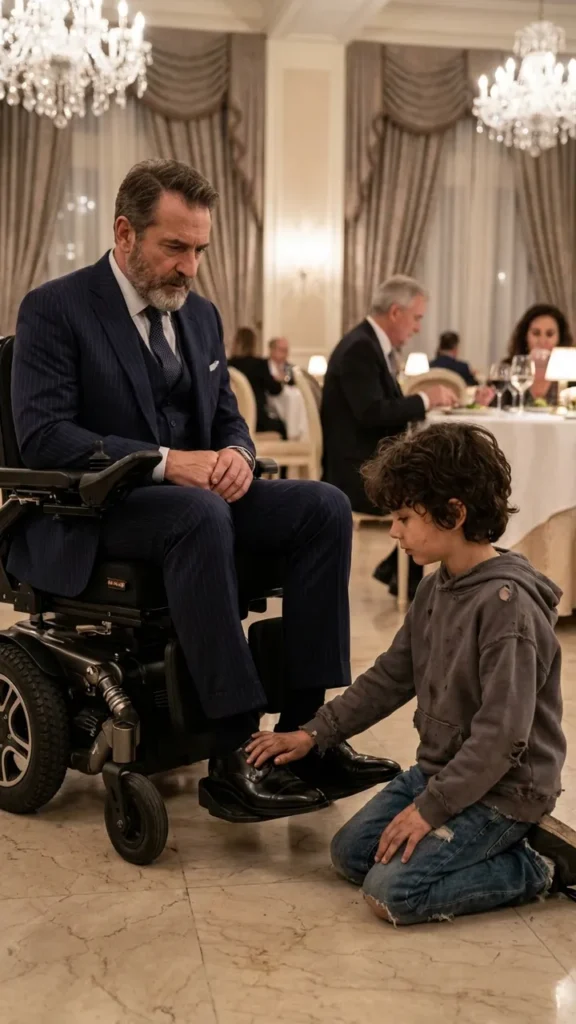
Robert Harrison sat in his wheelchair at a corner table, his dark navy pinstripe suit immaculate.
His salt-and-pepper hair was combed back.
His polished black dress shoes gleamed under the chandelier.
He felt a tug on his left shoe.
His head snapped down.
A boy-eight, maybe nine years old-knelt beside the wheelchair.
He wore a torn grey hooded sweatshirt with jagged rips across the chest.
His ripped blue jeans were stained.
Dark curly hair fell over his forehead.
His small hand gripped Robert’s shoelace.
“What the hell do you think you’re doing?” Robert’s voice cut through the restaurant’s murmur like a blade.
The boy flinched.
He didn’t let go.
“I said-get your hands off my shoe.”
The boy’s fingers loosened.
He looked up.
His eyes were large, brown, and wet.
A flicker of fear crossed his face.
Then something else.
Something older.
“I wasn’t stealing,” the boy whispered.
Robert’s jaw tightened.
He leaned forward, his broad shoulders straining the seams of his jacket.
Even in the wheelchair, he looked powerful.
Dangerous.
“You were touching my property.
That’s stealing in my book.” He grabbed the boy’s wrist.
The skin was cold.
Thin.
The boy whimpered. “Please.
I was just counting.”
“Counting?” Robert’s laugh was sharp, flat. “Counting what?
My money?
My cufflinks?”
“Your laces.” The boy’s voice cracked. “The loops on your shoes.”
Robert released him.
He stared.
The restaurant’s ambient noise seemed to fade.
A waiter hovered ten feet away, napkin draped over his arm, uncertain.
“Explain,” Robert said.
His tone was ice. “Before I call security.”
The boy rubbed his wrist.
He didn’t back away.
He stayed crouched, small, fragile-but rooted.
“My brother taught me,” he said. “He said if you count the loops on a person in a wheelchair, you can tell how far they’ve gone.
How many steps they’ve taken since the wheels stopped.”
Robert’s eyes narrowed. “That’s nonsense.”
“It’s not.” The boy’s voice grew stronger.
A plea crept in. “He said every loop is a mile.
And if you count enough, you can make their legs move again.”
The silence between them stretched.
Robert’s fingers tightened on the armrest of his chair.
The leather creaked.
“Your brother,” he said slowly. “Where is he now?”
The boy’s lower lip trembled.
His gaze dropped to the floor.
“He’s dead.”
A woman at the next table set down her wine glass.
The clink was loud.
No one spoke.
Robert’s chest rose and fell.
His face was unreadable, but his hands had begun to shake.
“How?” he asked.
His voice was quieter now.
The boy looked up.
His eyes held the weight of a funeral.
“A car hit him.
Last winter.” He paused. “The driver didn’t stop.”
Robert’s mouth opened.
Closed.
His throat moved as if he were swallowing glass.
The boy’s gaze drifted down to Robert’s shoes again.
“You have twelve loops,” he said. “That means you’ve gone far.
Maybe you don’t need to walk anymore.”
Robert flinched as if struck.
The waiter stepped forward. “Sir, should I-?”
“No.” Robert’s hand shot up.
He didn’t look away from the boy.
“What’s your name?” Robert asked.
“Caleb.”
A long pause.
The chandelier hummed overhead.
“Caleb,” Robert repeated.
The name landed like a stone in still water.
Then Caleb spoke again.
His voice was barely a whisper.
“My brother’s name was Jamal.”
Robert’s face went white.
He knew that name.
The air in The Sterling Room turned thick.
Robert’s knuckles were bone-white on the armrest.
His chest heaved once, twice.
He forced his voice back to authority.
“Jamal,” he said. “That’s a common name.”
Caleb shook his head slowly.
Small curls bounced against his forehead.
“Not this Jamal.” He reached into his sweatshirt pocket.
His hand came out holding a broken digital watch.
The face was cracked.
The second hand was frozen.
“He wore this,” Caleb said. “It stopped when he got hit.”
Robert stared at the watch.
A bead of sweat rolled down his temple.
“You’re lying,” he said. “Kids like you-you make up stories.
Beg for money.”
Caleb’s eyes didn’t waver. “I didn’t ask for anything.”
“Then why are you here?” Robert’s voice rose.
Diner heads turned.
The maître d’ stepped closer, but Robert waved him off with a sharp gesture. “Why are you crawling around a restaurant touching strangers’ shoes?”
“Because I had to see.” Caleb’s voice cracked. “You’re the one who hit him.”
The words hit the table like a gunshot.
Robert’s mouth went dry.
His left hand jerked, slapping against his thigh.
“That’s insane.” His voice strained. “I’ve never-” He stopped.
Caleb took a step closer.
His small frame cast a shadow across Robert’s polished shoes.
“You were driving a black Mercedes.
It had chrome rims.
Jamal was crossing Pine Street at 9:47 p.m. You ran a red light.”
Robert’s pulse hammered in his ears.
The restaurant spun.
“He didn’t die right away,” Caleb continued.
His voice was flat now, as if recounting a script he’d rehearsed a hundred times. “He crawled to the curb.
He begged a man in a suit to call an ambulance.”
Robert’s breathing stopped.
“The man got back in his car and drove away.”
Silence.
A fork clattered onto a plate nearby.
Someone coughed.
Robert’s hands were shaking so hard he gripped the armrest to steady them.
“How do you know it was me?” he rasped.
“Your shoes.” Caleb’s voice dropped to a whisper. “Jamal described them.
Polished black.
Navy suit.
He said the man had salt-and-pepper hair and looked rich.”
Robert looked down at his own reflection in the gleaming leather.
“I didn’t see him,” Robert said.
The words came out hollow. “It was dark.
I panicked.”
“You left him to die.”
The accusation hung in the air.
Robert looked up.
Caleb’s eyes were glassy, but he wasn’t crying.
He was watching-waiting.
“I came here tonight,” Caleb said, “to count your loops.
To see how far you’ve gone since that night.”
Robert’s throat tightened. “Why?”
“Because Jamal told me to find you.” Caleb’s voice broke on the last word. “He said if I ever saw a man in a wheelchair with navy shoes and a grey beard-that was him.
The man who killed me.”
Robert recoiled.
The wheelchair creaked.
“How could he have told you that?” Robert’s voice was a rasp. “He was dead.”
Caleb opened his mouth.
Closed it.
Then he said, “He told me the night before he died.
He said he’d seen you at the intersection.
He knew your face.”
Robert’s mind raced.
That was impossible.
He’d never seen a child at that intersection.
Only the body-the shape on the asphalt.
“You’re lying,” Robert said again, but his voice had no conviction.
Caleb stepped closer.
His torn hoodie brushed against the wheelchair’s arm.
“I’m not asking for money,” Caleb said. “I’m asking for the chance my brother never got.”
Robert stared at the boy’s face.
The same pleading.
The same desperation.
The same drowning.
“The chance to be seen,” Caleb whispered.
A cold chill ran down Robert’s spine.
He knew that phrase.
It was the same thing the boy in the street had said, seconds before the tires hit him.
“Please, mister,” the voice echoed in Robert’s memory. “I just need someone to see me.”
Now that boy’s brother stood before him.
Waiting.
Robert looked down at his own hands.
They were shaking.
The watch in Caleb’s hand ticked once.
A miracle.
Or a curse.
Robert didn’t know which.
‘Robert’s breath came shallow.
The restaurant lights blurred at the edges of his vision.
Caleb didn’t move.
His small hand still held the broken watch.
His eyes never left Robert’s face.
“You don’t believe me,” Caleb said.
It wasn’t a question.
Robert forced a laugh.
It came out cracked, hollow.
“Believe you?
You’re a child playing dress-up with lies.”
Caleb’s shoulders sagged.
He looked down at his own torn hoodie.
At the rips across his chest.
At the dirt on his jeans.
“My brother used to say,” Caleb began, voice soft, “that rich people don’t see poor people.
They see shadows.”
Robert’s jaw tightened.
“He said the only way to make them look is to touch something that matters to them.”
Caleb gestured at Robert’s shoes.
“Your laces matter.”
“They’re just shoelaces,” Robert snapped.
“No.” Caleb shook his head. “They’re the last thing that moves on your body.
The only thing that still takes steps.”
Robert’s hands froze on the armrest.
“Jamal said that’s why you polish them so hard.
Because you can’t walk anymore, but your shoes still can.”
A waiter passed behind Caleb.
He paused, glanced at Robert.
Robert’s glare sent him retreating.
“How would a dead boy know about my shoes?” Robert asked, his voice dropping to a whisper.
“Because he saw them,” Caleb said. “That night.
He saw them under the headlights.
He told me every detail before he-”
The boy stopped.
Swallowed.
“Before he died in the hospital.”
Robert’s throat tightened.
He remembered the hospital.
The news reports.
The hit-and-run that made the local paper for two days.
Then forgotten.
“I didn’t know he survived,” Robert said. “I thought he died on impact.”
Caleb’s eyes flared with old anger.
“He lived for three hours.
He told the nurses about the black car.
The chrome rims.
The navy suit.
They wrote it down.”
Robert’s stomach turned.
“But you never came forward,” Caleb continued. “No one ever arrested you.
Because you’re rich.
Because you have lawyers.”
Robert looked away.
His reflection stared back from the window-a ghost in a pinstripe suit.
“I counted your loops tonight because Jamal taught me,” Caleb said. “It was his game.
He said if you count the loops, you can guess how far a person has run.
Even if they can’t run anymore.”
The boy’s voice cracked.
“He said it helps you forgive them.”
Robert’s head snapped up.
“Forgive?”
“He didn’t want me to hate you.” Caleb’s eyes filled with tears. “He said hating made you heavy.
That it would keep me from walking forward.”
Robert stared at the boy.
At the torn clothes.
The broken watch.
The eyes that held a brother’s ghost.
“How many loops did you count?” Robert heard himself ask.
Caleb blinked.
“Twelve.”
A long silence.
“That means you’ve come far,” Caleb said. “Far enough to sit in a nice restaurant.
Far enough to forget.”
Robert’s hands trembled.
He looked down at his shoes.
The polished leather gleamed like a mirror reflecting a child’s blood.
“I haven’t forgotten,” he whispered.
Caleb took a step closer.
His small hand reached out.
He touched Robert’s knee.
“Then prove it.”
The contact sent a shock through Robert’s body.
He jerked back, but the wheelchair didn’t move.
Caleb’s hand stayed.
“Don’t touch me,” Robert said, but his voice lacked venom.
Caleb withdrew his hand slowly.
He tucked the broken watch back into his hoodie pocket.
“Jamal used to hold my hand when we crossed streets,” Caleb said. “He said I was too small to see traffic.
He’d squeeze three times.
That meant ‘I love you.'”
Robert’s mouth went dry.
“The last time I saw him, he squeezed my hand three times before he ran across Pine Street.”
Caleb’s voice dropped.
“He never came back.”
Robert closed his eyes.
The memory hit him like a freight train.
Rain-slicked asphalt.
Headlights cutting through darkness.
A shape darting into the street.
A thud.
A scream cut short.
He’d kept driving.
He’d told himself it was an animal.
A deer.
Anything but a child.
“His name was Jamal,” Caleb said again, louder now. “Jamal Thompson.
He was ten years old.
He liked video games and basketball.
He wanted to be a doctor.”
Robert’s hands gripped the armrest so hard his knuckles turned white.
“He saved his allowance for six months to buy that watch.”
Caleb pulled it out again.
The cracked face glinted under the chandelier.
Robert stared at the frozen second hand.
“It stopped at 9:47,” Caleb said. “That’s the exact time he hit the ground.”
Robert’s breath hitched.
A low hum filled his ears.
“That watch-I’ve seen it before,” Robert said, his voice hardly audible.
Caleb’s eyes widened. “What?”
“The night of the accident.
I stopped the car a block away.
I turned around.”
Robert’s face drained of color. “I saw something on the road.
A glint.
I thought it was broken glass.”
Caleb’s hands trembled.
“You went back?”
“I didn’t stop,” Robert said quickly. “I saw the body.
I saw someone kneeling over it.
I drove away.”
A tear rolled down Caleb’s cheek.
“That was my mother.
She found him.”
Robert felt the air leave his lungs.
“She said he was still holding his watch.
That it was still ticking when she held him.”
Caleb wiped his face with his sleeve. “It stopped when they closed the ambulance doors.”
The restaurant seemed to contract around them.
The clink of silverware faded.
The murmur of conversation became a distant roar.
Robert opened his mouth to speak.
Nothing came.
“You hit my brother,” Caleb said, his voice raw. “You left him in the rain.
And you’ve been walking away ever since.
In these shoes.”
He pointed at the polished leather.
Robert’s gaze fell to his own feet.
The shoes that had carried him through boardrooms and charity galas.
The shoes he polished every morning to forget the blood on the asphalt.
“I’m sorry,” Robert breathed.
Caleb’s face twisted.
“Sorry doesn’t bring him back.”
Robert nodded slowly.
His shoulders sagged.
“What do you want from me?” Robert asked. “Money?
A confession?”
Caleb’s eyes searched his.
“I want you to stop running.”
The words hung in the air.
Robert looked at the boy’s torn hoodie.
At the broken watch.
At the face that held a dead brother’s features.
“Jamal,” Robert repeated.
The name tasted like ash.
Caleb nodded.
“You’ll remember it now.”
CHAPTER 2: The Night of the Accident
‘Robert’s eyes stayed fixed on the shattered watch.
The second hand hadn’t moved in a year.
But in his mind, it spun backward.
Rain.
That’s what he remembered first.
The way it hammered the windshield.
The way the wipers couldn’t keep up.
He’d been driving home from a board meeting.
A merger deal worth thirty million.
He’d been drinking champagne at the after-party.
Two glasses.
Maybe three.
The road on Pine Street curved.
No streetlights.
No guardrails.
A shape appeared out of nowhere.
Small.
Fast.
Running.
Robert’s foot slammed the brake.
The car hydroplaned.
The thud came from the front bumper.
Then nothing.
“I didn’t stop,” Robert said aloud.
Caleb’s face hardened. “You just said you turned back.”
“I did.
A block away.
I reversed.” Robert’s voice cracked. “I saw the body lying in the rain.
I saw your mother running toward it.
I saw the blood spreading under the headlights.”
He gripped the armrest.
“I told myself he was already dead.
That there was nothing I could do.
That if I stayed, I’d lose everything.”
Caleb’s hands curled into fists. “You had a phone.
You had money.
You could have called an ambulance.”
“I was scared.”
“Scared?” Caleb’s voice rose. “My brother was dying on the road.
My mother was screaming.
And you were scared of losing your bonus?”
Robert flinched like he’d been struck.
The other diners turned.
A woman in pearls whispered to her husband.
Robert didn’t notice.
His entire world had shrunk to the boy in the torn hoodie.
“I buried it,” Robert said. “The guilt.
I bought a new car.
I donated to a children’s hospital.
I told myself it balanced out.”
“It didn’t.”
“No.” Robert’s throat burned. “It didn’t.”
Caleb stepped closer.
His small sneakers squeaked on the polished floor.
“You remember the headlights, right?
How bright they were?”
Robert nodded.
“Jamal told me he saw them.
He said they were like two suns.
He said he tried to jump out of the way, but his shoes slipped.”
A sob caught in Robert’s chest.
“He was wearing sneakers,” Caleb continued. “Old ones.
The soles were worn smooth.
He’d been begging Mom for new ones for months.
She said next paycheck.”
Caleb’s voice trembled.
“There was no next paycheck.”
Robert’s hands moved to his own shoes.
The polished leather.
The expensive soles.
He’d spent four hundred dollars on these shoes.
He’d spent nothing on Jamal.
“I’ve worn these shoes to funerals,” Robert whispered. “To weddings.
To court.
Never to a grave.”
“You will.”
Caleb’s voice was flat.
Dead.
“Jamal’s grave is in Greenwood Cemetery.
Row seven.
Plot twelve.”
Robert’s eyes widened.
“I go every Sunday,” Caleb said. “I bring dandelions.
He liked dandelions.
Said they were stubborn.”
The boy’s lip quivered.
“I talk to him.
I tell him I’m still counting loops.
I tell him I’m still waiting.”
“Waiting for what?”
“For the man who killed him to say his name.”
Robert’s head bowed.
The chandelier light caught the silver in his hair.
He looked old.
Broken.
“I’ll say it,” Robert said. “I’ll say his name.
I’ll say it every day if you want.”
Caleb shook his head.
“That’s not enough.”
“I know.”
“I didn’t come here for an apology.”
Robert looked up. “Then why?”
Caleb pulled the watch from his pocket again.
He held it out.
The cracked face reflected the room.
“Jamal had a habit.
When he was scared, he’d beg.
He’d say, ‘Please, mister, I’m just trying to get home.’ He said it to strangers on the bus.
He said it to teachers when he forgot homework.”
Caleb’s voice dropped.
“He said it to you.
That night.”
Robert’s blood ran cold.
“He was still alive when I got to him,” Caleb continued. “The nurses told me.
They said he kept repeating it. ‘Please, mister.
I’m just trying to get home.'”
Robert’s mouth opened.
No sound came.
“You heard him,” Caleb said. “Through your window.
Through the rain.
You heard him beg.”
“No.” Robert shook his head violently. “I didn’t hear anything.
I was too far.”
“You were close enough to see the body.
Close enough to see my mother.
You were close enough to hear.”
Caleb’s voice broke.
“Jamal begged for a chance.
A chance to live.
A chance to see his little brother again.”
Robert’s eyes welled.
“You didn’t give him that chance.”
The watch trembled in Caleb’s hand.
“I’m here now.
Asking for the same thing.”
Robert stared at the frozen second hand.
“I’m begging you, mister,” Caleb said, his voice shifting-higher, younger, imitating a child’s plea. “Please.
I’m just trying to get home.”
The words hit Robert like a physical blow.
His chest heaved.
His hands shook.
“You want a chance,” Robert whispered. “What chance?”
“A chance to do the right thing.” Caleb’s eyes locked onto his. “A chance to stop running.”
Robert’s gaze dropped to his shoes.
The polished loops.
Twelve of them.
Counting each step he’d taken away from Pine Street.
“If I confess,” Robert said slowly, “I go to prison.
I lose everything.
My company.
My house.
My reputation.”
“I know.”
“And you still want me to do it?”
Caleb nodded.
“Because Jamal never got to go home.
So neither should you.
Not until you’ve paid.”
The restaurant hummed.
A waiter cleared his throat nearby.
Robert held up a hand.
“Give me a moment.”
The waiter retreated.
Robert looked at Caleb.
At the torn hoodie.
The dark circles under the boy’s eyes.
The broken watch that held a year of grief.
“I don’t have a choice, do I?”
Caleb shook his head.
“You had a choice a year ago.
Now you only have consequences.”
Robert let out a long breath.
His shoulders slumped.
His hands lay limp on his lap.
“I’ll call my lawyer tomorrow.”
Caleb’s face didn’t change.
“No.
You’ll call him tonight.
From here.”
Robert’s eyes widened.
“I’m not letting you leave this restaurant without starting the process.”
The boy’s voice held no anger.
Only a quiet, relentless force.
“Jamal didn’t get to walk away.
Neither do you.”
‘Robert’s hand trembled as he reached for his phone.
The restaurant hummed with a new tension.
A woman in a sapphire dress turned her head.
Her fork paused mid-air.
Her husband followed her gaze.
Then another table.
Then another.
Whispers rippled like wind through wheat.
“Is that the Harrison?”
“The CEO?
The one in the chair?”
“Who’s the boy?”
Robert’s jaw tightened.
He could feel their eyes.
Hot.
Judging.
Caleb stood still.
His torn hoodie hung loose.
His hands clasped the broken watch.
“They’re watching,” Caleb said quietly.
“I know.”
“Do you care?”
Robert’s voice cracked. “I care.
I care too much.
That’s why I ran.”
A waiter appeared.
Young.
Clean-shaven.
White apron starched.
“Sir, is everything all right?
The maître d’ asked me to check.”
Robert didn’t look up. “Fine.
Leave us.”
“Sir, the boy-”
“I said leave us.”
The waiter hesitated.
His eyes flicked to Caleb.
To the watch.
To the visible distress on Robert’s face.
“Sir, if there’s a problem, we can call security.”
Robert’s head snapped up.
His voice sharpened into its old authority.
“I don’t need security.
I need you to walk away.
Now.”
The waiter stepped back.
Hands raised. “Understood, sir.”
He retreated.
The whispers grew.
A woman in pearls leaned toward her husband. “He’s talking to that child like a criminal.”
The husband shrugged. “Probably a panhandler.
They let anyone in these days.”
Robert heard them.
His knuckles whitened on the wheelchair’s rim.
Caleb didn’t flinch.
His eyes stayed locked on Robert.
“They think I’m a thief,” Caleb said. “A street kid.
A problem.”
“They don’t know.”
“No.
They don’t.”
Caleb tilted his head.
A sad smile touched his lips.
“But you do.
You know exactly what I am.”
Robert swallowed.
His throat felt like sandpaper.
“You’re Jamal’s brother.”
“I’m a reminder,” Caleb said. “A mirror.
A clock that stopped ticking.”
He lifted the watch.
The overhead light caught the cracked glass.
“You hear that?
The silence?
That’s the sound of a dead boy’s last heartbeat.”
Robert’s chest tightened.
He felt the eyes of the restaurant pressing on him.
The weight of their curiosity.
Their judgment.
He imagined tomorrow’s headlines.
“CEO Confronts Homeless Boy at Five-Star Restaurant.”
Then the real story.
“CEO Hit-and-Run Driver Exposed by Victim’s Brother.”
His reputation crumbled in his mind.
Caleb stepped closer.
His sneakers made no sound on the carpet.
“You want to wave them off,” Caleb said. “You want to pretend this is a misunderstanding.
A private matter.”
Robert nodded.
“It’s not private,” Caleb continued. “It’s public.
Like Pine Street.
Like the rain.
Like Jamal’s body lying in the road.”
Robert’s voice broke. “What do you want from me?”
“I already told you.
A chance.”
“I’m giving you that.”
“You’re giving me a phone call.
That’s not a chance.
That’s a delay.”
Caleb’s voice hardened.
“A chance means you feel it.
Right now.
In front of all these people.
The shame.
The fear.
The helplessness.”
Robert’s eyes widened.
“You want me to confess here?”
“I want you to start.”
The woman in pearls stood up.
She pulled out her phone.
Her husband tried to stop her.
She shook him off.
“I’m recording,” she said loudly. “This looks wrong.”
Robert’s blood ran cold.
Caleb didn’t turn around.
“Good,” Caleb said. “Let them see.”
Robert stared at the woman’s phone.
The red dot blinking.
His empire shrank to a screen.
His moment of truth.
Caleb held out the watch.
Not as a trophy.
As a witness.
“Look at it,” Caleb said. “Really look.”
Robert’s gaze dropped to the plastic casing.
The scuffed screen.
The cracked face.
A cheap digital watch.
The kind you buy at a gas station.
“It’s broken,” Robert said.
“No.
It’s stopped.”
Caleb’s fingers traced the glass.
“It stopped at 11:47 PM.
March 14th.
Last year.”
Robert’s breath caught.
“That’s the time you hit him.”
“I don’t remember the time.”
“The police do.
The hospital does.
The coroner does.”
Caleb’s voice flattened.
“Jamal was wearing this when he died.
The paramedics gave it to my mother.
She gave it to me.”
Robert’s hand moved toward it.
Caleb pulled back.
“Don’t touch him.
You lost that right.”
Robert’s hand hung in the air.
“I’m sorry,” he whispered.
“Sorry doesn’t fix a stopped watch.”
Caleb held the watch closer to Robert’s face.
“See the hour?
The minute?
The second hand frozen between two and three?”
Robert saw it.
The thin black needle.
Stuck.
Motionless.
“That’s where Jamal’s life ended.
Right there.
On a cold road.
With no one holding his hand.”
Caleb’s voice broke.
“He was alone.
You left him alone.”
Robert’s hands shook.
He gripped the wheelchair’s armrests.
“I didn’t mean to-”
“Didn’t mean to?” Caleb’s eyes blazed. “You drove away.
You let him drown in his own blood.
You let him die calling for his mother.”
The woman in pearls kept recording.
The whispers grew loud.
A man in a gray suit stood up. “Someone call the police.”
Robert heard nothing but the watch’s silence.
“How long?” Robert asked.
“How long what?”
“How long has it been stuck?”
“A year.
One year, four months, and six days.”
Caleb’s voice dropped to a whisper.
“I wind it every morning.
Hoping it moves.
Hoping maybe he’ll come back.”
Tears rolled down Robert’s cheeks.
He didn’t wipe them.
“I’m sorry,” he said again. “I’m so sorry.”
“Sorry doesn’t wind a watch.”
Caleb held it out again.
“Take it.”
Robert hesitated.
“Take it.
Feel how cold it is.
How dead.”
Robert’s fingers closed around the plastic.
The casing was warm from Caleb’s hand.
But the metal back was cold.
Cold like steel.
Like rain.
Like a body on asphalt.
Robert stared at the frozen time.
“I remember that night,” he said. “The rain.
The curve.
The thud.”
“You remember.”
“I remember looking in the rearview mirror.
Seeing a shape.
I told myself it was a deer.”
“It wasn’t a deer.”
“No.”
Robert’s voice cracked.
“It was a boy.
A boy with a name.
A boy with a brother.”
He looked at Caleb.
“I’ve carried that night every day.
Every meeting.
Every handshake.”
Caleb’s expression softened.
“Then carry it into a courtroom.”
Robert nodded slowly.
He looked at the watch again.
The second hand.
Frozen between two and three.
He pressed his thumb against the glass.
“I’ll never forget this time,” Robert said.
“Good,” Caleb replied. “Neither will I.”
He reached out and took the watch back.
His small fingers wrapped around it.
Then he looked at the woman with the phone.
“Keep recording,” Caleb said. “We’re not done yet.”
CHAPTER 3: The Cold Intent
‘Robert’s face shifted.
The tears dried.
The trembling stopped.
His eyes hardened into something Caleb hadn’t seen before.
A cold calculation.
A businessman’s reflex.
“Let me understand this,” Robert said slowly.
His voice dropped low.
Private.
Controlled.
“You want me to confess.
To the police.
For a hit-and-run that happened over a year ago.”
“Yes.”
“With no evidence.
No witnesses.
Just your word and a broken watch.”
Caleb’s grip tightened on the watch.
“Jamal’s word,” Caleb said. “His final word.”
“Jamal is dead.
He can’t testify.”
Robert’s tone turned clinical.
“A smart lawyer would tear that apart.
No physical proof tying me to the scene.
No forensic evidence.
No camera footage.”
Caleb’s eyes widened.
“Are you-”
“I’m not saying I won’t confess.
I’m saying I don’t have to.”
Robert’s fingers tapped the wheelchair’s armrest.
“But you do have to live with yourself.
Every day.
Every night.
Every time you close your eyes.”
Caleb’s voice cracked. “You’re threatening me.”
“I’m negotiating.”
Robert leaned forward.
His sharp features caught the light.
Salt-and-pepper hair perfectly styled.
Pinstripe suit immaculate.
“You’re a smart kid.
You found me.
You planned this.
You’re not just a victim.
You’re a strategist.”
Caleb didn’t answer.
“So let me offer you a strategy,” Robert continued.
“Fifty thousand dollars.
Cash.
Tonight.”
Caleb’s breath caught.
“You can go back to your mother.
Tell her you found the man who killed Jamal.
That he’ll rot in prison.”
“But?”
“But you won’t mention my name.
You’ll say it was someone else.
A stranger.
A car you never saw.”
Caleb’s face paled.
“You want me to lie.”
“I want you to survive.”
Robert’s eyes flicked to the woman with the phone.
“She’ll delete the video.
I’ll make sure of it.”
Caleb stared at him.
The restaurant’s chandelier cast shadows across both their faces.
“Fifty thousand dollars,” Caleb repeated.
“Tax-free.
No strings.
Just walk away.”
Caleb looked at the watch in his hands.
The frozen second hand. 11:47 PM.
“Jamal begged, didn’t he?” Caleb asked quietly.
Robert’s jaw tightened.
“He begged you to stop.
To call an ambulance.
To hold his hand.”
“I don’t-”
“He begged for a chance.
Just one chance.”
Caleb’s voice rose.
“And you gave him pavement.
You gave him rain.
You gave him death.”
Robert’s composure cracked.
“I’m offering you a life.”
“You’re offering me a lie.”
Caleb stepped back.
His voice grew louder.
The diners leaned in.
“You want me to trade my brother’s memory for fifty grand.”
“I want you to understand the real world.”
“The real world?” Caleb laughed.
Bitter.
Sharp.
“The real world is that you’re rich and I’m poor.
The real world is that you can buy your way out of anything.”
“Yes.”
“Then why haven’t you bought your way out of the wheelchair?”
Robert’s face went pale.
His hands gripped the armrests.
“You don’t know-”
“I know you were in a crash six months later.
I know you broke your spine.
I know you’ve been dying inside ever since.”
Caleb’s eyes burned.
“You think this chair is punishment.
It’s not.
It’s just the beginning.”
Robert’s voice shook. “What do you want?”
“The truth.
In public.
For everyone to hear.”
Robert’s cold intent cracked.
He looked at the woman’s phone.
At the waiter hovering.
At the faces turned toward him.
His empire dissolved in their stares.
“Fifty thousand,” he tried again. “Plus a house.
Education.
Your mother’s debts cleared.”
Caleb shook his head.
“Jamal didn’t die for a down payment.”
Robert’s shoulders sagged.
The businessman’s mask fell.
“I’m scared,” he whispered.
“Good,” Caleb said. “Now you know how Jamal felt.”
Robert sat back in his chair.
His hands dropped to his lap.
Limp.
Defeated.
“Who are you?” he asked.
“Caleb Wright.”
“Who sent you?”
“No one.”
“Then how did you find me?”
Caleb’s smile was thin.
Sad.
“I didn’t find you.
You found me.”
Robert’s eyes narrowed.
“Explain.”
“I’ve been coming to this restaurant every Saturday.
For six months.
Same spot.
Same time.”
Robert’s brow furrowed.
“Waiting for you?”
“No.
Waiting for the right moment.”
Caleb pointed to the window.
“The valet stand.
I watch the cars.
The license plates.
The faces.”
“You recognized me.”
“Your face was in every newspaper. ‘CEO Survives Crash.
Walks Again?’ Except you didn’t walk.
You rolled.”
Robert’s throat tightened.
“And tonight, you sat down two tables from my mother’s old apartment.
She used to clean this place.”
Caleb’s voice softened.
“The universe doesn’t forget.
Neither do I.”
Robert stared at him.
The chandelier light caught the boy’s face.
Mixed heritage.
Dark curls.
Eyes that held too much pain.
“You’ve been planning this for months.”
“I’ve been waiting for you to remember.”
Robert’s jaw dropped.
“Remember what?”
“The night of the accident.
You stopped at a red light.
You saw a kid crossing the street.
You honked.”
Caleb’s voice dropped.
“He waved.
You remember?”
Robert’s hands trembled.
“I-”
“He waved because he thought you were being polite.
That’s who Jamal was.
He waved at strangers.
He trusted people.”
Caleb’s eyes glistened.
“You didn’t honk because you were being nice.
You honked because you were angry.
Because the light was green and he was in your way.”
Robert’s face went white.
“Two seconds.
Two seconds changed everything.”
Caleb stepped closer.
His voice was barely a whisper.
“If you had waited two seconds, Jamal would be alive.
If you had slowed down.
If you had looked.
If you had cared.”
Robert’s head dropped.
“I know.”
“You know now.
But you didn’t know then.”
Caleb’s hand reached out.
Touched Robert’s sleeve.
Robert flinched.
“Don’t.”
“Too late.
You already touched Jamal.
With your bumper.
With your wheels.
With your fear.”
Caleb’s voice hardened.
“Now you’re sitting in a chair.
Just like he was.
On the road.
Helpless.”
Robert’s eyes squeezed shut.
The restaurant seemed to hold its breath.
A waiter approached the table.
“Sir, the maître d’ has asked me to-”
“Leave him,” Robert snapped.
The waiter froze.
“I said leave him.”
The waiter backed away.
The whispers grew.
Caleb looked around.
At the faces.
The phones.
The judgment.
“You see?” Caleb said softly.
“This isn’t a restaurant.
It’s a courtroom.
And the jury’s already decided.”
Robert’s eyes opened.
They were wet.
Red.
“What do I do?”
“You tell the truth.
In front of everyone.
Then you call the police.”
“And then?”
“Then we both find out if karma is real.”
Robert’s hands gripped the chair.
He looked at the watch in Caleb’s hand.
The frozen time.
Eleven forty-seven.
“All right,” Robert said.
His voice broke.
“All right.”
He turned to face the room.
The woman in pearls held her phone steady.
The diners leaned forward.
Robert Harrison, CEO, father, coward, took a breath.
And began to speak.
‘Robert’s voice cracked as he began.
“The night was raining.
Hard.
I was driving home from a board meeting.”
Caleb stood still.
His hands clutched the broken watch.
“I was angry.
The deal had fallen through.
My wife had left a message I didn’t want to hear.”
Robert’s eyes stared at the tablecloth.
“I took the shortcut through Jefferson Avenue.
The light was green.
I wasn’t speeding.
Not really.”
“Keep going,” Caleb said softly.
“A kid stepped off the curb.
He was wearing a hoodie.
Dark blue.
He had a backpack.”
Robert’s throat tightened.
“He looked both ways.
Then he started crossing.
I had the green.
I had the right of way.”
“You had a choice,” Caleb said.
“I had a second.
One second.
I saw his face.
He saw mine.”
Robert’s voice dropped.
“I hit the gas.”
The restaurant went silent.
“Why?” Caleb asked.
“Because I was angry.
Because I thought I could make it.
Because I didn’t want to be late.”
Robert’s hands gripped the armrests.
“He flew over the hood.
His head hit the windshield.
Then the pavement.”
Caleb’s eyes glistened.
“His backpack opened.
Papers everywhere.
A math worksheet.
A half-eaten sandwich.”
“Did you stop?”
Robert’s jaw trembled.
“I stopped.
Fifty feet ahead.
I got out.
I saw him lying there.”
“And?”
“And I got back in.
I drove away.”
Caleb’s voice rose.
“Did you call 911?
Did you check his pulse?
Did you hold his hand?”
“No.”
“Jamal was eleven years old.
He was walking home from his tutoring session.
He got straight A’s.
He wanted to be a doctor.”
Robert’s face crumpled.
“He begged me.
I heard him.
Through the rain.
He said, ‘Please, mister.
Please help me.'”
Caleb stepped closer.
“And you left him.”
“I left him.”
Robert’s voice broke.
“I called my lawyer.
I had my car repainted.
I told no one.”
“Until now.”
“Until now.”
Caleb held up the watch.
“The police found this in his pocket.
It stopped at 11:47.
The exact time the car hit him.”
Robert stared at it.
“The battery died.
Or the impact.
I don’t know.”
“I know,” Caleb said. “The impact broke it.
Just like it broke Jamal’s spine.”
The woman in pearls lowered her phone.
Her hand shook.
Robert looked at her.
At the other diners.
At the waiter frozen in the corner.
“I’m a coward,” Robert said. “I’ve been a coward my whole life.”
“You’re still a coward,” Caleb said. “But you’re a scared coward now.
That’s different.”
Robert nodded slowly.
“What happened after?” Caleb asked.
“The guilt.
Every night.
Every mirror.
Every time I saw a kid on the street.”
“And the crash?”
Robert’s eyes darkened.
“Six months later.
I was driving to a charity event.
A truck ran a red light.
I woke up in a hospital bed.
Paralyzed from the waist down.”
“Karma,” Caleb said.
“Maybe.
I don’t know.”
Robert’s voice hardened.
“I told myself it was punishment.
I told myself I paid the price.
I made peace with it.”
“Did you?”
“No.”
Robert’s eyes met Caleb’s.
“I never made peace.
I just buried it deeper.
Under money.
Under success.
Under this suit.”
Caleb’s voice softened.
“Jamal was buried in a small cemetery.
No headstone.
My mother couldn’t afford one.”
Robert’s breath caught.
“I’ll pay for it.
I’ll pay for everything.”
“That’s not why I’m here.”
The waiter approached again.
“Sir, the maître d’ insists.
The boy needs to leave.”
“Leave him,” Robert snapped.
The waiter froze.
The room held its breath.
“Now you know,” Caleb said. “Now everyone knows.”
Robert’s hands trembled.
“Now what?”
“Now you finish what you started.”
Robert looked at the phone in the woman’s hand.
“Call the police,” he said.
Caleb’s eyes widened.
“Are you sure?”
“I’m sure.”
Robert’s voice was steady now.
“I’m done running.”
The woman dialed.
The restaurant watched.
And Robert Harrison began to truly speak.
The maître d’ strode toward the table.
His name was Antoine.
Thirty years in hospitality.
He’d seen everything.
Mr. Harrison,” Antoine said, his voice clipped. “I must ask you to end this immediately.”
Robert didn’t look up.
“Go away.”
“This is a private establishment.
The boy is disturbing other guests.”
“The boy is telling the truth.”
Antoine’s jaw tightened.
“Sir, I’ve already called security.
They’ll escort the child out.”
Robert’s head snapped up.
His eyes were cold.
Hard.
“I said leave him.”
Antoine didn’t move.
“Mr. Harrison, your reputation-”
“My reputation is already destroyed.
Look around.”
Antoine glanced at the diners.
Phones raised.
Whispers spreading.
“Sir, I’m trying to protect you.”
“You’re trying to protect the restaurant.”
Robert’s voice sharpened.
“Tell me, Antoine.
How much do I spend here a year?
Twenty thousand?
Thirty?”
Antoine’s face paled.
“I don’t-”
“Answer the question.”
“Approximately forty-five thousand, sir.”
“And how much would you lose if I never came back?”
Antoine’s throat tightened.
“Significant revenue, sir.”
“Now imagine how much you’d lose if every news station reported that your restaurant tried to silence a twelve-year-old boy whose brother was killed by a hit-and-run driver.”
Antoine’s hands trembled.
“You wouldn’t.”
“I would.
I have lawyers.
I have PR teams.
I have the resources to ruin this place.”
The waiter beside Antoine stepped back.
“Mr. Harrison, please-”
“Get out of my sight.”
Antoine stood frozen.
Robert’s voice dropped to a whisper.
“Take the waiter.
Take the security.
Leave us alone.”
Antoine looked at Caleb.
At the watch in his hands.
At the tears on his face.
“Yes, sir,” Antoine said quietly.
He turned and walked away.
The restaurant exhaled.
Caleb looked at Robert.
“You didn’t have to do that.”
“Yes, I did.”
“You just threatened a man in front of fifty witnesses.”
“I just showed him what power looks like.
The same power I used to walk away from your brother.”
Caleb’s eyes glistened.
“You’re still learning.”
“I’m trying.”
The woman in pearls stepped forward.
“Mr. Harrison, the police are on their way.”
Robert nodded.
“How long?”
“Five minutes.”
Robert looked at Caleb.
“Five minutes.
Then everything changes.”
“I know.”
“Are you scared?”
Caleb’s voice cracked.
“Terrified.”
“Good.
So am I.”
Robert reached into his pocket.
Caleb flinched.
“It’s not money,” Robert said softly.
He pulled out a photograph.
Worn.
Folded.
“My son,” Robert said. “He’s twenty-three now.
He won’t talk to me.”
“Why?”
“Because he knows what I did.
He figured it out.
A year ago.”
Caleb stared at the photo.
“He looks like Jamal.”
Robert’s breath caught.
“He does?”
“Same eyes.
Same smile.”
Robert’s hand shook.
“I never saw it.”
“Maybe you didn’t want to.”
The door opened.
Two officers walked in.
The woman in pearls pointed.
“Over there.”
The officers approached.
Robert sat up straight.
Caleb clutched the watch.
The restaurant held its breath.
“Mr. Harrison?” the officer asked.
“Yes.”
“We received a report of a confession to a hit-and-run.
Do you wish to speak with us?”
Robert looked at Caleb.
“Yes,” Robert said. “I do.”
The officer nodded.
“Please come with us.”
Robert turned his wheelchair.
Caleb followed.
At the door, Robert stopped.
“Count my laces, son,” Robert said.
Caleb’s voice broke.
“Ready.”
“I’m ready too.”
The watch in Caleb’s hand trembled.
The second hand flickered.
Once.
Then stopped.
Outside, the rain began to fall.
CHAPTER 4: The Confession
‘The rain slicked the pavement outside.
Robert Harrison sat in his wheelchair at the restaurant entrance.
The two officers waited, notebooks ready.
Caleb stood beside him.
The broken watch pressed against his palm.
Robert’s voice emerged low. “I need to say this clearly.”
The first officer nodded. “Take your time, sir.”
“I was driving a black 2022 Mercedes.
November 14th. 11:47 PM.
Jefferson Avenue and Third Street.”
The officer wrote. “Go on.”
“The light was green.
A boy stepped off the curb.
Dark blue hoodie.
Backpack.
He looked both ways.”
Caleb’s breath hitched.
Robert continued. “I saw him.
I had a second to brake.
I didn’t.”
“You accelerated,” the officer said.
“I accelerated.”
“Why?”
“Because I was angry.
Because I thought I could make it.
Because I was a coward.”
The officer’s pen stopped. “Did you stop after the impact?”
“I stopped.
Fifty feet ahead.
I got out.
I saw him lying in the street.”
“And then?”
“I got back in.
I drove away.
I called my lawyer.
I had the car repainted the next morning.”
The second officer spoke. “The victim was Jamal Williams.
Eleven years old.”
“Yes.”
“He died at the scene.
Internal injuries.”
Robert’s head dropped. “I know.”
Caleb stepped forward. “Tell them the rest.”
Robert looked up. “Six months later.
I was driving to a charity event.
A truck ran a red light.
T-boned me on the driver’s side.”
The officers exchanged glances.
“I woke up in a hospital bed.
Vertebrae shattered.
Spinal cord severed.
Paralysis from the waist down.”
Caleb’s voice was flat. “Karma.”
Robert’s eyes met his. “I told myself it was punishment.
I told myself I paid the price.
I made peace with it.”
“Did you?” Caleb asked.
“No.
I buried it.
Under money.
Under success.
Under this suit.”
The first officer cleared his throat. “Mr. Harrison, you’re confessing to vehicular manslaughter and leaving the scene of an accident?”
“Yes.”
“Do you have legal representation present?”
“No.
I fired my lawyer last week.
I couldn’t sleep anymore.”
Caleb’s hand tightened on the watch. “You told me you were done running.”
“I am done running.”
The second officer stepped closer. “Sir, this confession will lead to charges.
Possibly prison.
Are you certain?”
Robert’s jaw set. “I’ve been in prison for a year.
Every night in that bed.
Every time I saw a child on the street.
That’s prison.”
The woman in pearls had followed them to the door.
Her phone still recording.
Robert looked at her. “Send that to the news.
Every station.
Every outlet.
Let them know what I did.”
She nodded slowly.
Caleb touched Robert’s arm. “Why now?”
Robert’s voice cracked. “Because you showed me Jamal’s face.
You showed me what I ran from.”
“I showed you a watch.”
“You showed me a life.
A life I took.
A life I never apologized for.”
The rain fell harder.
“I was at a board meeting that night,” Robert said. “We were negotiating a merger.
I was angry because the deal fell through.
I took that anger onto the road.”
“And Jamal paid for it,” Caleb said.
“Yes.”
“With his life.”
“Yes.”
Robert’s hands gripped the wheelchair armrests. “There’s more.
The night of the accident.
When I got out of the car.
He was conscious.”
Caleb froze. “What?”
“He was conscious.
He looked at me.
He said something.”
“What did he say?”
Robert’s voice broke completely. “He said, ‘Please, mister.
Please help me.
I’m just trying to get home.'”
Caleb’s face crumpled. “You heard him.”
“I heard him.”
“And you left.”
“I left.”
Caleb’s voice rose. “He was eleven.
He was scared.
He was bleeding on the pavement.
And you left him to die alone.”
“Yes.”
The officer’s radio crackled. “We need to proceed to the station, Mr. Harrison.”
Robert nodded. “I’m ready.”
Caleb grabbed his sleeve. “No.
You’re not ready.
Not yet.”
Robert looked at him.
“Jamal said one more thing.
Before he died.
The paramedics told my mother.”
Robert’s throat tightened. “What?”
“He said, ‘Tell my brother I love him.
Tell Caleb I’m sorry.'”
Robert’s eyes closed. “I’m sorry, Caleb.
I’m so sorry.”
“Sorry doesn’t bring him back.”
“I know.”
The officers moved to wheel Robert toward the cruiser.
Caleb fell into step beside him.
“The watch,” Caleb said. “It ticked once.”
Robert looked at him. “I know.”
“Maybe it was a sign.”
“Maybe it was Jamal.”
Caleb wiped his eyes. “Yeah.
Maybe it was.”
The police cruiser idled at the curb.
Rain streaked the windows.
Robert sat in his wheelchair under the awning.
Caleb stood facing him.
“I need you to hear something,” Caleb said.
“Alright.”
Caleb’s voice shifted.
It became higher.
Younger.
More desperate.
“Please, mister.
Please help me.
I’m just trying to get home.”
Robert’s breath caught. “That’s Jamal’s voice.”
“I know.
He said it to you.
Now I’m saying it to you.”
Robert’s eyes welled. “You sound just like him.”
“Because he’s in me.
Every day.
Every night.
I hear him.”
Caleb stepped closer.
The rain dripped off his torn hood.
“Jamal didn’t beg for himself.
He begged for his mother.
He begged for his future.”
Robert nodded slowly.
“He had a math test the next morning.
He studied three hours for it.
He got an A.”
“I know.”
“No.
You don’t know.
You don’t know that he saved his allowance for six months to buy me that watch.”
Robert’s voice broke. “I didn’t know.”
“He wanted me to have something to remember him by.
Something that ticked.”
Caleb held up the watch.
The second hand stayed frozen.
“It stopped ticking.
Just like he did.”
Robert reached out.
His hand trembled.
Caleb let him take the watch.
Robert turned it over.
The back was scratched.
A name was engraved: Jamal + Caleb.
Forever.
“You were his whole world,” Robert said.
“He was mine.”
Robert’s shoulders shook. “I took that from you.”
“Yes.”
“I can never give it back.”
“No.”
The officer cleared his throat. “Mr. Harrison, we need to leave.”
“One more minute,” Robert said.
He looked at Caleb. “What do you want from me?
Not money.
Not a confession.
What?”
Caleb’s voice returned to its youthful plea. “I want you to hear it again.
Exactly how Jamal said it.”
Robert’s eyes glistened.
Caleb took a breath.
Then he spoke.
“Please, mister.
Please help me.
I’m just trying to get home.”
The words hung in the rain.
“I’m begging you now,” Caleb said. “Not for me.
For him.”
Robert’s tears fell freely. “What do you want me to do?”
“Tell the world.
Tell them what you did.
Tell them Jamal’s name.”
“I will.”
“Tell them he was a good kid.
That he loved math.
That he wanted to be a doctor.”
“I will.”
“Tell them he didn’t deserve to die alone in the rain.”
Robert’s voice cracked. “He didn’t.
He didn’t deserve any of it.”
“Then make sure his name means something.
Not just a statistic.
Not just a hit-and-run.”
The woman in pearls lowered her phone.
She was crying too.
Robert wiped his eyes. “I’ll do it.
I’ll tell every reporter.
I’ll go to every court.
I’ll say his name until my voice gives out.”
Caleb’s expression softened. “That’s all I wanted.”
“Really?”
“Really.
I didn’t want money.
I didn’t want revenge.
I wanted you to remember.”
Robert’s voice broke again. “I will.
Every day.
Every night.”
Caleb reached into his pocket.
He pulled out a folded piece of paper.
“Jamal’s homework.
The night he died.
The math test.
He got every problem right except one.”
Robert took the paper.
It was wrinkled.
Stained with something dark.
“He missed number seven.
He was always bad at fractions.”
Robert’s hands shook. “Why are you giving me this?”
“Because you need to carry it.
The same way I carried it.”
“A reminder.”
“A burden.
Like the one you gave me.”
Robert folded the paper carefully.
He placed it in his suit pocket.
“I’ll carry it forever.”
“You don’t have a choice.”
The first officer stepped forward. “Mr. Harrison, we really must go.”
Robert nodded.
He looked at Caleb.
“Thank you, Caleb.
For not letting me run.”
Caleb’s voice was quiet. “You can’t run in a wheelchair.”
Robert almost smiled. “No.
I guess not.”
He turned his chair toward the cruiser.
Caleb called out. “Hey, mister.”
Robert stopped.
“Count my laces,” Caleb said. “That’s what Jamal would have wanted.”
Robert looked down at his own polished shoes.
The laces were double-knotted.
Perfect loops.
“One,” Robert whispered. “Two.
Three.
Four.”
Caleb’s tears mixed with rain.
“I’m ready, son,” Robert said. “I’m ready to go.”
The officer opened the cruiser door.
Robert wheeled forward.
Behind him, Caleb clutched the broken watch.
And for just a moment, he thought he heard a second tick.
‘The woman in pearls held her phone steady.
Her manicured fingers trembled slightly.
Robert turned his wheelchair to face her. “You’re recording.”
“Yes.”
“Good.”
Caleb stepped closer to the table.
His torn hoodie dripped rain onto the white tablecloth.
A man in a charcoal suit stood up. “This is a private establishment.
That child shouldn’t be here.”
Robert’s eyes snapped toward him. “Sit down.”
“I’ll call the manager.”
“Call whoever you want.”
The man pulled out his phone.
His wife tugged his arm. “Jerome, don’t.”
Robert’s voice carried across the room. “Let him call.
Let everyone call.
Let the whole city know what I did.”
The maître d’ appeared. “Sir, we have other guests.
This is disruptive.”
Robert’s jaw tightened. “Disruptive?
You want to see disruptive?”
He pulled the folded homework from his pocket.
Jamal’s math test.
The bloodstain was brown now.
Dried.
“This is what disruptive looks like.
A child’s blood on a test he aced.
A child I killed.”
The restaurant went silent.
Caleb’s eyes widened. “Mr. Harrison.”
“No.
They need to hear.”
Robert held up the paper. “This boy.
Jamal Williams.
Eleven years old.
He wanted to be a doctor.
He loved fractions.
He saved his allowance for six months.”
The woman in pearls zoomed in.
“I hit him with my car.
November 14th. 11:47 PM.
I left him to die.”
A waiter dropped a glass.
It shattered on the marble floor.
Robert continued. “I drove away.
I called my lawyer.
I repainted the car.”
A woman at the bar covered her mouth. “Oh my God.”
“I told myself I deserved the wheelchair.
I told myself karma took my legs.
But karma didn’t take my guilt.”
Caleb touched his arm. “That’s enough.”
“No.
It’s not enough.
Nothing is enough.”
Robert turned to the recording woman. “What’s your name?”
“Clarissa.
Clarissa Vance.”
“Are you on social media?”
“I run a lifestyle blog.
Forty thousand followers.”
“Post it.
Every second.
Tag the police.
Tag the news.”
Clarissa’s voice was soft. “Sir, this will ruin you.”
“It should.
I’ve been living a lie.
I’ve been eating in restaurants like this while Jamal’s family eats grief.”
Caleb stepped forward. “My mother works double shifts.
She hasn’t had a full meal in months.”
Robert’s hands gripped the armrests. “I have money.
I have millions.
And I sat in my penthouse while she struggled.”
The man in charcoal-Jerome-spoke again. “This is a private matter.
Take it outside.”
Robert’s voice sharpened. “It was a private matter.
When I was a coward.
When I hid behind lawyers and wealth.”
He gestured to Caleb. “This boy.
This boy found me.
He didn’t come for money.
He came for truth.”
Caleb’s voice cracked. “I came because Jamal told me to.”
The room drew a collective breath.
“What?” Robert said.
“Before he died.
At the hospital.
He told my mother.
He said, ‘Tell Caleb to find the man.
Tell him to make him remember.'”
Robert’s eyes glistened. “He knew?”
“He knew he wouldn’t make it.
He made me promise.
I was eight years old.”
The silence stretched.
Robert looked at Clarissa. “Are you getting this?”
“Yes.”
“Good.”
He turned back to Caleb. “What else did Jamal say?”
Caleb’s voice shifted.
Higher.
Younger.
More desperate.
“Tell Caleb I love him.
Tell him to be brave.
Tell him the man needs to remember my face.”
Robert’s composure broke completely.
Tears streamed down his cheeks.
“I remember,” he whispered. “I remember every detail.”
He looked at the other diners. “His backpack was blue.
He had a Superman sticker on it.
His sneakers were worn at the toes.”
Caleb nodded slowly. “He loved those sneakers.”
“I remember the sound.
The thud.
The way his body-”
“Stop,” Caleb said. “Don’t say it.”
Robert’s shoulders shook. “I’m sorry.
I’m so sorry.”
A woman at the corner table stood.
Her napkin fell to the floor.
“Mr. Harrison,” she said. “My son was hit by a drunk driver.
He survived.
The driver didn’t stop either.”
Robert looked at her.
“I never got an apology.
I never got a confession.”
Robert’s voice broke. “I’m sorry.”
“Not for me.
For him.”
She pointed at Caleb. “For that boy.
For his brother.”
Caleb’s tears fell. “Thank you, ma’am.”
Clarissa lowered her phone. “Sir, I’ll post it.
But I need to know.
Are you turning yourself in?”
Robert nodded. “The officers are outside.
They’re waiting.”
“Then go.
Do what you should have done a year ago.”
Robert wheeled toward the door.
He stopped.
“Clarissa.”
“Yes?”
“Make sure they know his name.
Jamal Williams.”
“I will.”
“And tell them he was good at fractions.
He missed one problem.
Number seven.”
“I’ll include it.”
Robert looked at Caleb. “Ready?”
Caleb wiped his eyes. “Ready.”
They moved toward the exit.
Behind them, the restaurant stayed frozen in silence.
CHAPTER 5: The Choice
The rain had softened to a drizzle.
Robert sat in his wheelchair under the awning.
Caleb stood beside him.
The two officers leaned against the cruiser.
“Mr. Harrison,” the first officer said. “We have a protocol.”
“I know.”
“You’ll be processed at central booking.
Charges will be filed within twelve hours.”
“I understand.”
“But there’s a choice here.”
Robert looked up. “What choice?”
“Full confession.
No plea.
Or we can arrange a deal.
Reduced sentence for cooperation.”
Robert’s eyes hardened. “No deal.”
“Sir, with your wealth, your legal team-”
“I fired my legal team.”
“You’ll get a public defender.”
“I’ll take the full sentence.”
Caleb spoke. “That’s not what I want.”
Robert turned. “What?”
“I didn’t come here to send you to prison forever.”
“Then why?”
Caleb’s voice was quiet. “I came here to make you stop running.”
Robert’s hands trembled. “I stopped.”
“No.
You offered money.
You offered a confession.
But you haven’t offered the one thing Jamal asked for.”
“And what’s that?”
Caleb stepped closer. “He asked for a chance.
A chance to get home.
A chance to live.”
Robert’s breath caught.
“You took that chance.
Now I’m giving you one.”
“To do what?”
“To live differently.
Not in prison.
In the world.
With the guilt.
With the memory.”
Robert’s voice cracked. “I don’t deserve that.”
“Jamal didn’t deserve to die.”
“No.”
“But he did.
And now you have to carry that.”
Caleb pulled the broken watch from his pocket. “This watch stopped at 11:47.
The moment Jamal died.”
Robert nodded.
“I want to see it move again.”
Robert stared at him. “You want a miracle.”
“I want a second chance.”
The officers exchanged glances.
Robert’s voice was low. “I can’t bring him back.”
“I know.
But you can live like he matters.”
“Caleb, I-”
“Make a deal.
Confess.
Do your time.
But when you get out, tell his story.
Every day.
Every school.
Every street corner.”
Robert’s eyes glistened. “You want me to survive this.”
“I want you to earn your survival.”
The first officer stepped forward. “Mr. Harrison, we need an answer.”
Robert looked at the watch.
At the frozen second hand.
“Can I have a moment?”
The officer nodded. “Take your time.”
Robert wheeled closer to Caleb. “You really think I can do this?”
“I don’t think.
I know.”
“Why?”
“Because Jamal believed in people.
Even when they didn’t believe in themselves.”
Robert’s voice broke. “I killed your brother.”
“Yes.”
“And you still want me to live?”
Caleb’s eyes filled with tears. “I want you to live like he mattered.”
Robert reached out.
Caleb took his hand.
“I’ll make the deal,” Robert said. “I’ll do the time.
I’ll tell his story until my voice gives out.”
“Promise?”
“On my life.”
The second hand moved.
Just once.
Robert heard it.
Caleb heard it.
The officers didn’t.
‘The restaurant doors swung open.
Robert wheeled through them.
The cold air hit his face.
The drizzle had stopped.
Caleb followed.
His torn sneakers squeaked on the wet pavement.
The two officers waited by the cruiser.
Their headlights cut through the fog.
Robert stopped at the edge of the awning.
His hands rested on the wheels.
“Caleb.”
“Yes, sir?”
“Come here.”
Caleb stepped closer.
His hood was down.
Rain clung to his curls.
Robert pointed at his shoes.
The polished black dress shoes.
The laces were double-knotted.
Perfect loops.
“Count them.”
Caleb’s eyes widened. “What?”
“Count my laces.
Like your brother taught you.”
Caleb’s voice trembled. “Mr. Harrison, I don’t-”
“Please.”
Caleb crouched.
His small fingers touched the first lace.
He counted softly.
“One.
Two.
Three.
Four.”
His voice cracked.
“Five.
Six.
Seven.
Eight.”
He stopped.
His shoulders shook.
“That’s eight,” he whispered. “Jamal always counted eight.
He said a man with eight loops was ready to move.”
Robert’s throat tightened. “Ready to move where?”
“Forward.
Away from what held him down.”
Robert looked at his legs.
Useless.
Dead weight.
“I can’t move forward, son.
I’m in a chair.”
Caleb stood.
His eyes were red. “You were already moving when you asked me to count.”
The first officer cleared his throat. “Mr. Harrison, we need to go.”
“Give me one minute.”
“Sir-”
“One minute.”
The officer nodded.
Robert turned to Caleb. “I want you to come with me.”
“To the station?”
“To the station.
To the courtroom.
To every place I tell his story.”
Caleb’s lip quivered. “My mother-”
“I’ll send a car.
I’ll pay for everything.
She can come.
She can watch.”
“Why?”
“Because Jamal’s face is the last thing I see before I sleep.
And I want to see yours when I wake.”
Caleb’s tears fell. “That’s heavy.”
“I deserve heavy.”
The second officer spoke. “Mr. Harrison, the car is ready.”
Robert grasped his wheels.
He pushed forward.
The chair rolled onto the wet asphalt.
Caleb walked beside him.
His hand brushed Robert’s arm.
“Mr. Harrison?”
“Yeah?”
“When you asked me to count… did you feel it?”
Robert stopped. “Feel what?”
“The weight.
Lifting.”
Robert stared at the night sky.
The clouds were breaking.
A single star flickered.
“I felt something.”
“That’s Jamal.”
Robert’s voice broke. “I don’t deserve him.”
“You don’t get to decide that.”
The officers opened the cruiser door.
Robert maneuvered himself inside.
The rear seat was vinyl.
Cold.
Caleb climbed in beside him.
The door shut with a solid thud.
The first officer got behind the wheel.
The second sat passenger.
The engine hummed.
“Sir,” the first officer said, “you understand your rights?”
“Yes.”
“You’re waiving attorney presence?”
“Yes.”
Caleb looked at Robert. “You’re really doing this.”
“I promised.”
“Promises break.”
“This one won’t.”
The cruiser pulled away from the curb.
The restaurant’s lights faded in the side mirror.
Robert stared at his reflection.
He saw a man he didn’t recognize.
Caleb pulled out the broken watch.
The second hand was frozen at 11:47.
“It hasn’t moved,” he whispered.
Robert looked at it. “Maybe it’s waiting.”
“Waiting for what?”
“For the right moment.”
The cruiser turned onto the main road.
Streetlights flashed overhead.
Caleb gripped the watch.
His knuckles were white.
“I’m scared,” he said.
“Of what?”
“That I’ll wake up.
That this is a dream.”
Robert reached over.
His hand covered Caleb’s.
“If it’s a dream, we’ll dream it together.”
Caleb’s tears dripped onto the watch face.
The second hand didn’t move.
Not yet.
The cruiser stopped outside the precinct.
Fluorescent lights buzzed above the entrance.
A few reporters milled near the steps.
Their cameras flashed.
Robert’s jaw tightened. “They’re fast.”
“Clarissa’s post went viral,” the first officer said. “Forty thousand shares in ten minutes.”
Caleb stared at the reporters. “You want me to go in first?”
“No.
We go together.”
The officer opened the door.
Robert shifted his weight.
His arms strained as he lifted himself into the wheelchair.
The reporters surged forward.
“Mr. Harrison!
Is it true you killed a child?”
“Mr. Harrison!
What happened the night of the accident?”
Robert didn’t answer.
He wheeled toward the entrance.
Caleb walked beside him.
His hand rested on the back of the chair.
The reporters followed.
Their questions blurred into static.
At the door, Robert stopped.
He turned to Caleb.
“The watch.”
Caleb pulled it out.
The broken casing.
The frozen second hand.
Robert took it.
His fingers traced the cracked glass.
“Jamal,” he whispered. “I’m sorry.
I’m sorry I didn’t stop.”
He pressed the watch to his lips.
The second hand moved.
A single tick.
Caleb gasped. “Robert-”
“I saw it.”
The hand stopped again.
But it had moved.
One second forward.
Caleb’s voice shook. “That’s… that’s not possible.”
“It’s possible,” Robert said. “If you believe.”
“I don’t understand.”
“Karma isn’t punishment, Caleb.
It’s a second chance.”
The reporters watched in silence.
One of them lowered her camera.
Robert held the watch out. “Take it.
It’s yours.”
Caleb took it.
His fingers closed around the metal.
“What do I do with it?”
“Keep it.
Remember.
And when you forget, count my laces.”
Caleb laughed through tears. “You’re going to prison.”
“For a while.
Then I’m getting out.
And I’m going to tell Jamal’s story in every school in this city.”
“Promise?”
“On the watch.”
Caleb slipped the watch into his pocket.
It felt warm.
The first officer opened the precinct door. “Mr. Harrison, we need to process you.”
Robert nodded.
He wheeled inside.
Caleb followed.
His sneakers echoed on the tile floor.
At the booking desk, Robert gave his statement.
Full confession.
No deals.
The sergeant looked at him. “You’re facing vehicular manslaughter.
Leaving the scene.
Up to fifteen years.”
“I understand.”
“With good behavior, maybe eight.”
“I’ll take ten.”
Caleb stood behind him. “Robert.”
“Yes?”
“I want to say something.”
“Say it.”
Caleb’s voice was clear. “You gave Jamal his chance.
Just now.
Outside.”
“I didn’t bring him back.”
“No.
But you made his watch move.
You made his memory real.”
Robert’s eyes glistened. “I did?”
“Yes.
And that’s enough.”
The sergeant cleared his throat. “Mr. Harrison, sign here.”
Robert took the pen.
His hand was steady.
He signed.
Caleb watched.
The watch in his pocket vibrated once.
He pulled it out.
The second hand was moving.
Slowly.
Steadily.
Tick.
Tick.
Tick.
Robert saw it. “It’s running.”
“It’s alive.”
Caleb held it up.
The dim precinct light caught the cracked glass.
“Jamal,” Caleb said. “I kept my promise.”
Robert reached out.
Caleb took his hand.
“Go home,” Robert said. “Tell your mother everything.”
“I will.”
“And Caleb?”
“Yes?”
“Thank you.
For counting.”
Caleb smiled.
His tears were gone.
“That’s what brothers do.”
He turned and walked toward the exit.
The watch ticked on.
Outside, the rain had stopped.
The stars were out.
Karma wasn’t punishment.
It was a second chance.
‘
