Table of Contents
CHAPTER 1: The Simmering Resentment
The air in the dining room was thick with unspoken resentment.
Eleanor Robinson surveyed the table, her gaze lingering on her daughter, Sarah.
A Thanksgiving feast lay before them, a mockery of familial peace.
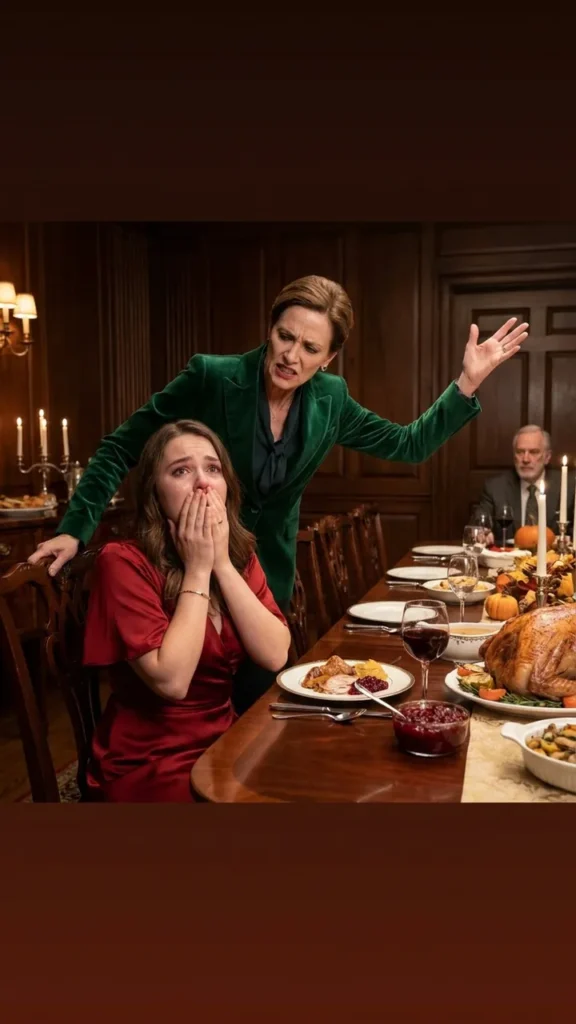
Eleanor stood behind Sarah.
Her knuckles were white where she gripped an invisible boundary.
Her face, a mask of furious disapproval, twisted in a grimace.
She raised her hand.
It was a sharp, decisive movement.
Sarah, in the foreground, looked fragile.
Her face was flushed, her eyes wide with a dawning terror.
Her hands flew to her mouth, muffling a cry that was already building.
“Robinson,” Eleanor’s voice cut through the strained silence.
It was a pronouncement, laced with venom.
Sarah flinched.
She knew what was coming.
She whispered, “Larry-”
Larry, seated across the table, grinned.
He was enjoying this.
His hands moved, a percussive rhythm of anticipation.
“you,” he responded, his voice booming with a cruel amusement.
Eleanor’s hand descended.
It landed not as a slap, but a forceful shove against Sarah’s head, pushing her forward.
Sarah’s scream tore through the room.
It was raw, piercing, a sound of pure agony.
Her eyes squeezed shut, tears blurring her vision.
“yeah,” she choked out, a desperate, broken sound.
“yeah,” Larry echoed, his laughter a cruel counterpoint to her sobs.
Then, Eleanor produced a plate.
It was laden with a thick, glistening, yellowish-brown mass-turkey stuffing, reeking of sage and gravy.
She held it above Sarah’s bowed head.
Sarah could only gasp, her hands still clamped over her face, a futile shield.
“yeah,” she whimpered.
Eleanor tilted the plate.
The contents cascaded downwards.
It was a messy, visceral deluge.
The warm, greasy mass plastered Sarah’s hair to her scalp.
It dripped down her face, her neck, staining the rich red satin of her dress.
The smell of overcooked herbs and gravy filled the air, a sickening perfume.
Sarah hunched over, her shoulders shaking.
The sobs wracked her body, uncontrolled.
Her hands, still covering her face, were now slick with the spilled food.
She was utterly broken.
Eleanor watched, her expression one of grim satisfaction.
Her eyes held a cold, hard glint.
Larry, in the background, continued to clap, his laughter uninhibited.
He found Sarah’s humiliation hilarious.
Arthur, the patriarch, sat silently at the table, a picture of passive observation, his face unreadable.
The once-festive dining room was now a scene of utter devastation.
Sarah, the victim of her own family’s cruelty, could only weep amidst the wreckage of their Thanksgiving.
The food, meant to nourish and bring joy, had become an instrument of her public shaming.
The scent of sage and gravy clung to Sarah like a shroud.
Each ragged breath she took was a fresh wave of shame.
Her red satin dress, once a symbol of a desperate attempt to appear festive, was now a ruined canvas of congealed stuffing.
Her blonde hair, usually meticulously styled, was matted and slicked with the greasy remnants.
Eleanor remained standing, her posture rigid, a queen surveying her conquered territory.
Her lips, usually pursed in perpetual disapproval, were now curved in a faint, chilling smile.
“Look at you,” Eleanor’s voice dripped with disdain, each word a tiny, poisoned dart. “Such a mess.
Just like always.”
Sarah flinched, a tremor running through her already shaking frame.
She couldn’t lift her head, couldn’t face the glares, the barely suppressed smirks.
She could feel the eyes on her, a suffocating weight.
Larry’s laughter erupted again, a braying sound that sliced through the thick silence. “Oh, Sarah, you really outdid yourself this time!
Who knew Thanksgiving stuffing could be so… artistic?” He punctuated this with another clap, loud and deliberate.
Sarah squeezed her eyes tighter, tears still streaming, now mixed with the greasy food.
Her throat felt raw, choked with unshed screams. “Stop,” she whispered, the sound barely audible. “Please, just stop.”
Arthur, the patriarch, finally shifted in his seat.
He cleared his throat, a small, insignificant sound.
His gaze, for a fleeting moment, met Sarah’s.
It was a look devoid of empathy, a clinical assessment.
Then, his eyes drifted back to his plate, as if the scene was an unpleasant but ultimately ignorable detail.
Eleanor stepped closer, her pearl necklace clicking softly against her black dress. “Stop?
Why should we stop?
You’ve been making a spectacle of yourself for years, Sarah.
This is just a more fitting display.” Her tone was icy, cutting.
“You… you always do this,” Sarah managed, her voice cracking.
She finally forced herself to look up, her vision blurred by tears and grease.
She saw Larry, his face alight with malicious glee, his eyes crinkling at the corners.
She saw Eleanor, her face a picture of cold satisfaction, her jaw set.
And she saw Arthur, her father, a silent, impassive statue.
“Do what, darling?” Eleanor purred, a mockingly sweet tone that made Sarah’s stomach churn. “We’re just having a nice family dinner.
You’re the one who’s making a scene.” She gestured vaguely at Sarah’s state. “Honestly, the way you carry on.
It’s embarrassing.”
Sarah’s breath hitched.
Embarrassing?
This was more than embarrassment.
This was torture.
This was designed to break her.
She could feel the heat rising in her cheeks, not from shame, but from a potent mix of humiliation and a burgeoning, terrifying anger.
Larry leaned forward, his grin widening. “Yeah, Sarah.
You always get so dramatic.
Mom’s just trying to make you see things clearly.
Like that stuffing.” He snickered.
Sarah’s hands, still slick with food, clenched into fists at her sides.
She could feel the grit of the stuffing against her skin.
The smell was overpowering, cloying.
It was the smell of her humiliation, seared into her senses.
She wanted to disappear.
She wanted the ground to swallow her whole.
But beneath the tears and the sobs, a tiny spark of defiance began to flicker.
‘Sarah finally pushed herself away from the table.
The scrape of her chair was jarring in the suddenly still room.
Her movements were jerky, uncoordinated, like a puppet with tangled strings.
Her eyes, red-rimmed and swollen, scanned the faces around her.
Eleanor, her lips still pursed in that chillingly superior smirk.
Larry, his amusement a physical presence, a predator enjoying the cornered prey.
And Arthur, his gaze now fixed on his untouched plate, a master of avoidance.
The silence stretched, thick and suffocating, broken only by Sarah’s ragged breathing.
“I… I can’t,” Sarah stammered, her voice barely a whisper.
The words were weak, but they held a new, raw edge.
She looked at her hands, still coated in the greasy stuffing.
It was a tangible symbol of their cruelty. “I can’t… do this anymore.”
Eleanor scoffed, a sharp, dismissive sound. “Can’t do what, dear?
Have a family dinner?
Is it too much for your delicate sensibilities?” Her tone was laced with sarcasm, each word meticulously chosen to wound. “Perhaps if you weren’t always causing trouble, we wouldn’t have to have these… interventions.”
Larry snorted. “Interventions?
More like a culinary masterpiece, Mom.
Sarah, you’re just upset because you didn’t get seconds.” He winked, a gesture of pure malice. “Don’t worry, I’m sure there’s more stuffing in the kitchen.
Maybe you can try a different angle next time.”
Sarah’s hands flew to her mouth, but this time, it wasn’t to stifle a cry.
It was to hold back a sob that threatened to consume her.
The sheer, unadulterated cruelty of it all was staggering.
They weren’t just mocking her; they were relishing her pain.
A hot flush spread from her neck to her hairline.
This wasn’t just a family dinner gone wrong.
This was a systematic dismantling of her spirit.
“You… you think this is funny?” Sarah’s voice rose, cracks appearing in its fragile facade.
Her eyes, no longer solely filled with tears, now held a flicker of something hard and unyielding. “You think hurting me is funny?”
Eleanor tilted her head, her blonde hair perfectly coiffed. “Darling, you are the one making a scene.
We are merely reacting to your… peculiar behavior.” She gestured with a delicate hand, the pearl necklace shimmering. “Honestly, the way you dramatize everything.
It’s exhausting.”
“Peculiar behavior?” Sarah’s voice was a low growl now. “Is it peculiar to want to be treated like a human being?
Is it peculiar to expect respect from your own family?” Her gaze swept across their faces, searching for a flicker of remorse, of understanding.
She found none.
Only cold amusement and passive indifference.
Larry leaned back, a smug expression on his face. “Oh, Sarah, here we go.
The victim routine.
It’s getting a little old, don’t you think?
Maybe you should have thought about that before you made such a mess of things.” He gestured at her dress. “Literally.”
The insult, so casual, so cruel, landed like a physical blow.
Sarah’s breath hitched.
She felt a surge of something primal, something born of years of suppressed hurt and indignation.
The sight of the stuffing clinging to her skin, the smell filling her nostrils, the sound of their laughter echoing in her ears – it all coalesced into a single, burning point of rage.
“You know what?” Sarah said, her voice trembling, but with a newfound strength.
She stood taller, ignoring the sticky mess that dripped from her hair. “You’re right.
I am making a mess.” She looked directly at Eleanor, her eyes blazing. “And you know who made this mess?
You did.
And you,” she turned her fiery gaze on Larry, “you encouraged her.”
A hush fell over the table, an almost palpable shock.
Larry’s smirk faltered for a fraction of a second.
Eleanor’s perfectly sculpted eyebrows rose slightly.
Arthur, for the first time, looked up from his plate, his gray eyes meeting Sarah’s with a flicker of something unreadable – perhaps surprise, perhaps a hint of unease.
“This isn’t a mess,” Sarah continued, her voice gaining momentum. “This is a declaration.
I am done.
Done with your cruelty.
Done with your games.
Done with being your punching bag.” She took a step back, her movements no longer jerky, but deliberate. “And I’m not going to sit here and let you pretend this is okay.”
She turned her back on them, her shoulders squared, the remnants of the stuffing a vivid testament to her ordeal.
The air in the room crackled with unspoken tension, a stark contrast to the festive atmosphere just moments before.
The feast, now a symbol of familial discord, lay forgotten.
Sarah didn’t look back.
Each step away from the table felt like a liberation, a shedding of a suffocating skin.
The dining room, with its opulent decor and the suffocating weight of her family’s judgment, receded behind her.
She could still hear Eleanor’s sharp intake of breath, Larry’s surprised grunt, and the unnerving silence from Arthur.
The scent of gravy and sage, however, was a persistent, nauseating reminder of what had just transpired.
She walked through the hushed hallways of the grand house, her footsteps echoing on the polished wood floors.
The red satin of her dress felt heavy, clinging uncomfortably to her skin, a constant, tangible reminder of the public humiliation.
She could feel the sticky residue in her hair, a gritty sensation that sent shivers down her spine.
Her hands were still slick, the smell of sage clinging to her fingertips.
She reached the grand double doors of the entrance and fumbled with the latch, her hands trembling slightly, not entirely from fear, but from the residual adrenaline and the dawning realization of her own defiance.
As she pulled the doors open, a blast of cool evening air hit her face, a welcome contrast to the stifling atmosphere inside.
She stepped out onto the manicured lawn, the vibrant red of her dress a stark contrast against the darkening twilight.
She didn’t know where she was going, only that she couldn’t stay.
The idea of calling a taxi, of having a stranger see her like this, felt overwhelming.
But the thought of returning to that room, to their faces, was unbearable.
As she stumbled onto the gravel driveway, her sobs, which she had been desperately trying to suppress, finally broke free.
They were raw, guttural sounds of pain, frustration, and a deep, crushing sadness.
Her shoulders shook uncontrollably, and she sank to her knees, the cool gravel digging into her skin.
Suddenly, a voice, sharp and concerned, cut through her distress. “Sarah?
Oh my God, Sarah, what happened?”
Sarah’s head snapped up.
Standing a few feet away, illuminated by the porch light, was her cousin, Emily.
Emily, who had arrived later and missed the main event, her face etched with alarm and confusion.
Emily, in her own sensible sweater and jeans, a picture of normalcy against Sarah’s disheveled state.
Sarah’s vision was blurred by tears, but she could see the genuine horror on Emily’s face as she took in Sarah’s appearance.
The stuffing matted in her hair, the streaks down her face and dress, the tear-soaked remnants of her once-beautiful gown.
“Emily,” Sarah choked out, her voice hoarse.
She tried to speak, to explain, but the words caught in her throat.
The trauma of the event, the shock, the humiliation – it all came crashing back. “Mom… she… she…”
Emily rushed forward, kneeling beside Sarah. “Hey, hey, it’s okay.
Just breathe.
Tell me what happened.” Her voice was gentle, comforting, a stark contrast to the venom Sarah had just endured.
Sarah’s breath hitched.
She looked at Emily’s kind, concerned eyes and something inside her broke.
The dam of suppressed emotion finally gave way. “She… she threw food at me, Emily,” Sarah whispered, the words barely audible above her sobs. “Mom.
She threw… stuffing.
All over me.
In front of everyone.”
Emily’s eyes widened, a look of disbelief mixed with dawning horror. “She what?”
“And Larry,” Sarah continued, the words tumbling out in a torrent now, fueled by Emily’s supportive presence. “Larry just laughed.
He thought it was hilarious.
He kept laughing.
And Dad… Dad didn’t do anything.
He just sat there.” The mention of her father’s inaction sent another wave of pain through her.
It was the betrayal of silence that often cut the deepest.
Emily gently placed a hand on Sarah’s shoulder, her touch a grounding force. “That’s… that’s awful, Sarah.
I’m so sorry.”
Sarah looked down at her hands again, the lingering greasiness a stark reminder. “She said I was making a mess.
That I was embarrassing them.
She said… she said I deserved it.” A fresh wave of tears cascaded down Sarah’s cheeks.
The words, spoken aloud, felt even more brutal, more devastating than when she had heard them spoken in the dining room.
The injustice of it all, the calculated cruelty, the utter lack of remorse – it was too much to bear.
Emily pulled Sarah into a comforting embrace, her whispered reassurances a small balm to Sarah’s wounded spirit.
CHAPTER 2: The Digital Deluge
‘Emily helped Sarah to her feet.
The porch light cast long shadows, making Sarah’s disheveled state even more stark. “Come on, let’s get you inside, out of this chill,” Emily said, her voice firm with purpose.
She guided Sarah towards the front door, her arm a steadying presence.
Inside, the air was warmer, but the oppressive silence of the house felt even more profound after the confrontation on the lawn.
Sarah, still sobbing intermittently, followed Emily into the living room.
The remnants of the Thanksgiving feast were still visible on the dining room table through the open doorway – a grotesque tableau of fractured family life.
Emily gently steered Sarah to the plush sofa.
She sat beside her, pulling a soft blanket around her shoulders. “You’re shaking,” Emily observed softly.
Sarah nodded, her teeth chattering. “It’s… it’s so cold.
And the smell…” She buried her face in her hands again.
Emily looked at her, her brow furrowed with concern. “Sarah, was this… was this planned?”
Sarah looked up, her eyes raw and red. “No.
Not like that.
She always finds a way to humiliate me.
Always.
But this… this was different.
It was so… deliberate.” Her voice cracked. “She hates me, Emily.
She really hates me.”
“Don’t say that,” Emily said, her voice sharp with a protective instinct. “Your mother is… complicated.
But she doesn’t hate you.”
Sarah let out a hollow laugh. “Then what is this?
Because I didn’t agree with her about something?
Because I looked at her the wrong way?
She waited until everyone was watching.
She wanted me to be utterly ashamed.” Tears welled up again. “And Larry… he loved it.
He was practically cheering her on.
And Dad… he just watched.” The words, spoken aloud to a sympathetic ear, seemed to magnify the cruelty.
Emily pulled out her phone. “I need to call someone,” she stated, her gaze hardening. “This isn’t okay.
This is abuse, Sarah.”
“No, no, don’t,” Sarah pleaded, her voice trembling. “It will just make things worse.
Mom will be furious.”
“Furious?
Sarah, she assaulted you with food!” Emily exclaimed, her voice rising in disbelief. “And your father stood by and did nothing.
This isn’t just a family squabble.
This is wrong.” Emily’s thumbs hovered over her phone screen. “I’m calling my dad.
And I’m going to tell him everything.”
Sarah watched, a knot of anxiety tightening in her stomach.
The thought of more people knowing, of the drama escalating, felt terrifying.
Yet, a small part of her felt a flicker of something akin to hope.
Emily began to dial, her expression resolute.
As Emily spoke in hushed, urgent tones to her father, Sarah noticed her phone buzz on the coffee table.
It was a notification from a social media app.
A live video.
Titled: “Thanksgiving Dinner Gone Wild!”
Her breath hitched.
Someone had filmed it.
Someone had captured the entire horrific scene.
She picked up her phone, her hands still sticky and smelling of sage.
The video was short, grainy, but unmistakably her.
The camera, held at an unsteady angle, captured Eleanor’s raised plate, the sickening cascade of stuffing, Sarah’s scream, and Larry’s raucous laughter.
It was horrifying.
It was real.
And it was already spreading.
Emily, finishing her call, turned back to Sarah. “Okay, my dad is coming over.
He’ll know what to do.” She then noticed Sarah staring at her phone, her face pale. “What is it?”
Sarah showed her the phone, her finger trembling as she pointed to the live video.
Emily’s eyes widened in shock. “No way.
Someone actually… filmed it?”
Sarah nodded, a fresh wave of nausea washing over her. “They’re calling it ‘Thanksgiving Dinner Gone Wild.’ It’s… it’s already being shared.” The realization hit her with full force.
This wasn’t just happening in their dining room anymore.
This was out there.
For the world to see.
The video, raw and unedited, spread like wildfire across social media platforms.
Within hours, “Thanksgiving Dinner Gone Wild” was trending.
Snippets of Eleanor’s furious expression, the sickening splatter of stuffing, and Larry’s cruel laughter were being dissected, shared, and commented on by thousands.
The initial shock of the act was compounded by the visible, undeniable evidence.
Public opinion, fueled by Sarah’s visible distress and the stark contrast of Emily’s concerned intervention captured in the background of some footage, quickly coalesced.
Eleanor, initially dismissive, found her carefully curated world unraveling.
Her phone began to ring incessantly, not with congratulatory calls, but with furious accusations and concerned inquiries.
Friends and acquaintances, previously privy to her image of a refined matriarch, were now seeing her in a completely different light.
News outlets, alerted by the online buzz, began to investigate.
Whispers turned into headlines.
The “woman who assaulted her daughter with stuffing” became a national talking point.
Online forums buzzed with outrage.
People shared their own stories of familial abuse, finding solidarity in Sarah’s plight.
Larry’s jovial facade crumbled under the scrutiny.
His amusement at Sarah’s suffering was now viewed as a deeply disturbing lack of empathy.
Colleagues began to distance themselves.
His social media, once filled with boisterous posts, was now being flooded with negative comments.
The light-hearted banter he had shared with his mother was re-contextualized as toxic enablement.
His laughter, once a sound of perceived wit, was now a symbol of callous cruelty.
Arthur, the silent observer, found his passivity under a harsh spotlight.
His refusal to intervene, his stoic indifference, was no longer seen as reserved composure but as tacit approval of abuse.
His business associates questioned his character.
His children, even those not present, were bombarded with questions and condemnation.
His carefully constructed image of a respectable patriarch was tarnished by his inaction.
Sarah, initially paralyzed by humiliation, found herself at the center of an unexpected storm of public support.
Strangers offered messages of solidarity, validation, and outrage on her behalf.
Donations poured into online fundraisers set up by concerned individuals to help her find stability.
The raw emotion captured in the video, the undeniable vulnerability, resonated deeply.
She was no longer just a victim in her family’s private drama; she was a symbol for countless others who had suffered similar injustices in silence.
Emily, standing by Sarah, became an unexpected advocate.
She spoke to the media, providing context and details of Sarah’s emotional and physical well-being.
Her calm, rational demeanor and unwavering support for Sarah highlighted the stark contrast with Eleanor and Larry’s behavior.
She ensured Sarah’s voice was heard, not just through the viral video, but through carefully worded statements that emphasized the long-term psychological impact of such abuse.
The immediate aftermath for Eleanor and Larry was social ostracization.
They were uninvited from events, their names whispered with disdain.
The family home, once a symbol of prosperity, became a place of shame.
For Arthur, it was a slow erosion of respect, a quiet condemnation that left him isolated.
Sarah, though still processing the trauma, began to heal.
The public outcry, while intense, provided a sense of justice.
Her suffering, once confined to the oppressive walls of her family home, was now validated on a global stage, offering a glimmer of hope that such acts would no longer be tolerated, even within the sanctity of a family dinner.
‘The digital storm raged, and the Robinson household, once a bastion of privilege, was now under siege.
Eleanor, accustomed to controlling every narrative, found herself utterly powerless.
Her phone was a relentless siren of condemnation.
Each ring was a fresh wave of public judgment.
Friends, once sycophants, now offered platitudes laced with thinly veiled shock.
The carefully constructed image of the elegant matriarch had shattered, replaced by the viral GIF of her stuffing-wielding rage.
“Eleanor, have you seen the news?” a strained voice crackled through the receiver.
It was Beatrice, Eleanor’s sister-in-law, her tone a brittle mix of concern and thinly veiled schadenfreude. “They’re calling you the ‘Stuffing Scourge’ on that morning show.
It’s… unpleasant.”
Eleanor scoffed, her grip tightening on the cordless phone. “Idle gossip, Beatrice.
They don’t understand family dynamics.
Sarah was being utterly unreasonable.” Her voice, though weak, still held a desperate flicker of her usual imperiousness.
“Unreasonable?
Eleanor, you assaulted your own daughter!
In front of the entire family, and now the world!” Beatrice’s voice rose, the pretense of concern evaporating. “Arthur is beside himself.
He’s been fielding calls all morning.
Someone even sent him a link to a petition demanding you face charges.”
“Charges?
For a Thanksgiving mishap?” Eleanor’s laugh was a harsh, broken sound. “This is preposterous.
Sarah is a drama queen.
Always has been.” She paced the length of her immaculate living room, the polished mahogany floor reflecting her agitated movements.
Meanwhile, Larry was attempting damage control, albeit in his own misguided way.
He sat in a dimly lit bar, nursing a whiskey, scrolling through comments on the viral video. “Honestly, it wasn’t even that much stuffing,” he muttered to himself, a defensive bravado seeping into his tone.
He’d even tried to post a flippant remark, “Just a little holiday spirit!” but it had been met with an avalanche of digital fury.
His face, usually alight with amusement, was now a mask of grim concern.
His phone buzzed.
It was a text from his boss: “Larry, we need to have a conversation.
Urgently.
About your… public persona.” The implied threat hung heavy in the air.
His jovial demeanor, once an asset, was now a liability.
He had gone from “lovable rogue” to “enabler of domestic abuse” in the public’s eyes.
Arthur, the stoic patriarch, sat in his study, the blinds drawn, creating a twilight gloom.
He hadn’t spoken a word since the video went live.
His silence was a deafening indictment.
He’d received a terse email from the board of his charitable foundation: “Arthur, given the current public scrutiny, we believe it would be prudent for you to take a leave of absence.” His reputation, built over decades of careful cultivation, was crumbling like dry earth.
He picked up a framed photograph of his family, his gaze lingering on Sarah’s smiling face from a happier time.
A knot of regret, cold and sharp, tightened in his chest.
Sarah, cocooned in Emily’s quiet apartment, was watching the news unfold on Emily’s laptop.
The pundits debated the legal implications, the psychological ramifications, the moral failings.
It was surreal, witnessing her private agony broadcast to millions.
Emily sat beside her, a steady, comforting presence.
“They’re saying they might press charges, Em,” Sarah whispered, her voice raspy. “Against Mom.”
Emily nodded, her jaw tight. “It’s possible, Sarah.
What she did was criminal.
And Dad’s position… it’s untenable.
He can’t hide from this anymore.”
“I just… I can’t believe it,” Sarah murmured, running a hand through her now-clean hair.
The lingering scent of sage still haunted her. “It all happened so fast, and then… it was everywhere.”
“It’s a lot,” Emily said softly, squeezing Sarah’s hand. “But look at the support, Sarah.
Look at all these people who are standing with you.
You’re not alone in this.” Sarah looked at the screen, at the flood of comments expressing sympathy and outrage.
For the first time since the incident, a fragile sense of hope flickered within her.
The fallout continued to ripple through the Robinson family, exposing the rot beneath their polished surface.
Eleanor, desperate to regain control, attempted a public apology.
It was a disaster.
Delivered via a shaky, pre-recorded video message, it was filled with platitudes and self-pity, never once admitting genuine remorse.
She blamed “misunderstandings” and “a moment of lost temper,” framing herself as the victim of a public frenzy.
This only intensified the backlash.
Online commenters lambasted her for her insincerity, her lack of accountability.
The “Stuffing Scourge” became a meme, a symbol of narcissistic entitlement.
“She’s trying to spin it!” Larry exclaimed, throwing his phone onto the plush sofa in his sparsely furnished apartment.
He’d been fired.
His boss, a stern man with zero tolerance for scandal, had been unequivocal. “Your association with this incident is detrimental to the company’s image, Larry.
We can’t have that kind of liability.” He picked up his phone again, scrolling through news articles detailing Eleanor’s failed apology. “She’s digging herself deeper.”
Arthur, meanwhile, had retreated further into his study.
The quiet of the room offered little solace.
He had received a formal letter from the foundation informing him of his immediate dismissal.
The shame was a heavy cloak.
He knew he had failed Sarah.
His silence had been a betrayal.
He looked at his hands, the hands that had signed contracts, managed empires, but had refused to reach out and stop his wife from hurting their daughter.
A deep weariness settled over him.
His legacy was not one of strength, but of cowardice.
Sarah, with Emily’s unwavering support, was preparing to speak publicly.
Not in a manufactured apology, but in a raw, honest interview designed to reclaim her narrative.
She met with a seasoned journalist, her voice trembling at first, then gaining strength as she recounted the full extent of her family’s dysfunction.
She spoke of the constant emotional manipulation, the belittling remarks, the insidious ways her mother chipped away at her self-worth.
She didn’t shy away from describing Larry’s cruel amusement and Arthur’s passive complicity.
“It wasn’t just about the stuffing,” Sarah explained, her eyes meeting the journalist’s directly. “It was about years of feeling invisible, of being constantly criticized.
That night, in front of everyone, was just the breaking point.
They wanted to break me.
But they didn’t.” She looked down at her hands, the faint smell of sage still a phantom memory. “They just made me stronger.
They made me realize I deserved better.”
The interview aired, and it resonated even more powerfully than the initial video.
Sarah’s vulnerability, her resilience, and her articulate condemnation of her family’s actions struck a chord.
The public outpouring of support intensified.
People shared stories of their own experiences with narcissistic parents and unsupportive partners, finding in Sarah’s voice a reflection of their own struggles.
Crowdfunding campaigns for Sarah’s therapy and future endeavors surpassed their goals.
Eleanor, seeing the unwavering public support for Sarah, finally understood the true depth of her defeat.
Her carefully constructed world, built on fear and manipulation, had crumbled.
She was no longer the matriarch; she was a pariah.
Larry, too, faced the consequences of his jovial cruelty, his social life in ruins.
Arthur remained a figure of quiet disgrace, his silence a permanent stain on his reputation.
Sarah, though forever marked by the trauma, had found her voice, her strength, and a global community that stood with her, a testament to the fact that even the most shattering of events could lead to liberation.
CHAPTER 3: The Lingering Scars
‘Eleanor sat in her silent, opulent living room.
The polished mahogany gleamed, but it offered no comfort.
Her phone lay on the antique coffee table, a dormant weapon.
The “Stuffing Scourge” moniker, hurled by faceless voices online, had burrowed deep, a constant, festering insult.
Her carefully constructed facade of grace and superiority had been ripped away, leaving her exposed and contrite, though she’d never admit the latter.
The public apology, a desperate, televised Hail Mary, had backfired spectacularly.
Her words, laced with a practiced sweetness that dripped of manipulation, had only fueled the fire.
Online commenters dissected her every pause, her every carefully chosen word, finding only the hollow echo of her own narcissism.
Memes of her contorted face, superimposed onto kitchen appliances, were now a permanent fixture on the internet’s landscape.
Larry nursed his third whiskey in the same dim bar, the sticky residue of spilled drinks a stark contrast to his once-pristine appearance.
His phone, now a symbol of his downfall, sat face down beside his glass.
The text message from his boss was a ghost that haunted him. “Your association with this incident is detrimental to the company’s image, Larry.
We can’t have that kind of liability.” Fired.
The jovial rogue, the lovable clown, had been transformed into the enabler of a domestic assault.
His social circle had vanished like smoke, replaced by awkward silences and averted gazes.
He’d tried to defend himself, to joke it away, but the laughter had died on his lips, choked by the sheer weight of public condemnation.
Arthur, the stoic patriarch, was a prisoner in his own study.
The drawn blinds cast long, oppressive shadows, mirroring the darkness that had settled over his life.
A formal letter from the foundation lay on his desk, its crisp edges a stark reminder of his disgrace.
Immediate dismissal.
The shame was a heavy, suffocating blanket.
He had failed Sarah.
His silence, his passive observation, had been a profound betrayal.
He looked at his hands, hands that had commanded boardrooms, signed multi-million dollar deals, but had been paralyzed, frozen, unwilling to intervene when his own wife had attacked their daughter.
A profound weariness, bone-deep and soul-crushing, had enveloped him.
His legacy, once a monument to achievement, was now a testament to cowardice.
Sarah, a sanctuary found in Emily’s quiet apartment, watched the news unfold on Emily’s laptop.
The television pundits debated, their voices a cacophony of analysis and judgment.
Legal implications.
Psychological ramifications.
Moral failings.
It was a surreal, agonizing spectacle, her private agony dissected and broadcast to millions.
Emily sat beside her, a steadfast anchor in the storm, her presence a silent reassurance.
“They’re saying they might press charges, Em,” Sarah whispered, her voice a fragile thread, raspy from days of weeping. “Against Mom.”
Emily nodded, her jaw tight with a controlled anger. “It’s possible, Sarah.
What she did was criminal.
And Dad’s position… it’s untenable.
He can’t hide from this anymore.
His silence is his guilt.”
“I just… I can’t believe it,” Sarah murmured, running a hand through her now-clean hair, though the phantom scent of sage still clung to her. “It all happened so fast, and then… it was everywhere.
My whole life, suddenly public property.”
“It’s a lot,” Emily said softly, her fingers finding Sarah’s, squeezing them with a comforting pressure. “But look at the support, Sarah.
Look at all these people who are standing with you.
You’re not alone in this.
You’ve started something important.”
Sarah looked at the screen, at the tidal wave of comments expressing sympathy, outrage, and solidarity.
For the first time since the brutal act, a fragile, tentative ember of hope flickered within her.
The public outcry was a balm, a validation that her pain was seen, her suffering acknowledged.
But the scars remained, etched deep into her psyche.
The memory of the stuffing, the smell, the feel of it clinging to her skin, would likely never fully fade.
The digital storm had subsided, leaving behind a landscape irrevocably altered.
Eleanor, stripped of her veneer of respectability, found herself ostracized.
The whispers followed her, not of admiration, but of revulsion.
Her attempts at damage control were laughable.
A series of carefully orchestrated “charitable appearances” fell flat, her smile too brittle, her words too rehearsed.
Each forced interaction was a reminder of her fall from grace, her public persona irrevocably tainted.
Friends who had once courted her favor now offered polite, distant nods.
The opulent mansion, once a symbol of her power, now felt like a gilded cage, her confinement complete.
Larry, no longer the life of the party, now found himself the pariah.
His jovial laughter was silenced, replaced by a gnawing anxiety.
He’d spent days crafting a heartfelt apology, rehearsing it in front of his bathroom mirror, but the words felt hollow, a pathetic attempt to rewrite history.
He’d even tried reaching out to Sarah, a desperate text message that went unanswered.
The silence was deafening.
He’d lost his job, his reputation, and the easy camaraderie he’d once taken for granted.
He now spent his evenings alone, the glow of his phone screen the only company, endlessly scrolling through articles that detailed his complicity, his role as the gleeful spectator to his sister’s humiliation.
Arthur, a ghost in his own home, remained locked in his study.
The outside world had become too much to bear.
The foundation had officially terminated his contract, a cold, clinical document that sealed his fate.
He replayed the Thanksgiving dinner in his mind, a recurring nightmare.
He saw Sarah’s terrified eyes, Eleanor’s furious glare, Larry’s cruel grin.
He saw himself, a silent statue, an accomplice through inaction.
He picked up the framed photograph of his family again, his gaze fixed on Sarah’s youthful, unblemished face.
A single tear traced a path down his weathered cheek, a silent acknowledgment of his profound failure.
He had built an empire, but he had failed to protect his own daughter.
Sarah, her voice now a clear, resonant instrument, continued to share her story.
The interview had been a turning point, not just for her, but for countless others.
Her raw honesty had ignited a movement.
The support poured in, a torrent of empathy and encouragement.
Crowdfunding campaigns for her therapy and future endeavors had not just met, but far surpassed their goals.
She was no longer just a victim; she was a symbol of resilience, a beacon of hope for those trapped in abusive familial dynamics.
She had found her voice, a powerful weapon forged in the fires of her trauma.
The public outcry had been a catalyst, a force that had shattered the carefully constructed facade of the Robinson family.
Eleanor was left to confront the wreckage of her own making, her reign of emotional terror over.
Larry faced the consequences of his complicity, his jovial facade dissolving into a stark reality.
Arthur, the passive patriarch, was forced to grapple with the weight of his inaction, his silence a permanent stain on his conscience.
Sarah, though forever marked by the experience, had emerged from the ashes, stronger, liberated, and finally free.
The echo of her liberation resonated not just in her own life, but in the lives of so many who found courage in her amplified voice.
‘Sarah sat across from her lawyer, Ms. Davies, in a stark, minimalist office.
The city buzzed below, a distant hum that couldn’t penetrate the charged atmosphere within.
Sarah’s hands, usually steady, trembled slightly as she traced the rim of a water glass.
“They’ve filed their response, Sarah,” Ms. Davies said, her voice calm but firm.
She slid a sheaf of papers across the polished desk. “Eleanor’s legal team is attempting to paint this as a… a ‘family dispute,’ a regrettable overreaction on your part to an incident with minor repercussions.”
Sarah’s breath hitched. “Minor repercussions?
She… she shoved stuffing all over me.
In front of everyone.” Her voice cracked, the raw wound reopening. “And Dad just sat there.
Larry just laughed.”
“I understand,” Ms. Davies said, her eyes softening with a professional sympathy. “But their strategy is clear: to dismiss it as domestic squabbling, something that should be handled privately, not in court.
They’re arguing you’re exaggerating the emotional distress.”
“Exaggerating?” Sarah’s voice rose, a tremor of anger beneath the hurt. “I haven’t slept properly in weeks.
Every time I close my eyes, I can still smell it.
Feel it.
And the way Larry looked… like it was a joke.
Like I was the joke.”
Ms. Davies picked up a pen. “Eleanor is claiming provocation.
That you were being defiant, disrespectful.
That the stuffing was… a misguided attempt at discipline.
They’ve even brought up your past disagreements, painting you as volatile.”
Sarah recoiled. “Defiant?
I asked for help!
I called for Larry.
And she attacked me.
This isn’t discipline, it’s abuse.
It’s been abuse for years, but I never had proof.
Now everyone saw it.
The whole world saw it.”
“And that’s our leverage, Sarah,” Ms. Davies countered, leaning forward. “The recordings.
The viral spread.
While they try to frame it as a private matter, the public nature of the assault changes everything.
We have witnesses, albeit online ones.
We have the undeniable visual evidence.
They can’t erase that.
Their attempt to minimize it only highlights their desperation.”
Sarah looked down at the papers, at the cold, legal jargon that sought to reduce her humiliation to a series of technical points. “What about Dad?
Will he testify?”
Ms. Davies sighed. “Arthur’s deposition was… difficult.
He’s maintaining his stance of having been an uninvolved observer.
He claims he didn’t fully grasp the severity of the situation in the moment.
His loyalty, it seems, lies with Eleanor, or perhaps with maintaining the family name, however tarnished.”
“So he’s just going to let her get away with it?” Sarah’s voice was a low whisper, filled with a profound disappointment.
“He’s making a choice, Sarah,” Ms. Davies said gently. “A choice that will have consequences.
We’re pushing for a restraining order, and a settlement that reflects the profound emotional and psychological damage.
But their tactics are designed to wear you down.
To make you question your own reality.”
Sarah took a deep breath, the scent of expensive paper and stale air filling her lungs.
She closed her eyes, picturing the bright red of her dress, the greasy yellow-brown of the stuffing, the unyielding faces around the table.
She saw Larry’s laughter, Eleanor’s triumphant sneer.
But this time, she also saw the faces of strangers online, sending her messages of support, of shared experiences.
“I’m not letting them win,” Sarah stated, her voice regaining a steely edge. “This isn’t just about me anymore.
It’s about every time someone else has been silenced, humiliated, or abused by their own family and told it’s their fault.”
She looked directly at Ms. Davies. “Let them file whatever they want.
I’m ready to fight.”
The courtroom was a sea of faces, a terrifyingly vast expanse that pressed in on Sarah.
The air crackled with anticipation, a palpable tension that seemed to vibrate through the polished wood of the benches.
Reporters, their notebooks clutched like weapons, scribbled furiously.
The public gallery was packed, a silent, judging jury.
Sarah, dressed in a simple, understated navy suit, sat beside Ms. Davies, her hands clasped tightly in her lap.
The familiar phantom scent of sage and gravy seemed to waft through the sterile air, a cruel olfactory ghost.
Eleanor sat opposite, a picture of defiant composure.
Her pearl necklace gleamed under the harsh fluorescent lights.
Her expression, though outwardly serene, held a brittle edge, a carefully constructed mask that Sarah knew hid a simmering rage.
Larry, looking unusually subdued, sat a few seats away from his mother, his usual joviality replaced by a grim unease.
Arthur, his face a roadmap of weary resignation, occupied a seat beside Eleanor, his gaze fixed on some distant point, a man trapped in his own silence.
Ms. Davies began her opening statement, her voice clear and unwavering, cutting through the hushed murmurs.
She painted a vivid picture of the Thanksgiving dinner, of the simmering resentment, of Eleanor’s escalating aggression.
She detailed the physical assault, the humiliation, and the profound psychological impact it had on Sarah.
She spoke of the viral nature of the event, the undeniable evidence, and how it was not merely a private family quarrel, but a case of domestic assault that had been broadcast to the world.
Then, Eleanor’s lawyer, a sharp-faced woman named Ms. Stern, rose to speak.
Her voice was like ice, cutting and precise.
She dismissed Sarah’s claims as exaggerated, a bid for attention and financial gain.
She painted Eleanor as a concerned mother, forced to react to a spoiled and disrespectful daughter.
She characterized the stuffing incident as an unfortunate, albeit messy, attempt at parental correction.
She even suggested Sarah had staged parts of the event for social media.
Sarah flinched at the accusations, the sheer audacity of it.
She could feel the eyes of the courtroom on her, dissecting her, judging her.
She focused on her breathing, on the steady presence of Ms. Davies beside her.
The first witness called was a distant cousin, a woman who had attended the dinner.
Under Ms. Davies’ gentle questioning, she described the tense atmosphere, Eleanor’s palpable anger, and Sarah’s increasing distress.
She confirmed Eleanor’s aggressive posture and the force with which Sarah’s head was pushed.
However, when questioned by Ms. Stern, she admitted she hadn’t seen the moment the stuffing was thrown, having been momentarily distracted.
Next was Larry.
He took the stand, his usual swagger absent.
Ms. Davies’ questions were direct. “Mr. Robinson, did you witness your mother assault your sister?”
Larry shifted uncomfortably. “She… she pushed her head.
I saw that.”
“And your reaction?” Ms. Davies pressed. “You laughed.”
Larry’s face flushed. “It was… it was a shocking situation.
I didn’t know how else to react.
It was a bit… absurd, wasn’t it?
All that food?”
“So you found your sister’s distress amusing?” Ms. Davies’ voice was sharp.
“No, no, of course not!” Larry stammered. “I just… I’m not good under pressure.”
Ms. Stern, during her cross-examination, tried to portray Larry as a sympathetic figure, caught between his mother and sister, a peacemaker trying to diffuse a tense situation with humor.
She highlighted his apologies to Sarah after the event.
Then it was Eleanor’s turn.
She sat with an almost regal bearing, her answers carefully rehearsed.
She spoke of Sarah’s ‘rebellious streak,’ her ‘ungrateful nature.’ She described the stuffing as a regrettable but necessary measure. “My daughter needed to be taught a lesson in respect,” she stated, her voice dripping with a false sincerity. “She was out of control.
I was simply… correcting her behavior.
The media has blown this entirely out of proportion.”
Ms. Davies’ cross-examination was relentless.
She presented clips of the viral video, forcing Eleanor to confront the visual evidence.
She highlighted the sheer violence of the act, the mess, the smell, and Sarah’s screams. “Is this how you discipline your children, Mrs. Robinson?
With a plate of food?
Is this ‘correcting behavior’ or is this public humiliation?
Is this an act of a loving mother or a vengeful one?”
Eleanor’s composure began to crack.
Her voice grew louder, her accusations more desperate. “She deserved it!
She was so rude, so disrespectful…”
The courtroom buzzed.
The public gallery leaned forward.
The trial was not just about Sarah and Eleanor; it was a public dissection of a family’s dysfunction, a stark portrayal of cruelty and complicity laid bare for all to see.
CHAPTER 4: Arthur’s Testimony
‘The courtroom felt impossibly small, suffocating even.
Arthur Robinson, the patriarch, was called to the stand.
His gray hair was slicked back, his dark suit immaculate, a stark contrast to the emotional chaos that had unfolded.
He sat heavily in the witness chair, his usual reserved demeanor amplified by a palpable weariness.
Ms. Davies approached him, her expression one of measured calm.
“Mr. Robinson,” she began, her voice projecting clearly, “you were present at the Thanksgiving dinner on November 26th of last year.
Can you describe the atmosphere leading up to the incident?”
Arthur cleared his throat, the sound amplified by the microphone. “It was… a family gathering.
As they always are.” His eyes flickered towards Eleanor, then quickly away.
“And the atmosphere within the dining room specifically?” Ms. Davies pressed. “Was it harmonious?
Or were there tensions?”
He hesitated. “There are always… discussions.
Minor disagreements.”
“Were these disagreements ‘minor’ on that evening, Mr. Robinson?
Or was there a palpable sense of animosity?”
Arthur shifted, his gaze dropping to his hands, which rested clasped on the table. “Eleanor was… displeased.
About certain matters.”
“Displeased enough to… physically assault your daughter?” Ms. Davies’ voice remained level, but the question hung in the air like a thunderclap.
A collective gasp rippled through the public gallery.
Eleanor’s face tightened, a flicker of something akin to panic crossing her features before she regained her glacial composure.
Arthur took a slow, deep breath. “I… I didn’t see it as an assault, precisely.
It was a regrettable incident.”
Ms. Davies leaned closer. “Regrettable?
Mr. Robinson, witnesses, including your son, have testified that you saw your wife shove Sarah’s head forcefully.
And then, you witnessed her pour a plate of food onto your daughter.
Can you confirm that?”
Arthur’s jaw tightened. “I saw… Eleanor put food on Sarah.
It was messy.
Unpleasant.”
“Unpleasant,” Ms. Davies echoed, her tone sharpening. “Mr. Robinson, your daughter was in distress.
Her screams were heard.
Did you intervene?”
He finally met Ms. Davies’ gaze, his eyes filled with a profound sadness. “I… I didn’t know what to do.
It happened so quickly.”
“You didn’t know what to do?” Ms. Davies repeated, incredulous. “Your daughter was being publicly humiliated, assaulted with food by her own mother.
Your son was laughing.
And you, the patriarch, did nothing?
You simply observed?”
“I… I try to avoid conflict,” Arthur mumbled, his voice barely audible. “I thought… perhaps it would blow over.
That it wasn’t my place.”
“Not your place?” Ms. Davies’ voice rose, a controlled fury evident. “To protect your daughter from a violent attack?
To stop your wife from further degrading her child?
Is that the role of a father in your estimation, Mr. Robinson?
To be a passive observer of familial abuse?”
Eleanor hissed something inaudible.
Ms. Stern immediately objected.
The judge overruled.
“Mrs. Robinson,” Ms. Davies continued, her gaze now fixed on Eleanor, but her words directed at Arthur, “your husband claims you were displeased.
Larry claims he found the situation ‘absurd.’ And you, Mrs. Robinson, you claim it was a form of ‘discipline.’ Mr. Robinson, in your opinion, was this an act of discipline, or an act of cruelty?”
Arthur looked at his wife, then at his daughter.
His shoulders slumped. “It was… too much,” he whispered. “Far too much.”
“So you admit it was cruel?” Ms. Davies pressed.
“I admit… it was wrong,” Arthur finally conceded, the words heavy with a lifetime of regret. “I should have done something.
I should have stopped it.
I am ashamed of my inaction.”
The courtroom was silent, the weight of Arthur’s admission hanging in the air.
His testimony, though late, provided a crucial validation of Sarah’s experience.
It exposed not only Eleanor’s brutality but also Arthur’s complicity through his silence.
Ms. Stern, seeing the damage, quickly moved to re-examine, attempting to portray Arthur as confused and unreliable.
But the seeds of doubt about Eleanor’s narrative had been firmly sown.
Sarah watched her father, a complex mix of relief and sorrow washing over her.
His words, however inadequate, were an acknowledgment of the truth.
The courtroom buzzed with nervous energy as the judge prepared to deliver the verdict.
Sarah sat rigid, her gaze fixed on the bench.
The ordeal had taken its toll; the vibrant color had leached from her cheeks, leaving her looking drawn and fragile, yet an unyielding resolve hardened her eyes.
Eleanor, by contrast, appeared almost bored, her expression conveying an air of entitlement, as if the outcome was a foregone conclusion.
Larry fidgeted, his usual boisterousness replaced by an anxious quiet.
Arthur sat beside Eleanor, his face a mask of quiet resignation, his earlier testimony clearly weighing heavily upon him.
The judge’s voice, calm and measured, began to cut through the tension.
He summarized the evidence, meticulously dissecting Eleanor’s claims of “discipline” and Sarah’s alleged “provocation.” He referenced Arthur’s testimony, noting the significant admission of cruelty and the failure to intervene.
He then addressed the viral nature of the event, emphasizing that the public dissemination of the assault amplified its impact and shifted it from a private family matter to a public display of abuse.
“The defense has argued that this was a private family dispute, an overreaction on the part of the plaintiff,” the judge stated, his gaze sweeping across the courtroom. “However, the evidence presented, including compelling visual and audio recordings, clearly demonstrates a physical assault and extreme emotional humiliation inflicted upon the plaintiff by the defendant, Eleanor Robinson.”
Eleanor shifted in her seat, a faint sneer touching her lips.
Larry leaned forward, his knuckles white.
“Furthermore,” the judge continued, his voice gaining a steely edge, “the defendant’s portrayal of her actions as ‘discipline’ is not supported by any reasonable standard of parenting or societal conduct.
The intent appears to have been malicious humiliation rather than corrective action.”
The judge paused, allowing his words to sink in.
Then, he delivered the verdict.
“On the charge of assault and battery, this court finds Eleanor Robinson guilty.”
A collective intake of breath swept through the courtroom.
Eleanor’s face contorted, her carefully constructed mask shattering.
She let out a strangled cry, a raw, guttural sound that echoed the screams from the Thanksgiving dinner.
Larry lunged forward, whispering frantically to his mother.
“And on the matter of emotional distress and public humiliation,” the judge continued, his voice unwavering, “this court finds in favor of the plaintiff, Sarah Robinson.”
Tears welled in Sarah’s eyes, not of pain, but of overwhelming relief.
She reached for Ms. Davies’ hand, her grip tight.
The public gallery erupted in applause, a wave of sound that washed over the courtroom.
Reporters scrambled, their cameras flashing furiously.
“Mrs. Robinson,” the judge announced, his tone grave, “you are hereby ordered to pay damages to the plaintiff in the amount of $250,000.
Additionally, a restraining order will be issued against you, prohibiting any contact with Ms. Robinson for a period of ten years.
Failure to comply will result in immediate incarceration.”
Eleanor stared at the judge, her eyes blazing with a mixture of disbelief and fury. “This is a travesty of justice!” she shrieked, her voice cracking. “You cannot do this to me!”
Security guards moved towards Eleanor, their presence a silent warning.
Ms. Stern attempted to calm her, but Eleanor was beyond reason.
Larry, pale and shaken, was being pulled away by his legal team.
Arthur sat stoically, his gaze fixed forward, the verdict a silent condemnation of his own inaction.
Outside the courthouse, a throng of reporters and supporters awaited Sarah.
The viral video had ignited a firestorm of public opinion, and her victory was being hailed as a triumph for victims of domestic abuse.
Sarah, still holding Ms. Davies’ hand, emerged into the sunlight, blinking against the sudden brightness.
She was scarred, but not broken.
The court’s decision, the public outcry, the vindication – it was a balm on a deeply wounded soul.
The world had seen Eleanor’s cruelty, and for the first time in years, Sarah felt truly heard.
The shame had been Eleanor’s, and the relief, finally, was hers.
‘The courthouse doors swung open, not to freedom, but to a cacophony.
Reporters, a swarm of hungry moths drawn to the flame of scandal, surged forward.
Cameras flashed, blindingly bright, capturing Sarah’s pale, triumphant face.
Her supporters, a diverse group united by a shared sense of outrage, cheered, their voices a wave of fervent approval.
Sarah’s hand tightened on Ms. Davies’ arm, a grounding anchor in the storm of public adulation.
“Sarah!
Sarah, over here!” a reporter with a microphone thrust it towards her. “What does this verdict mean to you?”
Sarah blinked, her throat tight.
She took a deep, steadying breath, Ms. Davies squeezing her hand encouragingly. “It means,” Sarah began, her voice softer than the roars around her, but clear, “that telling the truth matters.
That abuse, no matter who it comes from, is wrong.”
Another reporter, a woman with sharp eyes and an even sharper tone, cut in. “Mrs. Robinson insisted it was discipline.
How do you respond to that?”
Sarah met her gaze directly. “Discipline is meant to teach, to guide.
What happened to me was meant to break me.
There’s a difference.” She could feel the weight of Eleanor’s simmering rage even from this distance, an invisible current of malice.
“And your father’s testimony?
He admitted he should have intervened,” a third voice, a man this time, boomed. “Did that help your case?”
Sarah’s expression softened, a complex mixture of pain and a sliver of understanding. “My father’s words were important.
They showed that even silence can be broken.
That sometimes, it takes a long time, but the truth eventually finds its way out.” She looked towards where Eleanor was being escorted away, her face a thundercloud, Larry a pale shadow beside her.
Ms. Davies stepped forward, her voice cutting through the din with practiced authority. “We are grateful for the court’s decision.
It is a victory not just for Sarah, but for anyone who has suffered in silence.
The evidence presented was undeniable.
This was not a case of ‘discipline,’ but a calculated act of cruelty, amplified by the inaction of those who should have protected her.”
The crowd cheered again.
A woman with tears streaming down her face called out, “You’re so brave, Sarah!” Another person held up a sign that read: “Eleanor Robinson: Shame on You!”
As they finally reached a waiting car, Sarah looked back at the courthouse, a monument to her ordeal and her eventual vindication.
The echoes of Eleanor’s cruelty still resonated, a phantom ache in her chest.
But louder now were the sounds of support, of collective outrage, of a world that had finally seen.
The ordeal was over, but the fight for healing had just begun.
The viral nature of the incident had made her pain a public spectacle, but it had also transformed it into a catalyst for change, a testament to the power of shared experience and the pursuit of justice.
She felt the exhaustion seep into her bones, a deep weariness born of prolonged suffering, but beneath it, a quiet strength was blossoming.
The food, meant to symbolize family and sustenance, had been weaponized, but the truth, like a persistent weed, had finally broken through the concrete.
CHAPTER 5: The Reckoning
The fallout was swift and brutal, a social implosion ignited by the viral video and the courtroom verdict.
Eleanor Robinson, once a pillar of her exclusive social circle, found herself ostracized.
Invitations dried up.
The whispers that had once been about her impeccable taste now turned venomous, laced with disgust.
Luncheons became solitary affairs.
The country club doors, once wide open, now seemed to creak shut with icy finality.
One afternoon, Eleanor sat alone in her meticulously decorated living room, the silence deafening.
Her phone, usually buzzing with calls and texts, remained stubbornly quiet.
She scrolled through social media, a masochistic ritual, reading the torrent of condemnation. “Monster.” “Abuser.” “Narcissist.” The words were a physical blow, each one a testament to her shattered reputation.
She saw a comment from a former acquaintance: “I always knew there was something off about her.
The way she treated her staff… and her daughter, it was always unsettling.”
Larry, too, faced consequences, though of a different ilk.
His jovial nature was now seen as callousness, his amusement at his sister’s suffering as a sign of deep-seated cruelty.
Colleagues at the firm where he worked began to avoid him.
Clients, alerted by the viral news, quietly moved their accounts.
He overheard hushed conversations in the breakroom, fragments of judgment: “…can’t believe he laughed…”, “…a real sociopath…” His attempts at humor fell flat, met with stony silence or nervous coughs.
He found himself increasingly isolated, the easy camaraderie he once enjoyed replaced by a palpable sense of unease.
Arthur, the passive observer, found his reputation similarly tarnished.
His silence, once perceived as a quiet strength, was now viewed as complicity, a damning indictment of his character.
He received curt emails from his golf buddies canceling tee times.
His church community, usually so welcoming, offered polite, distant smiles.
He overheard a whispered conversation between two parishioners: “Such a shame.
He just let it happen.
What kind of man does that?” The weight of his inaction was a heavy cloak, suffocating him.
Sarah, meanwhile, was navigating a new reality.
The public outpouring of support was overwhelming, a constant stream of messages, offers of help, and shared stories.
She found herself in therapy, processing the trauma, but also finding strength in the community that had rallied around her.
One evening, a former friend, a woman named Chloe who had been at the periphery of their social circle, finally reached out.
“Sarah,” Chloe’s voice trembled over the phone, “I saw… everything.
I was there.
I saw what Eleanor did.
And I saw you.
I’ve been wanting to say something, but I was so scared.
I’m so, so sorry.”
Tears welled in Sarah’s eyes, a different kind this time.
Not of pain, but of connection. “Chloe,” she whispered, “thank you.
Just knowing I wasn’t the only one who saw… it means everything.”
“It was horrific,” Chloe continued, her voice thick with emotion. “And Larry… he was laughing.
I couldn’t believe it.
It made my skin crawl.
And your father… he just sat there.
It was like watching a car crash in slow motion, and no one would hit the brakes.”
Sarah listened, a quiet understanding settling over her.
The world was finally seeing the truth, the ugly, tangled mess of her family.
Eleanor and Larry were facing their social reckoning, their reputations in tatters.
Arthur was confronting the emptiness of his passive existence.
And Sarah, though bearing the scars, was finding her voice, surrounded by a newfound, genuine support system.
The storm had passed, leaving behind a landscape of shattered illusions, but also the promise of a clearer, more honest dawn.
‘The silence in Sarah’s therapist’s office was a stark contrast to the recent courtroom clamor.
Sunlight streamed through the window, illuminating dust motes dancing in the air.
Dr. Evelyn Reed, a woman with kind eyes and a calming presence, sat opposite Sarah, a notepad resting on her lap.
Sarah’s hands, though no longer trembling uncontrollably, still bore the ghost of the stuffing’s grimy residue.
Her red dress, now dry, was a faded memory of its former vibrancy, a silent witness to the ordeal.
“Sarah,” Dr. Reed began, her voice gentle, “you’ve been through an immense amount.
The trial, the public attention… it’s a lot for anyone to process.”
Sarah nodded, her gaze fixed on a framed print of a serene landscape. “It’s… surreal.
One minute I was a nobody, and the next, my entire life was on display.
Every tear, every whisper, analyzed by strangers.”
“And yet,” Dr. Reed prompted softly, “there was also a powerful outpouring of support.
People saw your pain, and they responded.”
“I know,” Sarah admitted, a small, weary smile touching her lips. “Chloe calling was… a lifeline.
To hear someone else say it was as horrific as I remembered.
That I wasn’t imagining the cruelty.” She paused, her voice catching. “She said Larry was laughing.
Like it was a show.
And my father… just watching.
It’s like they were all in a different reality.”
“That disconnect is a hallmark of narcissistic abuse, Sarah,” Dr. Reed explained. “The abuser creates a distorted reality.
And those who enable them, by their silence or their participation, become part of that distortion.”
Suddenly, Sarah’s phone buzzed, a jarring sound in the quiet room.
She glanced at the screen.
An unknown number.
Hesitantly, she answered.
“Hello?”
A gruff, unfamiliar male voice answered. “Is this Sarah Robinson?”
“Yes, speaking.”
“Sarah, my name is Mark Jenkins.
I’m a journalist with ‘The Daily Chronicle.’ We’ve been following your story very closely.
The footage, the trial… it’s resonated with so many people.
We’ve had thousands of messages from readers who have experienced similar domestic abuse and emotional manipulation.”
Sarah’s heart began to pound. “I… I don’t understand.”
“The public wants to hear more, Sarah,” Jenkins pressed. “Not just about the events, but about the aftermath.
What happens next?
How do people begin to heal when the people who hurt them are still out there?
How do you cope with the ongoing ostracization of your abusers, while you yourself are rebuilding?”
“I… I’m still figuring that out,” Sarah confessed, her voice barely a whisper. “It’s… it’s a process.
Every day is a step.
And the support has been incredible.
But the anger… the injustice…”
“And that’s what people connect with, Sarah,” Jenkins said, his voice gaining a persuasive edge. “Your vulnerability, your strength.
Your story has become a rallying cry.
We want to give you a platform to speak directly to them.
To show them that healing is possible, even after such profound betrayal.”
Sarah looked at Dr. Reed, her eyes wide with a mixture of apprehension and a dawning resolve.
Dr. Reed gave her a subtle nod, a silent encouragement to use her voice.
“I… I can do that,” Sarah said, the words firming with a newfound purpose. “I can tell them that they are not alone.
That their pain is valid.
And that justice, in its own way, can be found.”
Jenkins’ tone brightened. “Excellent.
We’ll arrange a time.
This is going to be huge, Sarah.
This isn’t just your story anymore.
It’s everyone’s.”
As Sarah ended the call, a sense of profound weight settled upon her.
The viral nature of her trauma had not only brought about the downfall of her abusers but had also thrust her into a position of unexpected influence.
The echoes of that Thanksgiving dinner were no longer just a personal torment; they were reverberating through countless lives, a testament to the shared human experience of pain and the enduring quest for healing.
The interview with ‘The Daily Chronicle’ was not a singular event, but a meticulously orchestrated series that continued to fuel the viral fire.
Sarah, with Dr. Reed’s guidance and a newfound inner fortitude, spoke with a raw honesty that captivated the public.
She detailed the years of subtle manipulations, the gaslighting, and the insidious way her mother had chipped away at her self-worth.
She described the suffocating silence of her father and the cruel amusement of her brother, not just as isolated incidents, but as a pattern of pervasive familial dysfunction.
“They made me believe I was the problem,” Sarah confessed in one particularly poignant segment, her voice steady, her gaze direct. “That my sensitivity was weakness, my emotions were an inconvenience.
And the stuffing… that wasn’t just food.
It was their way of trying to drown me, to make me disappear in the mess they created.”
The public response was overwhelming.
Online forums, once filled with judgment, now became havens for survivors.
Messages flooded Sarah’s inbox – stories of similar emotional abuse, tales of passive fathers, and vindictive mothers.
A powerful wave of empathy and solidarity swept across social media, transforming Sarah’s personal tragedy into a collective victory for the unheard.
Eleanor, meanwhile, was living a gilded cage.
Her opulent mansion, once a symbol of her status, now felt like a prison.
The few remaining acquaintances who still called did so in hushed tones, their words laced with a morbid curiosity rather than genuine concern.
She’d try to defend herself, her voice shrill and defensive, “It was a misunderstanding!
A moment of frustration!
She provoked me!” But her justifications fell on deaf ears.
The viral video, replayed endlessly, was her undeniable testament.
Her carefully curated image was in tatters, replaced by the stark reality of a spiteful, cruel matriarch.
The social ostracization was a constant, gnawing pain, a far cry from the admiration she had always craved.
Larry’s situation was less about social exile and more about a profound professional and personal reckoning.
The firm, after internal pressure and a dip in client confidence, had “restructured,” a polite term for his dismissal.
His jovial persona was now perceived as a dangerous lack of empathy.
He tried to play the victim, lamenting his own “unfortunate circumstances,” but his pleas were met with blank stares.
He found himself adrift, his shallow friendships evaporating like morning mist.
The laughter that had once defined him was now a haunting reminder of his cruelty.
He’d catch his reflection and see not a fun-loving guy, but a coward who reveled in another’s pain.
Arthur, the silent observer, found his quiet life disrupted by an unshakeable emptiness.
His golf buddies had stopped calling.
His former colleagues offered polite, pitying smiles.
He was forced to confront the hollowness of a life lived without principle.
His inaction had not protected him; it had merely isolated him.
He began attending grief counseling, not for a tangible loss, but for the profound loss of his own integrity.
He would sit in the sterile room, the words of the counselor echoing the silent accusations he heard in his own mind. “Mr. Robinson, what did you feel when you saw your daughter being humiliated?” His only consistent answer was a choked whisper: “Nothing.
I felt nothing.
And that’s the worst part.”
Sarah, though still healing, was emerging into a new dawn.
The public validation had been a balm, but the true healing was internal.
She was pursuing a degree in social work, driven by a desire to help others who had endured similar traumas.
Her relationships were now built on authenticity and mutual respect.
Chloe remained a steadfast friend, their bond forged in shared witnessing.
One crisp autumn afternoon, Sarah stood on a hill overlooking the city, the wind whipping through her hair.
The scar of Eleanor’s cruelty remained, a faint imprint, but it no longer defined her.
The food, once a symbol of her humiliation, had been transformed into the fuel for her resurrection.
The viral storm had exposed the darkness within her family, but it had also illuminated the boundless capacity for human kindness and resilience.
The echoes of that Thanksgiving dinner had, at last, been replaced by the promise of a brighter, more authentic future.
Her story, once a private nightmare, had become a beacon of hope, proving that even from the deepest, messiest wreckage, something beautiful could bloom.
‘
