Table of Contents
CHAPTER 1: The Man Beside the Rails
The rain came down in icy needles.
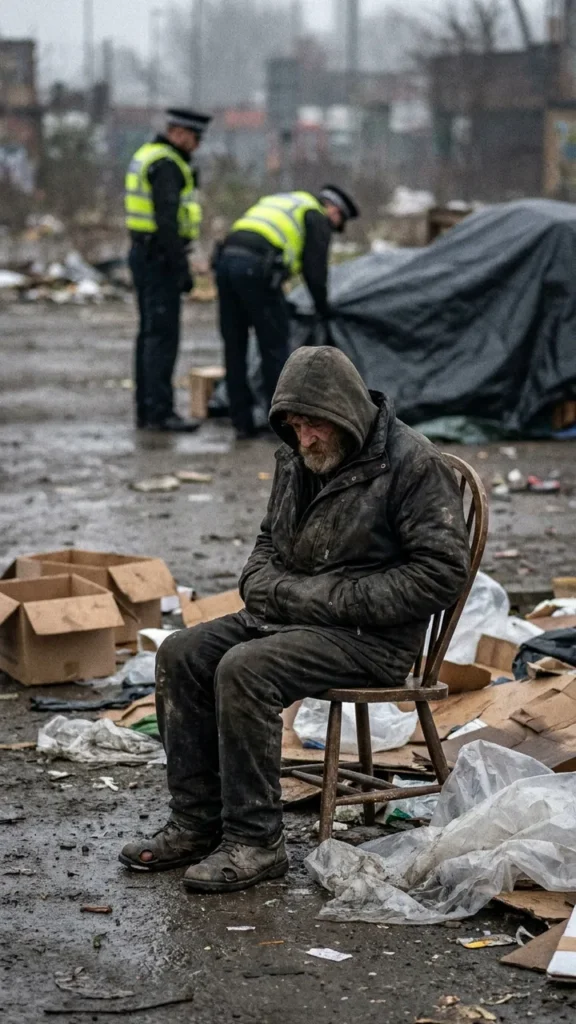
Arthur Pendelton lay curled inside a torn sleeping bag, wedged between a concrete pillar and a pile of rusted rail ties.
His body shook.
His teeth chattered.
The cold had seeped into his bones months ago and never left.
Above him, the freight train rumbled.
The ground vibrated.
Dust and diesel fumes mixed with the wet smell of creosote.
Arthur did not move.
His eyes were half-open, fixed on a crack in the concrete.
He had stopped counting the days.
Stop counting anything.
The only sound he made was the occasional rasp of breath.
His hands were blue.
His fingers cracked with frostbite.
He wore a dark jacket so soiled the original color was unrecognizable.
Loose pants, stained with mud and oil.
Shoes with holes that let the rain soak his socks.
He was 64 years old.
He looked 90.
A train whistle screamed in the distance.
Arthur flinched.
Then he closed his eyes.
He didn’t care anymore.
Two blocks away, Officer Sarah Davies and Officer Tom Miller sat in a warm cruiser, sipping coffee from a thermos.
The dispatcher’s voice crackled over the radio.
“Unit 47, we have a welfare check at the freight yard, mile marker 12.
Reports of a male subject living under the bridge.
Possible exposure.
Please respond.”
Miller set down his coffee. “Again?”
Davies wiped the condensation from the window. “Same spot.
Third time this winter.”
She sighed.
Not out of annoyance.
Out of weariness.
She had seen Arthur before.
Four weeks ago.
She had offered him a ride to the shelter.
He had refused.
He had mumbled something about being “too far gone.”
Miller put the cruiser in gear. “Let’s go.”
The tires splashed through puddles as they drove down the gravel access road.
The headlights cut through the gray drizzle.
The bridge appeared ahead-a low, dark concrete mouth swallowing the tracks.
Davies spotted the sleeping bag first.
“There.”
Miller parked twenty feet away, leaving the engine running.
The headlights illuminated the slumped figure.
Davies unbuckled her seatbelt. “I’ll go first.”
Miller nodded. “I’ll cover you from here.”
She stepped out.
The rain soaked her yellow vest instantly.
She walked slowly, deliberately.
Her boots crunched on the gravel.
Arthur heard the footsteps.
His body tensed.
He pulled the sleeping bag tighter over his head.
Davies stopped two feet away.
She lowered herself to one knee, bringing her face level with his.
“Mr. Pendelton?”
Silence.
“Mr. Pendelton, it’s Officer Davies.
Remember me?
We met a few weeks ago.”
A rustle.
The sleeping bag shifted.
A bloodshot eye appeared through a tear in the fabric.
“Go away.”
The voice was a hoarse whisper.
It sounded like gravel grinding against glass.
Davies did not move.
She kept her voice calm, soft.
“I’m not here to make you leave.
I’m here to help.”
Arthur’s eye narrowed. “Don’t need help.”
“Your hands are blue, Mr. Pendelton.
You’re shivering.
It’s 34 degrees.”
“I’m fine.”
Davies looked at the space around him.
A soggy cardboard box.
A few empty cans.
A photograph, face down in the mud.
She reached into her vest pocket.
She pulled out a small thermos.
“I have coffee.
Hot.
Fresh.
Will you take it?”
Arthur stared.
His cracked lips parted.
He didn’t answer.
But his hand-shaking, skeletal-reached out of the bag.
Arthur’s fingers wrapped around the thermos.
They were white.
Not pale-white.
The color of cold that had become permanent.
Davies watched him pull the thermos inside the bag.
She heard the cap unscrew.
A long, slow exhale.
Then the sound of swallowing.
“Thank you,” came the muffled voice.
“You’re welcome.”
She stayed on one knee.
The rain dripped off her cap.
Miller remained by the cruiser, arms crossed, scanning the area.
He trusted Davies to handle the conversation.
Arthur took another sip.
Then he pushed the sleeping bag down to his chin.
His face emerged.
Deep lines.
Hollow cheeks.
A beard that had not seen a comb in weeks.
Eyes that held nothing but exhaustion.
He looked at Davies.
Not with anger.
Not with fear.
Just… flat.
“Why are you here?”
“Welfare check.
Someone called.”
“Someone always calls.”
“Because people care, Mr. Pendelton.”
Arthur let out a dry laugh.
It turned into a cough.
He wiped his mouth with the back of his hand.
“People care about their guilt.
Not about me.”
Davies tilted her head. “Maybe.
But I’m here.
And I’m not leaving until you’re safe.”
Arthur stared at her.
Something flickered behind those dead eyes.
Confusion.
Maybe curiosity.
Miller stepped forward. “Mr. Pendelton, we have a place.
The Harbor.
It’s a warming center.
They have beds.
Food.
Medical care.”
Arthur shook his head. “I’ve been to places like that.
They treat you like trash.”
“Not this one,” Davies said. “I’ve been there.
I know the staff.
They treat everyone with dignity.”
Arthur looked down at his hands.
The thermos trembled in his grip.
“I don’t have anything left.”
“You have your life.”
He laughed again.
This time it was hollow.
“Not sure that’s worth much.”
Davies stood up.
She reached out her hand.
“Let us help you pack.
Then we’ll drive you there.
If you hate it, you can leave in the morning.
But at least tonight, you’ll be warm.”
Arthur’s gaze moved from her hand to her face.
He searched for a lie.
He found none.
Miller spoke again. “We’re not going to force you.
But the rain isn’t stopping.
The temperature’s dropping.
You won’t make it to morning.”
A long silence.
Freight train rumbled in the distance.
A whistle screamed.
Arthur slowly pushed the sleeping bag aside.
He sat up.
His joints cracked.
His body ached.
He looked at his belongings.
A cardboard box.
A photograph face-down in the mud.
He reached for the photo.
He picked it up.
He wiped the dirt off with his sleeve.
A woman with dark hair.
A young boy with a gap-toothed smile.
His wife.
His son.
Davies saw his hand shake.
“Who are they?”
Arthur’s voice cracked. “Everyone.”
He tucked the photograph into his jacket pocket.
Then he looked up at Davies.
“Okay.”
Davies nodded. “Thank you, Mr. Pendelton.”
She turned to Miller. “Grab the box from the trunk.”
Miller retrieved a clean cardboard box.
He walked over and knelt beside Arthur.
He began to gather the scattered items.
A rusted harmonica.
A worn Bible with the cover missing.
A few coins.
A single sock.
Davies helped Arthur stand.
He wobbled.
His legs were weak.
She kept a hand on his arm. “Take your time.”
Arthur looked around the bridge.
The place he had called home for three months.
He felt nothing.
He let Davies guide him toward the cruiser.
Miller packed the box and closed the trunk.
He opened the rear door.
Arthur paused at the threshold.
The back seat.
Clean.
Warm.
He hesitated.
Davies said, “It’s just a ride.
I promise.”
Arthur climbed in.
The seat was soft.
The heater hit his face.
He closed his eyes.
For the first time in months, he felt something other than cold.
Davies closed the door gently.
She got into the passenger seat.
Miller started the engine.
The cruiser pulled away from the bridge.
Arthur did not look back.
But his hand went to his jacket pocket.
He touched the photograph.
And somewhere, deep inside, a tiny ember of hope flickered.
‘Arthur stood by the cruiser, swaying slightly.
The rain plastered his grey hair to his scalp.
Water dripped from his beard.
His jacket hung heavy with moisture, the fabric clinging to his thin frame like a second skin.
Officer Davies held the cardboard box.
“Let’s pack your things, Mr. Pendelton.
We’ll bring everything.”
Arthur looked at the bridge.
The dark space under the concrete.
The pile of rags that had been his bed for three months.
“There’s nothing worth taking.”
“Your harmonica.
Your Bible.
The photograph.”
Arthur’s eyes narrowed. “You saw those.”
“I noticed them.”
He shuffled back toward the bridge.
His legs were unsteady.
Each step seemed to cost him something.
Davies followed but kept a respectful distance.
Arthur knelt.
His knees cracked.
He reached into the cardboard box that had been his storage.
The harmonica sat on top, tarnished and rusted, but intact.
He picked it up.
Turned it over in his hands.
“That was my father’s,” he said, his voice rough.
Davies said nothing.
She waited.
Arthur placed it gently into the new box.
Next came the Bible.
The cover was missing.
Pages were stained with water and mud.
The spine was broken.
“I haven’t opened this in years,” Arthur muttered.
“But you kept it.”
A long pause. “Yes.
I kept it.”
He placed it in the box.
Then his hand hovered over the photograph.
He lifted it slowly.
His fingers traced the edge.
“Emily and Thomas,” he said.
Davies moved closer. “Your family?”
Arthur nodded. “My wife.
My son.”
His voice cracked.
His jaw tightened.
“They died.”
“I know.”
“You know?”
“Officer Miller checked the records before we came.
We wanted to understand.”
Arthur looked at her sharply. “You investigated me.”
“We wanted to help you properly, Mr. Pendelton.”
His hand trembled.
His eyes grew wet.
Not from the rain.
“She would hate what I’ve become.”
“Your wife?”
“Emily.
She was kind.
She believed in people.
She would see me here, in this filth, and she would cry.”
Arthur’s voice broke.
He pressed his palm to his eyes.
Thomas.
Seven years old.
Gap-toothed smile.
A boy who loved trains.
Arthur remembered the day of the accident.
The phone call.
The hospital.
The two white sheets.
He had not gone to the funeral.
He could not.
Davies knelt beside him. “It’s okay to grieve.”
“It’s been five years.
I should be better.”
“Grief doesn’t have a timeline, Mr. Pendelton.”
He looked at her.
His eyes red-rimmed.
His face raw.
“Why do you care?”
“Because you’re a human being.
And you deserve dignity.”
Arthur stared at her for a long moment.
Then he placed the photograph carefully into the box.
Miller arrived with a plastic bag. “Found a few more items under the bridge.
Some socks, a scarf, a coffee can.”
Arthur looked at the bag. “That’s all of it.”
“Let’s go,” Davies said gently.
Arthur stood.
He held the box close to his chest.
Walking toward the cruiser, he stumbled.
His foot caught on a rail tie.
Davies caught him before he hit the ground.
“Easy,” she said.
Arthur gripped her arm.
His hands were ice.
“I’m sorry,” he whispered.
“For what?”
“For being a burden.”
Davies looked directly into his eyes.
“You are not a burden.
You are a man who has survived unspeakable pain.
That takes strength.”
Arthur said nothing.
But his eyes glistened.
Miller opened the rear door.
The overhead light illuminated the clean upholstery.
The seat was dry.
A faint smell of air freshener mixed with coffee.
Arthur stopped.
He stared into the back seat like it was a cage.
“The door closes,” he said.
“Yes.”
“I don’t like closed doors.”
Davies stood beside him. “I understand.”
“After Emily and Thomas died, I couldn’t stand being inside.
Four walls felt like a coffin.
I started sleeping outside.
Then I just… stayed.”
Miller spoke calmly. “The doors don’t lock from the outside.
You can open it anytime.”
Arthur looked at Miller. “Promise?”
“I promise.”
Arthur held the box tighter.
His body tensed.
His breathing quickened.
Davies placed a hand on his shoulder.
“Mr. Pendelton, you don’t have to get in.
But it’s cold.
And we have heat.
And coffee.”
Arthur laughed.
A dry, bitter sound.
“You drive a hard bargain.”
“Can you take a few steps?
Just one foot in?”
Arthur hesitated.
Then he moved.
His foot touched the floor mat.
The rubber grip felt strange against his worn-out sole.
He leaned forward.
His back ached.
His knees screamed.
He sat down on the edge of the seat.
The cushion was soft.
The heater was already blowing.
He exhaled.
A long, shaky breath.
“Okay,” he whispered.
Davies nodded. “Okay.”
She reached for the door.
Arthur flinched.
“I’m just closing it halfway,” she said. “So the rain stays out.
But you can see me the whole time.”
She pulled the door to, leaving a three-inch gap.
The cold air still seeped in.
But so did Arthur’s sightline to the officers.
He watched them through the crack.
Miller went to the driver’s side.
Davies got into the passenger seat.
She turned around and looked through the gap.
“How are you doing back there?”
Arthur held the box on his lap.
His fingers traced the edge of the photograph.
“I don’t know.”
“That’s okay.”
Miller started the engine.
The cruiser rumbled to life.
He checked the mirrors.
He pulled forward slowly.
The bridge disappeared behind them.
Arthur looked out the window.
The rain streaked across the glass.
Streetlights passed in yellow blurs.
He watched the city roll by.
Buildings he had not seen in months.
People walking with umbrellas.
A world that had moved on without him.
“I used to work at a hardware store,” Arthur said.
Davies turned. “What happened?”
“I stopped showing up.
They called.
I didn’t answer.
Eventually, they stopped calling.”
“How long did you work there?”
“Seventeen years.”
Miller looked in the rearview mirror. “That’s a long time.”
“Wasn’t worth anything in the end.”
“Your pension wasn’t collected?”
Arthur shook his head. “I didn’t care about money.
I didn’t care about anything.”
He looked down at the box.
“I just wanted to disappear.”
Davies let the silence hang.
Then she spoke softly. “You don’t have to disappear anymore.”
Arthur’s throat tightened.
He pressed his hand against his chest.
He could feel his heartbeat.
Faint but steady.
“I’m still here,” he said.
“Yes,” Davies said. “You are.”
The cruiser turned a corner.
A large building appeared ahead.
Warm lights glowed from the windows.
A sign read: “The Harbor – Dignity for All.”
Arthur’s hands trembled.
He had seen shelters before.
Dirty floors.
Rude staff.
The smell of bleach and despair.
But this place looked different.
Clean.
Bright.
Inviting.
Miller pulled into the parking lot.
He stopped the engine.
Davies turned to Arthur.
“We’re here.”
Arthur looked at the building.
Then at the officers.
His voice was barely audible.
“Are you coming inside?”
Davies smiled gently.
“Of course.
We’re not leaving until you’re settled.”
Arthur nodded.
His hand went to the door handle.
He paused.
Then he pushed the door open.
The rain was still falling.
But the building’s lights spilled across the parking lot.
Puddles glowed like gold.
Arthur stepped out into the light.
CHAPTER 2: The Ride
‘The cruiser pulled away from the curb.
Rain streaked the windows in diagonal sheets.
The wipers thumped a steady rhythm.
The heater hummed warm air against Arthur’s legs.
He sat in the back seat, the cardboard box on his lap.
His fingers traced the edge of the photograph.
He hadn’t looked at it yet.
He couldn’t.
Davies turned in her seat.
Her voice was calm.
“Do you have any allergies, Mr. Pendelton?”
Arthur blinked. “What?”
“Medical allergies.
So we can tell the facility.”
“No.
I don’t think so.”
“Any medications you’re taking?”
“No.”
“When was your last meal?”
Arthur’s stomach clenched.
He tried to remember.
“I don’t know.
Two days.
Maybe three.”
Davies nodded.
She didn’t react.
She didn’t judge.
Miller glanced in the rearview mirror.
His eyes were steady.
“There’s a water bottle in the door pocket.
You can drink it.”
Arthur looked down.
A blue bottle sat in the mesh holder.
He didn’t reach for it.
“Go ahead,” Davies said softly. “It’s for you.”
Arthur’s hand moved slowly.
His fingers closed around the bottle.
The plastic was cold.
Condensation slicked his palm.
He twisted the cap.
It crinkled.
He lifted it to his lips.
The water was cold.
Clean.
It hurt his dry throat.
He drank half the bottle in one go.
“Slow,” Davies said. “Your stomach might not handle it.”
Arthur stopped.
He lowered the bottle.
His hand shook.
“Thank you,” he whispered.
“You’re welcome.”
The cruiser passed a row of shuttered stores.
Graffiti covered a brick wall.
A man pushed a shopping cart through puddles.
Arthur watched him.
He recognized that man.
The same shuffle.
The same hollow eyes.
“I used to see people like me,” Arthur said. “Before.
When I still had a car.
I’d roll up my windows at stoplights.”
Davies said nothing.
“I thought they were weak,” Arthur continued. “I thought they chose this.
I thought if they just tried harder…”
He gripped the water bottle.
“I didn’t understand.”
“You understand now?”
Arthur’s voice cracked. “I understand that pain doesn’t care about effort.
It doesn’t care about trying.
It just exists.
And sometimes it’s bigger than you.”
Miller drove in silence.
Davies spoke gently. “It’s not weakness to be broken by grief.
It’s human.”
Arthur stared out the window.
The rain began to lighten.
The sky turned from dark grey to pale silver.
A sliver of sunlight broke through the clouds.
“Emily loved the rain,” Arthur said. “She called it the sky’s tears.
She said it meant the world was still feeling.”
His voice dropped to a whisper.
“I haven’t felt anything for a long time.”
Davies turned fully in her seat.
Her eyes were soft.
“You’re feeling something right now.”
Arthur looked at her.
“Fear,” he said. “Hope.
I don’t know which is worse.”
“They’re the same coin,” Davies said. “Different sides.”
Arthur’s jaw tightened.
The cruiser slowed.
Miller signaled.
They turned into a driveway.
A large building appeared ahead.
Warm lights glowed from every window.
A sign stood by the entrance.
“The Harbor – Dignity for All.”
Arthur’s breath caught.
“Is this it?”
“This is it,” Davies said.
The cruiser stopped.
Miller put the car in park.
The engine hummed.
Arthur didn’t move.
His hands locked around the box.
“I’m scared,” he said.
“That’s okay,” Davies replied. “We’re here with you.”
Miller killed the engine.
Silence filled the cruiser.
Rain pattered on the roof.
The heater clicked off.
Arthur sat frozen.
His hands trembled against the cardboard box.
His knuckles were white.
The photograph pressed against his fingers through the cardboard.
Davies opened her door.
Cold air rushed in.
“Take your time, Mr. Pendelton.”
Arthur blinked.
He looked at the building.
The Harbor was not what he expected.
No barred windows.
No metal detectors.
No shouting staff.
The entrance was wide.
Glass doors.
Flowers in ceramic pots on either side.
A warm orange glow spilled onto the wet pavement.
He saw a woman standing under the awning.
She held a towel.
She was smiling.
“Who is that?” Arthur asked.
“That’s Grace,” Miller said. “She runs the center.”
“She’s waiting for you,” Davies added.
Arthur’s throat tightened. “For me?”
“For you.”
He looked down at his hands.
His nails were black with dirt.
His skin was cracked.
His jacket smelled of mold and rain.
“I can’t go in there looking like this.”
Davies leaned into the back seat. “They have showers.
Clean clothes.
You’ll be taken care of.”
“I don’t deserve that.”
Davies met his eyes. “That’s not your decision to make.
Let them decide what you deserve.”
Arthur’s hands shook harder.
Miller got out of the cruiser.
He opened the rear door.
The rain splattered against his vest.
“Come on, Arthur.
One step at a time.”
Arthur looked at Miller.
Then at Davies.
Then at the building.
He took a breath.
His legs moved.
His feet touched the ground.
He stood.
His knees buckled.
He grabbed the door frame.
Davies caught his elbow.
“I got you.”
Arthur leaned on her arm.
His weight was light.
He was all bone and hollow.
They walked toward the entrance.
The woman under the awning stepped forward.
Her face was warm.
Her eyes were kind.
“Mr. Pendelton,” she said. “Welcome.
I’m Grace.”
Arthur stared at her. “You know my name.”
“Of course.
The officers called ahead.
We’ve been expecting you.”
She held out the towel.
“You must be cold.
Let’s get you inside.”
Arthur reached for the towel.
His fingers brushed the fabric.
It was soft.
Warm.
He pressed the towel to his face.
He didn’t move for a long moment.
Grace watched him.
She didn’t rush.
Arthur lowered the towel.
His eyes were red.
“I don’t remember the last time someone was nice to me.”
Grace smiled. “Well, get ready.
We’re going to be very nice to you.”
She gestured inside.
Arthur stepped through the glass doors.
The lobby was clean.
White walls.
Gray tile.
A reception desk with a vase of fresh flowers.
The smell of coffee and floor polish.
Arthur stood in the middle of the room.
Water dripped from his jacket onto the tile.
He was afraid to move.
Afraid to touch anything.
“This way,” Grace said.
She led him down a hallway.
Past a dining room with round tables.
Past a common area with armchairs and bookshelves.
Arthur saw a man sitting in one chair, reading a newspaper.
He looked up.
He nodded at Arthur.
Arthur nodded back.
They stopped at a door.
Grace opened it.
“This is your intake room.
We’ll do a short interview.
Then a shower.
Then a meal.”
Arthur looked inside.
A desk.
Two chairs.
A lamp.
“Sit wherever you’re comfortable,” Grace said.
Arthur sat.
He placed the box on the floor beside him.
Grace sat across from him.
She opened a folder.
“I’m going to ask some questions.
You can answer or not.
There are no wrong answers.”
Arthur nodded.
“When was the last time you saw a doctor?”
“I don’t know.
Years.”
“Any chronic pain?”
“My knees.
My back.
My hands.”
Grace wrote something down.
“Do you use drugs or alcohol?”
“No.”
“Have you ever been diagnosed with a mental health condition?”
Arthur paused.
“Depression.
After my wife and son died.
I never treated it.”
Grace looked up.
Her eyes were soft.
“We have counselors here.
On-site.
You can talk to someone when you’re ready.”
Arthur’s voice broke. “I don’t know how to start.”
Grace leaned forward.
“You just did.”
‘Grace closed the folder.
“Let’s get you settled.
Follow me.”
Arthur stood.
His legs wobbled.
The cardboard box pressed against his ribs.
Davies and Miller waited by the door.
Grace led them down a second hallway.
Past a laundry room.
Past a storage closet filled with blankets.
She stopped at a door marked “Guest Rooms.”
“It’s private.
Yours for as long as you need.”
Arthur swallowed. “Mine?”
“Yours.”
Grace opened the door.
A small room.
White walls.
A single bed with a blue comforter.
A wooden desk.
A lamp.
A window overlooking a garden.
Arthur stood frozen.
His chest tightened.
“This is for me?”
“All of it.”
Arthur touched the door frame.
His fingers left smudges on the white paint.
He stepped inside.
The floor was clean.
The room smelled of laundry soap and wood polish.
He placed the box on the desk.
His hand hovered over it.
He didn’t open it.
Grace stood at the doorway. “Take your time.
When you’re ready, I’ll show you to the shower.”
Arthur nodded.
He didn’t speak.
Davies stepped forward. “We have to go, Mr. Pendelton.
But we’ll check in on you tomorrow.”
Arthur turned.
He looked at her.
Then at Miller.
“You’re leaving?”
“We have to file a report,” Miller said. “But you’re in good hands.”
Arthur’s hand reached out.
He didn’t touch her.
Just let it hover in the air.
“Thank you.”
Davies nodded. “Take care of yourself.”
Arthur watched them walk away.
Their boots clicked on the tile.
They turned a corner.
Gone.
He was alone.
The room was silent.
The lamp hummed.
The window showed a patch of blue sky breaking through the clouds.
Arthur sat on the edge of the bed.
The mattress was firm.
The sheets were crisp.
He pressed his palm into the fabric.
He couldn’t remember the last time he touched clean sheets.
His eyes burned.
He sat there for a long moment.
His shoulders shook.
No sound came out.
Grace waited in the hallway.
She didn’t rush.
Finally, Arthur stood.
He walked to the door.
“I’m ready.”
Grace smiled. “This way.”
Grace led him back to the intake room.
Arthur sat in the same chair.
His hands gripped his knees.
His nails dug into the fabric.
Grace sat across from him.
She opened a new form.
“I need to ask a few more questions.
Is that okay?”
Arthur nodded.
“Are you in any pain right now?”
“My knees.
My back.
My hands.”
Grace wrote it down. “We have a nurse on staff.
She can see you after your shower.”
Arthur didn’t respond.
“When was your last meal?”
Arthur’s breath caught. “Two days.
Maybe three.
A sandwich from a gas station.
Some chips.”
Grace’s pen paused.
She looked at him.
“You’re hungry.”
Arthur’s eyes dropped to the floor. “Yes.”
“We’ll get you something as soon as we’re done here.
I promise.”
Arthur’s voice cracked. “I don’t want to be a burden.”
“You’re not a burden, Mr. Pendelton.
That’s not how this works.”
Arthur looked up.
His eyes were wet. “How does it work?”
Grace leaned forward. “You walk through that door.
You accept help.
You let us carry some of the weight for a while.
That’s all.”
Arthur’s jaw trembled. “I haven’t let anyone carry anything for five years.”
“I know.”
“I pushed everyone away.
My brother.
My old coworkers.
The only friend I had.”
“They might still be out there.”
“I burned those bridges.
They’re gone.”
Grace set her pen down. “You’re still here.
That’s what matters.”
Arthur’s hands shook.
He pressed them against his thighs.
“I don’t know who I am anymore.”
“You’re a man who lost his family.
A man who’s been surviving in the cold and rain.
A man who just walked into a building full of people who want to help.”
Arthur’s breath came in short gasps.
“I don’t think I can do this.”
“Breathe, Mr. Pendelton.
One breath at a time.”
Arthur focused on her voice.
He inhaled.
The air caught in his chest.
He exhaled.
“Good,” Grace said. “Again.”
He breathed with her.
Three breaths.
Four.
His shoulders lowered.
“Better?” she asked.
“Yes.”
“Okay.
One more question.
Then we’ll get you that shower.”
Arthur nodded.
“What’s the one thing you want most right now?”
Arthur looked at the window.
The sky was clear now.
Light flooded the room.
“To feel clean,” he said. “To feel like I’m not drowning.”
Grace smiled. “That’s a good answer.”
She stood.
She reached into a cabinet and pulled out a clean towel.
White.
Fluffy.
“Follow me.”
Arthur stood.
His legs felt steadier.
As they reached the door, Davies appeared.
She hadn’t left.
Arthur stopped. “I thought you had to go.”
Davies smiled. “I wanted to make sure you were okay.”
Arthur’s throat tightened. “I’m okay.”
Davies placed a hand on his shoulder.
Her warmth seeped through his dirty jacket.
“You are.
And you’ll be more than okay soon.”
Arthur nodded.
His hands tightened at his sides.
He walked with Grace to the shower room.
CHAPTER 3: The Shower and Clean Clothes
‘Grace pushed open a door marked “Private Shower – Reserved.”
Inside was a small bathroom.
White tile.
A shower stall with a plastic curtain.
A wooden bench.
A stack of towels.
A basket with soap, shampoo, and a comb.
Arthur stood at the threshold.
His boots left mud on the clean floor.
“This is private,” Grace said. “No one will bother you.
Take as long as you need.”
Arthur’s eyes fixed on the showerhead.
Water droplets clung to the metal.
“I haven’t used a shower in six months,” he whispered. “Just a bucket at the gas station.
Sometimes the river.”
“You have hot water now.
Unlimited.”
Arthur touched the edge of the sink.
His cracked fingers left a smear.
“I don’t know how to… be clean anymore.”
“You’ll remember.
It’s like riding a bike.”
Grace placed the clean clothes on the bench.
A folded grey tracksuit.
New underwear.
Socks still wrapped in plastic.
“Everything you need is here.
When you’re done, come back to the intake room.
I’ll have a meal waiting.”
Arthur nodded.
He didn’t speak.
Grace stepped out and closed the door.
The latch clicked.
Arthur stood alone.
The room hummed with the ventilation fan.
He looked at the shower curtain.
He reached out.
His hand trembled.
He pulled it back.
A scrape of plastic rings on the rod.
The showerhead gleamed.
Arthur unzipped his jacket.
The zipper stuck halfway.
He wrenched it.
The jacket fell to the floor.
A cloud of dust rose.
He peeled off his shirt.
The fabric was stiff with dirt and sweat.
It tore at his skin.
His chest was hollow.
Ribs visible.
Bruises from sleeping on concrete.
He kicked off his boots.
They hit the floor with a thud.
His pants slid down.
He stepped out of them.
Naked.
Shivering.
He stood in front of the mirror.
A stranger stared back.
Sunken eyes.
Grey stubble.
Skin the color of ash.
“Who are you?” he rasped.
No answer.
He turned to the shower.
He twisted the handle.
Water burst out.
Steam rose.
It hissed against the tile.
Arthur stepped under the spray.
The heat hit him like a fist.
He gasped.
His body convulsed.
His hands braced against the wall.
The water ran brown.
Dirt swirled around the drain.
Arthur closed his eyes.
He let the water pound his shoulders.
He started to cry.
Silent sobs.
His knees buckled.
He slid down the wall.
Sat on the floor of the shower.
Water cascaded over him.
“I’m sorry,” he whispered. “I’m so sorry.”
He stayed there for ten minutes.
The water ran clear.
His tears mixed with the spray.
Finally, he reached for the soap.
He lathered his hands.
He scrubbed his arms.
His chest.
His legs.
The dirt came off in gray streaks.
He washed his hair.
The shampoo foamed.
He massaged his scalp.
He rinsed.
Once.
Twice.
A third time.
Then he stood.
He turned off the water.
The silence rushed in.
He stepped out.
Water dripped onto the mat.
He dried himself with the towel.
The fabric was soft.
He pressed it against his face.
He dressed in the clean clothes.
The tracksuit was loose.
The socks were warm.
He felt like a different person.
He looked in the mirror again.
A man with wet grey hair.
Red-rimmed eyes.
A face that had seen too much.
But clean.
He touched his own cheek.
“One step,” he said. “One step at a time.”
He walked out.
Grace was waiting in the intake room.
She looked up as Arthur entered.
Her eyes softened.
“You look ten years younger.”
Arthur touched his tracksuit. “I feel… lighter.”
“Good.
Come.
The food is ready.”
She led him to a small dining area.
A table with a blue tablecloth.
A single plate.
A bowl of chicken soup.
Steam rose from the broth.
A basket of crusty bread.
A glass of apple juice.
A small dish with butter.
Arthur’s stomach clenched.
His mouth watered.
“Sit,” Grace said.
He sat.
His hands hovered over the plate.
He didn’t touch it.
Davies and Miller walked in.
They carried mugs of coffee.
They sat across from him.
“We’re not staying,” Davies said. “But we wanted to see you eat.”
Arthur’s eyes darted between them. “You don’t have to…”
“We want to,” Miller said.
He took a sip of coffee. “Go ahead.”
Arthur picked up the spoon.
His hand shook.
He dipped it into the soup.
He brought it to his mouth.
The warmth spread through his chest.
He tasted chicken.
Vegetables.
Salt.
Love.
He closed his eyes.
A tear slid down his cheek.
“It’s good,” he whispered.
“Eat slowly,” Grace said. “Your stomach isn’t used to it.”
Arthur nodded.
He took another spoonful.
Then a bite of bread.
He chewed.
He swallowed.
The room was quiet.
Only the sound of Arthur’s eating.
Davies watched him. “How does it feel?”
Arthur wiped his mouth with the back of his hand. “I forgot what food tasted like.
Really tasted.”
Miller leaned forward. “You’re safe now.
You don’t have to worry about the next meal.”
Arthur set the spoon down. “I keep thinking this is a dream.
That I’ll wake up under the bridge.”
“It’s real,” Grace said. “This is your new beginning.”
Arthur looked at the bread in his hand.
He broke off another piece.
“I don’t deserve this.”
Davies put down her coffee. “Why do you say that?”
“Because I gave up.
I let my life fall apart.
I let myself rot.”
Davies’ voice was calm. “You survived.
That takes strength.”
“Survival isn’t the same as living.”
“No,” she said. “But it’s the first step.”
Arthur stared at her.
His chest heaved.
“What if I fail again?”
“Then you try again.
That’s what this place is for.
A safety net.”
Arthur picked up the glass of apple juice.
He took a sip.
The cold sweetness shocked his tongue.
“I don’t have anyone left,” he said. “No one to call.”
“You have us now,” Miller said. “For today, that’s enough.”
Arthur’s grip tightened on the glass.
He looked at the two officers.
Their clean uniforms.
Their steady eyes.
“Why do you care?” he asked. “I’m nobody.”
Davies leaned across the table. “You’re not nobody.
You’re Arthur Pendelton.
A man who lost his way.
And we’re here to help you find it again.”
Arthur’s lips trembled.
He bit them.
He picked up the spoon again.
He ate another mouthful.
Slowly.
Deliberately.
Each bite a promise.
When the bowl was empty, he set the spoon down.
“Thank you,” he said. “For not giving up on me.”
Davies smiled. “We never will.”
‘Arthur set the empty bowl aside.
His hand moved to his pocket.
He pulled out a folded photograph.
The edges were soft, creased from years of handling.
He placed it on the table.
A woman with dark hair.
A boy of about ten.
Both smiling.
Davies leaned forward. “Your family?”
Arthur nodded.
His jaw tightened.
“That’s Sarah.
My wife.
And Joshua.
My son.”
Miller set down his coffee. “They’re beautiful.”
“They were.”
Arthur traced the photograph with his fingertip.
“Five years ago.
A drunk driver.
Ran a red light.”
The room went still.
Arthur’s voice cracked. “I got the call at work.
I was a foreman at a warehouse.
I dropped the phone.
I drove to the hospital.”
He paused.
“They were already gone.
Sarah died instantly.
Joshua survived for three hours.
I held his hand.”
Davies swallowed. “I’m so sorry.”
Arthur’s eyes glistened. “I told him it was okay.
That he could let go.
I sang his favorite song. ‘You Are My Sunshine.'”
He stopped.
His breath hitched.
“I sang it wrong.
I couldn’t remember the words.”
Miller looked at the floor. “You were there.
That matters.”
Arthur shook his head. “I wasn’t there when they needed me.
I was at work.
They were going to the grocery store.
Just a normal day.
And I wasn’t there.”
Davies reached across the table.
Her hand hovered near his.
“You can’t blame yourself for an accident.”
Arthur pulled the photograph closer. “I can.
I do.
Every day.”
His fingers trembled.
“I buried them in the same casket.
Sarah holding Joshua.
I couldn’t separate them.”
The silence was thick.
Grace stood in the doorway.
Her eyes were wet.
Arthur looked up. “I stopped going to work.
I stopped paying bills.
I stopped eating.
I just sat in the house.
Staring at their pictures.”
“Until the bank took the house,” Miller said softly.
“Yes.
They auctioned everything.
I had nothing left.
So I walked.”
Arthur folded the photograph.
He pressed it against his chest.
“I’ve been walking ever since.”
Davies exhaled slowly. “That’s a heavy burden.”
Arthur nodded. “Heavy enough to crush a man.”
“Yet you’re still here.”
Arthur looked at her. “I don’t know why.”
“Maybe because you’re not finished.”
Arthur tucked the photograph back into his pocket.
He patted it.
A ritual.
“I keep it close.
It’s the only thing I couldn’t sell.”
He laughed.
A hollow sound.
“I sold my wedding ring for a bottle of whiskey.
Three years ago.
That was my lowest.”
Miller’s jaw tightened. “We’ve all been low.”
Arthur met his eyes. “Have you?
Have you slept in a ditch?
Eaten from a dumpster?
Watched your hands bleed and not cared?”
Miller didn’t flinch. “No.
I haven’t.
But I’ve seen it.
Every day on the job.”
Arthur looked down. “I’m sorry.
I didn’t mean to attack you.”
“You didn’t.
You told the truth.
That’s rare.”
Arthur wiped his eyes with the back of his hand.
“I don’t know how to start over.”
Davies leaned in. “You already have.
You took the soup.
You took the clean clothes.
You took the shower.”
“That’s just washing off dirt.”
“Then keep washing.
One layer at a time.”
Arthur stared at the empty bowl.
“I don’t know if I can.”
Davies smiled gently. “You don’t have to know.
Just take the next step.”
Arthur pushed the bowl away.
His hands stayed on the table.
“I need to tell you something.”
Davies and Miller exchanged a glance.
“I’m listening,” Davies said.
Arthur took a breath.
His ribs expanded against the tracksuit.
“I didn’t just become homeless.
I chose it.”
Miller frowned. “Chose?”
Arthur nodded. “After the accident, I couldn’t face the world.
The house was full of memories.
The kitchen where Sarah made pancakes.
Joshua’s bedroom with the race car bed.
I couldn’t breathe.”
He paused.
“So I left.
I walked out the door.
I locked it behind me.
I never went back.”
“Where did you go?” Davies asked.
“Nowhere.
Everywhere.
I walked south.
I thought maybe the sun would burn away the pain.
It didn’t.”
Arthur looked at his hands.
“I found the train tracks by accident.
I followed them.
They led to the bridge.
I stayed.”
Davies tilted her head. “Why the tracks?”
Arthur’s voice dropped to a whisper. “Because some nights I thought about lying down on them.”
The air grew heavy.
“But I never did.”
Miller’s voice was quiet. “That takes courage too.”
“It takes cowardice.
I was too scared to die.
So I just existed.”
Arthur pulled at his sleeve.
“I stopped washing.
Stopped shaving.
I let my teeth rot.
I wanted to punish myself.
I wanted to look in the mirror and see the monster who wasn’t there when his family needed him.”
“But you’re not a monster,” Davies said.
“Then why does it feel like I am?”
Davies leaned forward. “Because you’re grieving.
And grief lies.”
Arthur’s face twisted. “I don’t know how to forgive myself.”
“You don’t have to.
Not today.
Maybe not tomorrow.
But you can start by accepting that you deserved better.”
Arthur’s eyes widened. “I don’t believe that.”
“I know.
But I believe it.
And Miller believes it.”
Miller nodded. “We do.”
Arthur looked at them, one after the other.
“You barely know me.”
“We know enough,” Davies said. “We saw a man under a bridge.
We saw a man who could still cry.
A man who remembered his son’s song.”
Arthur’s shoulders shook.
“I think about them every night.
I talk to them.
I tell Sarah I’m sorry.
I tell Joshua I love him.”
“What do they say back?”
Arthur closed his eyes. “In my dreams, Sarah says, ‘Come home, Arthur.'”
“Maybe this is coming home.”
Arthur opened his eyes.
Tears spilled over.
“I’m so tired of running.”
Davies stood.
She walked around the table.
She knelt beside Arthur’s chair.
“Then stop.
Right here.
This is your stop.”
Arthur pressed his hand to his mouth.
“Can I really stop?”
“You already have.”
CHAPTER 4: The Offer
‘Grace stepped into the room.
She held a clipboard and a folder.
Her smile was warm, professional.
“Arthur, may I sit?”
He nodded, still wiping his eyes.
She pulled a chair and sat across from him.
Davies remained standing near the wall.
Miller leaned against the counter.
“The Harbor is a transitional housing program,” Grace said.
“We offer shelter, meals, medical care.
Counseling.
Job training.
You can stay as long as you need.”
Arthur stared at her.
His hands clasped on the table.
“How long is that?”
“Indefinitely.
Until you’re ready to move on.
Some stay three months.
Others a year.
There’s no deadline.
No rush.”
Arthur’s throat tightened.
“I don’t have any money.”
“You don’t need any.
This is funded by donations and grants.
You’ve already qualified through the police referral.”
Arthur looked at Davies.
Davies nodded slowly.
“We contacted the dispatch,” Davies said.
“They have a partnership with The Harbor.
For people in crisis.”
Arthur’s voice cracked.
“I’m not in crisis.”
“You were,” Miller said softly.
“You are now.
But you don’t have to stay that way.”
Arthur turned back to Grace.
“What kind of counseling?”
“Individual therapy.
Group sessions.
We have a grief counselor who specializes in loss.
You can talk about Sarah and Joshua.
Or not.
It’s your pace.”
Arthur shook his head.
“I don’t know if I can talk about them.”
“Then you don’t have to.
But the option is there.
When you’re ready.”
Grace opened the folder.
She slid a form across the table.
“This is an intake application.
It asks for your name, date of birth.
Medical history.
Emergency contact.
You can leave blanks if you’re unsure.”
Arthur stared at the paper.
His fingers hovered over it.
“What if I fail?”
His voice was barely a whisper.
“Fail at what?”
“At living again.
I tried once.
After the accident.
I lasted two weeks.
Then I walked into the woods and didn’t come back.”
Grace didn’t flinch.
“Failure is part of recovery.
You fall.
You get up.
And we’ll help you get up.”
Arthur looked at Davies.
Then at Miller.
“You’ve done so much already,” he said.
“Why are you still here?”
Davies stepped closer.
“Because we’re not done.
You’re not done.”
Miller added, “We see you, Arthur.
Not the dirt.
Not the beard.
We see the man who sang ‘You Are My Sunshine.’
The man who loved his family.”
Arthur’s lip trembled.
“I don’t know who that man is anymore.”
“He’s sitting right in front of us,” Davies said.
Arthur looked down at the form.
The blank lines stared back.
Grace placed a pen beside it.
“You don’t have to decide now.
But this is your chance.
A real one.”
Arthur picked up the pen.
His hand shook.
“I’m scared.”
“That’s okay,” Grace said.
“Fear means you’re still alive.”
Arthur’s eyes met hers.
He set the pen down.
“I need a minute.”
“Take all the time you need.”
He stood up.
Walked to the window.
Stared out at the rain.
Davies and Miller stayed silent.
Arthur turned from the window.
His face was pale.
His hands hung limp at his sides.
“I can’t do this.”
His voice was flat.
Grace tilted her head.
“Why not?”
“Because I don’t deserve it.
I abandoned my life.
I let my wife and son die alone.”
Davies stepped forward.
“You didn’t let them die.
A drunk driver killed them.
You were at work.”
“I should have been there.
I should have protected them.”
“From a red light?
From a car going sixty miles an hour?
You couldn’t have stopped it.
No one could.”
Arthur shook his head violently.
“You don’t understand.
I wasn’t there when Joshua woke up from surgery.
I wasn’t there to hold Sarah one last time.”
“You were at the hospital, Arthur.
You held Joshua’s hand.
You sang to him.”
“Too late.
I was too late.”
Arthur sank back into the chair.
His shoulders slumped.
He buried his face in his hands.
“I don’t deserve kindness.
I don’t deserve a bed.
I don’t deserve food.”
Miller walked around the table.
He crouched beside Arthur’s chair.
“Arthur, look at me.”
Arthur slowly raised his head.
Miller’s eyes were steady.
“What you’re feeling is guilt.
But guilt isn’t truth.
It’s a shadow of what you think you should have done.”
Arthur blinked.
“It feels real.”
“Of course it does.
But you’ve been carrying it for five years.
And it hasn’t made anything better.”
Arthur’s jaw tightened.
“What would make it better?”
“Letting go.
Just a little.
Accepting that you’re human.
That you made choices.
Bad ones.
But you’re still here.”
“I don’t want to be here.”
“Then why are you?”
Miller’s voice was gentle but firm.
“Why did you take the soup?
Why did you shower?
Why did you let us drive you here?”
Arthur’s eyes glistened.
“Because I’m tired.
Tired of being cold.
Tired of being hungry.
Tired of hating myself.”
“Then stop hating yourself.
Start with one small step.
Sign the form.”
Arthur looked at the pen on the table.
His hand reached for it.
Then pulled back.
“What if I sign and then I fail anyway?”
“Then you try again.”
Grace spoke softly from behind.
“Failure isn’t final.
It’s just a detour.”
Arthur looked at Davies.
Davies smiled.
“Every man deserves a second chance, Arthur.
You are not your past.
You are not your grief.
You are a man who still remembers love.
That’s a good place to start.”
Arthur’s eyes searched hers.
He saw no pity.
Only patience.
Slowly, he picked up the pen.
His fingers wrapped around it.
He held it like a lifeline.
“Will you stay?”
He asked Davies.
“Until I sign?”
“I will.”
Arthur looked at Miller.
“You too?”
Miller nodded.
“We’re not going anywhere.”
Arthur took a deep breath.
He placed the pen on the paper.
His hand trembled over the first blank line.
“Just a name,” he whispered.
“Just my name.”
He wrote:
Arthur Pendelton.
The letters were shaky.
Almost illegible.
But they were there.
He set the pen down.
Looked up.
Tears streamed down his face.
“I did it.”
Davies placed a hand on his shoulder.
“You did it.”
Arthur let out a long, shaky breath.
“Now what?”
Grace smiled.
“Now we get you to your room.”
She picked up the form.
“You’re home, Arthur.”
‘Arthur stared at the form.
His signature sat on the paper.
Shaky.
Barely legible.
But it was there.
Grace smiled.
“You did it, Arthur.”
He exhaled.
A breath he had held for years.
Miller placed a pen on the table.
“That’s yours now.
Keep it.”
Arthur picked it up.
The plastic was warm from Miller’s hand.
He tucked it into his jacket pocket.
“Thank you,” he whispered.
Grace pulled a key card from her folder.
It was white, with a blue stripe.
“Room 214.
Second floor, end of the hall.
It has a window facing the garden.”
Arthur frowned.
“I can’t pay for this.”
“It’s already paid.
Donations.
Grants.
You don’t owe anything.”
His jaw tightened.
“I don’t want to owe anyone.”
“You don’t,” Davies said.
“This is a gift.
No strings.”
Arthur looked at the key card.
Then at Grace.
“What happens next?”
“I’ll walk you to your room.
Show you the bathroom, the linen closet.
There’s a schedule for meals in your folder.
Breakfast at 7:30.
Lunch at 12.
Dinner at 6.
Counseling appointments can be arranged tomorrow.”
Arthur nodded slowly.
“My things.
The box.”
“Already in your room,” Miller said.
“I brought it up while you were showering.”
Arthur’s eyes widened.
“You carried my box.”
“It wasn’t heavy.”
Arthur looked down.
His hands were clasped on the table.
“I don’t know how to repay this.”
“You don’t repay kindness,” Grace said.
“You pass it on.
When you’re ready.”
Arthur stood.
His legs felt stronger.
The soup had warmed him.
He turned to Davies and Miller.
“You’re leaving now?”
Davies nodded.
“We have to go back on patrol.”
His voice was soft.
“But we’ll check in tomorrow.
If you want.”
Arthur’s throat tightened.
“I’d like that.”
Miller extended his hand.
Arthur took it.
Miller’s grip was firm but gentle.
“You did the hard part, Arthur.
Now let yourself be helped.”
Arthur swallowed.
“I’ll try.”
Davies stepped forward.
He placed both hands on Arthur’s shoulders.
“You are not your past.
Remember that.”
Arthur’s eyes glistened.
“I don’t know who I am.”
“You’ll find out.
One day at a time.”
Davies released him.
He and Miller turned toward the door.
Arthur called out.
“Wait.”
They stopped.
Arthur walked to them.
His steps were slow but steady.
He reached into his jacket pocket.
Pulled out the pen Miller had given him.
“I want you to have this.
A reminder that you saved someone.”
Miller stared at the pen.
Then took it.
“I’ll keep it on my desk.”
Arthur managed a thin smile.
Grace touched his elbow.
“Ready for your room?”
He nodded.
She led him out of the dining area.
Down a clean hallway.
The walls were painted light blue.
Posters of flowers and trees hung on the walls.
A sign read: “You Belong Here.”
Arthur stopped at the sign.
“You Belong Here,” he repeated.
“Yes,” Grace said.
“You do.”
They reached a door.
Number 214.
Grace swiped the card.
The lock clicked open.
She pushed the door inward.
CHAPTER 5: The Room
Arthur stepped inside.
The room was small.
But clean.
A single bed with a white comforter.
A wooden nightstand.
A lamp with a soft yellow shade.
A window overlooking a garden.
Raindrops still clung to the glass.
Arthur stood in the center.
His hands hung at his sides.
He couldn’t move.
“This is mine?” he asked.
“Yes,” Grace said.
“For as long as you need.”
He walked to the bed.
Reached out.
Touched the pillow.
It was soft.
Fluffed.
He pressed his palm into the mattress.
It gave slightly.
Springs beneath a firm surface.
“I haven’t slept on a mattress in two years,” he said.
His voice was hollow.
Grace stood by the door.
“Take your time.
There’s a bathroom through that door.
Towels are on the shelf.
Soap.
Shampoo.
If you need anything, press zero on the phone.”
Arthur didn’t turn.
He stared at the bed.
“I used to have a bed.
A white one.
Pine frame.
Sarah picked it out.”
Grace stayed silent.
“She said it reminded her of clouds.
We laughed.
I told her she was ridiculous.”
He ran his fingers along the comforter.
A single tear rolled down his cheek.
“I never thought I’d sleep in a bed again.”
He sat down on the edge.
The mattress dipped.
His weight sank into it.
He closed his eyes.
“It smells like soap.
Clean soap.”
Grace spoke gently.
“Would you like me to leave you alone?”
Arthur opened his eyes.
“No.
Stay.
Please.”
She pulled a chair from the corner.
Sat across from him.
He looked around the room.
A wooden cross hung above the bed.
A small desk by the window.
A trash bin.
A lamp.
“It’s perfect,” he whispered.
“Too perfect.”
“You deserve perfect, Arthur.”
He shook his head.
“I don’t know what I deserve anymore.”
“That’s okay.
You don’t have to know right now.”
He looked at the window.
The rain had stopped.
A sliver of sunlight broke through the clouds.
“I can see the garden from here,” he said.
“Yes.
In spring, the roses bloom.
There’s a bench under the oak tree.
Residents sit there sometimes.”
Arthur’s lips curved.
A small, fragile smile.
“I used to plant roses.
Behind our house.
Sarah loved pink ones.”
Grace smiled.
“Maybe you can plant some here.
We have a community garden.”
Arthur looked at his hands.
Cracked.
Dirty.
But cleaner than before.
“I’d like that.”
He reached into his pocket.
Pulled out the faded photograph.
Set it on the nightstand.
Sarah and Joshua stared back at him.
He touched their faces.
“I’m going to try,” he said.
“For you.”
He looked up at Grace.
“I’m going to try.”
Grace nodded.
“That’s all anyone can ask.”
Arthur lay back on the bed.
His body sank into the mattress.
He stared at the ceiling.
“I think I can sleep here,” he said.
Grace stood.
“Rest now.
I’ll come check on you in the morning.”
She walked to the door.
Paused.
“Goodnight, Arthur.”
He didn’t answer.
His eyes were already closing.
She turned off the overhead light.
The lamp glowed softly.
Arthur pulled the blanket over himself.
It smelled like detergent.
Clean.
Safe.
He pressed his face into the pillow.
And for the first time in five years,
He felt the weight of hope settle on his chest.
‘Arthur lay in bed for only ten minutes.
He couldn’t sleep.
He sat up.
The photograph stared at him from the nightstand.
Sarah.
Joshua.
He touched their faces.
Then he stood.
His legs wobbled.
But held.
He walked to the door.
Opened it.
The hallway was empty.
He followed the sound of voices.
Down the stairs.
Into the lobby.
Davies and Miller stood by the front desk.
Grace was with them.
They were talking in low tones.
Arthur stopped.
Davies noticed him first.
“Arthur.
You should be resting.”
Arthur shook his head.
“I couldn’t rest without saying goodbye.”
Davies and Miller exchanged a glance.
Miller stepped forward.
“We’re just leaving now.”
Arthur walked toward them.
His worn-out shoes squeaked on the clean floor.
He stopped in front of Davies.
Extended his hand.
Davies took it.
Arthur’s grip was weak.
But sincere.
“Thank you,” Arthur whispered.
His voice cracked.
“For not treating me like garbage.”
Davies held his hand.
“You’re not garbage, Arthur.
You’re a man who lost his way.
Now you’re finding it again.”
Arthur swallowed.
He turned to Miller.
Extended his hand again.
Miller clasped it firmly.
Arthur’s eyes met his.
“Thank you for carrying my box.”
“It was nothing,” Miller said.
“It was everything,” Arthur said.
He released Miller’s hand.
Stepped back.
His chest heaved.
“I don’t know when I’ll see you again.”
Davies smiled.
“We’ll check in tomorrow.
Like I promised.”
Arthur nodded.
His eyes glistened.
“I’ll be here.”
Grace touched his elbow.
“Arthur, let’s get you back to your room.”
He didn’t move.
He stood looking at the two officers.
At their yellow vests.
At their calm faces.
“I want to watch you leave,” he said.
Davies blinked.
“Okay.”
They turned toward the glass door.
Arthur followed a few steps.
Davies pushed the door open.
Cool night air rushed in.
The rain had stopped.
Puddles glistened under the parking lot lights.
Davies stepped outside.
Miller followed.
They walked to the cruiser.
Davies opened the driver’s door.
Paused.
Looked back.
Arthur stood inside the lobby.
One hand pressed against the glass.
Davies raised his hand.
A small wave.
Arthur lifted his own hand.
Trembling.
Davies got into the cruiser.
The engine started.
Headlights cut through the dark.
The cruiser pulled away.
Arthur watched until the taillights disappeared.
He didn’t move.
Grace stood beside him.
“They’re good men,” she said.
Arthur nodded.
“They gave me my life back.”
He turned away from the door.
“I think I can sleep now.”
She guided him to the elevator.
He pressed the button for the second floor.
The doors slid open.
He stepped inside.
She didn’t follow.
“Goodnight, Arthur.”
“Goodnight, Grace.”
The doors closed.
He rode up alone.
The elevator smelled of lemon polish.
He closed his eyes.
Saw Sarah’s face.
Joshua’s laugh.
He opened his eyes.
The doors opened.
He walked to room 214.
Swiped the key card.
The lock clicked.
He entered.
Closed the door behind him.
The room was quiet.
The lamp still glowed.
He walked to the window.
Pushed aside the curtain.
The garden lay below.
Dark and wet.
A single streetlamp cast a soft orange glow.
He pressed his forehead to the glass.
Cool against his skin.
Breathed.
In.
Out.
He thought about tomorrow.
About breakfast.
About counseling.
About planting roses.
His hand went to his pocket.
The photograph was still there.
He pulled it out.
Held it against the glass.
Sarah and Joshua.
“I’m going to try,” he said.
His voice echoed in the empty room.
“For you.”
Davies drove slowly.
Miller sat in the passenger seat.
The radio crackled.
Dispatch called out a code.
Davies ignored it.
He stared at the road.
The headlights illuminated wet asphalt.
“He’ll make it,” Miller said.
Davies nodded.
“I know.”
“Something changed in his eyes.”
“He saw hope.”
Miller glanced out the window.
“I’ve seen hundreds of homeless men.
But Arthur…
He was different.”
Davies tightened his grip on the wheel.
“He had a life before.
A wife.
A son.
He lost everything.
We just reminded him he still exists.”
Miller was quiet.
Then he reached into his pocket.
Pulled out the pen Arthur had given him.
He held it up.
“I’ll keep this forever.”
Davies smiled.
“You should.”
The cruiser took a turn.
They passed the concrete bridge.
Arthur’s old sleeping spot.
A small pile of wet newspapers remained.
Nothing else.
“He’s gone from there,” Davies said.
“For good,” Miller said.
Back at The Harbor.
Arthur sat on the edge of his bed.
The photograph lay beside him.
He picked it up again.
Studied Sarah’s face.
Her dark hair.
Her bright smile.
Joshua’s gap-toothed grin.
He traced their outlines with his finger.
Then he placed the photograph back on the nightstand.
He stood.
Walked to the window.
The garden stretched below.
The clouds were breaking.
A sliver of moonlight touched the wet grass.
He saw the oak tree.
The bench.
He imagined himself sitting there.
Reading.
Or just watching.
The air smelled clean.
Rain-washed.
He thought about the days ahead.
The meals.
The shower.
The clean sheets.
He thought about planting roses.
He thought about passing on kindness.
A warmth spread through his chest.
He didn’t recognize it at first.
It had been so long.
Then he understood.
It was hope.
He opened the window a crack.
Cold air rushed in.
He breathed deeply.
His lungs filled.
He felt alive.
For the first time in five years.
He looked down at his hands.
Clean.
Scars remained.
But the dirt was gone.
He let out a long breath.
His reflection stared back at him in the glass.
He saw a man.
Not a ghost.
A man.
His lips curved.
Slowly.
A thin, fragile smile.
It trembled at the edges.
But it held.
He pressed his palm flat against the glass.
The cool surface against his skin.
“Sarah,” he whispered.
“Joshua.
I’m coming home.
Not to a house.
But to myself.”
The moon emerged fully.
Light flooded the garden.
He watched the last raindrop slide down the pane.
It glittered.
Then fell.
He stood there.
A man who had nothing.
Now had everything.
Hope.
Dignity.
A second chance.
His smile widened.
He closed his eyes.
And for the first time in five years,
Arthur Pendelton believed.
That tomorrow could be good.
That he deserved good.
That the world was not all cruelty.
He opened his eyes.
The garden glowed silver.
He touched the window.
“Thank you,” he said.
To the officers.
To Grace.
To the universe.
He stepped back.
Sat on the edge of the bed.
Reached for the lamp.
Paused.
He left it on.
A small light in the dark.
He lay down.
Pulled the blanket to his chin.
Stared at the ceiling.
His smile did not fade.
It stayed.
Small.
Fragile.
Real.
He closed his eyes.
And slept.
Not as a desperate man.
But as a man who had been saved.
By kindness.
By two officers in yellow vests.
And a woman who believed in second chances.
He dreamed of roses.
Of Sarah’s laugh.
Of Joshua’s hand in his.
He smiled in his sleep.
The photograph watched over him.
The room was warm.
The night was quiet.
And Arthur Pendelton was no longer alone.
‘
