Table of Contents
CHAPTER 1: The Discovery
The train tracks ran like scars through the industrial district.
Weeds grew between the rusted rails.
Broken glass glittered in the pale morning light.
A stench of diesel and decay hung in the air.
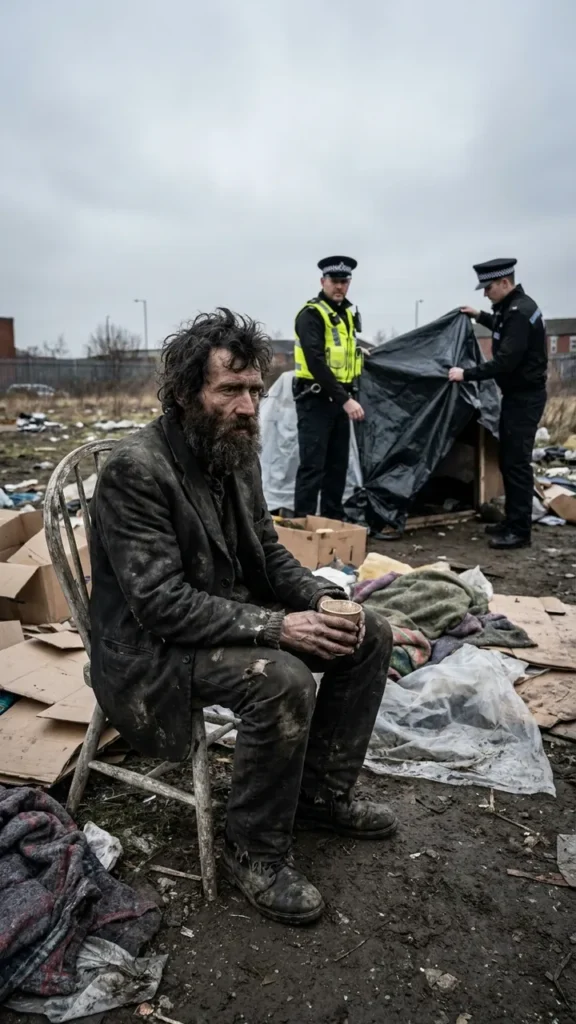
Officer Davies stepped out of the cruiser and adjusted his yellow vest.
His boots crunched on gravel.
Beside him, Officer Miller scanned the area, hand resting near his radio.
“Welfare check came in twenty minutes ago,” Miller said. “Some jogger reported a man living in the brush.”
Davies nodded. “Let’s go easy.”
They followed a narrow path between two abandoned warehouses.
Trash was everywhere.
Torn plastic bags.
Empty bottles.
A torn mattress with springs poking out.
Then they saw it.
A small structure made of blue tarps and cardboard.
The tarp sagged in the middle, held up by a single wooden pole.
It leaned against a concrete barrier.
The ground around it was muddy, littered with cigarette butts and food wrappers.
Davies slowed his pace.
He motioned for Miller to stay back.
“Hello?” Davies called out. “Police.
We’re not here to cause any trouble.”
No answer.
He stepped closer.
The tarp rustled.
A pair of eyes appeared in the gap.
Arthur Pendelton.
He was curled inside, knees drawn to his chest.
His jacket was dark with grime.
His hair was matted.
His beard was thick and tangled.
His face looked like crumpled paper-deep lines, sunken cheeks, hollow eyes.
He said nothing.
Davies crouched down, putting himself at eye level.
He kept his voice low, soft.
“Sir.
I’m Officer Davies.
This is Officer Miller.
We heard you might need some help.”
Arthur’s gaze darted to the side.
He looked at Miller’s uniform, then at the gun holstered on his belt.
He flinched.
“I ain’t done nothing wrong,” he rasped.
“We know,” Davies said. “Nobody’s accusing you of anything.
We want to help.”
Arthur’s hand trembled as it clutched the edge of the tarp.
The fabric was soaked from last night’s rain.
Drops fell onto his lap.
Miller stepped forward slowly.
He held up a bottle of water. “Can I give you this?
You look thirsty.”
Arthur stared at the bottle.
His lips were cracked, bleeding slightly.
He reached out.
His fingers were skeletal, nails black with dirt.
He took the bottle.
His hands shook as he unscrewed the cap.
He drank too fast.
Water dribbled down his chin, mixing with grime.
Davies waited.
“How long have you been out here?” he asked.
Arthur wiped his mouth with the back of his hand. “Don’t know.
Months.
Lost count.”
“A winter came and went,” Miller said quietly.
Arthur nodded. “Froze last January.
Thought I was dead.”
Davies felt a knot in his stomach.
He looked around at the filth.
The rats.
The broken bottles.
The cold.
“We can get you out of this,” Davies said. “There’s a shelter that takes people in.
They have beds.
Hot food.
Clean clothes.”
Arthur’s eyes widened.
Then narrowed. “I’ve heard that before.”
“This is different,” Miller said. “I’ve been there.
They treat you like a person.”
Arthur let out a bitter laugh. “A person.
Haven’t been a person in a long time.”
He lowered his head.
His shoulders shook.
Davies reached out and placed a hand on Arthur’s arm.
The touch was light, careful.
“You are a person, sir.
You always were.”
Arthur looked up.
For the first time, his eyes held something other than fear.
A flicker of hope.
But it was buried under years of pain.
The air was cold against Arthur’s skin.
He hadn’t moved from his crouch.
The water bottle sat in his hands, half empty.
He stared at the label as if it were a foreign object.
“Can you stand?” Davies asked.
Arthur shook his head. “Knees are bad.
Real bad.”
Miller moved closer.
He knelt beside Davies. “That’s okay.
We can help you.
But we need to pack your things first.
Anything you want to take?”
Arthur frowned. “Things?”
He gestured weakly around the tent.
The tarp.
A moldy sleeping bag.
A metal box.
A broken flashlight.
Plastic bags filled with empty cans.
“That’s all I got.”
Davies pointed to the metal box. “What’s in there?”
Arthur’s expression tightened. “Stuff.”
“Can we look at it?” Davies asked gently. “We need to make sure nothing gets left behind.”
Arthur hesitated.
Then he nodded.
Davies reached inside the tent.
The smell hit him-acrid sweat, urine, damp rot.
He grabbed the metal box.
It was heavy.
Rusted.
The lid was secured with a piece of twisted wire.
He set it on the ground in front of Arthur.
“You want to open it?” Davies said.
Arthur’s hands trembled as he unwound the wire.
It took three tries.
The lid creaked open.
Inside was a photograph in a cheap frame.
A woman with dark hair and a bright smile, holding a toddler.
Behind them, a small wooden house.
Arthur’s finger brushed the glass.
“My wife,” he whispered. “And my girl.
Sarah.”
He pulled out a gold ring.
It was thin, tarnished. “She gave me this.
Twenty-nine years ago.”
Then a folded piece of paper.
A crayon drawing of a stick figure family.
The words “Love Daddy” scrawled in red.
Arthur’s voice cracked. “She made that when she was five.”
Davies looked at Miller.
Miller’s jaw was tight.
“Those are important to you,” Davies said. “We’ll make sure they stay safe.”
Arthur nodded slowly.
He placed the photograph, the ring, and the drawing into a plastic bag.
He clutched it against his chest.
Miller began to dismantle the tent.
The tarp sagged.
A rat scurried out, making Arthur flinch.
“Sorry,” Miller said. “Didn’t mean to scare you.”
Arthur watched as Miller pulled the tarp down.
The pole fell.
The pile of trash that had been his home for months collapsed into a heap.
“Nothing there,” Miller said. “Just garbage.”
Arthur looked at the pile.
His eyes were empty.
“That’s all it ever was,” he said.
Davies stood up.
He offered Arthur his hand.
“Come on, Arthur.
Let’s get you out of here.”
Arthur stared at the hand.
It was clean.
Strong.
Offered without hesitation.
He took it.
His grip was weak.
Davies pulled him upright.
Arthur swayed.
His knees buckled.
Miller caught his other arm.
Together, they held him steady.
Arthur’s breath came in shallow gasps.
He was light.
Bone and skin.
A skeleton in a dirty jacket.
“Easy,” Davies said. “We got you.”
Arthur looked up at the sky.
It was grey.
Heavy with clouds.
But he could still see the sun behind them.
He swallowed.
“I don’t… I don’t know what to say.”
“You don’t have to say anything,” Miller said. “Just let us help.”
Arthur’s eyes filled with tears.
He blinked them back.
But one escaped, rolling down his cheek, cutting a clean path through the grime.
He didn’t wipe it away.
He let it fall.
‘Arthur wiped his face with the back of his hand.
The tear left a clean streak on his grimy cheek.
He looked down at the plastic bag in his lap.
It was empty, save for the bottle of water.
“There’s something else,” he rasped.
Davies waited.
Arthur pointed a trembling finger toward the collapsed heap of rags and cardboard. “Under there.
A metal box.
Rusted.”
Davies followed his gaze.
He stepped over the pile of debris.
A torn piece of blue tarp covered a small mound.
He lifted it.
The metal box sat there, wedged between a broken chair and a pile of rotting newspapers.
Davies picked it up.
It was heavy.
The rust flaked off onto his gloves.
He carried it back to Arthur and set it on the ground.
“Open it?” Davies asked.
Arthur nodded.
His hands shook as he worked the twisted wire.
The latch was stubborn.
He grunted.
Davies gently helped, prying the wire loose.
The lid creaked open.
Inside lay a faded photograph in a cracked frame.
A woman with dark hair and a wide smile, holding a toddler in a yellow dress.
Behind them, a small white house with a wooden porch.
Arthur’s breath hitched.
“That’s Eleanor,” he said softly. “My wife.
And Sarah.”
He reached in with two fingers, delicate, as if the picture might crumble.
He pulled out a gold ring.
Thin.
Tarnished.
Inside, an engraving: “Forever, E.”
“She gave me that on our wedding day,” Arthur said. “Twenty-nine years.
I never took it off.
Not until-” He stopped.
Davies heard the unspoken words.
Not until he hit rock bottom.
A folded piece of paper lay at the bottom.
Arthur unfolded it carefully.
A child’s crayon drawing.
Three stick figures: a tall man, a shorter woman, a small girl with yellow hair.
Above them, a red sun.
Below, the words “I love you Daddy” in wobbly letters.
Arthur’s face crumpled.
“She drew that for my birthday,” he whispered. “She was five.
I kept it all these years.”
Miller cleared his throat.
He looked away, blinking hard.
Davies said, “Let’s put them somewhere safe.”
Arthur nodded.
His fingers moved slowly, reverently, as he placed each item into the plastic bag.
The photograph.
The ring.
The drawing.
He tied the bag in a knot.
Then he held it to his chest like a child holding a stuffed animal.
“I thought I’d lost them,” he said. “When the tent collapsed last month, I thought they were gone.
I dug through the mud for hours.”
Davies’s jaw tightened. “You found them.”
Arthur looked up at him.
His eyes were wet again. “Yeah.
I found them.”
He clutched the bag tighter.
“This is all I have left of them.”
Miller crouched beside him. “Then we’ll make sure you keep them.”
Arthur’s lips parted.
He wanted to say something, but no words came.
He just nodded.
Miller stood up and walked to the tattered tent structure.
The blue tarp was frayed.
A single wooden pole held it upright.
Ropes were tied to a rusty pipe and a broken cinderblock.
The whole thing swayed in the breeze.
“Okay,” Miller said. “Let’s get this down.”
Arthur watched from the ground.
His knees were drawn to his chest.
He held the plastic bag like a lifeline.
Miller grabbed the pole.
He pulled.
The tarp sagged.
A pile of junk shifted inside.
Old cans.
A torn blanket.
A half-eaten loaf of bread, green with mold.
Then a squeak.
A rat burst out from under the tarp, its body fat and grey.
It scurried over Miller’s boot and disappeared into the brush.
Arthur flinched.
His whole body jerked backward.
His breath caught.
“It’s okay,” Davies said quickly. “It’s gone.”
Arthur’s face was pale. “They come at night.
Crawl on my legs.
I wake up screaming.”
Davies placed a hand on his shoulder. “You’re safe now.”
Arthur looked up at him.
His eyes were hollow, searching.
“No one ever says that to me.”
The words hung in the air.
Davies held his gaze. “I’m saying it now.”
Arthur’s throat moved.
He swallowed hard.
Miller pulled the tarp all the way down.
The pole clattered to the ground.
The tent collapsed into a messy heap.
A cloud of dust rose.
“Anything else you need?” Miller asked.
Arthur shook his head. “No.
Nothing.”
Davies helped Arthur to his feet again.
His grip was firm but gentle.
Arthur swayed.
His weight barely pressed down.
They stood there, the three of them, amid the rubble of Arthur’s life.
The train tracks stretched silently in the distance.
A bird called from a broken antenna.
“Let’s go,” Davies said.
Arthur looked back at the heap of tarps and trash.
His home for months.
A shelter made of nothing.
He turned away.
“Okay,” he whispered.
Miller took Arthur’s left arm.
Davies took his right.
They began to walk.
CHAPTER 2: The Walk to the Cruiser
‘Arthur’s legs refused to cooperate.
He stood, but only because Davies and Miller held him upright.
His knees buckled inward.
His worn-out shoes scraped the gravel.
“Easy,” Miller said.
His voice was low, steady. “Take your time.”
Arthur’s breath came in short gasps.
The plastic bag crinkled against his chest.
His fingers were white-knuckled around the handles.
Davies shifted his grip, sliding his hand under Arthur’s armpit. “We’ve got you.”
They moved one step at a time.
The ground was littered with debris.
A crushed beer can.
A burnt log.
A syringe, broken in half.
Arthur’s shoe caught on a rusted pipe.
He stumbled.
Miller caught him. “I’ve got you.”
Arthur’s head hung low.
His greying hair was matted with sweat.
He smelled of mildew and old smoke.
The odor clung to him like a second skin.
They passed the fire pit.
A circle of black stones.
Ash and charred wood.
A half-melted plastic fork.
“I burned my trash there,” Arthur muttered.
His voice was a dry rasp. “Kept the rats away.”
Davies said nothing.
He just kept walking.
A train whistle blew in the distance.
Long and mournful.
Arthur flinched.
His body tensed.
“It’s okay,” Davies said. “Just a train.”
Arthur’s eyes darted toward the tracks. “They come through at 3 AM.
Shook the ground.
I used to think the world was ending.”
Miller guided him around a puddle of murky water. “You won’t hear them tonight.”
Arthur’s throat clicked. “You don’t know that.”
Miller’s grip tightened, just a fraction. “I do.”
They reached a patch of gravel where the patrol car was parked.
A black-and-white Ford.
Spotless.
The headlights reflected off the weeds.
Arthur stopped.
He stared at the vehicle.
His lips parted. “I haven’t been in a car in… I don’t know how long.”
Davies looked at him. “It’s a short ride.
You’ll be fine.”
Arthur’s knees began to shake.
His whole body trembled. “Last time I was in a police car, they took me to the station.
I slept on a concrete floor.”
Davies’s voice was soft. “That won’t happen today.”
Miller opened the rear door.
The interior light clicked on.
The seat was grey fabric.
Clean.
No stains.
Arthur’s eyes widened. “It’s too clean.”
“It’s just a seat,” Miller said.
“I’ll get it dirty.”
Davies shook his head. “It’s a car.
It’s meant to be used.”
Arthur hesitated.
His hand hovered over the door frame.
The plastic bag rustled.
“I don’t want to be a problem,” he whispered.
Miller leaned in. “You’re not a problem.
You’re a person.”
Arthur’s jaw tightened.
His eyes glistened.
He took a breath.
Then he lowered himself into the seat.
His body sank into the cushion.
His grimy jacket pressed against the clean fabric.
He sat rigid, hands in his lap, clutching the bag.
Davies closed the door gently.
The click of the latch was soft.
Arthur stared straight ahead.
Through the windshield, he could see the heap of tarps and garbage where he had lived.
It looked small now.
Pathetic.
He turned his head.
He caught his reflection in the side window.
A stranger looked back.
Grey skin.
Hollow cheeks.
Bloodshot eyes.
A beard that hadn’t been trimmed in months.
He lifted his hand and touched his own face.
“Who is that?” he whispered.
Miller slid into the passenger seat.
He glanced over his shoulder. “That’s you, Arthur.”
Arthur shook his head. “No.
That’s not me.”
Davies got in the driver’s seat.
He adjusted the rearview mirror.
Their eyes met.
“It will be,” Davies said. “Soon.”
Arthur looked away.
The engine started.
A low rumble.
The car vibrated.
Arthur closed his eyes.
He felt the plastic bag against his chest.
He felt the photograph inside.
The ring.
The drawing.
He opened his eyes again.
The train tracks were already fading in the side mirror.
Arthur sat very still.
His knees were pressed together.
His hands lay flat on the plastic bag in his lap.
The seatbelt was cinched tight across his chest.
He had put it on himself when Davies asked.
The buckle clicked.
The webbing pulled snug.
It felt foreign.
A restraint.
A safety.
He didn’t know which.
The car smelled of coffee.
A faint trace of air freshener.
Something clean and artificial.
Arthur’s nostrils flared.
He breathed in.
“You okay back there?” Davies asked.
Arthur’s voice was barely a whisper. “Yes.”
It was a lie.
His heart pounded.
Sweat beaded on his palms.
He pressed his hands into the bag, feeling the hard edge of the photograph frame through the plastic.
The car rolled forward.
The gravel crunched under the tires.
They passed the fire pit.
The collapsed tent.
The rusted pipe.
Arthur’s eyes stayed fixed on the window.
He saw his reflection again.
This time, the car’s interior light made his face look even more gaunt.
Dark circles under his eyes.
Deep furrows along his forehead.
He turned away.
“Where are you taking me?” he asked.
Davies glanced in the mirror. “Someplace warm.
With a bed.”
Arthur’s throat tightened. “A shelter?”
“Yes,” Davies said. “A good one.”
Arthur shook his head. “I’ve been to shelters.
They take your stuff.
They make you leave at dawn.
They don’t let you stay if you’re sick.”
Miller turned around. “This one is different.
It’s run by a nonprofit.
They don’t turn people away.”
Arthur’s fingers twitched. “I don’t have any money.”
“You don’t need it,” Miller said.
Arthur fell silent.
He stared at the plastic bag.
The drawing.
The ring.
The photograph.
His daughter’s face.
Sarah.
She would be in her twenties now.
He hadn’t seen her since she was fourteen.
He remembered the day she left.
Eleanor had been dead for three months.
He was drunk.
He said things.
Terrible things.
Sarah had walked out the door.
She never looked back.
Arthur closed his eyes.
The memory burned.
“You okay?” Davies asked.
Arthur opened his eyes. “Just tired.”
Davies nodded. “Get some rest.
It’s twenty minutes.”
Arthur leaned his head against the window.
The glass was cold.
It vibrated against his skull.
He watched the scenery change.
The industrial train yard gave way to empty lots.
Then houses.
Then convenience stores.
A gas station.
A laundromat.
A church.
Life.
Moving.
Bright lights.
He had forgotten what it looked like.
Miller reached over the seat.
He held a small bottle of water. “Here.
Finish this.”
Arthur took it.
His hands shook as he unscrewed the cap.
He drank.
The water was cold.
It hurt his throat.
He lowered the bottle.
A drop of water clung to his chin.
“Thank you,” he said.
Miller smiled. “You’re welcome.”
Arthur looked at the water bottle.
Then at the officers.
Their clean uniforms.
Their calm faces.
He didn’t understand why they were being kind.
He didn’t trust it.
But he was too tired to fight.
He closed his eyes again.
The car hummed.
The wheels rolled.
And Arthur Pendelton, for the first time in months, felt something close to safety.
‘The car hummed along the asphalt.
Arthur kept his eyes closed.
The plastic bag rested on his thighs.
His fingers curled around the handles.
Davies drove with both hands on the wheel.
His eyes flicked to the rearview mirror every few seconds.
Miller sat in the passenger seat.
He stared out the window.
His thumb tapped against his knee.
The silence was thick.
Arthur’s throat clicked when he swallowed.
He opened his eyes.
The streetlights passed overhead in rhythmic pulses.
Yellow light.
Darkness.
Yellow light.
“Where are you taking me?” Arthur asked again.
His voice was a croak.
Dry.
Broken.
Davies glanced in the mirror. “Someplace warm.
With a bed.”
Arthur blinked. “That’s not an address.”
“It’s a promise,” Davies said.
Miller turned.
He held up a phone. “New Hope Transitional Shelter.
Brick building.
Green door.
I’ve been there before.”
Arthur’s jaw tightened. “How do you know they’ll let me in?”
“I called ahead,” Davies said. “They have a room.”
Arthur’s hands began to shake.
The plastic bag crinkled. “You called ahead?”
“Standard procedure,” Miller said. “We do this a lot.”
Arthur stared at them.
His eyes narrowed. “You do this a lot?”
Davies nodded. “Welfare checks.
Homeless encampments.
We try to connect people to services.”
Arthur’s lips parted.
He wanted to say something.
He didn’t know what.
“You’re not arresting me?” Arthur asked.
Davies shook his head. “No.”
“You’re not taking me to a hospital?”
“No,” Davies said. “Not unless you want to go.”
Arthur’s throat tightened.
His eyes burned.
He looked down at the bag.
“I don’t understand,” he whispered. “Nobody helps people like me.”
Miller turned fully.
His face was calm.
His eyes were steady. “That’s not true, Arthur.
We’re here.”
Arthur sniffed.
He wiped his nose with the back of his hand.
The sleeve of his jacket was grimy.
He left a streak of dirt on his cheek.
“I haven’t eaten in two days,” Arthur said.
Davies’s hands tightened on the wheel. “There’s food at the shelter.
Hot food.”
Arthur’s stomach clenched.
He folded forward.
His forehead touched the plastic bag.
“I’m tired,” he said. “I’m so tired.”
“You can sleep tonight,” Miller said. “Real bed.
Real pillow.”
Arthur’s shoulders shook.
A small sound escaped his throat.
It was half a sob, half a laugh.
“I used to have a bed,” he said. “A real one.
With sheets.”
Davies kept his voice low. “You’ll have one again.”
Arthur lifted his head.
He stared at the back of Davies’s headrest. “You don’t know that.”
“I do,” Davies said. “Because I’m going to make sure you get it.”
Arthur fell silent.
He looked out the window.
They passed a row of houses.
Porch lights.
A dog barking in a fenced yard.
A woman walking a stroller.
Normal life.
A life he had lost.
His hand drifted to the plastic bag.
He pressed his palm against the photograph inside.
“That your family?” Miller asked.
Arthur didn’t answer.
He just held the bag tighter.
The car turned left.
The street got narrower.
Trees lined the sidewalks.
The streetlights grew dimmer.
“Almost there,” Davies said.
Arthur felt his heart pound.
He didn’t know what to expect.
He was afraid to hope.
Arthur’s mind drifted.
He thought of Sarah.
She would be twenty-six now.
Maybe married.
Maybe a mother.
He didn’t know.
He had missed everything.
Her high school graduation.
Her first job.
Her wedding.
Her children.
He had thrown it all away.
His hand moved to the plastic bag.
He pulled open the top.
His fingers found the edge of the photograph.
He pulled it out.
The photo was faded.
The corners were bent.
The image showed a woman with dark hair and a wide smile.
Eleanor.
She stood in front of a red door.
A little girl clutched her hand.
Sarah.
Age six.
Missing a front tooth.
Arthur’s hand trembled.
“That your family?” Miller asked again.
Arthur nodded.
His voice was gone.
Miller leaned over the seat.
He looked at the photo. “Beautiful.”
Arthur’s throat burned. “My wife.
Eleanor.
And my daughter.
Sarah.”
“Where are they now?” Miller asked.
Arthur’s eyes dropped. “Eleanor died.
Cancer.
Twelve years ago.”
Miller’s face softened. “I’m sorry.”
“Sarah stopped talking to me after that,” Arthur said. “I was… not good.
I drank.
I said things.”
His voice cracked.
“I lost her,” Arthur whispered. “I lost everything.”
Davies’s eyes met his in the mirror. “You’re still here, Arthur.
That means something.”
Arthur shook his head. “I’m a ghost.
I was dead out there.”
“You’re not dead,” Miller said. “You’re in this car.
You’re going to a shelter.
You’re alive.”
Arthur looked at the photo again.
Eleanor’s face.
Sarah’s gap-toothed smile.
“I haven’t seen her in twelve years,” Arthur said. “She probably thinks I’m dead.”
“Do you want to find her?” Davies asked.
Arthur’s breath caught. “I don’t know if I deserve to.”
Davies said nothing.
Miller turned back.
He looked out the windshield.
The car slowed.
They pulled up to a brick building.
A green door.
A sign above it: “New Hope Transitional Shelter.” Warm yellow light glowed from the windows.
Arthur’s heart pounded.
“This is it,” Davies said.
Arthur didn’t move.
He stared at the building.
His fingers clutched the photograph so hard the edges curled.
“I’m scared,” Arthur said.
Miller turned. “Of what?”
“That it’s a trick.
That I’ll get inside and someone will yell at me.
Or throw me out.”
Davies cut the engine.
He turned in his seat. “Arthur.
Look at me.”
Arthur looked up.
Davies’s eyes were steady. “No one is going to hurt you.
No one is going to throw you out.
We are here.
We will stay until you are inside and safe.”
Arthur’s eyes burned. “Why?”
“Because you’re a human being,” Davies said. “And you deserve kindness.”
Arthur’s hand shook.
He put the photo back in the bag.
He took a breath.
Then he opened the door.
CHAPTER 3: Arrival at the Facility
‘The car sat idle.
Arthur didn’t move.
His hand still gripped the door handle.
His knuckles were white.
Through the windshield, he saw the green door.
Warm light spilled from its windows.
“Arthur,” Davies said gently. “We’re here.”
Arthur’s jaw tightened.
His eyes scanned the building.
He looked for signs of danger.
A locked gate.
A security guard.
A metal detector.
“I’ve been to shelters before,” Arthur said.
His voice was flat.
Hollow.
Miller turned in his seat. “This one is different.”
“They all say that,” Arthur muttered. “They all promise.
Then they wake you at five AM.
Shove you out into the cold.
Treat you like garbage.”
Davies unbuckled his seatbelt.
He turned fully.
His face was calm.
His eyes held no judgment.
“Not this one,” Davies said. “I know the director.
Helen.
She runs it with dignity.”
Arthur’s lip curled. “Dignity.
That’s a word rich people use.”
Davies didn’t flinch. “I’m not rich.
I’m a cop.
I’ve seen a lot of shelters.
Most of them are bad.
This one is not.”
Arthur stared at him.
His eyes searched for a lie.
He found none.
“What’s the catch?” Arthur asked.
“No catch,” Davies said. “They have funding.
They have beds.
They have food.
And they have a rule.”
“What rule?”
“You can stay as long as you need.”
Arthur’s breath caught.
His chest tightened. “That’s not a rule.
That’s a myth.”
“It’s real,” Miller said. “I’ve dropped off four people here.
Two of them got jobs.
One got an apartment.”
Arthur shook his head. “I’m old.
I’m broken.
Nobody hires me.”
“You don’t know that,” Davies said.
Arthur’s eyes burned.
He looked down at the plastic bag.
The photograph inside.
Eleanor’s face.
Sarah’s smile.
“I don’t want to hope,” Arthur whispered. “It hurts too much.”
Davies nodded. “I know.
But hope is the only way out.”
Arthur sat still.
The engine ticked as it cooled.
Streetlights buzzed overhead.
A dog barked in the distance.
Then Arthur opened the door.
He stepped out.
His knees buckled.
Miller was there.
His hand caught Arthur’s elbow.
“Easy,” Miller said. “Take your time.”
Arthur’s legs shook.
He leaned against the car.
The metal was cold.
Real.
Davies came around.
He stood beside Arthur.
He didn’t rush.
“Whenever you’re ready,” Davies said.
Arthur looked at the green door.
He took a breath.
“I’m ready,” he said.
They walked.
Arthur’s worn-out shoes scraped the concrete.
Each step was slow.
Painful.
They reached the door.
Davies pressed a buzzer.
The sound echoed inside.
Arthur’s heart pounded.
The door opened.
A woman stood there.
Mid-forties.
Dark hair pulled back.
Blue vest.
Warm eyes.
She smiled.
“Arthur?” she said. “I’m Helen.
Welcome.”
Arthur froze.
His mouth opened.
No words came.
Helen stepped aside. “Please.
Come in.”
Arthur looked back at Davies.
Davies nodded.
Arthur stepped forward.
The warmth hit him.
It smelled like soap.
Like coffee.
Like home.
Arthur’s eyes filled with tears.
Helen closed the door behind them.
The lock clicked.
Arthur flinched.
Helen noticed.
She didn’t react.
She just smiled.
“It’s okay,” she said. “That’s just to keep the cold out.”
Arthur looked around.
The hallway was clean.
White walls.
A beige floor.
A bulletin board with flyers.
A potted plant in the corner.
Everything was normal.
He felt out of place.
His dirty jacket.
His matted hair.
His smell.
He expected Helen to step back.
To wrinkle her nose.
To tell him to stand outside until he was cleaned up.
She didn’t.
She extended her hand.
“Arthur Pendelton,” she said. “It’s good to meet you.”
Arthur stared at her hand.
It was clean.
Soft.
Unafraid.
He looked at his own hand.
The dirt caked under his nails.
The grime on his palm.
“I’m dirty,” Arthur said.
Helen’s smile didn’t fade. “I wash my hands.”
Arthur hesitated.
Then he took her hand.
Her grip was firm.
Warm.
“Thank you,” Arthur whispered.
Helen nodded. “You’re welcome.”
Davies and Miller stepped inside.
They stood by the door.
Their hands rested on their belts.
Their eyes were soft.
“We’ll stay until you’re settled,” Davies said.
Arthur shook his head. “You’ve done enough.
You can go.”
“We’ll stay,” Miller repeated.
Arthur’s throat tightened.
Helen gestured down the hall. “Let me show you to intake.
It’s just a small office.
We’ll get some paperwork done.”
Arthur’s chest tightened. “Paperwork?”
“Just basic info,” Helen said. “Name.
Age.
Medical needs.
Nothing scary.”
Arthur’s hands trembled. “I don’t have ID.
I lost it.
Years ago.”
Helen shrugged. “We can work with that.”
Arthur blinked. “What?”
“We don’t turn people away because they lost their ID,” Helen said. “That’s not how dignity works.”
Arthur’s jaw dropped.
He looked at Davies.
Davies smiled. “Told you.”
Arthur’s eyes burned.
He swallowed hard.
“Okay,” he said. “Okay.”
Helen led him down the hall.
The floor was warm under his shoes.
He passed a window.
He saw a small garden.
A bench.
A bird feeder.
“My room has a window,” Arthur said.
Helen glanced back. “Yes.
Every room does.”
“I haven’t had a window in months,” Arthur said.
His voice cracked.
Helen stopped.
She turned.
“Arthur,” she said softly. “You are safe here.
No one is going to take anything from you.
No one is going to hurt you.
You can breathe now.”
Arthur’s shoulders shook.
His eyes fell to the floor.
“I don’t know how to breathe anymore,” he said.
Helen stepped closer.
She didn’t touch him.
She just stood near.
“Then let me help you learn,” she said.
Arthur looked up.
He saw her eyes.
They were kind.
He nodded.
Helen led him into a small office.
A desk.
Two chairs.
A computer.
A lamp.
“Have a seat,” she said.
Arthur sat.
The chair was soft.
He leaned back.
His body ached.
His mind raced.
But for the first time in years, his heart felt light.
He looked at the plastic bag in his hands.
Eleanor’s face.
Sarah’s smile.
Maybe.
Just maybe.
He could find them again.
‘Helen sat behind the desk.
Arthur sat across from her, the plastic bag clutched to his chest.
The office was small.
A clock ticked on the wall.
A computer hummed.
A single lamp cast warm light.
Arthur’s eyes darted around the room.
He scanned the corners.
The door.
The window.
Helen noticed.
“Arthur,” she said softly. “You’re safe.”
He nodded.
But his jaw stayed tight.
Helen picked up a clipboard.
Her voice was calm, unhurried.
“I just need some basic information.
Okay?”
Arthur’s fingers curled around the bag. “Okay.”
“Full name?”
“Arthur James Pendelton.”
“Age?”
“Sixty-three.”
Helen wrote it down. “Any medical conditions?
Diabetes?
Heart problems?
Allergies?”
Arthur’s eyes flickered to the door.
Davies and Miller stood in the hallway.
They weren’t looking at him.
They were talking quietly.
“Arthur?” Helen prompted.
He blinked. “Back injury.
Can’t lift heavy.
Knees are bad.”
Helen nodded. “Are you on any medication?”
“No.”
“Any allergies?”
“No.”
“Do you have a primary care doctor?”
Arthur let out a hollow laugh. “I haven’t seen a doctor in six years.”
Helen’s pen paused.
She looked at him.
Her eyes were soft.
“We have a nurse who visits every Tuesday.
I’ll schedule you an appointment.”
Arthur’s throat tightened. “I can’t pay.”
“It’s free.”
He stared at her.
“Why?” he asked.
His voice was raspy. “Why do you do this?”
Helen put the clipboard down.
She folded her hands.
“Because everyone deserves a chance to start over.”
Arthur’s lips trembled.
He looked down at the bag.
The photograph inside.
Eleanor’s face.
“I don’t trust anyone,” he said. “I’ve been burned too many times.”
Helen didn’t flinch. “That’s fair.
You don’t have to trust me today.
Or tomorrow.
Just stay.
Eat.
Sleep.
Let your body rest.”
Arthur’s shoulders sagged.
His hands shook.
A tear slid down his cheek.
He wiped it with the back of his hand.
His skin was rough.
Cracked.
Helen waited.
In the hallway, Davies and Miller stood side by side.
Davies leaned against the wall.
His eyes were fixed on Arthur.
“He’s like a scared animal,” Davies said quietly.
Miller nodded. “But he’s inside.
That’s the first step.”
“Yeah,” Davies said. “First step.”
Inside the office, Arthur let out a long breath.
“Is that all?” he asked.
Helen smiled. “Almost.
Do you have any immediate needs?
Pain?
Hunger?
Thirst?”
Arthur’s hand went to his stomach.
It growled.
“I haven’t eaten in two days,” he said.
Helen wrote something on the clipboard. “We’ll get you food after you’ve showered.
Clean clothes.
A bed.”
Arthur’s chest heaved.
“I don’t deserve this,” he said.
Helen’s expression didn’t change.
“Deserve isn’t the point.
Need is.”
Arthur’s eyes burned.
He didn’t have words.
Helen stood up.
She walked around the desk.
She stopped in front of him.
“Arthur,” she said. “You survived.
That’s enough.”
He looked up at her.
His eyes were wet.
He nodded.
Helen led Arthur down a narrow hallway.
The walls were pale blue.
The floor was linoleum.
It smelled of bleach and soap.
Arthur’s nose twitched.
“Clean,” he whispered.
Helen glanced back. “Yes.
We keep it clean.”
They stopped at a door.
A small sign: “Shower Room – Men.”
Helen opened it.
Inside was a small tiled room.
A shower head on a metal pipe.
A plastic stool.
A shelf with bottles.
Helen picked up a folded towel from a rack.
White.
Fluffy.
She handed it to Arthur.
His hands shook as he took it.
Then she gave him a bar of soap.
Still wrapped.
New.
“Use as much as you need,” she said.
She reached into a basket and pulled out a plastic bag.
Inside: a grey sweatshirt.
Jeans.
Socks.
Underwear.
All new.
Tags still on.
“These are for you,” Helen said.
Arthur stared at the clothes.
His throat closed.
“It’s been four months,” he said.
His voice cracked. “Four months since I washed.
Since I had clean clothes.”
Helen’s eyes softened.
“Take all the time you need,” she said.
Arthur’s hands trembled.
The towel slipped.
He caught it.
Helen pointed to a small bench.
“You can leave your old clothes there.
We’ll wash them if you want.
Or we can dispose of them.
Your choice.”
Arthur looked down at his jacket.
It was stiff with grime.
The fabric was torn.
The smell was sour.
“Burn them,” he said. “Please.”
Helen nodded. “Okay.”
She turned to leave.
“Helen,” Arthur said.
She stopped.
“Thank you.”
She smiled. “You’re welcome, Arthur.”
The door clicked shut.
Arthur stood alone in the small room.
The silence was loud.
He could hear the hum of a ventilation fan.
The drip of a faucet.
He looked at the shower.
The white tiles.
The clean floor.
He touched the towel.
It was soft.
Arthur slowly unzipped his jacket.
His fingers were numb.
The zipper stuck.
He tugged it.
It opened.
He shrugged the jacket off.
It fell to the floor with a thud.
Heavy with dirt.
He untied his shoes.
They were worn through.
The soles were paper-thin.
He peeled off his pants.
His shirt.
His socks.
He stood naked.
The air was cool on his skin.
He looked at his reflection in the tiled wall.
A ghost.
Bones and shadows.
His ribs showed.
His arms were thin.
His face gaunt.
He didn’t recognize himself.
Arthur turned to the shower.
He twisted the knob.
Water sputtered.
Then streamed.
Steam rose.
He stepped under it.
The water hit his back.
Hot.
Stinging.
He gasped.
His body shook.
He hadn’t felt hot water in months.
Only cold from a public bathroom tap.
Sometimes rain.
He stood still.
Let the water run over him.
Dirt ran off his body.
Grey water swirled down the drain.
Arthur closed his eyes.
He pressed his forehead against the tile.
He cried.
Silent sobs.
Shoulders heaving.
The water washed away his tears.
He didn’t know if he was crying from pain or relief.
Maybe both.
After a long time, he reached for the soap.
He unwrapped it.
Brought it to his nose.
Soap.
Clean.
Lavender.
He lathered his hands.
He washed his arms.
His chest.
His legs.
His hair.
The soap suds turned brown.
He rinsed.
He washed again.
The water ran clear.
Arthur turned off the water.
He stood dripping.
The room was quiet.
He grabbed the towel.
He pressed it to his face.
It smelled like fabric softener.
He dried himself.
Slowly.
Carefully.
He put on the new clothes.
The sweatshirt was soft.
The jeans fit well.
The socks were thick.
He looked at his old clothes in a pile on the floor.
He didn’t touch them.
Arthur opened the door.
Helen was standing in the hallway.
She looked at him.
“Arthur,” she said softly.
He nodded.
She smiled.
“Ready for something to eat?”
CHAPTER 4: The Transformation – Physical
‘Arthur stepped into the hallway.
Helen took a step back.
Her eyes widened.
Arthur’s hair was damp.
Dark grey strands clung to his scalp.
His beard was trimmed.
Helen had handed him a disposable razor in the shower.
He had shaved off the scruff.
His jawline was sharp now.
His skin was pink.
Clean.
Alive.
He wore the grey sweatshirt.
The jeans.
The new socks.
He looked ten years younger.
“Arthur,” Helen breathed. “You look…”
Arthur’s hands hung at his sides.
He didn’t know where to put them.
“Different,” he finished.
Helen nodded. “Different.
Good different.”
Arthur looked down at his clothes.
The fabric was soft.
It didn’t smell.
He felt like he was wearing someone else’s skin.
Davies and Miller walked toward them.
Davies stopped.
His mouth opened slightly.
“Mr. Pendelton,” Davies said. “Good lord.”
Miller let out a low whistle. “Look at you.
Clean shaven.
New clothes.
You look like a new man.”
Arthur’s cheeks flushed.
He wasn’t used to compliments.
“I feel strange,” he said.
His voice was still raspy.
But steadier.
Davies smiled. “Strange is good.
Strange means change.”
Arthur touched his own face.
The skin was smooth.
No grime.
No crust.
He hadn’t touched his own bare skin in months.
His eyes burned.
“I don’t recognize myself,” he whispered.
Miller stepped closer. “That’s because you’ve been surviving.
Not living.
Now you can start living.”
Arthur’s throat tightened.
Helen touched his elbow. “Come.
Let’s get you something to eat.”
Arthur nodded.
He took a step.
His new socks were soft on the linoleum.
He paused.
“My bag,” he said. “The plastic bag.
With my things.”
Helen pointed to the bench near the shower door. “I brought it out.
It’s right there.”
Arthur walked over.
He picked up the bag.
The photograph was inside.
Eleanor.
The ring.
The drawing.
He clutched it to his chest.
“I don’t want to lose this,” he said.
Helen’s voice was gentle. “You won’t.
Your room has a small safe.
You can keep it there.”
Arthur’s eyes widened. “A safe?”
“For valuables,” Davies said. “Everyone gets one.”
Arthur looked at the bag.
He had nothing.
But to him, this was everything.
“Okay,” he said.
He followed Helen down the hallway.
Davies and Miller walked behind him.
As they passed a window, Arthur caught his reflection.
He stopped.
The man in the glass was clean.
His shoulders were straight.
His face had color.
Arthur stared.
For the first time in years, he didn’t look like a ghost.
“Arthur?” Helen called.
He blinked.
“Coming,” he said.
He walked away from the reflection.
But he carried the image with him.
Helen led Arthur into a dining hall.
The room was large.
Fluorescent lights hummed overhead.
Long tables lined the floor.
Chairs were pushed in neatly.
At the far end, a serving station glowed.
Steam rose from metal trays.
The smell hit Arthur first.
Meatloaf.
Mashed potatoes.
Green beans.
His stomach clenched.
A low growl escaped his throat.
“Sit anywhere,” Helen said. “I’ll bring you a plate.”
Arthur stood frozen.
The room was warm.
Clean.
People sat at the tables.
Some ate quietly.
Others talked in low voices.
No one stared at him.
Arthur chose a table near the wall.
He sat down.
The chair was sturdy.
The table was wiped clean.
He placed the plastic bag on his lap.
His hands rested on the table.
They were clean.
The nails were short.
The cracks in his skin were fading.
He didn’t recognize his own hands.
Helen returned with a tray.
She set it down in front of him.
A plate of meatloaf.
A mound of mashed potatoes with gravy.
Green beans.
A roll.
A small cup of apple juice.
Arthur stared at the food.
Steam rose.
The smell was rich.
His mouth watered.
“I… I can’t pay,” he said.
Davies appeared beside him.
He pulled out a chair and sat down.
“It’s free, Arthur.
Eat.”
Arthur’s hands shook as he picked up the fork.
The metal felt foreign.
He stabbed a piece of meatloaf.
He brought it to his mouth.
The first bite hit his tongue.
Flavor exploded.
Arthur closed his eyes.
He chewed slowly.
The meat was tender.
The sauce was savory.
He swallowed.
A tear rolled down his cheek.
He took another bite.
Then another.
Davies watched him.
“Take your time,” Davies said.
Arthur didn’t respond.
He ate.
Mashed potatoes.
Smooth.
Buttery.
Green beans.
Salted.
The roll.
Soft.
Warm.
He dipped it in the gravy.
He finished everything.
The plate was clean.
Arthur leaned back.
His stomach was full.
For the first time in days.
He let out a shaky breath.
“Thank you,” he whispered.
Davies leaned forward.
“Arthur, can I ask you something?”
Arthur nodded.
“How did you end up out there?”
Arthur’s jaw tightened.
He stared at the empty plate.
“I was a carpenter,” he said. “Twenty-five years.
Good work.
Good pay.”
He paused.
“I hurt my back.
Lifting a beam.
Herniated disc.
Surgery.
Physical therapy.
But I couldn’t work anymore.”
Davies listened.
“Lost the house.
Lost the car.
My wife, Eleanor, she got sick.
Cancer.
We had no insurance.”
Arthur’s voice cracked.
“She died.
I sold everything to pay for the funeral.”
Davies’s eyes softened.
“I had a daughter.
Sarah.
She tried to help.
But I pushed her away.
I was ashamed.
I didn’t want her to see me fall apart.”
Arthur’s fingers curled around the plastic bag.
“She stopped calling.
I don’t blame her.”
Davies spoke quietly. “You’re still here.
That counts for something.”
Arthur looked up.
His eyes were wet.
“I thought I’d die out there.
Alone.
In that tent.
No one would find me until the smell got bad.”
Davies reached across the table.
He placed his hand on Arthur’s wrist.
“You’re not out there anymore.”
Arthur’s throat tightened.
He couldn’t speak.
He just nodded.
‘Davies leaned back in his chair.
The fluorescent lights hummed overhead.
Arthur’s empty plate sat between them.
“Tell me about your daughter,” Davies said.
Arthur’s fingers tightened on the plastic bag.
“Sarah.
She’s thirty-four now.
Lives in Oregon.”
“Does she know where you are?”
Arthur shook his head.
“I haven’t called her in six years.
I don’t have a phone.
I don’t have an address.”
Davies nodded slowly.
“Would you like to call her?”
Arthur’s eyes snapped up.
“I can’t.
She probably thinks I’m dead.”
“She might be worried sick, Arthur.”
Arthur’s jaw clenched.
“I don’t want her to see me like this.”
“Like what?”
“Broken.
Useless.
A failure.”
Davies leaned forward.
“You’re not a failure.
You fell.
That’s different.”
Arthur let out a bitter laugh.
“Same result.
I’m alone.”
“Not anymore.”
Arthur stared at the table.
“I was a good carpenter.
Custom cabinets.
Built-in shelves.
My hands knew what to do.”
He held up his hands.
They were clean now.
But the calluses were gone.
“Now they shake when I hold a fork.”
Miller walked over.
He pulled a chair and sat down.
“Arthur, how long were you out there?”
Arthur’s eyes drifted.
“Three years.
First in my truck.
Then under a bridge.
Then the tent.”
“How did you survive?”
“Odd jobs.
Panhandling.
Soup kitchens.
Sometimes I ate out of dumpsters.”
His voice dropped.
“You learn to ignore the smell.”
Davies’s face tightened.
“Did anyone ever reach out to you?”
“Once.
A church group.
Gave me a sandwich.
Told me God loved me.”
He paused.
“I didn’t believe them.”
Miller folded his hands on the table.
“Why not?”
Arthur looked up.
His eyes were hollow.
“Because if God loved me, He wouldn’t have let my wife die.
He wouldn’t have taken my back.
He wouldn’t have let me end up in a tent.”
Davies spoke quietly.
“Sometimes bad things happen to good people.
It doesn’t mean you’re being punished.”
“What does it mean, then?”
Davies paused.
“It means you’re human.
It means life is hard.
But it also means you can still choose.”
“Choose what?”
“To keep going.
To let people help you.”
Arthur’s eyes dropped to his hands.
“I don’t know how.”
“Start small,” Miller said. “Breathe.
Eat.
Sleep.
Tomorrow, we’ll figure out the next step.”
Arthur’s throat tightened.
“You’re not going to kick me out in the morning?”
Miller shook his head.
“No.
This place has beds.
Caseworkers.
They’ll help you find work if you’re able.
They’ll help you contact your daughter.”
Arthur’s hands trembled.
He opened his mouth.
Closed it.
Then he whispered.
“I don’t deserve this.”
Davies reached out.
He placed his hand on Arthur’s shoulder.
“Yes, you do.”
Arthur’s chin quivered.
He looked at the empty plate.
The clean table.
The warm room.
He felt something crack inside him.
Something old.
Something frozen.
He let out a shaky breath.
“I don’t even know who I am anymore.”
Davies smiled gently.
“That’s okay.
You’ll find out.”
CHAPTER 5: The Moment of Vulnerability
Arthur’s eyes welled up.
The tears came without warning.
He tried to blink them back.
They fell anyway.
One.
Then another.
He put down his fork.
His shoulders began to shake.
“I thought I’d die out there,” he said.
His voice was raw.
Broken.
“Alone.”
Davies didn’t speak.
Miller didn’t move.
They let him cry.
Arthur pressed his palm to his eyes.
“I planned it, you know.
I had a bottle of pills.
Kept it in my jacket pocket.”
He choked.
“Three nights ago.
I held them in my hand.
I counted them.
Twenty-seven.”
Arthur’s voice cracked.
“I put them in my mouth.”
His lips trembled.
“Then it started to rain.
Cold rain.
It hit the tent.
Made a sound.”
He paused.
“I thought about the sound of rain on the roof of my house.
When Eleanor was alive.
When we were warm.”
Arthur broke down.
His body heaved.
The plastic bag fell from his lap.
Miller reached down.
He picked it up.
Held it out.
Arthur took it.
His fingers curled around the edges.
“I was so scared,” he whispered. “So cold.
So tired.”
Miller placed a hand on his shoulder.
“You’re not alone now.”
Arthur looked up.
His face was wet.
His eyes were red.
“I don’t want to be alone anymore,” he said.
His voice was barely audible.
Davies leaned in.
“You won’t be.
We’re here.
Helen’s here.
This place is full of people who care.”
Arthur sobbed.
Quietly.
His shoulders shook.
Helen appeared in the doorway.
She saw him crying.
She didn’t approach.
She just nodded at Davies.
Davies turned back to Arthur.
“Let it out.
It’s okay.”
Arthur cried.
He cried for Eleanor.
For the house.
For the life he lost.
He cried for Sarah.
For the years he threw away.
He cried for the man he used to be.
Minutes passed.
Slowly, the sobs faded.
Arthur wiped his face with his sleeve.
The grey sweatshirt grew dark with tears.
“I’m sorry,” he said.
“Don’t be,” Miller said.
Arthur sniffed.
“I haven’t cried in a long time.
I forgot what it felt like.”
Davies smiled.
“It feels like being human.”
Arthur let out a shaky laugh.
“I guess I still am one.”
“Yeah,” Miller said. “You are.”
Arthur looked at the plastic bag.
He opened it.
His fingers found the photograph.
He pulled it out.
A woman’s face.
Smiling.
Brown hair.
Warm eyes.
Eleanor.
Arthur touched her image.
“I miss you,” he whispered.
He placed the photograph back in the bag.
Then he closed it.
He looked at Davies.
“What happens now?”
Davies stood.
“Now, you get some rest.
Tomorrow, you meet your caseworker.
You start the paperwork.
You take it one step at a time.”
Arthur nodded.
“I can do that.”
Davies extended his hand.
Arthur hesitated.
Then he took it.
His grip was weak.
But steady.
“Thank you,” Arthur said.
Davies held his gaze.
“You’re a human being, Arthur.
Never forget that.”
Arthur’s eyes glistened.
But this time, he didn’t cry.
He breathed.
And for the first time in years, the air felt clean.
‘Davies stood.
Miller stood.
The chairs scraped the linoleum.
Arthur remained seated.
His hands rested on the plastic bag.
His knuckles were white.
“We should go,” Davies said.
His voice was soft.
“Let you rest.”
Arthur nodded.
But he didn’t move.
Miller adjusted his vest.
“Helen will take good care of you.
She’s got a heart the size of this building.”
Arthur’s eyes stayed on the table.
“Thank you,” he whispered.
Davies turned.
He took a step toward the door.
Arthur’s hand shot out.
His fingers wrapped around Davies’s wrist.
The grip was weak.
Desperate.
Davies stopped.
He looked down.
Arthur’s voice cracked.
“Thank you.
For not treating me like garbage.”
Davies’s face softened.
He placed his other hand over Arthur’s.
The touch was warm.
Steady.
“You’re a human being, Arthur.
Never forget that.”
Arthur’s breath hitched.
He pulled his hand back.
He stared at his own palm.
Miller stepped forward.
He placed a card on the table.
“That’s the station number.
If you need anything.
Anything at all.”
Arthur picked up the card.
His thumb traced the edge.
“I don’t have a phone.”
“Helen will let you use the office line,” Miller said.
“We’ll check in tomorrow.”
Arthur’s jaw tightened.
“You don’t have to.”
Davies smiled.
“We want to.”
Arthur swallowed.
His throat was dry.
“Why?”
Davies tilted his head.
“Because you matter.
That’s why.”
Arthur’s eyes glistened.
He blinked.
The tears didn’t fall.
Miller cleared his throat.
“We’ve got other calls.
But we’ll be back.”
Arthur nodded.
He couldn’t speak.
Davies touched his cap.
“Goodnight, Mr. Pendelton.”
Arthur watched them walk to the door.
Their boots squeaked on the floor.
The fluorescent light flickered.
At the door, Davies paused.
He looked over his shoulder.
“Sleep well.”
Arthur’s lips parted.
A single word escaped.
“You too.”
The door clicked shut.
Arthur sat alone.
The plastic bag sat on his lap.
He could hear the hum of the refrigerator in the kitchen.
Helen appeared in the doorway.
Her blue vest was bright.
Her smile was kind.
“Ready to see your room?”
Arthur looked up.
His eyes were red.
But he nodded.
He stood slowly.
His legs were shaky.
He held the plastic bag against his chest.
Helen extended her hand.
Arthur hesitated.
Then he took it.
Her fingers were warm.
“This way,” she said.
Arthur followed.
His worn-out shoes shuffled on the linoleum.
The card from Miller was in his pocket.
He felt the weight of it.
A promise.
A thread.
He walked down the hallway.
Past a bulletin board covered in flyers.
Past a water fountain that hummed.
Helen stopped at a door.
Number 217.
She unlocked it.
The door swung open.
A small room.
A single bed.
Clean white sheets.
A window.
Outside, a garden.
Flowers.
A bench.
A streetlamp casting orange light.
Arthur’s breath caught.
“It’s beautiful,” he whispered.
Helen stepped back.
“It’s yours.
For as long as you need.”
Arthur’s hands trembled.
He let go of the doorframe.
He walked inside.
The bed creaked as he sat.
The sheets smelled of detergent.
Clean.
He placed the plastic bag beside him.
His fingers found the zipper.
He pulled it open.
Inside: the photograph.
Eleanor’s smile.
The wedding ring.
The child’s drawing.
He pulled out the drawing.
A house.
A stick figure family.
The sun.
A smiley face.
His daughter’s hand.
Twenty years ago.
Arthur’s lips quivered.
He looked at the garden.
The flowers swayed in the breeze.
He thought of Sarah.
Of the call he would make tomorrow.
Of the possibility.
He touched the photograph.
Eleanor’s eyes.
Her warm eyes.
“I’m still here,” he whispered.
He placed the photograph back.
He closed the bag.
He lay back on the bed.
The pillow was soft.
The blanket was warm.
The window let in the night air.
Arthur’s eyes closed.
A single tear escaped.
It rolled down his cheek.
But his lips curved upward.
Small.
Fragile.
Real.
Arthur lay in the quiet.
The room breathed with him.
The clock on the wall ticked.
He opened his eyes.
The ceiling was white.
No cracks.
No stains.
Clean.
He sat up slowly.
His back ached.
But it was a familiar ache.
Not the sharp pain of cold concrete.
He looked at the window.
The garden glowed under the streetlamp.
A moth circled the light.
Arthur stood.
His knees popped.
He walked to the window.
His bare feet felt the carpet.
Soft.
Warm.
He pressed his palm to the glass.
The surface was cool.
He watched the moth.
It kept circling.
He thought of the tent.
The rat.
The smell.
The rain.
He thought of the pills.
The twenty-seven pills.
The taste of plastic in his mouth.
He turned away.
He walked back to the bed.
He sat.
The plastic bag lay beside him.
He opened it again.
His fingers found the photograph.
He pulled it out.
Eleanor’s face.
Her smile.
Her hair.
Arthur traced her cheek with his thumb.
“I’m sorry,” he said.
His voice was hoarse.
“I’m sorry I gave up.”
He held the photograph to his chest.
He could feel his heartbeat.
Slow.
Steady.
His eyes drifted to the nightstand.
A lamp.
A notepad.
A pen.
He reached for the pen.
His hand shook.
He wrote on the notepad.
“Dear Sarah.”
He paused.
His mind scrambled for words.
He had none.
He set the pen down.
He looked at the drawing.
The child’s drawing.
The smiley face.
Arthur’s lips twitched.
He picked up the drawing.
He held it next to the photograph.
Eleanor and Sarah.
Together.
In his hands.
He thought of the call.
Tomorrow.
He would ask Helen for the phone.
He would dial the number.
His heart pounded.
What if she didn’t answer?
What if she hung up?
He pushed the thought away.
Davies’s voice echoed in his mind.
“You’re a human being.”
Arthur set the photograph and drawing on the nightstand.
He straightened them.
Aligned.
He leaned back against the headboard.
The pillow supported his neck.
He breathed in.
Out.
The room smelled of soap.
Clean clothes.
Safety.
He looked at the window again.
The moth was gone.
The garden was still.
Arthur smiled.
It was small.
His lips barely curved.
But it was there.
A fragile arc.
A crack in the wall.
Light seeping through.
He touched his face.
His fingers brushed his beard.
Trimmed.
Clean.
He thought of the shower.
The hot water.
The steam.
The feeling of being clean.
He had forgotten.
Forgotten what it felt like to be warm.
Forgotten what it felt like to be seen.
He looked at his hands.
Clean hands.
The calluses were gone.
But they would come back.
He would work again.
Maybe not carpentry.
Something.
He would call Sarah.
He would tell her he was alive.
He would ask for forgiveness.
Arthur’s smile widened.
Just a fraction.
He pulled the blanket up to his chest.
The fabric was soft.
He lay down.
He closed his eyes.
The photograph was beside him.
The drawing was beside her.
Eleanor.
Sarah.
Him.
He whispered into the dark.
“I’m still here.”
A single tear leaked from his eye.
But his smile remained.
The clock ticked.
The garden rustled.
The room held him.
Arthur Pendelton slept.
For the first time in three years.
He slept without fear.
Outside, the stars blinked.
Inside, a man dreamed.
He dreamed of a house.
A workshop.
A daughter’s voice.
And in the dream, he smiled.
A real smile.
Full.
Bright.
Morning would come.
But for now, there was peace.
Arthur breathed.
The plastic bag lay still.
The photograph watched over him.
And in the quiet, something grew.
A seed.
A hope.
Arthur’s lips moved.
No sound.
Just the shape.
“Thank you.”
The room listened.
The night answered.
He was not alone.
Not anymore.
The end.
‘
