Table of Contents
CHAPTER 1: The Rain-Soaked Discovery
The rain came down in sheets.
It hammered the gravel beside the train tracks, turning the ground into a cold, black slurry.
Officer Davies squinted through the windshield of the patrol car, his wipers working on full speed.
“You see that?” he asked.
Officer Miller leaned forward, his hand resting on the dashboard. “Yeah.
A tent.
Right on the edge of the right-of-way.”
It was barely a tent.
A torn blue tarp, sagging under the weight of water, held up by twisted branches and a single broken pole.
It sat in a shallow ditch, not ten feet from the iron rails.
Davies killed the engine.
The rain drummed on the roof.
“Let’s check it out,” he said.
They stepped out into the downpour.
Yellow high-visibility vests soaked immediately.
Water ran down their faces.
The smell of wet earth and diesel filled the air.
Davies approached first.
His boots squelched in the mud.
“Hello?” he called. “Police.
We’re not here to cause trouble.”
No answer.
He crouched low near the tent flap.
The opening was held shut by a piece of frayed rope.
He could see movement inside.
A shape.
Someone curled into a ball.
“Sir?
Can you hear me?
My name is Officer Davies.
I’m with my partner, Officer Miller.
We just want to talk.”
A long pause.
Then a voice.
Raspy.
Thin.
“Go away.”
Davies exchanged a glance with Miller.
Miller nodded, staying back, giving space.
“Sir, we’re worried about you.
This isn’t safe.
The trains come through here fast.
You’re soaked.
You need help.”
Silence.
Davies tried again. “What’s your name?”
“…Arthur.”
“Arthur.
That’s a good name.
Arthur, can you come out?
Just for a minute?
We can talk somewhere dry.”
The tent flap moved.
A hand appeared.
Dirty, thin, nails cracked.
Then the face.
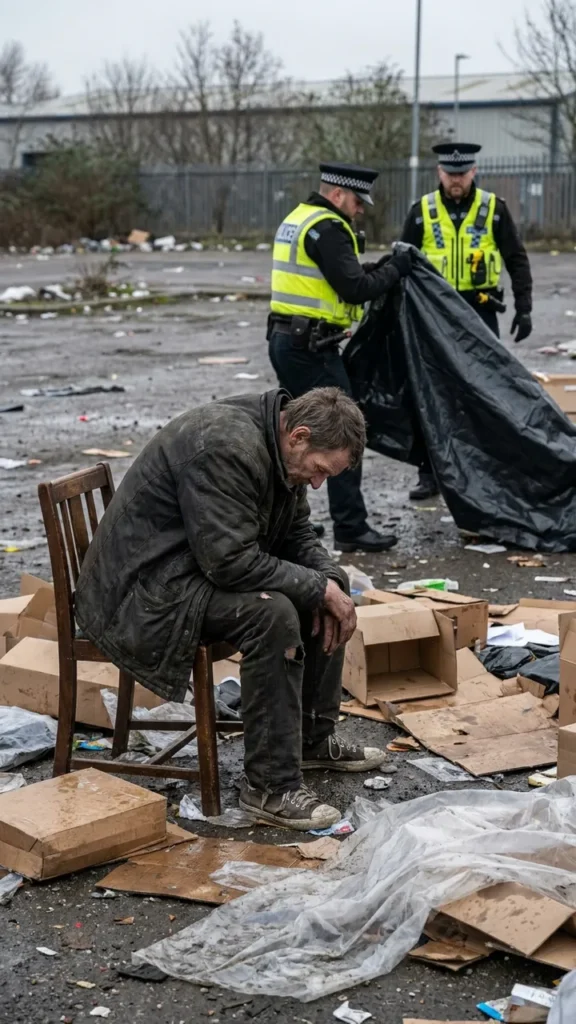
Arthur Pendelton looked like a man carved from sorrow.
Grey hair matted against his skull.
A beard filled with mud.
His eyes-hollow, downcast-barely lifted to meet Davies’ gaze.
He wore a dark jacket, so caked with grime it looked like leather.
Loose pants, torn at the knee.
Shoes with no laces, the soles peeling away.
He was shivering.
Violently.
“I ain’t done nothing wrong,” Arthur whispered.
“We know,” Davies said softly. “We’re not here to arrest you.
We’re here to help.”
Arthur’s fingers tightened on the wet nylon.
His whole body trembled.
“I don’t need help.”
Miller stepped forward, voice calm but firm. “Arthur, you’re hypothermic.
You can barely stand.
This isn’t about need.
This is about survival.”
Arthur’s eyes flickered to Miller.
Fear.
Resentment.
But also something else.
A crack.
A tiny opening.
Davies held out his hand.
Palm up.
“Let us help you pack your things.
We’ll take you somewhere warm.
Somewhere with a bed.
A meal.
No strings attached.”
Arthur stared at that hand.
The rain kept falling.
Behind them, a distant horn blared.
A freight train was coming.
The ground vibrated.
Arthur flinched.
His gaze darted to the tracks, then back to Davies.
“I got nothing worth packing,” he said.
“Then let’s just go,” Davies replied.
Arthur hesitated.
One more second.
Then he reached out and took Davies’ hand.
His fingers were ice.
His grip was weak.
Davies helped him to his feet.
Arthur swayed, dizzy.
Miller moved in, steadying him from the other side.
The train roared past, a blur of iron and noise, shaking the air.
Arthur didn’t look back.
Arthur stood in the rain, shivering.
His thin frame seemed to fold in on itself.
Water dripped from his beard.
His eyes stayed fixed on the ground.
Davies kept his hand on Arthur’s elbow.
Gentle.
Not gripping.
“Let’s get you out of this weather first,” Davies said. “Miller, can you grab the tarp?
Anything dry inside?”
Miller nodded.
He knelt at the tent entrance, pulled back the flap.
The smell hit him.
Damp.
Mold.
Stale sweat.
Empty cans of beans.
A crumpled sleeping bag that was more wet than dry.
Miller’s jaw tightened.
He didn’t show disgust.
He started gathering items.
A rusted metal locket on a broken chain.
A single photograph, curled at the edges-a woman in her thirties, smiling.
A pair of wool socks, dry, tucked inside a plastic bag.
Miller placed each item into a clear evidence bag he pulled from his pocket.
Not for evidence.
For dignity.
“Arthur,” he said, holding up the locket. “This.
You want to keep this?”
Arthur looked up.
For the first time, his eyes focused.
He reached for the locket with a trembling hand.
“That’s mine,” he whispered. “Please.”
Miller handed it to him.
Arthur clutched it against his chest.
“We’ll keep it safe,” Miller said. “I promise.”
Davies spoke softly. “Arthur, do you have any other belongings?
Anything you want to bring?”
Arthur shook his head. “No.
Nothing.”
“Alright.
Let’s walk to the car.
It’s just fifty feet.
Can you make it?”
Arthur nodded, but his legs wobbled.
The cold had numbed his muscles.
His shoes slipped on the wet gravel.
Davies put an arm around his back. “Take your time.
We’re not in a hurry.”
They walked slowly.
Arthur’s steps were small, shuffling.
Each breath came out as a white puff in the cold air.
Miller followed behind, carrying the bag of belongings.
He kept his eyes scanning the tracks, the road, the trees.
Professional.
Alert.
They reached the patrol car.
Davies opened the rear door.
The seat was dry.
He had turned on the heater before getting out.
“Watch your head,” Davies said.
Arthur ducked inside.
The warmth hit him like a wave.
He sat down, hands still clutching the locket.
His shoulders began to shake-not from cold now, but from something deeper.
Davies closed the door gently.
Not a slam.
A click.
He got into the driver’s seat.
Miller slid into the passenger side.
Davies turned to look at Arthur through the partition. “We’re going to a place called New Dawn Center.
It’s a shelter, but it’s more than that.
They have beds, food, showers.
People who care.”
Arthur didn’t answer.
He stared at his reflection in the window.
He saw a stranger.
“I don’t deserve this,” he said finally.
Davies turned the key.
The engine hummed.
“Everyone deserves a chance, Arthur.”
Miller reached into the glove compartment.
He pulled out a granola bar.
Wrapped.
Still fresh.
He handed it back to Arthur. “Eat.
You need energy.”
Arthur looked at the bar.
Then at Miller.
His eyes were wet.
“Thank you,” he said.
The words came out cracked, barely audible.
Miller nodded. “You’re welcome.”
Davies pulled the car onto the road.
The rain continued, but the wipers cleared the view.
Arthur bit into the granola bar.
It tasted like honey, like a memory of a better time.
He chewed slowly.
Behind them, the train tracks faded into the gray afternoon.
Ahead, a new horizon waited.
‘Arthur’s legs buckled as he stood.
He leaned against the tent pole.
The tarp sagged.
Water poured off the edges.
“I can’t…” he whispered.
Davies held his arm. “You can.
One step at a time.”
Arthur’s eyes darted to the filthy ground.
Empty cans lay scattered.
A rusted can of beans.
A crushed soup tin.
“I got nothing,” he said. “Just trash.”
Miller knelt beside the tent.
He pulled the torn blue tarp aside.
The inside was a nest of damp cardboard and shredded fabric.
“Arthur, we’re not judging,” Miller said. “We just want to gather what’s yours.”
Arthur’s face crumpled. “Why?
I ain’t worth a damn thing.”
Davies squeezed his shoulder. “You’re worth enough for us to be here.
That’s a start.”
Arthur let out a ragged breath.
He pointed a trembling finger toward a corner of the tent.
“The blanket.
Under there.”
Miller reached in.
His fingers touched something wet and slimy.
He pulled out a moldy wool blanket.
Green patches covered the fabric.
It smelled of mildew and earth.
“This?” Miller asked.
Arthur nodded. “My mother’s.
Last thing she gave me.”
Miller folded it carefully.
He placed it in a dry plastic bag from his pocket.
“Anything else?” Davies asked.
Arthur’s gaze dropped to his own chest.
His hand clutched the rusted locket.
He hadn’t let go of it.
“This.
Only this.”
Davies looked at the locket.
It was cheap, tarnished.
The chain was broken and tied in a knot.
“That’s important to you,” Davies said.
Arthur’s voice cracked. “My daughter.
Lisa.
She’s… she’s grown now.
I ain’t seen her in ten years.”
Davies didn’t push. “We’ll keep it safe.
You keep holding it.”
Miller continued searching.
He found three empty cans of cheap beer, a broken pair of glasses, and a single photograph curled at the edges.
The photo showed a young woman with dark hair, smiling under a tree.
“That’s her,” Arthur said. “Lisa.
She was nineteen there.”
Miller placed the photo inside a clear evidence bag.
Not for evidence.
For preservation.
“We’ll bring it,” Miller said.
Arthur’s eyes filled with tears.
He blinked them away.
The rain slowed to a drizzle.
Davies glanced at the sky. “We need to move.
More rain coming.”
Arthur shuffled forward.
He bent down slowly, joints creaking, and picked up the empty cans.
One by one.
He held them in his cupped hands.
“I can’t leave them here,” he said. “Animals might cut themselves.”
Davies swallowed.
He picked up a can himself. “We’ll take them.
There’s a trash bin near the car.”
Arthur looked at him.
For the first time, a flicker of something appeared in his eyes.
Not trust.
Not yet.
Curiosity.
“You’re serious,” Arthur said.
“I am,” Davies replied.
Miller gathered the last items.
A crumpled photograph.
The moldy blanket.
A small plastic bag containing a toothbrush with no bristles.
“That’s all,” Miller said.
Arthur stood still.
He stared at the ruined tent.
The place he had called home for three months.
“I never thought I’d leave,” he said.
Davies put a hand on his back. “You’re leaving now.
And you’re not coming back.”
Arthur closed his eyes.
He clutched the locket so hard his knuckles turned white.
“Okay,” he whispered.
He turned away from the tent.
The empty cans clanked in his hands.
Behind him, the blue tarp flapped in the wind.
It looked like a dead bird.
Miller slung the bag over his shoulder.
Davies guided Arthur toward the patrol car.
Gravel crunched under their feet.
A train horn sounded in the distance.
Long and low.
Arthur flinched.
But he kept walking.
The gravel path was slick.
Arthur’s worn shoes had no grip.
The soles flapped against the wet stones.
He took a step and his left foot slid sideways.
He stumbled.
Davies caught him.
Arm around the waist.
Steady.
“Easy,” Davies said. “You’re okay.”
Arthur’s breath came in short gasps. “I’m sorry.
I’m sorry.”
“No need to apologize.”
Miller walked ahead, eyes scanning the tracks.
The train was coming.
He could feel the vibration through his boots.
“We have about thirty seconds before it passes,” Miller said. “Let’s cross the gravel strip now.”
The three of them moved together.
Arthur’s legs were weak.
Each step was a battle.
The ground shook harder.
The horn blared again.
Closer.
Arthur’s heart hammered.
His vision blurred.
He felt like he was falling even when he was standing still.
“I can’t,” he gasped.
Davies tightened his grip. “You can.
Look at me, Arthur.”
Arthur lifted his eyes.
Davies’ face was calm.
No judgment.
No pity.
“One foot.
Then the other.
We’re almost there.”
Arthur nodded.
He forced his right foot forward.
Then his left.
The train burst out of the curve.
A wall of iron and noise.
It roared past, twenty feet away.
Wind whipped Arthur’s wet hair.
The sound was deafening.
He froze.
Miller stepped closer, positioning himself between Arthur and the tracks.
His hand rested on his radio, ready.
But his eyes were on Arthur.
“It’s just a train,” Miller said, voice steady. “It passes.
You stay still.
We stay with you.”
The cars flew by.
Freight containers, rusted and gray.
The ground trembled.
Arthur’s knees shook.
He gripped the locket so hard it bit into his palm.
Then, as suddenly as it came, the train was gone.
The noise faded.
The wind died.
Silence.
Arthur let out a breath he didn’t know he was holding.
“It’s gone,” he whispered.
“Yes,” Davies said. “And so are you.
Let’s finish this walk.”
They reached the patrol car.
Miller opened the rear door.
The interior light glowed warm.
Arthur hesitated.
He looked back at the tracks.
At the empty field.
At the tent that was now just a blue smudge in the distance.
“I don’t know who I am anymore,” he said.
Davies gestured to the seat. “Inside.
You can find out tomorrow.”
Arthur ducked into the car.
The leather smelled clean.
The heater blew warm air against his wet clothes.
He sat down.
His hands were still shaking.
Miller handed him a clean towel from the trunk. “Dry off.
We’ll be there in fifteen minutes.”
Arthur took the towel.
He pressed it against his face.
It smelled like laundry detergent.
He started to cry.
Not loud.
Not dramatic.
Just silent tears rolling down his weathered cheeks.
Davies got into the driver’s seat.
He didn’t turn on the engine immediately.
“Arthur,” he said, “you did the hardest part.
You walked away.”
Arthur wiped his eyes with the towel. “I ain’t walked away from nothing my whole life.
I just hid.”
Davies looked at him in the rearview mirror. “Hiding takes courage too.
But you don’t have to hide anymore.”
Arthur clutched the locket.
He held it against his chest.
“Will they take me?” he asked. “At the center?”
“Yes,” Miller said. “They’re expecting you.”
Arthur stared out the window.
The rain had stopped.
A patch of blue sky broke through the clouds.
“Okay,” he said. “Okay.”
Davies started the engine.
The car pulled away from the gravel lot.
Behind them, the train tracks gleamed silver in the wet light.
Ahead, the road curved toward a new life.
CHAPTER 2: The Ride in Silence
‘The car hummed.
The heater blew warm air against Arthur’s wet clothes.
Steam rose from his jacket.
The leather seat squeaked beneath him.
He gripped the locket.
His reflection stared back from the window.
A stranger.
Hollow eyes.
Sunken cheeks.
Gray stubble matted against pale skin.
“I look dead,” he whispered.
Davies didn’t answer.
He drove with both hands on the wheel.
Eyes on the road.
Miller sat in the passenger seat.
He glanced at the rearview mirror.
“You’ve been through a lot,” Miller said. “That shows.”
Arthur’s throat tightened. “I used to have a job.
A house.
A lawn.”
“What happened?” Davies asked.
Arthur was silent for a long moment.
The car passed a row of boarded-up houses.
Graffiti covered the walls.
“I lost it,” he said. “Piece by piece.
First the job.
Then the house.
Then my wife.
Then my daughter.”
“Your wife left you?” Davies asked.
“She died.”
The words hung in the air.
Heavy.
“I’m sorry,” Davies said.
Arthur shook his head. “I let her down.
When she got sick, I couldn’t afford the medicine.
I watched her fade.
Then I started drinking.
Lisa couldn’t take it.
She left.”
The car slowed at a stoplight.
Rain began to tap against the windshield again.
Miller reached into the center console.
He pulled out a granola bar.
He held it over the seat.
“Here,” Miller said. “Eat.”
Arthur stared at the bar.
The wrapper was bright blue.
It looked foreign.
Unreal.
“I ain’t eaten in two days,” he said.
“Then eat.”
Arthur’s hand shook as he took the bar.
His fingers fumbled with the wrapper.
He couldn’t tear it open.
Davies glanced at him in the mirror. “Need help?”
Arthur’s face flushed. “I can’t even open a damn granola bar.”
“It’s okay,” Davies said. “Pull the corner.
Right there.”
Arthur found the seam.
He tore it open.
The scent of oats and honey filled the car.
He bit into it.
The taste hit him like a memory.
Sweet.
Warm.
Human.
He ate the whole bar in three bites.
His stomach cramped.
He hadn’t eaten that much in weeks.
“Slow down,” Miller said gently. “You’ll make yourself sick.”
Arthur held the empty wrapper.
He folded it neatly.
Then he placed it in his jacket pocket.
“I’ll throw that away later,” he said.
“You can keep it,” Davies said. “No rush.”
Arthur looked at the street passing by.
Strip malls.
Gas stations.
A church with a cracked steeple.
“Where are we going?” he asked.
“New Dawn Center,” Davies said. “It’s a shelter.
But it’s more than that.
They have beds.
Showers.
Meals.
Counselors.”
“I don’t have money.”
“You don’t need money.”
Arthur’s jaw tightened. “What’s the catch?”
“No catch,” Miller said. “You stay as long as you need.
They help you get back on your feet.”
Arthur let out a bitter laugh. “Feet.
I can barely stand.”
“You’re sitting now,” Davies said. “That’s a start.”
Arthur stared at the locket.
He rubbed his thumb over the rusted surface.
“Lisa,” he whispered. “I’m sorry.”
The car turned onto a wider road.
Trees lined the street.
The buildings grew cleaner.
White paint.
Green lawns.
“We’re almost there,” Miller said.
Arthur’s pulse quickened.
His palms grew sweaty.
He wiped them on his dirty pants.
“They’s going to turn me away,” he said. “Look at me.
I’m a monster.”
“You’re a man,” Davies said. “A man who needs help.
And that’s okay.”
The car slowed.
Arthur looked ahead.
A building stood at the end of the street.
Two stories.
Warm lights in the windows.
A sign above the door read “New Dawn Center.” The letters glowed soft white.
“That’s it,” Miller said.
Arthur’s breath caught.
“I can’t,” he said. “I can’t go in there.”
Davies pulled the car into the driveway.
He parked.
Then he turned off the engine.
“Arthur,” Davies said, “look at me.”
Arthur didn’t move.
“Look at me.”
Slowly, Arthur turned his head.
His eyes met Davies’s in the mirror.
“You’ve already done the hard part,” Davies said. “You got in the car.
You ate the food.
Now you just have to walk through a door.”
Arthur’s eyes filled with tears.
“I’m scared,” he said.
“That’s okay,” Davies said. “We’re all scared.
But you’re not alone.”
Miller opened his door.
The cold air rushed in.
“Ready?” Miller asked.
Arthur clutched the locket.
He clutched it so hard his fingers ached.
Then he nodded.
“Okay,” he said. “Okay.”
The door opened.
Arthur stepped out of the car.
His legs buckled.
He grabbed the doorframe to steady himself.
The air smelled different here.
Clean.
Rain-washed grass.
Fresh paint.
He looked up at the building.
New Dawn Center.
The letters glowed above the entrance.
A ramp led to double glass doors.
Inside, warm yellow light spilled onto the porch.
“This way,” Davies said.
He walked beside Arthur.
Miller followed behind.
Arthur’s shoes squelched with every step.
Water dripped from his jacket.
He left a trail of droplets on the concrete.
A woman stood at the entrance.
She was in her forties.
Dark hair pulled back in a bun.
A warm sweater.
Glasses perched on her nose.
She held a clipboard to her chest.
“You must be Arthur,” she said.
Her voice was soft.
Steady.
Arthur stopped.
He stared at her.
“How do you know my name?”
“Officer Davies called ahead,” she said. “My name is Maria.
I’m the intake coordinator.”
Arthur looked down at his feet.
His worn shoes.
His muddy pants.
“I don’t belong here,” he said.
Maria stepped closer.
She didn’t flinch at the smell.
At the dirt.
At the decay.
“Arthur,” she said, “this is exactly where you belong.”
She knelt.
She knelt right there on the clean porch.
In front of him.
So her eyes met his.
“We’ve been waiting for you,” she said.
Arthur’s lip trembled.
“I got nothing,” he said. “I got nothing to give.”
“You don’t have to give anything,” Maria said. “You just have to receive.
For once.”
Arthur looked at Davies.
Davies nodded.
He looked at Miller.
Miller gave a small smile.
Arthur turned back to Maria.
“I don’t know how to do that,” he whispered.
“I’ll show you,” she said.
She stood.
She held out her hand.
Arthur stared at it.
Her palm was clean.
Soft.
Warm.
He looked at his own hands.
Caked with dirt.
Nails broken.
Knuckles raw.
“I’ll dirty you,” he said.
“I’ve been dirtied before,” Maria said. “I’m still here.”
Arthur hesitated.
Then, slowly, he reached out.
His hand touched hers.
She didn’t flinch.
She closed her fingers around his.
“Come inside,” she said. “Let’s get you warm.”
She led him through the double doors.
The lobby opened before him.
High ceilings.
Soft lighting.
A couch with colorful pillows.
A fish tank bubbling in the corner.
The warmth hit him like a wall.
He shivered.
“Let’s start with a shower,” Maria said. “We have clean clothes.
Towels.
Soap.
Everything you need.”
Arthur’s throat tightened.
“I don’t remember the last time I had a shower,” he said.
“You’ll remember this one,” Maria said.
She led him down a hallway.
Past a common room with a TV.
A man sat on a couch, reading a newspaper.
He looked up and nodded at Arthur.
Arthur nodded back.
They stopped at a door.
“This is the bathroom,” Maria said. “Take your time.
There’s fresh clothes folded on the stool.
When you’re ready, come find me in the dining hall.
I’ll have a plate of food waiting.”
Arthur stood in the doorway.
He looked at the bathroom.
White tiles.
Clean sink.
A mirror above it.
He hadn’t seen himself in a mirror in months.
“I’ll be right out here if you need anything,” Davies said.
Arthur turned.
Officer Davies was standing at the end of the hall.
Officer Miller beside him.
Arthur’s voice cracked.
“Thank you,” he said.
Davies nodded. “You’re welcome.”
Arthur stepped into the bathroom.
He closed the door.
He stood in front of the mirror.
And he wept.
Not loud.
Not dramatic.
Just silent tears flowing down his cheeks.
He didn’t recognize the man staring back.
But for the first time in years, he wanted to.
‘The bathroom door opened.
Steam poured out like a breath released.
Arthur stood in the doorway.
His hair was wet.
His face was pink from scrubbing.
He wore a pair of donated jeans.
A soft gray sweater.
Socks that actually fit.
He looked down at himself.
Clean.
For the first time in months, he was clean.
Maria stood in the hallway.
She smiled.
“There you are,” she said.
Arthur’s hands fidgeted at his sides. “I… I don’t know what to say.”
“You don’t have to say anything,” Maria said. “Follow me.”
She led him to the dining hall.
The room was bright.
Fluorescent lights hummed overhead.
Long tables stretched across the floor.
A few people sat eating.
They glanced up.
They nodded.
Then they returned to their meals.
Maria guided Arthur to a small table near the window.
“Sit,” she said.
Arthur sat.
The chair was sturdy.
The table was clean.
A napkin sat folded beside a metal fork.
Maria disappeared through a swinging door.
Arthur sat alone.
He stared at his hands.
Clean hands.
Pink knuckles.
Nails still broken, but clean.
He pressed his palms flat against the table.
The sensation.
Smooth.
Cool.
Solid.
Maria returned.
She carried a tray.
She set it down in front of him.
A bowl of soup.
Steam rising.
A thick slice of bread.
Butter melting into the crust.
A cup of coffee.
Black.
Arthur stared at the food.
His stomach growled loud enough to echo.
“Eat,” Maria said.
Arthur picked up the spoon.
His hand shook.
Soup splashed onto the table.
He froze. “I’m sorry.”
“Don’t apologize,” Maria said. “Just eat.”
Arthur brought the spoon to his lips.
The broth was hot.
Rich.
Salty.
He closed his eyes.
“I forgot,” he whispered.
“Forgot what?” Maria asked.
“What food tastes like.”
He took another spoonful.
Then another.
He picked up the bread.
He tore it with his teeth.
He chewed slowly.
Maria sat across from him.
She didn’t speak.
She just watched.
Arthur’s eyes filled with tears.
“I don’t deserve this,” he said.
“Yes, you do,” Maria said.
“I been living like an animal.”
“You’re not an animal.
You’re a man.
A man who got lost.”
Arthur set the bread down.
His jaw tightened.
“I ain’t been called a man in years,” he said.
“Then I’ll call you one now,” Maria said. “Arthur, you are a man.
You are worthy of this meal.
Worthy of this bed.
Worthy of help.”
Arthur’s shoulders shook.
He didn’t sob.
He just trembled.
Silent tears rolled down his cheeks and dripped into the soup.
Maria reached across the table.
She placed her hand on his.
“Finish your meal,” she said softly. “Then we’ll talk about next steps.”
Arthur nodded.
He picked up the spoon again.
He ate every drop.
When he finished, he sat back in the chair.
His stomach was full.
Warm.
“I don’t remember the last time I felt full,” he said.
“That feeling will come back,” Maria said. “Your body remembers how to be human.
It just forgot for a while.”
Arthur wiped his mouth with the napkin.
“What happens now?” he asked.
“Now,” Maria said, “you rest.
I’ve got a room ready for you.
It’s small.
But it’s clean.
The bed is soft.”
Arthur’s voice cracked. “A bed.”
“A real bed.
With sheets.
And a pillow.”
Arthur closed his eyes.
“I don’t know how to thank you,” he said.
“You don’t have to,” Maria said. “Just stay.
Let us help you.”
Arthur opened his eyes.
He looked around the room.
People eating.
Laughing.
Alive.
“I’m scared,” he admitted.
“That’s okay,” Maria said. “Being scared means you’re still here.
Still fighting.”
Arthur reached into his pocket.
He pulled out the locket.
It was rusted.
Tarnished.
But it was still intact.
Maria’s eyes softened.
“What’s that?” she asked.
Arthur held it in his palm.
“It’s all I got left,” he said.
“May I see?”
Arthur hesitated.
Then he handed it to her.
She took it gently.
She turned it over in her hands.
“It’s beautiful,” she said.
“It’s not,” Arthur said. “It’s broken.
Like me.”
Maria opened it.
Inside was a faded photograph.
A young girl.
Maybe eight years old.
Brown hair.
Gap-toothed smile.
Arthur’s voice was barely a whisper.
“My daughter,” he said. “Lisa.”
Maria closed the locket.
She handed it back to Arthur.
“She’s beautiful,” Maria said.
Arthur clutched the locket to his chest.
“I ain’t seen her in six years,” he said.
“Six years?”
“I messed up.
Bad.
I chose the bottle over her.
She couldn’t watch me kill myself.”
Maria nodded slowly.
“Would you like to call her?”
Arthur’s eyes went wide.
“I can’t,” he said. “She don’t want to hear from me.”
“You don’t know that.”
“I know.
I know because I tried.
Two years ago.
I called from a payphone.
She hung up.”
“That was two years ago,” Maria said. “People change.
You’re changing right now.”
Arthur shook his head.
“I ain’t ready.”
“You will be,” Maria said. “When you’re ready, I’ll be here.
We’ll make the call together.”
Arthur wiped his eyes.
“Thank you,” he said. “For everything.”
Maria stood.
“Now,” she said, “let me show you to your room.”
She led him down a hallway.
The walls were painted pale blue.
Photos hung in frames.
Landscapes.
Mountains.
Lakes.
Sunsets.
Arthur stopped at one photo.
A lake at dawn.
Mist rising.
Light touching the water.
“I used to go fishing,” he said. “With my father.”
“That sounds like a good memory,” Maria said.
“It was,” Arthur said. “Before everything went wrong.”
Maria touched his shoulder.
“Not everything went wrong,” she said. “You’re still here.”
Arthur nodded slowly.
They continued walking.
Maria stopped at a door.
Room 112.
“This is you,” she said.
She opened the door.
The room was small.
A single bed.
A white pillow.
A blue blanket.
A nightstand with a lamp.
A window overlooking the garden.
Arthur stepped inside.
He touched the blanket.
It was soft.
He touched the pillow.
It was plump.
He sat on the edge of the bed.
The mattress gave under his weight.
“It’s so clean,” he whispered.
“It’s yours for as long as you need it,” Maria said.
Arthur lay back.
He stared at the ceiling.
White.
Smooth.
No cracks.
“I don’t know what to do with myself,” he said.
“Rest,” Maria said. “That’s all you have to do tonight.”
Arthur closed his eyes.
“I feel like I’m dreaming,” he said.
“You’re not dreaming, Arthur.
This is real.”
Maria moved toward the door.
“I’ll leave you now,” she said. “If you need anything, press the button on the nightstand.
Someone will come.”
Arthur opened his eyes.
“Maria,” he said.
She turned.
“Yes?”
“Thank you for kneeling.”
Maria smiled.
“Everyone deserves to be met at their level,” she said.
She stepped out.
She closed the door softly.
Arthur lay in the silence.
The room was warm.
The sheets smelled like lavender.
He pulled the locket from his pocket.
He opened it.
Lisa’s face stared back at him.
“I’m sorry, baby girl,” he whispered. “I’m so sorry.”
He pressed the locket to his lips.
Then he placed it on his chest.
He closed his eyes.
The rain tapped against the window.
For the first time in years, Arthur felt the weight of the earth beneath him.
The weight of being held.
He drifted.
Darkness came.
But it wasn’t cold.
It was warm.
And somewhere in that warmth, a tiny flicker of hope began to glow.
CHAPTER 3: Clean Clothes and a Meal
‘Arthur woke to pale light.
The window faced east.
Morning sun filtered through the glass.
He lay still.
The blanket was tucked around his chin.
The pillow cradled his neck.
His body ached, but it was a good ache.
The ache of a body that had slept on a mattress.
He sat up.
The locket slid off his chest.
He caught it.
He stared at it.
Lisa’s face.
Still there.
Still smiling.
He pressed it to his forehead.
Then he swung his legs off the bed.
The floor was warm.
He stood.
He walked to the small dresser.
On top lay folded clothes.
A pair of jeans.
A soft gray sweater.
Socks.
Underwear.
Donated.
Clean.
He undressed slowly.
The dirty jacket and pants lay in a heap by the bed.
He didn’t look at them.
He pulled on the jeans.
They fit.
Slightly loose at the waist.
He tied the drawstring.
The sweater was warm.
It smelled like detergent.
A faint scent of lavender.
He looked down at himself.
A man.
Not a ghost.
He opened the door.
The hallway was quiet.
The smell of coffee drifted from the dining hall.
Arthur followed it.
He pushed open the dining hall door.
The room was brighter now.
Sunlight streamed through the windows.
A dozen people sat at tables.
Some ate.
Some talked.
A woman laughed.
Arthur stood at the threshold.
His stomach twisted.
He didn’t belong here.
But his feet moved anyway.
He walked to the serving counter.
A volunteer stood behind it.
A woman with gray hair and kind eyes.
“Good morning,” she said. “What can I get you?”
Arthur’s voice came out rough. “Whatever you got.”
“Toast?
Eggs?
Oatmeal?”
“Toast,” he said. “Please.”
She smiled.
She placed two slices of wheat toast on a plate.
A small pat of butter.
A cup of coffee.
“Take a seat,” she said. “I’ll bring it over.”
Arthur took the plate.
He carried it to a table near the window.
He sat.
The chair was solid.
The table was clean.
He stared at the toast.
Butter melting into the warm bread.
His hands shook.
He picked up a slice.
He bit into it.
The crunch.
The warmth.
The salt.
He chewed slowly.
Tears came.
He didn’t wipe them away.
They fell onto the plate.
Drops of salt mixing with butter.
He ate the first slice.
Then the second.
He drank the coffee.
Hot.
Bitter.
He set the cup down.
His hands were still shaking.
“You okay, hon?”
The volunteer stood beside him.
Arthur nodded. “I’m fine.”
“You sure?”
Arthur looked up at her. “I ain’t had breakfast in a long time.”
“Breakfast is important,” she said. “Gets you started right.”
Arthur’s throat tightened.
“I forgot,” he said. “I forgot what it felt like to be full.”
She touched his shoulder. “Eat as much as you want.
There’s more.”
Arthur looked at the empty plate.
He wanted more.
But he couldn’t ask.
“Thank you,” he whispered.
She nodded.
She walked away.
Arthur sat alone.
The sun warmed his face.
He held the locket through the sweater.
He felt it against his chest.
A small weight.
A small hope.
Maria entered the dining hall.
She spotted Arthur immediately.
He sat alone.
Hands wrapped around his coffee cup.
Staring out the window.
She walked over.
“Morning, Arthur.”
He turned.
His eyes were red.
But they were clear.
“Morning.”
“How did you sleep?”
“Like a dead man,” he said. “First time in years.”
Maria sat across from him.
“Good.
That’s good.”
She noticed his hand resting on his chest.
Over the locket.
“You’re holding onto that pretty tight.”
Arthur looked down at his hand.
He pulled it away.
“Sorry,” he said.
“Don’t be.
It’s important to you.”
Arthur was silent.
Then he pulled the locket out from under his sweater.
He held it in his palm.
“You saw the picture,” he said. “But you don’t know the rest.”
Maria leaned forward.
“Tell me.”
Arthur’s fingers traced the rusted edge.
“That little girl.
Lisa.
She was eight in that photo.
I took it at a park.
She was wearing a pink dress.
Her grandmother gave it to her.”
He paused.
“I was sober that day.”
Maria stayed quiet.
“I had been sober for three months,” Arthur continued. “I was trying.
Really trying.
I had a job.
A small apartment.
I was gonna be a real father.”
His voice cracked.
“But I relapsed.
Two weeks later.
I lost everything.
Lisa’s mother took her away.
I didn’t fight it.
I was too drunk to fight anything.”
He opened the locket.
The photo was yellowed.
Creased.
But the girl’s smile was still bright.
“There’s something else,” Arthur said.
He pressed his thumbnail against the edge of the locket.
It popped open.
A hidden compartment.
Inside lay a lock of hair.
Brown.
Fine.
Tied with a pink ribbon.
“She cut it for me,” Arthur whispered. “Before I left.
She said, ‘Daddy, keep this with you so you never forget me.’ ”
Maria’s eyes glistened.
“I never sold it,” Arthur said. “Even when I was starving.
Even when I ate out of trash cans.
I never sold it.”
He held the locket out.
Maria didn’t take it.
She just looked.
“That’s not just a locket,” she said. “That’s a promise.”
Arthur nodded.
“I broke every promise I ever made,” he said. “But not that one.”
Maria reached into her pocket.
She pulled out a phone.
“Arthur,” she said softly. “Do you want to try calling her?”
Arthur’s hand clenched around the locket.
“She’ll hang up.”
“Maybe.
Maybe not.
But you’ll never know if you don’t try.”
Arthur looked at the phone.
His heart hammered.
“I don’t know the number,” he said.
“I can find it,” Maria said. “I have contacts.
Give me her name.
Her mother’s name.
I can find her.”
Arthur hesitated.
Then he whispered.
“Lisa Pendelton.
Her mother is Sarah.
Sarah Connors.”
Maria typed into the phone.
“Give me five minutes.”
She stood.
Arthur grabbed her wrist.
“Wait.”
Maria stopped.
“If she doesn’t want to talk… I need to be ready.”
Maria knelt beside his chair.
“You’re ready,” she said. “You’ve been ready for six years.
You just didn’t know it.”
Arthur let go.
Maria walked to the corner of the room.
She made the call.
Arthur watched her lips move.
He clutched the locket.
He closed his eyes.
The light from the window painted the back of his eyelids red.
He waited.
And for the first time in years, he prayed.
‘Maria stood in the corner of the dining hall.
Phone pressed to her ear.
Arthur watched her from the table.
His hands gripped the locket.
His breathing shallow.
Maria nodded into the phone.
She wrote something on a scrap of paper.
Then she walked back.
“I found her,” Maria said quietly. “Lisa Pendelton.
She lives in the next town over.
Her mother gave me the number.”
Arthur’s throat tightened.
“She answered?”
“No.
I spoke to a records clerk.
But I have the direct line now.”
Maria held out the phone.
The screen glowed with a number.
Arthur stared at it.
Seven digits.
A chasm.
“I can’t,” he whispered.
“Yes you can,” Maria said. “You can.
Right now.”
Arthur’s fingers trembled as he took the phone.
He pressed the call button.
The line rang once.
Twice.
A woman’s voice answered.
“Hello?”
Arthur’s mouth went dry.
He recognized it.
Lisa.
“Lisa?” His rasp cracked.
Silence.
Then her voice, hard and sharp.
“Who is this?”
“It’s… it’s your father.”
The silence stretched.
Arthur could hear her breathing.
Fast.
Angry.
“You have some nerve,” Lisa said. “Calling me after six years.”
Arthur’s eyes burned.
“I know.
I know I don’t deserve to-” He choked. “But I’m sorry.
I’m so sorry.”
“Sorry?” Her voice rose. “You left me, Dad.
You chose a bottle over me.
Over Mom.
I had to watch you destroy yourself.
I was eight years old.”
Tears streamed down Arthur’s face.
“I know.
I know I failed.
I failed you every day.”
“Why now?” Lisa demanded. “Why did you call me now?
Are you drunk?”
“No,” Arthur said. “No.
I’m clean.
I’m… I’m at a shelter.
I’m trying.”
A bitter laugh from the phone.
“How many times have you tried?
You said that before.
You said it every time you came back.”
Arthur clutched the locket.
“I still have your hair,” he whispered. “The lock you gave me.
I never sold it.
I kept it through everything.”
Lisa was quiet.
Then her voice softened.
Barely.
“You kept it?”
“Yes.
Every night.
It’s all I had.”
Arthur heard a sniff on the other end.
“Dad… I don’t know what to say.”
“You don’t have to say anything,” Arthur said. “I just wanted you to know I’m sorry.
And I love you.
I never stopped loving you.”
A long pause.
The dining hall hummed with distant chatter.
“I need time,” Lisa said finally. “I can’t just… forget.”
“No.
No, of course not.
Take all the time you need.”
“Can I call you back?” Her voice cracked.
Arthur’s heart broke open.
“I’d like that.”
“I have the number now,” Lisa said. “I’ll… I’ll think about it.”
“Thank you,” Arthur whispered. “Thank you for answering.”
The line went dead.
Arthur lowered the phone.
His hands shook.
Maria placed a hand on his shoulder.
“You did it,” she said softly.
Arthur looked at the locket in his palm.
He held it to his chest.
“She said she’d call back.”
“She will,” Maria said. “Give her time.”
Arthur nodded.
Wiped his eyes with the back of his hand.
The sun through the window felt warmer.
Twenty minutes later.
Arthur sat in the common room.
He stared at the phone Maria had lent him.
It hadn’t rung.
Davies and Miller walked through the entrance.
They had come for a welfare check.
Maria nodded toward the common room.
“He made the call,” she said quietly. “To his daughter.
It went better than expected.”
Davies exchanged a look with Miller.
They walked to the doorway.
Stood silently.
Watching.
Arthur didn’t notice them.
He was hunched forward.
The locket dangled from his fingers.
Then the phone buzzed.
Arthur jumped.
He grabbed it.
Answered with a shaking hand.
“Hello?”
“Dad.”
Lisa’s voice.
Different now.
Not angry.
Tired.
“I thought about what you said,” she continued. “I talked to Mom.
She told me you really are at a shelter.”
“Yes,” Arthur said. “I am.”
“She said she checked.
You’ve been there three days.”
“Four,” Arthur corrected. “I think.”
Lisa sighed.
“I don’t know if I can trust you.
But I want to.”
Arthur’s breath hitched.
“That’s more than I deserve.”
“Where are you?” she asked. “The shelter?
Can I come see you?”
Arthur’s eyes went wide.
“Now?”
“Tomorrow.
After work.
I can take the bus.”
“Yes,” Arthur said quickly. “Yes, please.
I’ll be here.
I promise.”
“Don’t promise,” Lisa said. “Just be there.”
“I will.”
A pause.
Then Lisa’s voice broke.
“I missed you, Dad.
I hated you.
But I missed you.”
Arthur pressed the phone to his ear.
Tears poured silently.
“I missed you too, baby girl.
Every single day.”
“I’ll call you before I come,” Lisa said. “Okay?”
“Okay.”
“Bye, Dad.”
“Bye, Lisa.”
The line clicked.
Arthur lowered the phone.
He saw Davies and Miller in the doorway.
He stood.
Davies stepped forward.
“You alright, Arthur?”
Arthur’s face was wet.
But his eyes were alive.
“She’s coming,” he said. “My daughter.
She’s coming to see me.”
Miller smiled.
“That’s great news.”
Arthur looked at them.
At their yellow vests.
At their kind faces.
“Thank you,” he said. “For not treating me like garbage.”
Davies shook his head.
“You’re a person, Arthur.
Everyone deserves a second chance.”
Arthur nodded.
He held out his hand.
Davies took it.
Then Miller.
“I won’t waste it,” Arthur said. “I swear.”
Davies squeezed his hand.
“We know you won’t.”
They stood there.
Three men.
One locket.
A glimmer of hope in a cracked heart.
CHAPTER 4: The Officers’ Goodbye
‘Davies checked his watch.
“We should head back,” he said. “Shift’s almost over.”
Miller nodded.
Arthur stood by the table.
The locket pressed against his chest.
He looked at the two officers.
At their yellow vests.
Their kind eyes.
“You’re leaving,” Arthur said.
It wasn’t a question.
Davies stepped closer.
“We’ll check on you tomorrow.
If that’s alright.”
Arthur swallowed.
His throat was dry.
“That’s more than…”
He stopped.
Didn’t know how to finish.
Miller put a hand on Arthur’s shoulder.
“You did good today, Arthur.
Real good.”
Arthur’s face crumpled.
He didn’t cry.
But his hands trembled.
“Can I walk you out?” he asked.
Davies smiled.
“Of course.”
They walked through the corridor.
Past the dining hall.
Past the intake desk.
Maria watched them pass.
Gave a small wave.
Arthur nodded at her.
They reached the front door.
The evening air hit Arthur’s face.
Cool.
Clean.
The parking lot was quiet.
Davies turned to Arthur.
“Listen,” he said. “We see a lot of people out there.
A lot of bad days.”
Arthur looked at the ground.
“You were different,” Davies continued. “You didn’t fight.
You didn’t curse us.
You just… needed help.”
Arthur’s jaw tightened.
“I was ashamed,” he said. “That’s all.
Too ashamed to even look at you.”
Miller stepped forward.
“Shame keeps people out here,” he said. “You let it go today.
That’s brave.”
Arthur looked up.
His eyes wet.
“I don’t know how to thank you.”
Davies shook his head.
“Just stay,” he said. “Stay here.
Do the work.
That’s how you thank us.”
Arthur nodded.
Slow.
Deliberate.
“I will.”
Davies held out his hand.
Arthur took it.
The grip was firm.
Strong.
Arthur’s grip was still shaking.
But it was real.
Miller shook his hand too.
“Good luck, Arthur.”
Arthur’s voice cracked.
“You too.
Both of you.
Stay safe out there.”
Davies and Miller walked to their cruiser.
Arthur stood at the door.
Watched them get in.
The engine rumbled.
Davies waved through the window.
Arthur raised his hand.
A simple gesture.
The cruiser pulled away.
Red taillights disappearing into the dusk.
Arthur stood there.
Alone.
But not abandoned.
He looked down at his hand.
The hand that had shaken theirs.
The hand that still held the locket.
He turned.
Walked back inside.
The door closed behind him.
The dormitory was quiet.
Twelve beds.
Eight were empty.
Arthur found his bunk near the window.
A thin mattress.
White sheets.
A pillow that smelled like detergent.
He sat on the edge.
The locket dangled from his neck.
He didn’t take it off.
He lay back.
The mattress was soft.
Too soft.
He wasn’t used to it.
He stared at the ceiling.
A single light fixture.
A crack running from the corner to the center.
He listened.
The hum of a heater.
The distant clatter of dishes.
His own breathing.
He closed his eyes.
Then opened them.
He couldn’t sleep.
His mind raced.
Lisa.
Her voice.
Her anger.
Her promise.
He touched the locket.
Opened it.
The faded photo inside.
A girl with pigtails.
Six years old.
Smiling.
His daughter.
He pressed it to his lips.
The door creaked.
Maria poked her head in.
“Arthur?
You alright?”
He sat up.
“Yeah.
Yeah, I’m fine.”
She stepped inside.
“Can I get you anything?
Water?
Tea?”
“No,” he said. “Thank you.”
She walked closer.
Sat on the edge of the bed across from him.
“You did something hard today,” she said. “Calling her.
Facing her anger.”
Arthur looked at the locket.
“I had to.
I owed her that.”
“She’s coming tomorrow?”
“She said she would.”
Maria nodded.
“Do you know what you’ll say?”
Arthur let out a breath.
“I don’t know.
The truth.
Everything.
I don’t know where to start.”
Maria leaned forward.
“Start with ‘I’m sorry.’ Then listen.
Let her talk.
Let her be angry.
Let her cry.
Just be there.”
Arthur nodded.
His hands were clasped in his lap.
“I can do that.”
Maria stood.
“Rest now.
Tomorrow’s a new day.”
She walked to the door.
“Maria?” Arthur said.
She turned.
“Thank you.
For not judging me.”
Her smile was soft.
“Everyone deserves dignity, Arthur.
You’re no different.”
She left.
The door clicked shut.
Arthur lay back again.
Stared at the ceiling.
The crack.
The light.
His breathing slowed.
He heard rain.
Soft at first.
Then harder.
Tapping against the window.
He watched the drops slide down the glass.
The sound was steady.
Rhythmic.
He closed his eyes.
The locket rose and fell on his chest.
His hand rested over it.
For the first time in years.
Arthur slept without fear.
The rain sang him into darkness.
And somewhere in his dreams.
A little girl with pigtails.
Smiled at him.
‘Sunlight streamed through the window.
Arthur stirred.
His eyes fluttered open.
For a moment, he didn’t know where he was.
The ceiling.
The crack.
The white sheets.
Then it hit him.
New Dawn Center.
He was safe.
He sat up slowly.
His body ached.
But it was a different ache.
Not the cold ache of the ground.
Not the sharp ache of hunger.
Just the deep, dull ache of a body that had finally rested.
He looked at the window.
Light poured in.
Golden and warm.
He blinked.
The rain was gone.
The world outside was green.
A tree branch tapped against the glass.
Leaves shimmered.
He breathed in.
The air smelled different.
Clean.
He smelled something else.
Coffee.
And toast.
His stomach growled.
He looked at his hands.
The locket still rested on his chest.
He touched it.
It was warm.
He swung his legs over the side of the bed.
His feet touched the floor.
Cold linoleum.
He stood.
His legs were shaky.
But they held.
He walked to the window.
Looked out.
A small garden.
Flowers.
A bench near a pond.
Birds hopped on the grass.
He pressed his palm against the glass.
It was cool.
He whispered.
“I’m here.”
A knock on the door.
Maria’s voice.
“Arthur?
Breakfast is ready.”
He turned.
“Coming.”
He walked to the door.
Opened it.
Maria stood there.
She smiled.
“Good morning.
How did you sleep?”
Arthur rubbed his eyes.
“Better than I have in… a long time.”
“Good.
Coffee’s fresh.
Eggs, toast, oatmeal.”
Arthur nodded.
His stomach growled again.
Maria laughed softly.
“Come on.”
He followed her down the hall.
The corridor was bright.
Paintings on the walls.
Landscapes.
Oceans.
Mountains.
He stopped at one.
A beach at sunset.
Maria waited.
“Do you like it?”
Arthur stared.
“I used to take my daughter to the beach.
When she was small.”
Maria said nothing.
Just stood beside him.
Arthur blinked.
Tore his gaze away.
“Sorry.
Let’s go.”
They entered the dining hall.
A few people sat at tables.
An older woman with a scarf.
A young man with a bandaged hand.
They looked up.
Nodded at Arthur.
He nodded back.
He took a tray.
Maria pointed to the food.
He piled scrambled eggs.
Two slices of toast.
A banana.
A small carton of milk.
He sat at an empty table near the window.
The sunlight fell across his plate.
He picked up the fork.
His hand trembled.
He took a bite.
The eggs were warm.
Fluffy.
He chewed slowly.
His eyes filled.
He blinked.
A tear slid down his cheek.
He wiped it with the back of his hand.
He took another bite.
Then another.
He finished the eggs.
The toast.
He drank the milk.
He felt full.
For the first time in months.
Full.
He leaned back.
Exhaled.
Maria sat down across from him.
“How was it?”
Arthur looked at his empty plate.
“Good.
Really good.”
“There’s more if you want.”
He shook his head.
“No.
This is enough.”
He paused.
“More than enough.”
Maria smiled.
“After breakfast, we have a meeting.
A caseworker will talk to you about next steps.”
Arthur tensed.
“Next steps?”
“Housing.
Job training.
Whatever you need.”
Arthur looked at his hands.
“I don’t know what I need.”
Maria leaned forward.
“That’s okay.
You don’t have to know.
Just listen.
Then decide.”
Arthur nodded.
Slow.
“Okay.”
He picked up his tray.
Brought it to the wash station.
He turned back to Maria.
“Where’s the meeting?”
“Room 104.
I’ll walk you there.”
Arthur followed her.
His steps were steadier now.
The locket bumped against his chest.
A reminder.
He had a reason.
He wanted to be better.
For Lisa.
For himself.
They stopped at a door.
Room 104.
Maria opened it.
A small office.
A desk.
A laptop.
Two chairs.
A woman stood by the window.
She turned.
Mid-thirties.
Dark hair in a neat bun.
Glasses.
A kind face.
She smiled.
“Arthur?
I’m Grace.
The caseworker.”
Arthur stepped inside.
“Hello.”
Grace gestured to the chair.
“Please, sit.”
Arthur sat.
The chair was soft.
He folded his hands in his lap.
Grace sat across from him.
Maria stood by the door.
“I’ll leave you two to talk,” she said.
Arthur looked at her.
Panic flickered in his eyes.
Maria caught it.
“I’ll be right outside.
Okay?”
Arthur swallowed.
“Okay.”
She left.
The door closed.
Arthur focused on his hands.
Grace opened her laptop.
“Arthur, I’ve read your intake form.
I know it’s been a long road.”
He didn’t look up.
“Yes.”
“But you’re here now.
That’s the hardest part.”
He lifted his eyes.
“What happens now?”
Grace smiled.
“Now, we plan.”
CHAPTER 5: The Social Worker’s Plan
Grace clicked on her laptop.
The screen glowed.
She turned it so Arthur could see.
A list.
“Housing options,” she said.
Arthur leaned forward.
Read the words.
Shelter.
Transitional housing.
Permanent supportive housing.
“We have a few paths,” Grace continued.
She pointed at the screen.
“You’re in the temporary shelter now.
You can stay up to 90 days.”
Arthur nodded.
“During that time, we’ll work on income.
Job training.
Benefits.”
Arthur’s jaw tightened.
“I don’t have any skills.”
Grace tilted her head.
“What did you do before?”
Arthur stared at the wall.
“Construction.
Labor.
Whatever I could get.”
“That’s a skill.
You know how to work with your hands.”
Arthur looked at his hands.
Calloused.
Scarred.
“Yeah,” he said. “I guess.”
Grace typed something.
“There’s a program.
Warehouse training.
Eight weeks.
Paid stipend.
They help with placement after.”
Arthur’s eyes widened.
“Paid?”
“Yes.
Small amount.
But it’s something.”
Arthur leaned back.
His heart beat faster.
“I don’t know if I can do that.”
“Why not?”
He rubbed his face.
“I’m old.
I’m tired.”
Grace’s voice was soft.
“Arthur, you’re 62.
That’s not old.
And tired is temporary.”
He looked at her.
She didn’t look away.
“I’ve seen people start over at 70.
At 80.
You have time.”
Arthur let out a breath.
“What about housing?”
Grace pulled up another page.
“We have a partnership with a building downtown.
Shared apartments.
Low rent.
You’d have your own room.
Shared kitchen and bathroom.”
Arthur’s throat tightened.
“My own room?”
“Yes.”
He thought of the tent.
The mud.
The cold.
“That sounds… impossible.”
Grace smiled.
“It’s not.
It’s a process.
But you’re already in it.”
Arthur looked down.
His fingers traced the locket.
“My daughter,” he said. “She’s coming today.”
Grace nodded.
“I know.
Maria told me.”
“I don’t know if she’ll forgive me.”
Grace closed her laptop.
Looked at him directly.
“That’s not something you can control.
You can only control what you do now.”
Arthur’s eyes welled.
“I want to be better.
I want to show her I can change.”
Grace leaned forward.
“Then show her.
One step at a time.”
Arthur wiped his eyes.
“Okay.”
Grace handed him a folder.
Inside, papers.
Information about the program.
The housing.
A phone number.
“Read through this.
Take your time.
No pressure.”
Arthur held the folder.
It felt heavy.
But good.
“Thank you,” he whispered.
Grace stood.
“I’ll check in with you tomorrow.
We’ll set up a schedule.”
Arthur stood too.
His legs felt stronger.
“I’ll do it,” he said. “I’ll do the program.”
Grace’s smile widened.
“Good.”
She opened the door.
Maria was there.
Waiting.
Arthur stepped out.
The sunlight hit him again.
He looked at the folder.
Then at the garden.
The bench.
The pond.
Something stirred inside him.
Hope.
Small.
Fragile.
But real.
He walked to the bench.
Sat down.
The wood was warm.
He opened the folder.
Read the first page.
Warehouse Training Program.
Start date: Next Monday.
He closed his eyes.
Breathed.
The air smelled like grass.
Like coffee.
Like possibility.
He put the folder beside him.
Unclasped the locket.
Opened it.
The little girl smiled.
“I’m trying, Lisa,” he whispered. “I’m trying.”
He closed the locket.
Pressed it to his heart.
The sun was warm on his face.
For the first time in years.
He felt like he belonged somewhere.
‘The garden stretched before him.
Sunlight pooled on the grass.
A small pond glittered in the center.
Arthur stood at the edge of the path.
He held the folder against his chest.
The locket pressed into his ribs.
He took a step.
Then another.
The gravel crunched under his shoes.
New shoes.
Donated.
Clean.
He looked down at them.
They fit.
A bench sat near the pond.
Wooden slats.
Freshly painted white.
He walked to it.
Sat down.
The wood was warm.
He placed the folder beside him.
Leaned back.
Closed his eyes.
The air smelled of damp earth.
Of flowers.
Of something green and alive.
He breathed in.
Deep.
Slow.
His lungs expanded.
No cough.
No rattle.
He opened his eyes.
A dragonfly skimmed the pond surface.
Ripples spread.
Goldfish flickered beneath.
Arthur watched them.
They moved without hurry.
Without fear.
He unclasped the locket.
Opened it.
The little girl smiled up at him.
“I’m here,” he whispered. “I made it.”
A shadow fell across him.
He looked up.
Maria stood there.
She held two cups of coffee.
“Mind if I join you?”
Arthur nodded.
She sat beside him.
Handed him a cup.
The warmth seeped into his palms.
He lifted it to his lips.
Sipped.
Coffee.
Real coffee.
Not the bitter, burned brew he used to scavenge.
“This is good,” he said.
Maria smiled.
“From the machine in the staff room.
I added a little cream.”
Arthur took another sip.
Set the cup on his knee.
“I can’t remember the last time I sat like this.”
Maria looked at the pond.
“Like what?”
“Like I wasn’t hiding.
Like I wasn’t waiting for someone to tell me to move.”
She nodded.
“That’s a good feeling.”
Arthur glanced at her.
“You do this a lot?
Help people like me?”
Maria shrugged.
“It’s my job.
But it’s not just a job.”
Arthur looked back at the water.
“Why?”
She was quiet for a moment.
Then: “Because everyone deserves a second chance.
Even when they don’t believe it themselves.”
Arthur’s throat tightened.
He swallowed.
“I don’t know if I deserve it.”
Maria turned to him.
“Deserve isn’t the point.
You’re here.
That’s enough.”
A breeze stirred the leaves above them.
Arthur watched the light dance.
“Lisa… my daughter.
She’s coming at noon.”
“I know,” Maria said. “I’ll be there if you need me.”
Arthur gripped the coffee cup.
“I don’t know what to say to her.”
“Just tell her the truth.
That’s all you can do.”
He nodded.
Slow.
Uncertain.
He looked at the locket again.
The little girl.
Now a woman.
A stranger.
But still his daughter.
He closed the locket.
Pressed it to his chest.
“I’ll try,” he said.
Maria stood.
“Take your time.
I’ll be inside.”
She left.
Arthur stayed.
The sun climbed higher.
The pond glittered.
He closed his eyes again.
This time, he didn’t see the darkness.
He saw light.
He saw a bench.
A garden.
A future.
The crunch of tires on gravel.
Arthur opened his eyes.
A police cruiser pulled into the parking lot.
His heart stuttered.
Old fear.
Old reflex.
But then he recognized the two figures.
Officer Davies.
Officer Miller.
They stepped out.
Same uniforms.
Same yellow vests.
Same calm expressions.
Arthur stood.
The folder slipped off his lap.
He bent to pick it up.
His hands trembled slightly.
Davies spotted him.
Raised a hand.
Waved.
Arthur waved back.
A small, awkward motion.
Davies and Miller walked toward him.
Their boots crunching on the gravel.
Arthur remained by the bench.
Davies reached him first.
Smiled.
“Arthur.
Good to see you.”
Arthur’s throat worked.
“Good to see you too.”
Miller stood a step behind.
Nodded.
“How are you doing?”
Arthur looked down at his clean clothes.
At the folder in his hands.
“Better,” he said. “A lot better.”
Davies glanced at the garden.
“This is a nice spot.”
Arthur nodded.
“I was just sitting.
Thinking.”
“About?”
Arthur let out a breath.
“About everything.
About starting over.”
Davies crossed his arms.
“We heard about the program.
Warehouse training.
That’s great.”
Arthur’s eyes widened.
“How did you-”
Miller smiled.
“We called Maria.
Checked in on you.
That’s allowed, right?”
Arthur’s chest swelled.
Warm.
Full.
“You came all this way to check on me?”
Davies shrugged.
“You’re our case.
We wanted to see how you were settling in.”
Arthur looked between them.
Something cracked inside him.
Not pain.
Something else.
Gratitude.
He stepped forward.
Extended his hand.
Officer Davies took it.
Firm handshake.
Then Miller.
Arthur’s grip was stronger than before.
Not the weak, shaky hand of the tent.
“Thank you,” Arthur said. “For everything.
For not giving up on me.”
Davies’ eyes softened.
“You did the hard part.
We just drove you here.”
Arthur shook his head.
“No.
You saw me.
You saw a human being.
That’s more than I’d had in years.”
Silence.
A bird sang in a nearby tree.
Miller cleared his throat.
“We should let you get back to your morning.
But we’ll check in again.”
Arthur smiled.
A real smile.
It reached his eyes.
It lifted the deep lines on his face.
“I’d like that.”
Davies turned to leave.
Then stopped.
“Arthur?”
“Yeah?”
“Your daughter.
She’s coming today.
We know.”
Arthur’s smile faltered.
Then steadied.
“I’m ready,” he said. “Or I will be.”
Davies nodded.
“That’s all anyone can ask.”
The two officers walked back to the cruiser.
Arthur watched them go.
He stood by the bench.
The sun bathed him.
He lifted his face to the light.
A real, joyful smile spread across his weathered face.
No fear.
No shame.
Just hope.
He whispered to himself.
“I’m here.
I’m doing this.”
He touched the locket.
Felt its warmth.
He turned and walked toward the main building.
His steps steady.
His heart light.
Inside, his new life waited.
And he was ready.
‘
