Table of Contents
CHAPTER 1: The Kingdom of Refuse
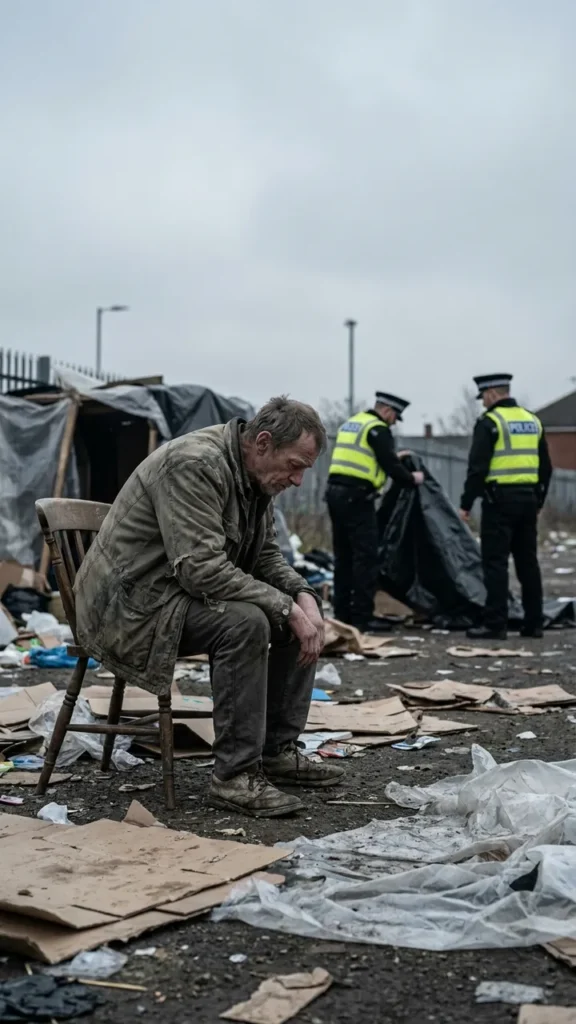
The wind whipped dust devils across the barren lot, a symphony of grit and decay.
Arthur Pendelton sat on a skeletal wooden chair, his only throne in this kingdom of refuse.
His world was a patchwork of discarded cardboard, ripped plastic sheeting, and the omnipresent smell of damp earth and desperation.
His jacket, once a robust shield against the elements, was now a canvas of grime, mirroring the deep fissures on his face, each line a story etched by time and hardship.
Two figures emerged from the haze, their bright yellow vests a jarring beacon against the muted tones of his existence.
Police.
Officer Davies and Officer Miller approached with a measured calm, their movements devoid of the usual suspicion.
One of them, Officer Miller, wrestled with a large black tarp, a stark contrast to Arthur’s fragile shelter.
Arthur watched them, his gaze heavy, his usual stoicism tested by their unexpected presence.
He felt a gentle touch on his arm.
Officer Davies’ hand, surprisingly warm through the thin fabric of his jacket, grounded him.
Arthur, with a weary sigh that seemed to carry the weight of years, allowed himself to be guided.
His limbs felt like lead, each movement a monumental effort.
The officers’ hands were firm but not rough, a silent assurance that this was not an arrest, but an intervention.
They helped him up.
The world swam for a moment, the railway tracks a distant, blurry line.
Together, the three of them moved, a slow procession away from the debris that had been his home.
Arthur stumbled slightly, his worn shoes catching on unseen obstacles, but the officers’ steadying presence prevented him from falling.
They were navigating him towards a waiting police car, its siren silent, its presence a promise of something other than this desolation.
The back door of the police vehicle swung open, revealing a space that was clean, contained, and blessedly free of the detritus that clung to his existence.
Arthur was carefully helped to sit.
The familiar weight of weariness settled over him as he leaned back, the motion of the car a gentle rocking.
He closed his eyes, a fragile peace washing over him.
The world outside blurred into streaks of green and brown, a distant hum that no longer felt threatening.
Then, a new path.
Paved.
Lined with neat houses, their facades clean and inviting.
A sign, bold and welcoming, proclaimed: “WELCOME HOME.” Officer Davies and Officer Miller were there again, their presence no longer an intrusion but a steadying hand.
Arthur walked between them, his steps lighter now, his gaze lifted.
And then, it happened.
A smile bloomed on his face, a genuine, radiant bloom that transformed his weathered features.
It was a smile that held the promise of a new dawn, a silent acknowledgment of unexpected kindness.
His eyes, which had held so much pain, now sparkled with a joy that had been long absent.
The officers, their faces reflecting a quiet satisfaction, continued to support him, guiding him towards this newfound haven.
It was a moment of profound human connection, a testament to the power of compassion in a world that had long forgotten Arthur Pendelton.
The journey from the trash heaps to this welcoming path was not just a physical one, but a journey back to himself.
Arthur Pendelton shivered, not entirely from the chill that permeated the air, but from the gnawing emptiness that had become his constant companion.
His breath plumed white, a fleeting ghost against the grimy canvas of his jacket.
The railway tracks nearby hummed with a distant, indifferent energy, a soundtrack to his existence.
He ran a skeletal hand over the worn fabric of his trousers, the material rough and smelling faintly of stale urine and despair.
“Hey, sir.
You alright there?” Officer Miller’s voice cut through the low hum of the tracks.
It was steady, direct, but held no edge of accusation.
Arthur flinched, his head snapping up.
He squinted, his eyes, accustomed to the perpetual gloom, struggling to adjust to the sudden clarity of the approaching figures.
Two uniforms, starkly bright against the drab landscape.
Yellow vests.
Police.
His heart, a tired drum, gave a weak thud against his ribs.
Officer Davies, his face etched with a professional calm that somehow didn’t mask a flicker of genuine concern, stepped forward.
He kept a respectful distance, his hands visible, relaxed. “Sir, we’re here to help.
We’ve got a place you can go.”
Arthur’s mouth felt like sandpaper.
He tried to speak, but only a dry rasp escaped.
He simply stared, his gaze fixed on the yellow vests, a stark warning from a world he no longer belonged to.
He saw Officer Miller wrestling with a large, tattered black tarp near his makeshift shelter.
A symbol of the precariousness of his entire life.
“It’s okay, sir,” Officer Davies said, his voice soft but firm.
He took a step closer, extending a hand.
It was a gesture that felt alien, terrifyingly so.
Arthur’s instinct was to recoil, to disappear into the shadows.
But something in Davies’ eyes, a steady, unyielding empathy, held him.
He felt the touch.
Davies’ hand, surprisingly warm, landed on Arthur’s bicep.
It was a grounding sensation, a brief anchor in the swirling vortex of his desolation.
Arthur let out a long, ragged sigh.
It felt like the exhalation of years of pent-up misery.
He nodded, a barely perceptible movement.
His limbs felt heavy, unresponsive, as if they belonged to someone else.
The officers’ grip was firm, yet remarkably gentle.
There was no force, no threat, just a quiet understanding.
This wasn’t an arrest.
This was an intervention.
They helped him stand.
The world tilted for a moment.
The rusted metal of a discarded shopping cart seemed to lurch towards him.
The railway tracks blurred into a meaningless grey ribbon.
His worn shoes snagged on a loose piece of rebar.
Officer Miller’s arm shot out, steadying him instantly.
The three of them moved, a slow, deliberate procession away from the cardboard and plastic that had been his world.
Arthur’s feet shuffled, each step a victory against the inertia of his despair.
The police car, its lights off, its siren silent, waited like a promise.
A promise of an exit from this living death.
‘The back door of the police vehicle swung open.
Arthur Pendelton flinched at the sudden exposure, bracing for the usual stench of stale cigarettes and desperation that clung to such spaces.
Instead, a wave of clean, almost sterile air met him.
The interior was surprisingly spacious, the plastic seats a stark, unblemished grey.
There was no litter, no discarded wrappers, no evidence of the grim realities he associated with enclosed spaces.
It was a sanctuary, of sorts.
Officer Davies gently guided him in, his movements unhurried, his voice a low murmur. “Take your time, sir.
Just sit down.” Arthur sank onto the seat, his frail body seeming to melt into the surprisingly comfortable padding.
The familiar weight of weariness, a constant burden, settled over him.
He leaned his head back, the subtle rocking motion of the car a surprisingly soothing lullaby.
He closed his eyes, a fragile peace washing over him.
It was a fleeting sensation, a mere breath of respite from the relentless storm of his existence.
The world outside, glimpsed through the smudged windows, blurred into streaks of indifferent green and brown.
The distant hum of the engine, once a symbol of movement and progress he had long been denied, no longer felt threatening.
It was simply a sound, fading into the background of his newfound, temporary quiet.
Officer Miller secured the door, his actions efficient and unobtrusive.
He didn’t crowd Arthur, giving him space, a silent acknowledgment of his need for personal territory, however small.
Arthur could feel their presence, a comforting pressure, a silent promise that he was not alone, not being abandoned to the elements.
He felt a surprising urge to cry, a dam of buried emotions threatening to break.
But the weariness was too profound.
He could only absorb the quiet, the cleanliness, the strange absence of the squalor that had defined him.
The car pulled away from the tracks.
The rhythmic clatter of the wheels on asphalt replaced the distant rumble of trains.
Arthur kept his eyes closed, his senses slowly recalibrating.
He heard the soft click of Officer Davies’ seatbelt. “Almost there, sir,” Davies said, his voice a low rumble that vibrated through the quiet.
Arthur didn’t respond, his focus solely on the sensation of motion, on the feeling of being contained within this sterile bubble.
He could hear the faint crackle of the police radio, a distant murmur of voices discussing mundane matters.
It was a sound of normalcy, a world he had almost forgotten existed.
He imagined the officers’ faces, the professional detachment warring with their evident empathy.
He wondered what they thought of him, this derelict clinging to existence on the fringes of society.
He felt a phantom itch on his cheek, a reflex from constantly needing to scratch away the grime.
He resisted the urge, a small victory.
Then, the landscape began to change.
The gritty lots and discarded industrial remnants gave way to something softer, more organized.
Paved roads replaced dirt tracks.
Neat, single-story houses, their lawns trimmed and their paint fresh, began to appear.
A stark contrast to the decaying structures he was accustomed to.
He dared to open his eyes.
A sign, its letters bold and painted in cheerful blue, came into view.
It stood at the entrance to a cluster of buildings. “WELCOME HOME.” The words struck him with an unexpected force.
Welcome home.
The concept was so foreign, so alien, it took a moment to register.
He felt a tremor run through his thin frame.
It wasn’t entirely fear.
There was a nascent, fragile hope stirring within him.
He looked at Officer Davies, whose gaze met his in the rearview mirror.
A faint, reassuring smile touched the officer’s lips.
It was a look that said, “This is it.
This is your chance.” Arthur shifted, his posture changing almost imperceptibly.
The heavy resignation that had slumped his shoulders seemed to loosen its grip.
He felt a faint stirring of something other than despair.
It was the faintest ember, but it was there.
The police car glided to a stop in front of a building that looked more like a community center than any institution Arthur Pendelton had ever encountered.
It was low-slung, with wide windows and a gently sloped roof, surrounded by a well-maintained garden.
A single, dignified entrance beckoned.
Officer Davies and Officer Miller exited the vehicle, holding the doors open.
Their presence was no longer an intrusion, but a steadying hand.
They stood on either side of Arthur as he alighted, his movements still stiff, but with a newfound awareness of his surroundings.
He felt their quiet presence, a silent assurance that he was supported.
He took a step onto the smooth, paved walkway.
His worn shoes, once magnets for debris, now made a clean, crisp sound.
He walked between them, a slow procession towards the entrance.
His steps, previously heavy with the weight of years of despair, felt a fraction lighter.
His gaze, habitually fixed on the ground, began to lift.
He looked at the clean facade of the building, at the vibrant green of the grass, at the clear blue sky above.
It was overwhelming.
A wave of emotion, suppressed for so long, threatened to engulf him.
He could feel a prickling behind his eyes.
His throat felt tight.
He saw people inside the building, moving about calmly, their faces serene.
None of them stared.
None of them pointed.
There was no judgment in their eyes, only a quiet acceptance.
He reached the entrance, and a woman, dressed in soft, neutral clothing, stepped out.
Her smile was gentle, her eyes kind. “Welcome,” she said, her voice warm and melodious. “We’re so glad you’re here.” There was no suspicion, no pity.
Just genuine welcome.
Arthur Pendelton stood there, caught between his past and this bewildering present.
He looked at the woman, then at Officers Davies and Miller, who stood a respectful distance behind him, their expressions unreadable but radiating a quiet satisfaction.
Something inside him shifted.
A dam broke.
And then, it happened.
A small tremor started at the corners of Arthur’s mouth.
It grew, gaining strength, transforming into something he hadn’t felt in decades.
A smile bloomed on his face, a genuine, radiant bloom that seemed to push back the deep fissures etched by hardship.
It was a smile that held the promise of a new dawn, a silent acknowledgment of unexpected kindness, of a profound human connection.
His eyes, which had held so much pain and weariness, now sparkled with a joy that had been long absent.
The light that flickered within them was not the reflection of the harsh sun, but the inner glow of rediscovered hope.
He felt tears welling up, but they were no longer tears of sorrow.
They were tears of release, of overwhelming gratitude.
Officer Davies caught Arthur’s eye, and a small, knowing nod passed between them.
Officer Miller offered a subtle, almost imperceptible smile, a shared moment of quiet triumph.
They had done more than just pick up a destitute man.
They had offered a lifeline, a chance to reclaim a lost life.
Arthur’s steps, as he was gently guided into the building by the woman, were noticeably lighter.
His posture was straighter.
The weight of the world, which had pressed him down for so long, seemed to have lessened its grip.
He looked back one last time at the police car, a symbol of his rescue, and then at the welcoming face of the woman beside him.
The journey from the trash heaps to this welcoming path was not just a physical one.
It was a journey back to himself, a rediscovery of the man beneath the grime and despair.
The smile on his face was a testament to the power of compassion, a beacon of hope in a world that often seemed intent on crushing the fragile spirit of its most vulnerable.
The seed of change, planted by the unwavering kindness of two officers, had begun to sprout.
CHAPTER 2: The Echo of Kindness
‘The woman, whose name Arthur would later learn was Eleanor, led him through a bright, airy common room.
Sunlight streamed through the large windows, illuminating dust motes dancing in the air.
It smelled faintly of lemon polish and something comforting, like warm bread.
Other residents were present, some reading, some chatting quietly, others simply gazing out the windows.
They glanced at Arthur, their expressions open, a few offering small, polite nods.
It was a stark, almost jarring, contrast to the furtive, suspicious glances he’d endured for years.
“Please, have a seat anywhere you like, Arthur,” Eleanor said, her voice a gentle invitation.
She gestured towards a comfortable-looking armchair by a window.
Arthur hesitated, his feet rooted to the polished linoleum.
His eyes scanned the room, searching for any sign of the judgment he had come to expect.
Officer Davies stepped forward, his presence a silent anchor. “It’s alright, Arthur.
She means it.” Davies’ voice was low, reassuring.
He placed a hand lightly on Arthur’s shoulder, a firm but kind pressure.
Arthur felt a tremor run through him.
It wasn’t fear, but a deep, unfamiliar sensation of being acknowledged.
Arthur slowly moved towards the armchair.
His movements were still stiff, his bones protesting every shift.
As he lowered himself into the plush cushions, a sigh escaped him, a sound of pure exhaustion that seemed to release years of pent-up tension.
He leaned his head back, the softness of the chair a luxurious shock against his grimy hair.
He closed his eyes for a moment, breathing in the clean air.
Officer Miller approached Eleanor, speaking in hushed tones.
Arthur couldn’t make out their words, but the cadence of their voices was calm, professional.
He opened his eyes and watched them, a flicker of curiosity cutting through his weariness.
He saw Officer Davies observing him, his expression one of quiet contemplation.
“Arthur,” Eleanor began, kneeling slightly so she was closer to his eye level. “We have some fresh clothes for you.
And a shower.
You must be tired.”
Arthur’s throat felt dry.
He managed a raspy croak. “Clothes?”
Eleanor smiled kindly. “Yes.
Clean clothes.
And then, if you’re up to it, we can get you something to eat.
Whatever you’d like.”
He looked at her, at the genuine concern in her eyes.
It was so unlike anything he had experienced.
The concept of “wanting” felt alien.
For so long, survival had been the only imperative.
Officer Davies interjected softly, “We’ll be heading out soon, Arthur.
But we wanted to make sure you were settled.
Is there anything at all you need us to do before we go?”
Arthur stared at the officers.
Their bright yellow vests, which had seemed so alien and intrusive just hours ago, now felt like symbols of a safety he hadn’t known existed.
He thought of his meager belongings, the tattered tarp, the few scraps of plastic.
“My… my chair,” he mumbled, pointing vaguely back towards the train tracks. “The wood.”
Officer Miller’s brow furrowed slightly. “Your chair, sir?”
Arthur nodded, his voice barely audible. “It’s… it’s all I have.”
Eleanor’s gaze flickered to Davies and Miller.
A silent understanding passed between them.
“We can certainly arrange for that to be collected, Arthur,” Davies said smoothly. “Just point us in the right direction when you’re feeling up to it.”
Arthur felt a strange lightness in his chest.
It wasn’t just about the chair.
It was about the fact that someone was listening.
That his words, however broken, had weight.
He looked at the officers, a profound sense of gratitude washing over him.
He wanted to thank them, but the words felt inadequate.
He simply nodded, his eyes conveying more than his raspy voice ever could.
The silence stretched, filled only by the soft hum of activity in the room.
The air in the common room seemed to thicken with unspoken emotions.
Arthur’s fragile smile had faded, replaced by a look of profound contemplation.
He watched Eleanor as she moved about the room, her interactions with other residents effortless and warm.
He saw a woman, older than him, with kind eyes, drop a book.
Eleanor was there instantly, picking it up with a gentle smile.
“Thank you, dear,” the older woman said, her voice thin but steady.
Arthur’s gaze shifted back to Officers Davies and Miller, who were now standing near the entrance, speaking quietly.
He could see their faces, the professional mask firmly in place, yet there was a subtle softness around their eyes that spoke of something more.
They were witnessing his first tentative steps towards a new life, and he could sense their quiet pride.
“Arthur,” Officer Davies called softly, his voice cutting through the gentle murmur of the room.
Arthur’s head turned, his focus snapping to the officer.
Davies walked towards him, his gait measured and deliberate.
He stopped a few feet away, his hands clasped loosely in front of him.
“We’re heading back now,” Davies said, his tone even. “But we just wanted to check in one last time.
Make sure you felt… comfortable.” He hesitated, searching for the right word. “Safe.”
Arthur’s eyes met Davies’s.
He saw no judgment there, no impatience, only a genuine desire to know he was alright.
The contrast with the hardened faces he had encountered on the streets, the dismissive waves, the hurried “move alongs,” was stark.
“Yes,” Arthur rasped, the word feeling surprisingly firm. “Thank you.” He paused, then added, “You… you didn’t have to.”
Officer Miller joined them, standing beside Davies.
His expression was equally calm, but his eyes held a quiet intensity. “It’s what we do, sir,” Miller said, his voice steady. “Sometimes it’s just about being in the right place at the right time.
And seeing a need.”
Arthur felt a lump form in his throat.
He was a need that had been ignored for so long. “But… you were kind.”
Davies offered a faint smile. “That’s part of it, Arthur.
Kindness is… it’s often the first step.” He glanced around the room, at the faces of the residents. “This is a good place.
A safe place.
We’ll be back to check on you, of course.
But for now… just focus on getting yourself sorted.”
Arthur nodded slowly.
He looked at the worn, calloused hands that had once dug through refuse, now resting on his lap.
They looked alien in this clean, bright space.
He saw the dirt ingrained in his fingernails, a testament to his past.
He felt a wave of shame, quickly followed by a surge of determination.
He would scrub those hands clean.
He would wash away the grime, and with it, the despair.
Miller spoke again, his tone practical. “Eleanor will help you with everything.
We trust her.
And we trust you’ll do your best, Arthur.”
Davies extended his hand.
Arthur looked at it for a moment, then slowly, deliberately, he reached out and clasped it.
Davies’s grip was firm, warm, and held for a beat longer than strictly necessary.
It was a silent confirmation.
A promise.
As the officers turned to leave, Arthur watched them.
He saw their yellow vests disappear through the double doors.
He was left standing in the quiet hum of the common room, the scent of lemon polish and warm bread filling his senses.
The weight of their witness, of their belief in him, settled upon his shoulders, not as a burden, but as a guiding force.
He looked at Eleanor, who was now approaching him with a gentle smile.
The journey was far from over, but for the first time in what felt like an eternity, Arthur Pendelton felt a true sense of purpose, a fragile but potent hope for what lay ahead.
The echoes of their kindness resonated within him, a powerful balm to a soul long parched.
‘Arthur stood in the doorway of a small, immaculately clean room.
It smelled of bleach and laundry detergent.
Eleanor, her presence a steady warmth, gestured inside. “This will be yours, Arthur.
For now.
Everything you need is here.”
He stepped inside.
A single bed, neatly made with crisp white sheets, dominated the space.
A small dresser stood against one wall, a mirror above it reflecting the starkness.
There was a small wardrobe, a simple chair.
It was a world away from the tattered tarp and the skeletal chair.
“A shower,” Eleanor said, her voice soft, “is through there.” She pointed to a door. “We have clean clothes waiting for you.
Everything you need to start fresh.”
Arthur’s gaze swept over the room.
It was almost too much.
Too clean.
Too quiet.
He felt a tremor start in his hands, a faint, involuntary shake.
He clenched them into fists, pressing them into his soiled pants.
“I… I need to wash,” he rasped, the words thick with disuse.
Eleanor nodded, a gentle understanding in her eyes. “Take your time, Arthur.
No rush.
When you’re ready, I’ll have a meal prepared for you.”
He moved towards the bathroom.
The door was light, easy to open.
Inside, the tiles gleamed.
A shower stall, clear glass reflecting the bright light.
He looked at his reflection in the small mirror above the sink.
The lines on his face seemed deeper now, etched by years of neglect.
His grey hair was matted, his beard a tangled mess.
He turned on the shower.
Hot water, a rush of steam that fogged the glass.
He hesitated, then stripped off his soiled jacket, his pants.
They fell in a heap on the floor, a testament to his former life.
He stepped into the shower.
The water, hot and cleansing, felt like a baptism.
He scrubbed at his skin, his hair, the grime resisting at first, then slowly yielding.
Tears pricked at his eyes, hot and unexpected, mingling with the shower spray.
He wasn’t crying for sadness, but for relief.
A deep, bone-weary relief.
He scrubbed at his hands, the ingrained dirt stubborn, a visible symbol of his past he desperately wanted to erase.
Eleanor knocked softly. “Arthur?
Are you alright?”
He turned off the water, the sudden silence amplifying the sound of his own breathing. “Yes,” he called back, his voice a little stronger. “I’m ready.”
He dried himself with a thick, soft towel.
It was impossibly white.
He found the clothes laid out for him: a clean t-shirt, a pair of simple, soft trousers, socks, underwear.
He dressed slowly, each movement deliberate.
The fabric felt strange against his skin, a soft caress.
He looked in the mirror again.
The face staring back was still weathered, still old, but the grime was gone.
His hair, though still grey, was cleaner.
His beard was less wild.
He looked, for the first time in years, like a person.
Not a ghost.
He walked out of the bathroom, back into the room.
Eleanor was waiting by the door, a tray in her hands.
A plate of food, simple but wholesome: a thick slice of bread, some stew, a glass of water.
“Just a light meal,” she said, her smile warm. “We can get you more later, if you’re hungry.”
Arthur sat on the edge of the bed, the mattress yielding softly beneath him.
He picked up the bread.
It was warm.
He took a bite.
The taste was rich, satisfying.
He ate slowly, deliberately, savoring each mouthful.
He looked at Eleanor, at the genuine kindness in her face.
“Thank you,” he said, his voice still raspy, but with a new note of sincerity.
“You’re very welcome, Arthur,” she replied.
She remained standing, a quiet observer, allowing him his space, his recovery.
The air in the common room seemed to thicken with unspoken emotions.
Arthur’s fragile smile had faded, replaced by a look of profound contemplation.
He watched Eleanor as she moved about the room, her interactions with other residents effortless and warm.
He saw a woman, older than him, with kind eyes, drop a book.
Eleanor was there instantly, picking it up with a gentle smile.
“Thank you, dear,” the older woman said, her voice thin but steady.
Arthur’s gaze shifted back to Officers Davies and Miller, who were now standing near the entrance, speaking quietly.
He could see their faces, the professional mask firmly in place, yet there was a subtle softness around their eyes that spoke of something more.
They were witnessing his first tentative steps towards a new life, and he could sense their quiet pride.
“Arthur,” Officer Davies called softly, his voice cutting through the gentle murmur of the room.
Arthur’s head turned, his focus snapping to the officer.
Davies walked towards him, his gait measured and deliberate.
He stopped a few feet away, his hands clasped loosely in front of him.
“We’re heading back now,” Davies said, his tone even. “But we just wanted to check in one last time.
Make sure you felt… comfortable.” He hesitated, searching for the right word. “Safe.”
Arthur’s eyes met Davies’s.
He saw no judgment there, no impatience, only a genuine desire to know he was alright.
The contrast with the hardened faces he had encountered on the streets, the dismissive waves, the hurried “move alongs,” was stark.
“Yes,” Arthur rasped, the word feeling surprisingly firm. “Thank you.” He paused, then added, “You… you didn’t have to.”
Officer Miller joined them, standing beside Davies.
His expression was equally calm, but his eyes held a quiet intensity. “It’s what we do, sir,” Miller said, his voice steady. “Sometimes it’s just about being in the right place at the right time.
And seeing a need.”
Arthur felt a lump form in his throat.
He was a need that had been ignored for so long. “But… you were kind.”
Davies offered a faint smile. “That’s part of it, Arthur.
Kindness is… it’s often the first step.” He glanced around the room, at the faces of the residents. “This is a good place.
A safe place.
We’ll be back to check on you, of course.
But for now… just focus on getting yourself sorted.”
Arthur nodded slowly.
He looked at the worn, calloused hands that had once dug through refuse, now resting on his lap.
They looked alien in this clean, bright space.
He saw the dirt ingrained in his fingernails, a testament to his past.
He felt a wave of shame, quickly followed by a surge of determination.
He would scrub those hands clean.
He would wash away the grime, and with it, the despair.
Miller spoke again, his tone practical. “Eleanor will help you with everything.
We trust her.
And we trust you’ll do your best, Arthur.”
Davies extended his hand.
Arthur looked at it for a moment, then slowly, deliberately, he reached out and clasped it.
Davies’s grip was firm, warm, and held for a beat longer than strictly necessary.
It was a silent confirmation.
A promise.
As the officers turned to leave, Arthur watched them.
He saw their yellow vests disappear through the double doors.
He was left standing in the quiet hum of the common room, the scent of lemon polish and warm bread filling his senses.
The weight of their witness, of their belief in him, settled upon his shoulders, not as a burden, but as a guiding force.
He looked at Eleanor, who was now approaching him with a gentle smile.
The journey was far from over, but for the first time in what felt like an eternity, Arthur Pendelton felt a true sense of purpose, a fragile but potent hope for what lay ahead.
The echoes of their kindness resonated within him, a powerful balm to a soul long parched.
CHAPTER 3: The Weight of Witness
‘Arthur stood in the doorway of a small, immaculately clean room.
It smelled of bleach and laundry detergent.
Eleanor, her presence a steady warmth, gestured inside. “This will be yours, Arthur.
For now.
Everything you need is here.”
He stepped inside.
A single bed, neatly made with crisp white sheets, dominated the space.
A small dresser stood against one wall, a mirror above it reflecting the starkness.
There was a small wardrobe, a simple chair.
It was a world away from the tattered tarp and the skeletal chair.
“A shower,” Eleanor said, her voice soft, “is through there.” She pointed to a door. “We have clean clothes waiting for you.
Everything you need to start fresh.”
Arthur’s gaze swept over the room.
It was almost too much.
Too clean.
Too quiet.
He felt a tremor start in his hands, a faint, involuntary shake.
He clenched them into fists, pressing them into his soiled pants.
“I… I need to wash,” he rasped, the words thick with disuse.
Eleanor nodded, a gentle understanding in her eyes. “Take your time, Arthur.
No rush.
When you’re ready, I’ll have a meal prepared for you.”
He moved towards the bathroom.
The door was light, easy to open.
Inside, the tiles gleamed.
A shower stall, clear glass reflecting the bright light.
He looked at his reflection in the small mirror above the sink.
The lines on his face seemed deeper now, etched by years of neglect.
His grey hair was matted, his beard a tangled mess.
He turned on the shower.
Hot water, a rush of steam that fogged the glass.
He hesitated, then stripped off his soiled jacket, his pants.
They fell in a heap on the floor, a testament to his former life.
He stepped into the shower.
The water, hot and cleansing, felt like a baptism.
He scrubbed at his skin, his hair, the grime resisting at first, then slowly yielding.
Tears pricked at his eyes, hot and unexpected, mingling with the shower spray.
He wasn’t crying for sadness, but for relief.
A deep, bone-weary relief.
He scrubbed at his hands, the ingrained dirt stubborn, a visible symbol of his past he desperately wanted to erase.
Eleanor knocked softly. “Arthur?
Are you alright?”
He turned off the water, the sudden silence amplifying the sound of his own breathing. “Yes,” he called back, his voice a little stronger. “I’m ready.”
He dried himself with a thick, soft towel.
It was impossibly white.
He found the clothes laid out for him: a clean t-shirt, a pair of simple, soft trousers, socks, underwear.
He dressed slowly, each movement deliberate.
The fabric felt strange against his skin, a soft caress.
He looked in the mirror again.
The face staring back was still weathered, still old, but the grime was gone.
His hair, though still grey, was cleaner.
His beard was less wild.
He looked, for the first time in years, like a person.
Not a ghost.
He walked out of the bathroom, back into the room.
Eleanor was waiting by the door, a tray in her hands.
A plate of food, simple but wholesome: a thick slice of bread, some stew, a glass of water.
“Just a light meal,” she said, her smile warm. “We can get you more later, if you’re hungry.”
Arthur sat on the edge of the bed, the mattress yielding softly beneath him.
He picked up the bread.
It was warm.
He took a bite.
The taste was rich, satisfying.
He ate slowly, deliberately, savoring each mouthful.
He looked at Eleanor, at the genuine kindness in her face.
“Thank you,” he said, his voice still raspy, but with a new note of sincerity.
“You’re very welcome, Arthur,” she replied.
She remained standing, a quiet observer, allowing him his space, his recovery.
The air in the common room seemed to thicken with unspoken emotions.
Arthur’s fragile smile had faded, replaced by a look of profound contemplation.
He watched Eleanor as she moved about the room, her interactions with other residents effortless and warm.
He saw a woman, older than him, with kind eyes, drop a book.
Eleanor was there instantly, picking it up with a gentle smile.
“Thank you, dear,” the older woman said, her voice thin but steady.
Arthur’s gaze shifted back to Officers Davies and Miller, who were now standing near the entrance, speaking quietly.
He could see their faces, the professional mask firmly in place, yet there was a subtle softness around their eyes that spoke of something more.
They were witnessing his first tentative steps towards a new life, and he could sense their quiet pride.
“Arthur,” Officer Davies called softly, his voice cutting through the gentle murmur of the room.
Arthur’s head turned, his focus snapping to the officer.
Davies walked towards him, his gait measured and deliberate.
He stopped a few feet away, his hands clasped loosely in front of him.
“We’re heading back now,” Davies said, his tone even. “But we just wanted to check in one last time.
Make sure you felt… comfortable.” He hesitated, searching for the right word. “Safe.”
Arthur’s eyes met Davies’s.
He saw no judgment there, no impatience, only a genuine desire to know he was alright.
The contrast with the hardened faces he had encountered on the streets, the dismissive waves, the hurried “move alongs,” was stark.
“Yes,” Arthur rasped, the word feeling surprisingly firm. “Thank you.” He paused, then added, “You… you didn’t have to.”
Officer Miller joined them, standing beside Davies.
His expression was equally calm, but his eyes held a quiet intensity. “It’s what we do, sir,” Miller said, his voice steady. “Sometimes it’s just about being in the right place at the right time.
And seeing a need.”
Arthur felt a lump form in his throat.
He was a need that had been ignored for so long. “But… you were kind.”
Davies offered a faint smile. “That’s part of it, Arthur.
Kindness is… it’s often the first step.” He glanced around the room, at the faces of the residents. “This is a good place.
A safe place.
We’ll be back to check on you, of course.
But for now… just focus on getting yourself sorted.”
Arthur nodded slowly.
He looked at the worn, calloused hands that had once dug through refuse, now resting on his lap.
They looked alien in this clean, bright space.
He saw the dirt ingrained in his fingernails, a testament to his past.
He felt a wave of shame, quickly followed by a surge of determination.
He would scrub those hands clean.
He would wash away the grime, and with it, the despair.
Miller spoke again, his tone practical. “Eleanor will help you with everything.
We trust her.
And we trust you’ll do your best, Arthur.”
Davies extended his hand.
Arthur looked at it for a moment, then slowly, deliberately, he reached out and clasped it.
Davies’s grip was firm, warm, and held for a beat longer than strictly necessary.
It was a silent confirmation.
A promise.
As the officers turned to leave, Arthur watched them.
He saw their yellow vests disappear through the double doors.
He was left standing in the quiet hum of the common room, the scent of lemon polish and warm bread filling his senses.
The weight of their witness, of their belief in him, settled upon his shoulders, not as a burden, but as a guiding force.
He looked at Eleanor, who was now approaching him with a gentle smile.
The journey was far from over, but for the first time in what felt like an eternity, Arthur Pendelton felt a true sense of purpose, a fragile but potent hope for what lay ahead.
The echoes of their kindness resonated within him, a powerful balm to a soul long parched.
‘Arthur watched Eleanor approach, her smile a steady beacon in the quiet room.
He still held the ghost of Officer Davies’ handshake, a warmth that lingered against the chill of his past.
The common room was a symphony of subtle sounds – the rustle of Eleanor’s clothing, the soft clinking of a mug being set down, the distant murmur of a television.
He took a deep breath, the scent of lemon polish and something akin to comfort filling his lungs.
It was a stark contrast to the metallic tang of old rain and decay that had been his constant companion.
“Ready for a little more to eat, Arthur?” Eleanor asked, her voice gentle.
She gestured to a small table near a window where a plate of fruit and a fresh glass of water sat. “Just to tide you over.”
Arthur nodded, his gaze still fixed on the double doors where the officers had disappeared. “They… they were very kind,” he managed to rasp out, the words still feeling foreign on his tongue.
It wasn’t just kindness; it was an active, deliberate choice.
A choice to see him, not the dirt and the despair.
Eleanor’s eyes softened. “They are good men, Arthur.
They saw you.
And they did something about it.
That’s what matters.” She sat opposite him, her movements economical and graceful. “It’s easy to look away.
So many people do.”
“I… I’ve seen them look away,” Arthur admitted, his voice barely above a whisper.
He traced the rim of the water glass with a finger, the smooth, cool surface a luxury. “For years.
Just… ignored.
Like I wasn’t there.
Or worse, like I was a problem to be kicked along.” His hand trembled slightly, and he quickly stilled it, tucking it beneath the table.
“But they saw you,” Eleanor reiterated, her tone firm. “And they chose to help.
That’s the real story, Arthur.
Not the years of being invisible, but this moment.
This choice.” She picked up an apple, its skin a vibrant red, and offered it to him. “This is a new chapter.
It’s okay to feel… overwhelmed.
It’s okay to feel everything.”
Arthur took the apple, its weight substantial in his palm.
He remembered apples from long ago, crisp and sweet.
Not the bruised, worm-eaten things he sometimes found.
He took a small, tentative bite.
The crisp snap echoed in the quiet room.
A surge of something akin to nostalgia, followed by a sharp pang of regret, washed over him.
“I don’t know how to be… this,” Arthur confessed, gesturing vaguely at the clean room, the fresh fruit, Eleanor’s composed presence. “I don’t know how to be a person again.” His voice cracked. “I forgot how.
The streets… they change you.
They strip you down.
You become just… survival.”
Eleanor leaned forward, her gaze unwavering. “You are not just survival, Arthur.
You are Arthur.
And Arthur is still here.
He just got buried a little.
We’re here to help you dig him out.” She paused, her expression thoughtful. “What do you remember, Arthur?
About before?”
The question hung in the air.
Memories, fragmented and distant, flickered at the edges of his awareness.
A woman’s laughter.
The smell of baking bread.
Sunlight on a garden. “It’s… fuzzy,” he admitted, his voice hoarse. “Like looking through a dirty window.”
“We’ll clean the window, Arthur,” Eleanor said, her voice unwavering. “One pane at a time.
You have time now.
All the time you need.
No one is going to tell you to ‘move along’ here.” She stood and walked towards a small bookshelf, running a finger along the spines. “We have books.
Music.
People who want to talk.
Or people who just want to sit in quiet.
Whatever you need.”
Arthur watched her, the simple act of her reaching for a book imbued with a profound significance.
It was an act of normalcy, of a life lived outside the shadows.
He closed his eyes for a moment, the steam from the shower, the feel of clean clothes, the taste of the apple – they were sensations he’d almost forgotten.
The officers’ act of reaching out had been a physical intervention, but Eleanor’s presence was a gentle, sustained hand.
It was the quiet, persistent affirmation that he was worthy of being seen, of being cared for.
The weight of their witness was not a burden, but a promise.
The evening deepened, and a quiet hum settled over the facility.
Arthur sat in the common room, the apple in his hand, a small, tangible anchor.
He watched the other residents, their faces etched with their own stories, their own struggles, but united by a shared space of tentative peace.
He saw Mrs. Gable, the woman Eleanor had helped with the book, now engaged in a quiet conversation with another resident, a small smile playing on her lips.
It was a tableau of quiet resilience.
Eleanor approached, carrying a tray with a steaming mug and a small plate of biscuits. “Tea, Arthur?” she offered, her voice low. “Chamberlain’s favorite blend.
He says it helps with reflection.” She placed the mug beside him.
The aroma was warm and soothing.
Arthur nodded, taking a slow sip.
The warmth spread through him, a gentle diffusion of the tension that had coiled within him for so long. “Reflection,” he murmured.
The word felt heavy, loaded.
He had spent so much time reflecting on his mistakes, his failures, his invisibility.
“It’s not about dwelling on the past,” Eleanor said, sensing his unease. “It’s about understanding it.
So you can move forward.
You don’t have to carry all of it with you.
Not anymore.” She gestured towards the window, where the first stars were beginning to prick the twilight sky. “Look.
The world keeps turning.
And it’s still beautiful.”
Arthur followed her gaze.
The sky, unmarred by the harsh city lights he’d known, was a deep, velvety canvas.
He saw a single star, bright and steady.
It was a tiny point of light, but it held its own.
“I… I remember trying to find work, once,” Arthur began, his voice raspy, a confession unfolding. “After… after things went wrong.
They wouldn’t even look at me.
Saw my clothes, my… my state.
Just waved me away.
Said I wasn’t ‘presentable’.” He clenched his jaw, the memory still raw. “How can you be presentable when you’ve got nothing?
When you’ve lost everything?”
Eleanor sat beside him, her presence a quiet strength. “That’s the cruelty of it, isn’t it?
The system that’s supposed to help sometimes just pushes you further down.
But that doesn’t define you, Arthur.
Those people who waved you away, their judgment?
That’s their problem.
Not yours.”
“But it felt like my problem,” Arthur whispered. “It became my problem.
I started to believe them.
That I was just… nothing.
A smudge.
Something to be wiped away.” He looked down at his hands, the clean nails a jarring contrast to the ingrained dirt he had scrubbed away.
The effort had been immense, a physical battle against the tangible evidence of his neglect.
“They were wrong,” Eleanor stated, her voice firm and clear. “You are not nothing, Arthur.
You are a person.
And you deserve respect.
You deserve a chance.” She picked up a biscuit. “Just like this biscuit is good, even if it looks a little crumbly on the outside.
The quality is inside.”
Arthur let out a shaky breath.
He looked at Eleanor, at the unwavering belief in her eyes.
It was a belief he hadn’t seen directed at him in decades.
It was a belief that mirrored, in its quiet intensity, the look he’d seen in Officer Davies’s eyes.
They had seen something in him.
Something he had almost forgotten existed.
“They’re coming back, aren’t they?” Arthur asked, his gaze returning to the door, a flicker of apprehension mixed with a strange sort of anticipation. “The officers?”
“They will,” Eleanor confirmed. “They care.
It’s more than just a job for them, Arthur.
They saw a fellow human being who needed help.
That’s the kind of thing that stays with you.
The kindness.” She smiled. “And the kindness that is given, can also be received.
And then, passed on.”
Arthur nodded slowly.
He took another sip of tea, the warmth spreading, pushing back the last vestiges of the cold he had carried for so long.
The journey was far from over, but for the first time, the path ahead didn’t feel like a sheer, insurmountable cliff.
It felt like a road, perhaps a little rough, but a road nonetheless, leading somewhere new.
Somewhere he could, perhaps, finally begin to be Arthur again.
The echo of their kindness was not just in his mind, but in the very marrow of his bones, a quiet, persistent hum of hope.
CHAPTER 4: The Weight of Witness
‘The common room lights were dimmed, casting long shadows that danced with the fading daylight.
Arthur sat, the teacup still warm in his hands.
Eleanor’s words about the officers’ kindness echoed in his mind.
It wasn’t just an act; it was a choice.
A choice he hadn’t experienced in what felt like an eternity.
He watched Mrs. Gable across the room, her conversation a soft murmur, a tangible sign of connection he’d thought lost to him forever.
Eleanor returned, a gentle presence at his side. “They’re on their way back, Arthur,” she said softly. “Officer Davies and Officer Miller.
They wanted to check in.”
Arthur’s breath hitched.
He’d been anticipating it, yet the confirmation sent a tremor through him.
He set the teacup down with a slight clatter. “They… they don’t have to,” he rasped. “I’m not a project.
I’m just… here.”
“They want to be here, Arthur,” Eleanor corrected, her voice unwavering. “That’s the difference.
They saw a person, not a problem.
And they’re following through.
That’s what good people do.
They don’t just see a wound; they try to help heal it.” She gestured towards the window. “Look at that sky.
It’s still the same sky that was there when you were… when you had a different life.
It’s waiting for you to see it again, without the filter of despair.”
Arthur looked.
The velvety darkness was now dotted with more stars, sharp pinpricks of distant light.
He remembered stargazing with someone, long ago.
A feeling of peace, of vastness. “It looks… clean,” he whispered. “The stars.”
“They are,” Eleanor affirmed. “And so can you be.
It’s not about erasing the past, Arthur.
It’s about building a future where that past doesn’t dictate your present.
Those officers, Davies and Miller, they saw the mess, yes, but they saw the person underneath the mess.
That’s a rare gift, Arthur.
And it’s one you deserve.”
A car door slammed outside.
Arthur’s head snapped up.
His heart hammered against his ribs, a frantic bird trapped in a cage.
He could hear footsteps on the gravel path.
Eleanor placed a reassuring hand on his forearm. “Just breathe, Arthur.
They’re here to help.
They’re not here to judge.
They’re here to support.”
The door to the common room opened.
Officer Davies and Officer Miller stood there, their faces etched with a familiar, quiet concern.
Officer Davies held a small, neat paper bag.
Officer Miller’s expression was open, a silent question.
“Arthur,” Officer Davies said, his voice calm and steady. “Good to see you again.
How are you settling in?”
Arthur swallowed, his throat dry. “I’m… I’m okay,” he managed.
He looked from Davies to Miller.
Their presence felt less like an intrusion now, more like an anchor.
Officer Miller stepped forward slightly. “We brought you something, Arthur.
Just a few things.
Thought they might be helpful.” He extended the paper bag.
Arthur took it.
It was surprisingly light.
He peered inside.
A new toothbrush.
A small tube of toothpaste.
A bar of soap.
A comb.
Simple things.
Things he hadn’t possessed for so long they felt like alien artifacts.
He clutched the bag, his knuckles white.
The rough paper felt substantial, real.
“Thank you,” he choked out, the words thick with unshed tears.
He looked up at Officer Davies, meeting his gaze directly.
He saw not pity, but respect.
It was like a physical balm.
“We’re glad we could help, Arthur,” Officer Davies said, a faint smile touching his lips. “That’s what we’re here for.”
Officer Miller cleared his throat softly. “Eleanor’s told us you’re doing well, Arthur.
That’s good to hear.
Really good to hear.” He glanced around the room, his gaze lingering on Mrs. Gable’s quiet conversation. “This place is designed to help people get back on their feet.
It’s a process, you know?
Not always easy.”
Arthur nodded, still clutching the paper bag.
The weight of the contents felt significant.
They were not just items; they were symbols.
Symbols of a life that was being offered back to him. “I… I’ve never had anyone… do this,” he said, his voice a low rumble. “Not like this.” He looked at the bag again. “These things… they feel like… like I matter.”
Officer Davies stepped closer, his posture open and non-threatening. “You do matter, Arthur.
That’s the fundamental truth.
Sometimes life throws people curveballs, sometimes people make bad choices, sometimes they just fall through the cracks.
But that doesn’t diminish their worth.
Not one bit.” He met Arthur’s gaze. “We saw you.
And we wanted to make sure you knew you weren’t alone anymore.”
“It’s easy to become invisible out there,” Officer Miller added, his tone tinged with understanding. “People get used to looking past the hard cases.
But everyone’s got a story.
And sometimes, all it takes is someone to listen to that story.
Someone to offer a hand.”
Arthur’s chest tightened.
He had been so used to being invisible, to being overlooked.
To being the problem, the smudge on the clean pavement.
These men, in their bright yellow vests, had seen him.
They had stopped.
They had reached out.
“I… I thought I was just going to disappear,” Arthur admitted, his voice cracking. “Fade away.
No one would even notice I was gone.” He finally lifted his eyes fully to meet theirs. “You coming out there… that was… it was like seeing a light.”
Officer Davies nodded slowly. “We see a lot of things, Arthur.
But the moments that stick with you, the ones that make the job worthwhile, are when you can actually make a difference.
When you can offer a hand up, not just a hand out.
Seeing you here, smiling earlier… that’s what makes it worthwhile.” He gestured around the room. “This is a good place.
You’ve got support here.
And you’ve got a chance.
Don’t waste it, Arthur.”
“We’ll be around,” Officer Miller added. “Checking in.
Making sure everything’s alright.
You need anything, anything at all, you let Eleanor know.
Or you let us know.
We’re part of your team now, in a way.”
Arthur looked at the paper bag, then back at the two officers.
Their faces were earnest, their sincerity palpable.
The weight on his shoulders felt a fraction lighter.
The path ahead, though still uncertain, no longer seemed shrouded in impenetrable darkness.
He saw not just a street, but a horizon.
A horizon that, for the first time in years, held the promise of a shared dawn.
The kindness they had shown him had planted a seed, and he felt, for the first time in a long time, that it might just have a chance to grow.
‘The common room buzzed with a low, comforting hum of activity.
Arthur sat, the teacup warming his hands, each sip a tiny comfort.
Eleanor’s words about Officer Davies and Officer Miller lingered, not as mere observations, but as a stark reminder of a kindness he’d almost forgotten existed.
He watched Mrs. Gable across the room, her gentle chatter with another resident a melody he hadn’t heard in years.
It was the sound of belonging.
Eleanor returned, her presence a soft breeze. “They’re on their way back, Arthur,” she said, her voice a hushed promise. “Officer Davies and Officer Miller.
They wanted to check in.”
Arthur’s breath hitched.
He’d been expecting it, a nervous flutter in his chest.
His hand trembled slightly as he set the teacup down. “They… they don’t have to,” he rasped, the words catching in his dry throat. “I’m not a project.
I’m just… here.”
“They want to be here, Arthur,” Eleanor corrected, her gaze steady and firm. “That’s the difference.
They saw a person, not a problem.
And they’re following through.
That’s what good people do.
They don’t just see a wound; they try to help heal it.” She gestured towards the window, where the night sky was beginning to deepen. “Look at that sky.
It’s still the same sky that was there when you were… when you had a different life.
It’s waiting for you to see it again, without the filter of despair.”
Arthur looked.
The velvet darkness was now dotted with more stars, sharp pinpricks of distant light.
He remembered stargazing with someone, long ago.
A feeling of peace, of vastness. “It looks… clean,” he whispered, the word foreign on his tongue. “The stars.”
“They are,” Eleanor affirmed. “And so can you be.
It’s not about erasing the past, Arthur.
It’s about building a future where that past doesn’t dictate your present.
Those officers, Davies and Miller, they saw the mess, yes, but they saw the person underneath the mess.
That’s a rare gift, Arthur.
And it’s one you deserve.”
A car door slammed outside.
Arthur’s head snapped up, his heart hammering against his ribs like a trapped bird.
Footsteps crunched on the gravel path.
Eleanor placed a reassuring hand on his forearm. “Just breathe, Arthur.
They’re here to help.
They’re not here to judge.
They’re here to support.”
The door to the common room swung open.
Officer Davies and Officer Miller stood silhouetted against the dim hallway light, their faces etched with a familiar, quiet concern.
Officer Davies held a small, neat paper bag.
Officer Miller’s expression was open, a silent question.
“Arthur,” Officer Davies said, his voice calm and steady. “Good to see you again.
How are you settling in?”
Arthur swallowed, his throat tight. “I’m… I’m okay,” he managed.
He looked from Davies to Miller.
Their presence felt less like an intrusion now, more like an anchor in a turbulent sea.
Officer Miller stepped forward slightly. “We brought you something, Arthur.
Just a few things.
Thought they might be helpful.” He extended the paper bag.
Arthur took it.
It was surprisingly light.
He peered inside.
A new toothbrush.
A small tube of toothpaste.
A bar of soap.
A comb.
Simple things.
Things he hadn’t possessed for so long they felt like alien artifacts.
He clutched the bag, his knuckles white.
The rough paper felt substantial, real.
“Thank you,” he choked out, the words thick with unshed tears.
He looked up at Officer Davies, meeting his gaze directly.
He saw not pity, but respect.
It was like a physical balm, soothing wounds he hadn’t realized were still so raw.
“We’re glad we could help, Arthur,” Officer Davies said, a faint smile touching his lips. “That’s what we’re here for.”
CHAPTER 5: The Shared Horizon
Officer Miller cleared his throat softly. “Eleanor’s told us you’re doing well, Arthur.
That’s good to hear.
Really good to hear.” He glanced around the room, his gaze lingering on Mrs. Gable’s quiet conversation. “This place is designed to help people get back on their feet.
It’s a process, you know?
Not always easy.”
Arthur nodded, still clutching the paper bag.
The weight of the contents felt significant.
They were not just items; they were symbols.
Symbols of a life that was being offered back to him. “I… I’ve never had anyone… do this,” he said, his voice a low rumble, thick with emotion. “Not like this.” He looked at the bag again, tracing the lines of the paper. “These things… they feel like… like I matter.”
Officer Davies stepped closer, his posture open and non-threatening. “You do matter, Arthur.
That’s the fundamental truth.
Sometimes life throws people curveballs, sometimes people make bad choices, sometimes they just fall through the cracks.
But that doesn’t diminish their worth.
Not one bit.” He met Arthur’s gaze, his eyes conveying a depth of understanding. “We saw you.
And we wanted to make sure you knew you weren’t alone anymore.”
“It’s easy to become invisible out there,” Officer Miller added, his tone tinged with empathy.
He’d seen it himself on the streets. “People get used to looking past the hard cases.
But everyone’s got a story.
And sometimes, all it takes is someone to listen to that story.
Someone to offer a hand.”
Arthur’s chest tightened, a familiar ache that was slowly, tentatively, beginning to recede.
He had been so used to being invisible, to being overlooked.
To being the problem, the smudge on the clean pavement.
These men, in their bright yellow vests, had seen him.
They had stopped.
They had reached out.
“I… I thought I was just going to disappear,” Arthur admitted, his voice cracking.
The confession felt like releasing a dam. “Fade away.
No one would even notice I was gone.” He finally lifted his eyes fully to meet theirs, a spark of raw vulnerability in his gaze. “You coming out there… that was… it was like seeing a light.”
Officer Davies nodded slowly. “We see a lot of things, Arthur.
But the moments that stick with you, the ones that make the job worthwhile, are when you can actually make a difference.
When you can offer a hand up, not just a hand out.
Seeing you here, smiling earlier… that’s what makes it worthwhile.” He gestured around the room, encompassing the residents and the quiet, purposeful activity. “This is a good place.
You’ve got support here.
And you’ve got a chance.
Don’t waste it, Arthur.”
“We’ll be around,” Officer Miller added, his voice firm but encouraging. “Checking in.
Making sure everything’s alright.
You need anything, anything at all, you let Eleanor know.
Or you let us know.
We’re part of your team now, in a way.”
Arthur looked at the paper bag, then back at the two officers.
Their faces were earnest, their sincerity palpable.
The weight on his shoulders felt a fraction lighter.
The path ahead, though still uncertain, no longer seemed shrouded in impenetrable darkness.
He saw not just a street, but a horizon.
A horizon that, for the first time in years, held the promise of a shared dawn.
The kindness they had shown him had planted a seed, and he felt, for the first time in a long time, that it might just have a chance to grow.
‘Officer Miller cleared his throat softly. “Eleanor’s told us you’re doing well, Arthur.
That’s good to hear.
Really good to hear.” He glanced around the room, his gaze lingering on Mrs. Gable’s quiet conversation. “This place is designed to help people get back on their feet.
It’s a process, you know?
Not always easy.”
Arthur nodded, still clutching the paper bag.
The weight of the contents felt significant.
They were not just items; they were symbols.
Symbols of a life that was being offered back to him. “I… I’ve never had anyone… do this,” he said, his voice a low rumble, thick with emotion. “Not like this.” He looked at the bag again, tracing the lines of the paper. “These things… they feel like… like I matter.”
Officer Davies stepped closer, his posture open and non-threatening. “You do matter, Arthur.
That’s the fundamental truth.
Sometimes life throws people curveballs, sometimes people make bad choices, sometimes they just fall through the cracks.
But that doesn’t diminish their worth.
Not one bit.” He met Arthur’s gaze, his eyes conveying a depth of understanding. “We saw you.
And we wanted to make sure you knew you weren’t alone anymore.”
“It’s easy to become invisible out there,” Officer Miller added, his tone tinged with empathy.
He’d seen it himself on the streets. “People get used to looking past the hard cases.
But everyone’s got a story.
And sometimes, all it takes is someone to listen to that story.
Someone to offer a hand.”
Arthur’s chest tightened, a familiar ache that was slowly, tentatively, beginning to recede.
He had been so used to being invisible, to being overlooked.
To being the problem, the smudge on the clean pavement.
These men, in their bright yellow vests, had seen him.
They had stopped.
They had reached out.
“I… I thought I was just going to disappear,” Arthur admitted, his voice cracking.
The confession felt like releasing a dam. “Fade away.
No one would even notice I was gone.” He finally lifted his eyes fully to meet theirs, a spark of raw vulnerability in his gaze. “You coming out there… that was… it was like seeing a light.”
Officer Davies nodded slowly. “We see a lot of things, Arthur.
But the moments that stick with you, the ones that make the job worthwhile, are when you can actually make a difference.
When you can offer a hand up, not just a hand out.
Seeing you here, smiling earlier… that’s what makes it worthwhile.” He gestured around the room, encompassing the residents and the quiet, purposeful activity. “This is a good place.
You’ve got support here.
And you’ve got a chance.
Don’t waste it, Arthur.”
“We’ll be around,” Officer Miller added, his voice firm but encouraging. “Checking in.
Making sure everything’s alright.
You need anything, anything at all, you let Eleanor know.
Or you let us know.
We’re part of your team now, in a way.”
Arthur looked at the paper bag, then back at the two officers.
Their faces were earnest, their sincerity palpable.
The weight on his shoulders felt a fraction lighter.
The path ahead, though still uncertain, no longer seemed shrouded in impenetrable darkness.
He saw not just a street, but a horizon.
A horizon that, for the first time in years, held the promise of a shared dawn.
The kindness they had shown him had planted a seed, and he felt, for the first time in a long time, that it might just have a chance to grow.
Eleanor, observing from a distance, offered a subtle nod, a silent acknowledgment of the profound shift occurring before her eyes.
The air in the room, once heavy with Arthur’s quiet despair, now held a fragile, nascent hope.
Davies and Miller exchanged a look, a shared understanding passing between them.
They had done their part.
The rest was up to Arthur.
And for the first time, Arthur felt capable of taking that next step.
He clutched the bag of toiletries tighter, the simple act of holding them a tangible connection to his own reemerging self.
The scent of soap, faint but distinct, cut through the stale air, a whisper of cleanliness and renewal.
It was a small thing, a very small thing, but in Arthur’s world, it was monumental.
The days that followed settled into a rhythm.
Not the harsh, brutal rhythm of the streets, but a gentle, measured cadence.
Arthur found himself waking before the alarm, a strange eagerness propelling him.
The small toiletries bag was his constant companion, each use of the toothbrush, the soap, the comb, a small ritual of reclamation.
He would catch his reflection in the polished surfaces of the common room and, for the first time in decades, he didn’t flinch away.
He saw the lines on his face, yes, but now, alongside the weariness, there was a faint softening, a hint of something less haunted.
One afternoon, Officer Davies and Officer Miller paid another visit.
They weren’t in uniform this time, wearing civilian clothes that made them seem less like authority and more like… neighbors.
Davies carried a small, worn book.
Miller had a small bag of groceries.
“Thought you might need some reading material, Arthur,” Davies said, handing him the book.
It was a collection of short stories. “Something to pass the time.
And Miller here brought some essentials.
Don’t want you going hungry.”
Miller grinned, a genuine, easy smile. “Just a few things.
Thought you might like some proper bread.
And maybe some fruit.”
Arthur took the book, his fingers tracing the embossed title.
His heart felt a little lighter. “You didn’t have to,” he rasped, the words still a little rough, but less so than before.
“We wanted to,” Davies replied simply.
He sat down on the chair opposite Arthur, his movements relaxed. “How’s everything going?
Really?
With the program, with… everything?”
Arthur hesitated.
The question, so direct, so open, was almost too much.
He looked at Eleanor, who was sitting nearby, her presence a silent anchor.
He looked at the officers, their faces etched with genuine concern. “It’s… it’s hard,” he admitted, his voice low. “Old habits.
Old thoughts.
They still come back.
Like shadows.” He gestured vaguely with the book. “This place… it’s safe.
It’s good.
But outside… it’s still out there.”
Miller nodded. “That’s understandable, Arthur.
You’ve been through a lot.
It’s not going to be an overnight fix.
But you’ve got a foundation now.
A real foundation.
And people who want to help you build on it.”
“We’ve also been talking to some people,” Davies added, his gaze steady. “About some potential opportunities.
Nothing concrete yet, but… possibilities.
For work.
Something light, to start.
Just to get you back into a routine.
To feel productive again.”
Arthur blinked, his eyes widening.
Work?
The word felt alien, a relic from a life he barely remembered.
He had been prepared for shelter, for food, for kindness.
But for a chance at purpose?
That was beyond anything he had dared to imagine.
“Work?” he whispered, the word catching in his throat.
“Small steps, Arthur,” Davies reassured him. “Nothing too demanding.
Just something to give you structure.
To let you know you’re contributing.
To remind you that you have value.”
Eleanor finally spoke, her voice soft but firm. “They’re not just being nice, Arthur.
They’re investing in you.
Because they believe in you.
And that’s a powerful thing.”
Arthur looked from Davies to Miller, then to Eleanor.
The weight of his past was still there, a heavy cloak, but it felt less suffocating now.
He could see the edges of the cloth fraying, revealing a sliver of light.
The smile that had bloomed on his face by the police car, a fragile sprout, was beginning to unfurl.
It wasn’t the radiant bloom of that first day, but a more grounded, resilient expression.
A smile that acknowledged the struggle, but also the possibility.
A smile that whispered, not of a forgotten past, but of a future being painstakingly, gently, rebuilt.
The officers stood, their duty here for the moment fulfilled. “We’ll be in touch, Arthur,” Davies said, his voice carrying the promise of continued support.
Miller gave a final, encouraging nod.
As they left, Arthur watched them go, the book of stories clutched in his hand, the groceries a tangible reminder of their belief.
He was no longer Arthur Pendelton, the man lost in the refuse.
He was Arthur, a man with a story, and perhaps, finally, a future.
The horizon, once a distant, mocking line, now felt a little closer, a little brighter, and blessedly, shared.
‘
