Table of Contents
CHAPTER 1: The Quiet Act of Kindness
The midday sun beat down on the bustling city street, reflecting off the polished windows of “Gourmet Burgers.” Inside, the aroma of grilled meat and onions mingled with the low hum of conversation.
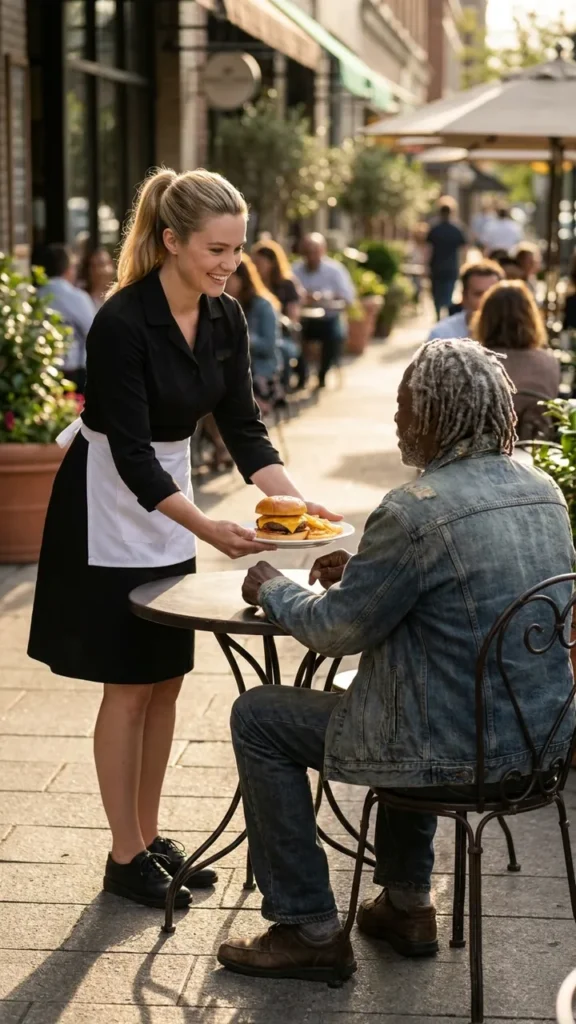
Outside, at a small, wrought-iron table, a scene of quiet generosity was unfolding.
Eleanor, a young waitress with a perpetually cheerful disposition and a blonde ponytail that bounced with her movements, approached an elderly Black man.
His name was Arthur.
His face, a roadmap of a life lived fully, was framed by a cascade of grey dreadlocks.
He wore a faded denim jacket, ripped at the seams, a testament to resilience rather than neglect.
Eleanor placed a plump, juicy burger, crowned with a golden slice of cheese, onto the table before him.
“Here sir,” Eleanor said, her voice warm and genuine. “It’s on me.”
Arthur’s eyes, deep and knowing, met hers.
A flicker of surprise crossed his features, quickly followed by a gentle smile that crinkled the corners of his eyes.
He reached out, his calloused fingers hovering over the plate.
Suddenly, the glass door of the restaurant swung open with aggressive force.
A man in a perfectly tailored black suit, his tie cinched tight, stormed out.
His name was Mr. Sterling, the owner of Gourmet Burgers.
His face was a mask of fury, his grey-streaked hair slicked back, a stark contrast to the carefree air of the street.
He carried a sleek leather briefcase, his knuckles white as he gripped it.
Sterling’s gaze landed on Eleanor, and his eyes narrowed with incandescent rage.
He pointed a trembling finger, his voice a harsh bark that cut through the ambient street noise.
“Do you want me to fire you?” he bellowed, his voice echoing the shock of his demand. “Do you want me to fire you?”
Eleanor froze, her smile vanishing, replaced by a mixture of fear and confusion.
Arthur, mid-reach for his burger, recoiled slightly, his gaze shifting from Eleanor to the enraged owner.
The casual atmosphere of the outdoor cafe shattered.
Sterling took another aggressive step towards Eleanor, his face inches from hers.
His eyes bulged with an almost unhinged fury.
“Get out right now!” he screamed, the words spat out like venom.
Eleanor’s lower lip trembled.
She glanced at Arthur, a silent plea in her eyes.
Arthur, his earlier gratitude now overshadowed by a growing sense of injustice, watched the scene unfold.
He had expected a quiet meal, a moment of respite.
He had not expected this display of petty tyranny.
Sterling’s attention then shifted, his furious gaze raking over Arthur, a sneer forming on his lips.
He seemed to imply Arthur was the cause of Eleanor’s supposed transgression.
“You,” Sterling spat, his voice dripping with disdain as he gestured dismissively towards Arthur’s burger, “think you can just take what’s not yours?”
Arthur remained silent, his gaze steady, a profound weariness settling upon him.
He had faced many hardships, many indignities, but this man’s casual cruelty was a particularly bitter pill.
Eleanor, however, found a spark of defiance igniting within her.
She stepped slightly in front of Arthur, her chin lifting. “Mr. Sterling, he’s a customer.
And I offered to pay for his meal.”
Sterling let out a humorless laugh, a dry, rasping sound. “A customer?
He’s a beggar!
And you, Eleanor, are costing me money.
You are fired!” He jabbed his finger towards her one last time, the gesture a definitive, brutal dismissal.
Just as Eleanor’s eyes welled up with tears, Arthur slowly pushed his plate forward.
He then looked directly into the camera, a knowing glint in his eyes, a subtle smile playing on his lips.
“You really want to know what happens next?” he asked, his voice a low, resonant rumble that seemed to carry the weight of years and wisdom.
He paused, letting the question hang in the air, his smile widening, transforming his weathered face into a beacon of quiet amusement.
“Then watch carefully.”
The implication was clear.
This was not the end.
This was merely the beginning of a story that would undoubtedly unfold with a dramatic and perhaps unexpected turn, a testament to the unexpected kindness found in the face of unbridled cruelty.
The stolen moment of generosity had ignited a spark, and Arthur, with his knowing gaze, suggested that the flames were far from extinguished.
The words “Then watch carefully” hung in the air, a cryptic promise.
Arthur’s direct gaze, aimed with uncanny precision at something unseen beyond the bustling street, sent a ripple through the small crowd that had begun to gather.
A young man, no older than Eleanor, fumbled with his phone.
He’d been filming the entire exchange, initially out of morbid curiosity, but Arthur’s final words shifted something.
The raw injustice, the stark cruelty of Sterling against the quiet dignity of Arthur and the kindness of Eleanor, had been too much to ignore.
He zoomed in on Arthur’s face, capturing the subtle, knowing smirk that had replaced the weariness.
Then, he panned to Eleanor, her shoulders slumped, the remnants of tears glistening on her cheeks.
Sterling, meanwhile, stood rigid, his face a thundercloud, oblivious to the device capturing his ignominy.
The recording, mere minutes long, was brutally honest.
It showcased Sterling’s rage, his demeaning language, and Eleanor’s earnest defense.
The young videographer, whose name was Leo, uploaded the footage to a popular social media platform with the caption: “Boss fires kind waitress for feeding homeless man.
Unbelievable.” He added hashtags: #JusticeForEleanor #BoycottGourmetBurgers #CorporateCruelty.
He tagged local news outlets and several large social justice advocacy groups.
Within an hour, the video had thousands of views.
The numbers climbed exponentially.
Comments flooded in, a torrent of outrage. “This is disgusting!” one read. “That owner is a monster!” another exclaimed. “This poor woman lost her job for being human!”
Eleanor, still standing outside, numbly watched her phone.
Friends and family were tagging her, sharing the video.
The quiet injustice had exploded into a public spectacle.
She felt a wave of nausea, a dizzying mix of shame and a dawning sense of validation.
Arthur stood a few feet away, his presence a silent anchor.
He hadn’t moved, his expression unreadable, as if he’d anticipated this very outcome.
Sterling, having regained some semblance of composure, paced back and forth on the sidewalk, oblivious to the digital storm brewing.
He muttered to himself, “Insubordination.
That’s what it was.
Disrupting business.” He didn’t see Leo, now discreetly filming Sterling’s agitated movements.
The contrast was stark: the furious, self-absorbed owner and the quiet, resilient man who had become the unwitting symbol of a larger struggle.
The hashtag #BoycottGourmetBurgers began trending.
People shared the video, adding their own stories of poor customer service or perceived greed from other businesses.
The initial act of kindness by Eleanor had cracked open a dam of public sentiment.
Arthur’s direct address to the “camera” had transformed a local incident into a potential viral movement.
The quiet ripple had become a wave, and its destination was unclear, but its force was undeniable.
Eleanor looked at Arthur, a question in her eyes.
He simply nodded, a subtle, encouraging gesture.
The game had truly begun.
‘The digital wildfire raged.
Eleanor’s face, a picture of quiet kindness, was plastered across news feeds.
Arthur’s stoic presence beside her, his knowing look, became the rallying cry. #BoycottGourmetBurgers dominated social media.
The anger was palpable, a raw, unadulterated fury directed at Mr. Sterling’s blatant display of cruelty.
Online petitions demanding his apology and Eleanor’s reinstatement gained thousands of signatures within hours.
People shared stories of their own encounters with corporate indifference, their voices amplified by the shared outrage.
Sterling, initially dismissive, found himself trapped in a rapidly escalating crisis.
He sat in his sleek, glass-walled office, the city lights blurring outside.
His phone buzzed relentlessly, each notification a fresh wave of condemnation.
He’d tried a brief, stilted statement to a local news blog: “An unfortunate misunderstanding concerning employee insubordination.
Gourmet Burgers maintains a professional environment.” It was a disaster.
The public saw it for what it was: a pathetic attempt to deflect blame.
“Insubordination?” a popular online commentator scoffed on a live stream, her voice dripping with contempt. “The only insubordination here is Sterling’s refusal to acknowledge basic human decency!” She held up her own phone, displaying Eleanor’s tear-streaked face. “This woman showed compassion.
This man,” she gestured towards Sterling’s photo, “showed us his true, ugly colors.”
Eleanor, overwhelmed, sat with her parents.
They held her close, their pride in her battling with their fear for her future.
Her phone, no longer just a communication device, felt like a portal to a world she barely understood.
Friends flooded her inbox with messages of support.
One even offered her a job at their small bakery, a lifeline in the storm.
Arthur, who had quietly found a bench across the street, watched the scene unfold, a flicker of grim satisfaction in his deep-set eyes.
He had seen this before – the mighty brought low by their own arrogance.
Sterling, his jaw clenched, paced his office.
He refused to back down.
He saw this as a challenge, a test of his will. “They want to dictate how I run my business?” he seethed, slamming his fist onto his mahogany desk. “They think a few angry tweets will bring me to my knees?
I’ll show them.
I’ll weather this storm.” He picked up his phone, dialing his lawyer. “Get me the best PR team money can buy.
And find out who that old man is.
I want dirt.
I want to discredit him.
I want to make Eleanor look like she was trying to extort me.” The venom in his voice was a stark contrast to the polished veneer he presented to the world.
He was a cornered animal, lashing out.
The online backlash intensified.
Users unearthed Sterling’s past business dealings, finding patterns of exploitative practices.
Anonymous former employees of Gourmet Burgers began sharing horror stories of his harsh management and low wages.
The narrative solidified: Sterling was not just a bad boss; he was a symbol of unchecked corporate greed.
The boycott was no longer just about Eleanor and Arthur; it was about a broader disillusionment with the system.
Eleanor’s small act of kindness had ignited a fire, and Sterling’s stubborn refusal to acknowledge it was fanning the flames.
The pressure was building, a silent, invisible force that would soon crack his carefully constructed facade.
As the digital storm raged around Gourmet Burgers, a different narrative began to surface.
Whispers about Arthur, the quiet homeless man, started to spread online.
Initially, he was just the recipient of Eleanor’s kindness, a symbol of vulnerability.
But as people dug deeper, as Arthur himself, through subtle hints dropped to those who reached out, began to share fragments of his past, a more complex picture emerged.
He wasn’t just a homeless man; he was Arthur Jenkins, a former skilled tradesman who had lost everything after a devastating illness and a predatory loan company.
His story resonated deeply.
It spoke of a system that could chew up and spit out even the most hardworking individuals.
His quiet dignity in the face of Sterling’s aggression, his resilience despite his current circumstances, painted him not as a victim, but as a survivor.
The public sympathy for Eleanor now expanded, encompassing Arthur.
People saw him as a testament to the human spirit, and Sterling’s treatment of him as a profound insult to that spirit.
Online communities, galvanized by his story, started sharing similar experiences of hardship and injustice.
Meanwhile, Eleanor found herself in a new kind of struggle.
While the crowdfunding campaign for her and Arthur was gaining momentum, her job search was proving surprisingly difficult.
Potential employers were hesitant.
The story, while garnering sympathy, had also painted her as someone who might cause trouble or be a liability. “We appreciate your situation, Eleanor,” one manager said apologetically, “but we need someone who won’t create waves.” The shame of being fired, amplified by the public spotlight, weighed heavily on her.
She felt a profound sense of isolation, even amidst the outpouring of support.
Her parents watched her, their hearts aching.
Her mother, a stern but loving woman, finally said, “Eleanor, darling, you did a good thing.
A brave thing.
Don’t let these people make you doubt yourself.
This is their shame, not yours.” Her father, a quiet man, nodded in agreement.
He had always taught her to stand up for what was right, and she had.
Now, they were her fortress, shielding her from the harsh realities of a world that didn’t always reward kindness.
Sterling, however, remained defiant.
He launched a counter-offensive, leaking doctored information about Arthur’s alleged past “trouble-making.” He tried to paint Eleanor as an attention-seeker, complicit in Arthur’s supposed manipulation.
His lawyer issued statements about defamation and the potential for legal action against those spreading “falsehoods.” But the more he attacked, the more the public rallied behind Arthur and Eleanor.
His attempts to divide and conquer were backfiring spectacularly.
He was digging his own grave, brick by brick, with every arrogant word and every calculated lie.
The narrative was shifting from a simple firing to a battle between genuine compassion and corporate villainy, and Sterling was losing decisively in the court of public opinion.
CHAPTER 2: The Community Unites
‘The relentless online storm finally began to affect Sterling’s carefully curated empire.
Gourmet Burgers, once a bustling hub of city dwellers seeking a quick bite, now stood eerily quiet.
The once-familiar aroma of burgers was replaced by a faint, sterile emptiness.
Customers, their faces glued to their phones, pointed at the vacant tables and shook their heads.
The hashtag #BoycottGourmetBurgers wasn’t just a trending topic; it was a tangible force, emptying Sterling’s pockets and rattling his gilded cage.
Eleanor, amidst the escalating crisis, received a call.
It was from a local community organizer, a woman named Brenda with a voice like warm honey and a steely resolve.
Brenda had been following the story with growing admiration for Eleanor’s quiet strength.
“Eleanor,” Brenda began, her voice tinged with urgency and a hint of excitement, “we’re organizing a peaceful demonstration outside Sterling’s restaurant.
We want to show him, and the city, that empathy still matters.
We want to amplify Arthur’s story, your story.
We need your support.
More importantly, we need Arthur’s.”
Eleanor’s heart fluttered.
A demonstration?
It felt both terrifying and exhilarating.
She immediately contacted Arthur.
They met at their usual quiet spot in the park, the dappled sunlight filtering through the leaves.
Arthur listened intently, his grey dreadlocks framing his weathered face.
“A demonstration,” Arthur mused, his deep voice a low rumble. “The people are speaking.
It’s about time someone listened.” He looked at Eleanor, his kind eyes filled with a newfound resolve. “I will be there, Eleanor.
If my presence can help shine a light on this… this injustice, then I will stand tall.”
The news of the protest spread like wildfire through social media.
Local news outlets, sensing a story with genuine human interest and a clear antagonist, began to cover the impending event.
The online outrage translated into real-world action.
People who had never met Eleanor or Arthur felt a personal connection to their struggle, a shared affront to their own sense of fairness.
Meanwhile, Sterling, blindsided by the depth of the public backlash, was frantically trying to salvage his reputation.
His expensive PR team, hired to spin the narrative, found themselves battling a tidal wave of genuine public sentiment.
Their carefully crafted press releases about “disgruntled former employees” and “exaggerated claims” were met with derision and mockery.
Every attempt to discredit Arthur or Eleanor only served to further unite the public behind them.
Sterling’s lawyer, a sharp-faced man named Davies, cornered him in his opulent office. “Mr. Sterling, the boycott is crippling us.
Our profits are down forty percent this week alone.
The media is circling.
We need to change tactics.
This aggressive approach isn’t working.”
Sterling slammed his fist on the desk, the crystal decanter on his side table rattling precariously. “Change tactics?
Davies, I am Sterling!
I do not bow to public opinion!
These people are weak.
They will forget.
We just need to weather this storm.
Find more dirt on Jenkins.
Dig deeper.
Make him look like a criminal.
That will shut them up.”
Davies sighed, running a hand through his thinning hair. “Sir, with all due respect, the more you dig, the more you uncover about his past, the more sympathy he garners.
People see a man who fell on hard times, not a criminal.
And Eleanor… she’s a sympathetic figure.
The narrative is set: you are the cruel, uncaring businessman, and they are the innocent victims of your wrath.”
Sterling glared, his dark eyes burning with a mixture of fury and desperation.
He was a man accustomed to control, and the loss of it was a bitter, unbearable pill.
He refused to acknowledge the growing power of collective empathy.
The day of the protest dawned crisp and clear.
A crowd, numbering in the hundreds, began to gather.
They carried signs: “Kindness is Not a Crime,” “Empathy Over Profit,” “Sterling: Your Burgers Are Cold, Your Heart Colder.” Eleanor, dressed in a simple but neat blouse, stood beside Arthur, his ripped denim jacket a familiar sight.
Arthur, his posture straighter than usual, met the gaze of the reporters and the protestors with a quiet dignity that spoke volumes.
The energy was palpable, a potent mix of anger and hope, a collective demand for accountability.
The protest outside Gourmet Burgers was a sea of signs and determined faces.
The low hum of conversation had long since faded, replaced by the unified chant, “Sterling!
Sterling!
Shame on you!” Eleanor stood near the front, her initial nervousness giving way to a quiet sense of empowerment.
Arthur was by her side, a silent, formidable presence.
He no longer looked weary; there was a fire in his deep-set eyes, a reflection of the collective spirit surrounding them.
Sterling, peeking through the blinds of his executive office, his face a mask of disbelief and fury, watched the scene unfold.
His PR team’s assurances of “a minor inconvenience” felt like a cruel joke.
This was not a minor inconvenience; this was a full-blown revolt.
His phone, once a symbol of his power, now felt like an instrument of torture, buzzing incessantly with angry messages and news alerts.
Suddenly, the restaurant’s main doors burst open.
Sterling’s head snapped up.
He watched, stunned, as a small group of protestors, galvanized by the chant, began to push their way inside.
Security guards, outnumbered and outmaneuvered, were overwhelmed.
The chanting grew louder, echoing through the once-pristine interior.
“You wanted to see me, Sterling?” a voice boomed from the doorway.
It was Arthur.
He hadn’t charged in; he had walked, slowly and deliberately, with Eleanor following close behind.
His voice, normally soft, carried an authority that Sterling had never heard before.
Sterling stumbled back, his face paling.
Davies, the lawyer, appeared at his side, his own expression a mixture of shock and dread. “Mr. Sterling, this is… this is not good.
We need to de-escalate.”
Sterling ignored him, his gaze locked on Arthur. “You… you old fool!
You think you can do this?
You think you can bring me down?” His voice was a ragged whisper, the arrogance crumbling.
Arthur took another step forward, his eyes never leaving Sterling’s. “I am not trying to bring you down, Sterling.
You are doing that to yourself.
But I will not stand by and watch you crush the spirit of good people.
I saw your cruelty.
The world saw your cruelty.
And now, the world demands answers.”
Eleanor, finding her voice, stepped forward. “We’re not here for revenge, Mr. Sterling.
We’re here for accountability.
You fired me for showing basic human kindness.
You belittled a man who has suffered more than you can imagine.
That’s not how a business owner should act.
That’s not how a human being should act.” Her voice, though trembling slightly, was firm.
The protestors, now filling the entrance to the dining area, began to chant louder.
The pressure was immense.
Sterling was cornered, exposed.
The carefully constructed façade of his success was shattering around him.
Davies stepped forward, his hand raised placantly. “Mr. Sterling understands the gravity of the situation,” he announced, his voice strained. “He is prepared to… to offer a sincere apology.
And to make amends.”
Sterling stared at Davies, then at Arthur and Eleanor, his eyes wild.
He opened his mouth to protest, but the sheer weight of the moment, the unified disapproval radiating from the crowd, silenced him.
He let out a choked sound, a mix of resignation and humiliation.
With a heavy sigh that seemed to carry the weight of his downfall, Sterling finally spoke, his voice barely audible. “I… I apologize.
To both of you.
And to the public.
What I did was… wrong.
Inexcusable.” He couldn’t bring himself to look at them directly.
The apology, delivered under duress, hung in the air.
It was a start.
The crowdfunding campaign for Eleanor and Arthur immediately saw a surge of donations.
Eleanor received multiple job offers, including a management position at a larger, more ethical establishment.
Arthur, now a symbol of resilience, was offered assistance in finding stable housing and support services.
Sterling’s business, though damaged, began a slow, painful rebuild under new management after he was forced to sell his controlling stake.
The viral spark had ignited a fire of awareness, proving that even in the face of immense power and cruelty, the simple act of human kindness, amplified by community, could indeed bring about a profound reckoning.
‘The air inside Gourmet Burgers still buzzed with the residual energy of the confrontation.
Sterling stood frozen, the forced apology a bitter taste in his mouth.
The protestors outside, sensing the shift, began to cheer.
Eleanor and Arthur exchanged a look – a mixture of relief and a profound understanding of the long road ahead.
Davies, the lawyer, stepped forward, his face a mask of strained professionalism. “Mr. Sterling,” he began, his voice low and urgent, “we need to manage the fallout.
The media is outside.
Your investors are demanding explanations.
The apology, while necessary, is just the first step.”
Sterling finally managed to tear his eyes away from Arthur.
He looked around the once-familiar restaurant, now filled with a hostile crowd.
His empire, built on an edifice of arrogance and exploitation, was crumbling before his eyes.
He saw not just empty tables, but the faces of everyone he had ever mistreated, amplified by the glowing screens of a hundred phones. “What do they want?” he rasped, his voice thin and reedy, stripped of its former authority.
“They want justice, Mr. Sterling,” Eleanor said, her voice clear and steady. “They want to see that kindness is valued.
That people like you, who prey on the vulnerable, will be held accountable.” She met his gaze, not with anger, but with a quiet strength that seemed to unnerve him more than any shout could have.
Arthur stepped closer, his presence a calming yet imposing force. “You built your success on the backs of people like me, Sterling.
On the backs of people like Eleanor.
You thought you were invincible.
You thought you could crush anyone who stood in your way.
But you underestimated the power of people coming together.
You underestimated the power of a story.” He gestured towards the protestors, their faces illuminated by the flashing cameras of news crews. “This is what happens when you treat people like dirt.
This is what happens when you forget what it means to be human.”
Davies cleared his throat. “Mr. Sterling has agreed to a full public statement, as well as the establishment of a fund for displaced employees and community outreach programs.
He will also be stepping down from his leadership position in the company, effective immediately.” The words were precise, clinical, a testament to the legal damage control already in motion.
Sterling flinched as if struck. “Stepping down?
You can’t do this!
I built this!”
“You built it on a foundation of sand, Mr. Sterling,” Arthur replied, his voice resonating with a deep, sorrowful truth. “And the tide has finally come in.”
The news of Sterling’s downfall spread like wildfire.
The initial apology, forced and delivered under duress, was met with skepticism.
But as the details of the fund and his resignation emerged, a palpable sense of vindication swept through the online community. #SterlingOut and #JusticeForArthur trended globally.
Investigations were launched into Gourmet Burgers’ labor practices.
Employees who had been mistreated or unjustly fired began to come forward, their stories adding further weight to the narrative of Sterling’s corrupt reign.
The glossy image of Gourmet Burgers was irrevocably tarnished, replaced by the stark reality of its owner’s depravity.
Sterling, a man who had thrived on public image, found himself exposed and reviled.
He was no longer the titan of the restaurant industry, but a pariah.
The very system he had manipulated had turned on him, his greed and cruelty serving as the anvil upon which his empire was shattered.
The aftermath of Sterling’s public humiliation was a period of profound change, both for the individuals involved and for the wider community.
Eleanor, no longer burdened by the fear of reprisal, found her job search transformed.
Her previous termination, once a mark of shame, was now a badge of honor, a testament to her integrity.
Restaurants, eager to align themselves with positive values, vied for her expertise.
She eventually accepted a position as a restaurant manager at a small, locally owned establishment known for its commitment to ethical sourcing and fair labor.
The atmosphere was warm, supportive, and felt like coming home.
Arthur, too, found his life irrevocably altered.
The viral story had not only brought him justice but also a network of support.
The community outreach programs funded by the remnants of Sterling’s empire, coupled with a surge of private donations, provided him with stable housing.
More importantly, he found a sense of belonging.
He began volunteering at a local soup kitchen, sharing his story and offering a listening ear to others facing hardship.
His quiet wisdom, once overlooked, was now sought after.
He was no longer just Arthur, the homeless man; he was Arthur, the symbol of resilience, the man who had stared down his oppressor and emerged with his dignity intact.
The crowdfunding campaign, initially launched for Eleanor and Arthur, had become a beacon of hope for countless others facing similar injustices.
It evolved into a foundation dedicated to supporting workers’ rights and advocating for compassionate business practices.
The online outrage had coalesced into a tangible force for good, demonstrating the power of collective action in a digital age.
Sterling’s downfall served as a stark, unforgettable lesson: that empathy, integrity, and community could triumph over greed and cruelty.
One crisp autumn afternoon, Eleanor and Arthur met at their favorite park bench.
The leaves were turning, painting the landscape in vibrant hues of red and gold.
A sense of peace settled over them, a quiet satisfaction that transcended any material gain.
Eleanor handed Arthur a small, beautifully crafted wooden bird. “A thank you,” she said, her voice filled with emotion. “For everything.
For being brave.”
Arthur turned the bird over in his calloused hands, his eyes crinkling at the corners. “Kindness, Eleanor,” he said, his voice a low, resonant rumble, “is never wasted.
It’s like planting a seed.
You don’t always see the fruit immediately, but it grows.
It always grows.” He looked up at the sky, a gentle smile on his face. “And sometimes, a little spark can set the whole forest ablaze.” The viral spark that had ignited their story had indeed created a wildfire of change, a testament to the enduring power of human connection and the unwavering pursuit of justice.
Their story, no longer just a dramatic moment, had become a legend of hope.
CHAPTER 3: The Echo Chamber of Outrage
‘The digital storm raged. #SterlingOut and #JusticeForArthur weren’t just trending; they were hurricanes.
Every news outlet, from local blogs to international networks, picked up the story.
The viral video of Arthur’s quiet plea and Sarah’s tearful dismissal, amplified by countless shares and impassioned commentary, had become a global phenomenon.
The internet, a vast echo chamber of collective emotion, reverberated with outrage.
Sterling’s initial statement, released through a hastily hired public relations firm, was a masterpiece of corporate obfuscation.
It spoke of an “unfortunate workplace disagreement,” a “misinterpretation of company policy,” and hinted at “employee insubordination.” It painted Sarah as a rogue element and Arthur as an unwelcome disruption.
But the carefully crafted words fell flat.
The video was too raw, too real.
The public saw through the spin.
“Misunderstanding?
He practically threatened to assault her!” a popular online commentator, “JusticeJunkie,” declared in a viral video response. “And calling a man who’s clearly struggling a ‘beggar’?
That’s not policy, that’s pure evil.”
The digital backlash was immediate and brutal.
Users flooded Gourmet Burgers’ social media pages with furious comments.
The carefully curated images of happy families enjoying burgers were drowned in a sea of condemnation. #BoycottGourmetBurgers became the dominant hashtag.
People shared photos of themselves destroying their loyalty cards.
Online reviews plummeted.
The restaurant’s Yelp and Google pages became battlegrounds for public opinion.
“Never again!” one review read. “I saw the video.
Sterling’s cruelty is sickening.
We will not support a business that treats people like that.”
“This isn’t just about a burger,” another added. “It’s about basic human decency.
Sterling needs to be held accountable.”
Meanwhile, Sarah, the focus of so much digital sympathy, was overwhelmed.
Her phone buzzed incessantly with messages of support, job offers, and interview requests.
The initial fear and humiliation had been replaced by a dizzying sense of validation, but also a profound anxiety about the future.
She was grateful for the outpouring of kindness, but the sudden spotlight was intense.
Arthur, however, remained grounded.
The viral fame was a distant, abstract thing to him.
He was more concerned with the immediate, tangible impact.
He saw the hope in Eleanor’s eyes, the relief in the faces of his fellow volunteers at the soup kitchen.
He knew this wasn’t about him anymore; it was about a larger principle.
He watched the news reports with a quiet stoicism, his grey dreadlocks framing a face that had seen too much hardship to be easily swayed by fleeting fame.
He understood the power of the narrative, the way a single spark could ignite a prairie fire.
He had seen it before, in different forms, throughout his long life.
This, he knew, was just the beginning of the inferno.
He sat on his usual park bench, a worn book open on his lap, the distant roar of online discourse a mere murmur in the background of his quiet contemplation.
He knew that words, spoken with conviction and backed by undeniable truth, could indeed shake the foundations of the world.
The initial PR damage control had backfired spectacularly.
Sterling’s carefully worded denials only fueled the public’s distrust.
The more he tried to spin the narrative, the more people dug for the truth.
Investigations into Gourmet Burgers’ labor practices, spurred by the viral incident and the subsequent public outcry, began to uncover a pattern of exploitation.
Whistleblowers, emboldened by the momentum, started to emerge.
Former employees, who had previously suffered in silence, began to share their own stories of unfair dismissal, wage theft, and disrespectful treatment at the hands of Sterling and his management team.
The narrative shifted from a single incident to a systemic problem.
The glossy facade of Gourmet Burgers cracked, revealing the rot beneath.
“He fired me for taking a five-minute break when I was sick,” one former cook recounted on a popular podcast. “Said I was lazy.
He doesn’t care about anyone but himself.”
“I worked double shifts for minimum wage, and he complained when I asked for overtime pay,” another tearfully explained in a televised interview. “He treats his staff like disposable rags.”
The mounting evidence was undeniable.
The online outrage solidified into organized action.
Protests, initially spontaneous flash mobs outside Gourmet Burgers’ flagship location, began to be coordinated.
Handmade signs, bearing slogans like “Justice for Arthur” and “Sterling is a Scoundrel,” bobbed in the crisp autumn air.
The protestors, a diverse mix of former employees, local activists, and everyday citizens, chanted slogans that echoed the anger and frustration resonating across social media.
Sterling, holed up in his opulent penthouse, watched the news with a growing sense of dread.
The protests were no longer just online chatter; they were a physical manifestation of his downfall.
His investors, once a source of unwavering support, were now demanding answers.
Their calls were no longer polite inquiries but urgent warnings.
The financial implications of the boycott and the mounting legal challenges were too significant to ignore.
Davies, his lawyer, delivered the grim prognosis. “Mr. Sterling, the company’s stock has tanked.
Your key investors are threatening to pull out entirely.
The media is relentless.
The FTC is launching a formal inquiry into your labor practices.
You have to be seen to be taking responsibility, or this will destroy you entirely.”
Sterling, his face pale and drawn, slammed his fist on the mahogany desk. “Responsibility?
They’re trying to ruin me!
I built this empire!”
“You built it on exploitation, sir,” Davies said, his voice devoid of emotion. “And now the foundation is crumbling.
The public has seen your true colors.
Your reputation is in tatters.
You have two options: face complete ruin, or try to mitigate the damage.
The apology you’ve been advised to issue is no longer enough.
They want more than words now.
They want concrete action.”
Arthur, now comfortably housed and involved in community initiatives, felt a quiet sense of vindication.
He saw the news reports, the protestors, the former employees finding their voice.
He knew the fight wasn’t over, but the tide had turned.
He sat with Eleanor at their favorite park, the wooden bird she had given him nestled in his palm.
“It’s a lot, isn’t it?” Eleanor said softly, watching a group of young people organizing a new online campaign. “All this… noise.”
Arthur nodded, his deep eyes reflecting the vibrant fall foliage. “Noise, yes.
But it’s the sound of change, Eleanor.
The sound of people refusing to be silenced.
Sterling thought he was untouchable.
He thought his money and his power made him immune to the consequences of his actions.
He was wrong.
The world is watching now.
And the world doesn’t like bullies.” He squeezed the wooden bird, a small, tangible symbol of kindness in a world often defined by its absence.
The weight of exposure, once a threat to Sterling, was now the instrument of his reckoning.
‘The relentless tide of negative press and public condemnation was a physical force.
Sterling’s penthouse, once a sanctuary of power, felt like a gilded cage.
His expensive suits now hung heavy, mirroring the weight of his impending doom.
Davies, his lawyer, entered the room, his face grim, holding a thick sheaf of papers.
“Mr. Sterling,” Davies began, his voice low and measured, “the FTC has officially filed charges.
Unfair labor practices, wage violations, retaliatory firing.
They’re seeking maximum penalties.”
Sterling scoffed, pacing the opulent carpet. “Penalties?
They can’t penalize me.
I am the system!”
“The system is turning on you, sir,” Davies countered, his eyes steady. “The media has obtained leaked internal memos.
Your own words are being used against you.
Statements detailing your disdain for ‘entitled employees’ and your explicit instructions to ‘squeeze every last drop of labor’ for minimum cost.”
Sterling stopped, his breath catching. “Leaked?
How?
Who would dare?”
“Fear breeds courage, Mr. Sterling.
And your former employees have had enough of being afraid.
The FTC investigation has corroborated many of their claims.
We’re talking class-action lawsuits, massive fines.
Your investors are lawyering up.
They want to sever ties before they’re dragged down with you.”
The news was a physical blow.
Sterling’s face contorted, his arrogance cracking. “This is a witch hunt!
A smear campaign orchestrated by that old beggar and that whiny waitress!”
“They are the catalyst, sir,” Davies said, his gaze unwavering. “But the rot was already there.
And now, it’s exposed.
The protests have moved from outside your restaurant to outside your corporation’s headquarters.
They’re demanding your resignation.
They’re demanding accountability.”
Outside the penthouse window, the city lights shimmered, oblivious to Sterling’s unraveling.
The sounds of sirens, once a distant hum, now seemed to punctuate his downfall.
He felt a tremor in his hands, a sensation he hadn’t experienced since his early, desperate days.
This was different.
This was the roar of a world that had finally seen him, truly seen him, and rejected him.
He sank into a plush armchair, his empire crumbling around him.
The power he had wielded so carelessly was now a weapon turned against him, forged from the very injustices he had perpetuated.
Sarah, once terrified and humiliated, found herself navigating a whirlwind of unexpected opportunities.
The viral video and the subsequent public outcry had made her a symbol of resilience.
Job offers poured in, not just from small diners, but from reputable businesses that valued integrity.
She felt a profound sense of relief, but also a deep empathy for those still caught in difficult work environments.
“It’s overwhelming, Arthur,” Sarah confided during one of their frequent meetings. “So many people want to help.
But I can’t stop thinking about everyone else who’s been treated like that, and who doesn’t have a viral video.”
Arthur, his face etched with a quiet understanding, nodded. “That’s the true victory, Sarah.
Not just for you, but for all of them.
Your story cracked the door open.
Now, others are finding the courage to push it wide.”
Indeed, the “ripple effect” was palpable.
A crowdfunding campaign, initially set up for Sarah, had quickly expanded to include support for other former Gourmet Burgers employees who had come forward.
Legal aid organizations offered pro bono services to those seeking to reclaim unpaid wages.
The story had transcended a single incident, igniting a broader conversation about corporate responsibility and worker rights.
Eleanor, Arthur’s friend and an active community organizer, was at the forefront of these initiatives. “It’s incredible,” she told Sarah, her eyes shining. “People are donating not just money, but their time, their skills.
We’re seeing former employees start their own worker cooperatives.
It’s like the entire community woke up.”
Sarah accepted a position at “The Green Sprout,” a popular local cafe known for its ethical sourcing and employee-friendly policies.
Her new boss, a kind woman named Maria, expressed her admiration for Sarah’s strength. “We saw what happened, Sarah.
We believe in treating people with respect.
You’re part of the family here now.”
Arthur, meanwhile, had been invited to speak at a workers’ rights conference.
He stood before a packed auditorium, not as a homeless man, but as a respected elder, his voice resonating with quiet authority.
He spoke of the dignity of labor, the corrosive nature of unchecked power, and the transformative force of compassion.
“We are not cogs in a machine,” Arthur declared, his gaze sweeping across the diverse faces. “We are human beings.
And when one of us is diminished, we are all diminished.
But when we stand together, when we lift each other up, we become a force that cannot be ignored.
The kindness shown to me that day was a spark.
Your courage, your solidarity, that is the fire that will change the world.”
The applause was deafening, a thunderous affirmation of his words.
Sarah watched from the front row, tears of pride and gratitude welling in her eyes.
The journey had been arduous, marked by fear and injustice, but it had led to this: a profound sense of belonging, a testament to the enduring power of empathy, and the quiet, unshakeable strength of the human spirit.
The old order was crumbling, and in its place, something new, something better, was beginning to bloom.
CHAPTER 4: The Crowdfunding Cascade
‘The initial crowdfunding campaign, a desperate plea for a single waitress and an elderly man, had morphed into a full-blown movement.
Sarah and Arthur were no longer just victims; they were the faces of a burgeoning fight against corporate greed.
Eleanor, with her sharp organizational skills and boundless energy, was the conductor of this digital orchestra.
The donations weren’t just numbers on a screen; they were tangible expressions of solidarity.
Every dollar represented a person who had witnessed Sterling’s cruelty and refused to let it stand.
“It’s like a dam broke, Arthur,” Eleanor said, her voice breathless during a meeting at a community center buzzing with activity.
Piles of flyers and donation tally sheets covered the tables. “We hit our initial target for Sarah in less than 24 hours.
Now, it’s expanded.
We’re setting up separate funds for the other former employees who’ve come forward.
The legal team is swamped, but they’re working miracles.”
Arthur, his grey dreadlocks framing a face etched with a quiet solemnity, nodded.
He’d been inundated with requests for interviews, for appearances.
His quiet dignity, amplified by the viral video, had become a beacon. “It’s the collective voice, Eleanor.
The one voice that Mr. Sterling never bothered to hear.
They heard it through the outrage, through the shared humanity.”
Sarah, still adjusting to this new reality, found herself constantly looking over her shoulder, half-expecting Sterling to reappear.
But the fear was being replaced by a burgeoning sense of purpose.
She spent her days helping Eleanor manage the influx of support, responding to emails, and coordinating with the legal aid groups.
The offers of employment continued to pour in, but the weight of responsibility for the other former employees kept her grounded.
“Maria at The Green Sprout has been amazing,” Sarah told Arthur, clutching a steaming mug of tea. “She’s letting me work flexible hours so I can help with this.
She says she understands.
That this is bigger than just a job for me now.”
“That’s the seed of change, Sarah,” Arthur replied softly, his eyes crinkling at the corners. “Kindness begets kindness.
Compassion breeds more compassion.
Your act, it was a single stone dropped in a pond.
But the ripples, they are becoming waves.”
Eleanor gestured towards a large whiteboard covered in names and donation amounts. “We’re also getting pledges of support from local businesses, even some national organizations that champion worker rights.
They’re offering pro bono services, donations of goods for the employees who lost their jobs, even mentorship opportunities.
It’s truly overwhelming, in the best possible way.” She pointed to a growing list. “And then there are the former Gourmet Burgers employees.
We’ve identified ten others who were fired under similar circumstances, or who reported grievances and were silenced.
Their stories are heartbreaking, Arthur.
The legal team is already building cases based on the evidence we’ve gathered.”
Arthur looked at Sarah, a deep understanding passing between them. “The struggle for dignity is never easy.
But it is always worth it.
Remember that, Sarah.
When the noise gets too loud, when the doubt creeps in, remember why we started this.
For them.
For everyone who suffers in silence.”
The digital storm had a very real, very physical impact.
Gourmet Burgers, once a trendy fixture in the city’s culinary landscape, was bleeding customers and revenue.
The hashtags #BoycottGourmetBurgers and #SterlingOut were trending relentlessly.
Online reviews plummeted to abysmal lows, filled with scathing condemnations of the restaurant’s owner.
Sterling, ensconced in his opulent penthouse, was watching his empire crumble not from the outside, but from the inside out.
His carefully constructed image of success was being systematically dismantled, pixel by pixel, tweet by tweet.
Davies, Sterling’s lawyer, entered the penthouse, his face a grim mask.
He held a tablet, its screen displaying a barrage of negative news articles and social media posts. “Mr. Sterling, the boycott is crippling.
Our suppliers are hesitant to deliver.
Several franchise partners are requesting immediate buyouts, citing irreparable brand damage.
Your investors… they’re in a panic.”
Sterling paced, his expensive loafers silent on the plush carpet.
His face was pale, his eyes darting nervously. “Panic?
They’ll get their money.
Just… just tell them to hold on.
This will blow over.
It’s just a few angry people.”
“Sir,” Davies said, his voice strained, “it’s far more than a few angry people.
The FTC investigation has escalated.
They’ve issued subpoenas for all financial records and employee contracts.
The lawsuits are mounting.
And the media… they’re digging into every aspect of your business practices.
They’ve found records of wage disputes from years ago, ignored complaints about unsafe working conditions, even instances of alleged harassment that were swept under the rug.”
Sterling stopped, his breath catching in his throat.
He felt a cold dread seeping into his bones, a stark contrast to the controlled rage he usually exuded. “Harassment?
That’s a lie!
They’re trying to fabricate things!”
“They have witnesses, sir,” Davies continued, his tone devoid of sympathy. “Former employees who are now willing to testify.
The internal memos we discussed are being leaked to every major news outlet.
Your own words, Mr. Sterling, are being used as the primary evidence against you.
The narrative has shifted from a disgruntled employee to a predatory executive.”
Sterling ran a hand through his slicked-back hair, the grey streaks seeming to mock him.
He looked out the window, the city lights blurring into an indistinguishable haze.
He had built this empire on the backs of others, on their sweat and their silence.
Now, their silenced voices were roaring back, amplified by a thousand digital platforms.
He felt a tremor in his hands, a sign of the fear that was beginning to consume him.
The power he had wielded with such impunity was now a crushing weight, bearing down on him, threatening to bury him alive.
The protests outside his corporate headquarters were no longer distant rumblings; they were a palpable force, a storm gathering strength, ready to unleash its fury.
‘The chanting grew louder, a unified roar that vibrated through the concrete and glass of Sterling’s corporate headquarters.
Eleanor, her face flushed with a righteous fire, stood at the front of the crowd, a megaphone amplifying her voice.
Sarah stood beside her, a determined glint in her eyes, no longer the timid waitress but a symbol of resilience.
Arthur, his presence a quiet anchor, stood a little behind them, his gaze steady and unwavering.
“We are here today,” Eleanor’s voice boomed, “because Mr. Sterling and his greed have silenced too many voices for too long!”
Hundreds of faces, a tapestry of anger and hope, turned towards the towering building.
Signs bobbed and weaved: “Justice for Workers,” “Sterling is a Scab,” and the ubiquitous “#BoycottGourmetBurgers.” The air crackled with a potent mix of fury and solidarity.
Inside the sterile, modern office, Sterling watched the scene unfold on a bank of security monitors.
His hands, once steady, now trembled.
Davies stood beside him, his face a picture of grim resignation.
“They’re demanding your apology, Mr. Sterling,” Davies said, his voice barely audible above the distant din. “And they’re demanding you step down.
The police are here, but they’re not dispersing the crowd.
They’re under orders to maintain peace, not to quell a legitimate protest.”
Sterling slammed his fist onto his desk.
The expensive wood groaned. “Legitimate?
This is a circus!
A mob!
They’re trying to extort me!”
“They have public opinion, sir,” Davies countered, his tone flat. “And they have evidence.
The leaked memos, the sworn testimonies… it’s all damning.”
Suddenly, the main doors of the building shuddered under a heavy impact.
A wave of protesters, having breached the perimeter, surged into the lobby.
Security guards, outnumbered and outmatched, were quickly overwhelmed.
The chants intensified, now echoing through the cavernous space.
Sterling stared at the monitors, his face a mask of disbelief and fear.
He had always operated from a position of absolute power, insulated by wealth and lawyers.
Now, the very people he had exploited were at his doorstep.
Eleanor, still leading the charge, entered the lobby.
Her eyes scanned the opulent surroundings, a stark contrast to the community center where they’d organized.
She locked eyes with Sterling, who had emerged from his office, a lone figure against the onslaught.
“Mr. Sterling!” Eleanor’s voice was strong, clear, cutting through the cacophony. “We’re not going away until you take responsibility for your actions!”
Sarah stepped forward, her voice shaking slightly but firm. “You fired me for showing compassion.
You treated people like dirt.
You think you can get away with it?”
Sterling scoffed, a pathetic attempt at his former arrogance. “This is an overreaction.
A misunderstanding.
I have the right to run my business as I see fit.”
Arthur, now at the front of the protesters, spoke, his voice a deep rumble that commanded attention. “No man has the right to break the spirit of another.
You built your fortune on the backs of those you crushed.
Today, they are standing up.”
The crowd pressed closer.
Sterling visibly shrank under their collective gaze.
The power he once exuded had evaporated, replaced by a palpable fear.
CHAPTER 5: Arthur’s Return, This Time Empowered
The raw power of the protest had forced Sterling into a corner.
His lawyers had advised him to concede, to apologize, but his arrogance had blinded him.
Now, the storm he had sown was about to reap its whirlwind.
The demands for his resignation were deafening.
The FTC investigation had intensified, and the threat of criminal charges loomed large.
Gourmet Burgers was teetering on the brink of financial ruin, its stock plummeting, its reputation in tatters.
It was in this charged atmosphere that Arthur reappeared, not as the hesitant victim, but as a figure of quiet strength.
He wasn’t seeking a handout or revenge.
He was there to witness the culmination of a movement he had inadvertently helped ignite.
He stood near Eleanor and Sarah, a silent sentinel.
Davies, his face etched with worry, approached Sterling in his now-emptied office.
The noise from the protest was a constant, unnerving reminder of his downfall. “The board is demanding your resignation, Mr. Sterling.
The investors are pulling out.
There’s no salvaging this without you stepping aside.
And the legal team believes a sincere public apology is our only chance to mitigate the damage.”
Sterling looked out at the protesters, his gaze no longer filled with rage, but with a dawning, bitter realization.
He had underestimated the power of solidarity.
He had underestimated the human spirit.
Eleanor, seeing Sterling emerge, raised her megaphone again. “Mr. Sterling!
The people you wronged are here!
They demand to be heard!
They demand justice!”
Sarah stood beside her, her fear replaced by a quiet resolve.
She no longer saw the cruel businessman, but a man trapped by his own avarice.
Then, Arthur stepped forward.
The crowd hushed.
He looked directly at Sterling, his eyes holding a profound understanding. “You sought to break them,” Arthur said, his voice carrying across the silent square. “But you only made them stronger.
You built walls of fear.
Today, those walls are crumbling.”
Sterling flinched.
Arthur’s words were not accusations, but observations, delivered with the weight of lived experience.
“I offered you kindness,” Arthur continued, his voice gaining a touch of quiet authority. “You repaid it with cruelty.
But look around you, Mr. Sterling.
Kindness, when nurtured, grows.
Cruelty, left unchecked, devours itself.”
A palpable shift occurred.
The aggressive energy of the crowd softened, replaced by a unified focus on Sterling.
He stood alone, his carefully constructed facade cracking under the pressure of Arthur’s words and the silent judgment of the hundreds gathered.
The scene was set for the final act.
Sterling, stripped of his power and his reputation, was finally facing the consequences of his actions.
Arthur, the man who had been so casually dismissed, now stood as a testament to the enduring power of empathy and the collective will of those who refuse to be silenced.
The storm had broken, and a new dawn, one built on dignity and respect, was beginning to emerge.
‘Sterling’s face contorted.
Arthur’s words were like stones, each one chipping away at his carefully constructed fortress of denial.
He opened his mouth, a strangled sound escaping.
Davies stepped forward, placing a hand on Sterling’s arm.
“Mr. Sterling,” Davies said, his voice low but firm, “it’s over.
The board has voted.
You’re out.
They’re giving you one last chance to address the crowd, to try and salvage something.
Or they’ll call the authorities themselves.”
Sterling looked at Davies, then back at the sea of faces.
He saw no pity, only a collective demand for accountability.
He saw Sarah, her gaze steady, no longer afraid.
He saw Eleanor, her expression resolute.
And he saw Arthur, a silent, powerful presence, the embodiment of the spirit Sterling had tried to crush.
The weight of his own cruelty settled upon him, heavy and suffocating.
Eleanor, sensing the shift in Sterling, spoke again, her voice amplified by the megaphone, but softer now, less accusatory, more expectant. “Mr. Sterling.
We are waiting.
The people you hurt are waiting.”
Sterling took a shuddering breath.
His arrogance, his fury, his denials – all of it crumbled.
He reached out, snatching the megaphone from Eleanor’s hand.
His hand trembled violently.
“I… I have wronged you all,” Sterling began, his voice cracking.
The words, so foreign, so difficult to form.
He looked at Sarah. “Sarah.
I… I unjustly fired you.
For an act of kindness.
I was wrong.
Terribly wrong.”
He then turned his gaze to Arthur, his eyes meeting the elder man’s steady stare. “Arthur.
I… I insulted your dignity.
I judged you without knowing you.
I am deeply sorry for the humiliation I caused.”
He swept his gaze across the entire crowd, the immense weight of his apology hanging in the air. “My actions were driven by greed and a profound lack of empathy.
I have let success blind me to the humanity of others.
I have created a toxic environment.
I am… I am truly sorry.”
The apology, though forced, was delivered with a raw, desperate sincerity that silenced the crowd.
It wasn’t enough to erase the pain, but it was a confession.
The FTC lawyers, who had been observing from a nearby building, signaled to the police.
The immediate threat of arrest subsided, replaced by a palpable sense of closure.
Sterling lowered the megaphone, his shoulders slumped.
He looked like a defeated man.
He was stripped of his power, his wealth, his reputation.
The empire he had built on exploitation was collapsing around him.
“The company will be making a formal statement,” Davies announced, stepping forward to retrieve the megaphone. “Mr. Sterling has agreed to cooperate fully with all investigations.
And a significant portion of his personal assets will be used to compensate those who have been wronged.”
The crowd murmured, a wave of relief and vindication washing over them.
The power had shifted.
The people had spoken, and they had been heard.
Arthur watched Sterling, not with triumph, but with a quiet understanding of the man’s self-inflicted ruin.
The fallout from Sterling’s public confession was swift and decisive.
The FTC launched a full-scale investigation, leading to charges of corporate malfeasance and unfair labor practices.
Sterling’s personal assets were frozen, with a substantial portion earmarked for restitution.
Gourmet Burgers, facing irreparable damage to its brand, was forced into bankruptcy.
The once-imposing building now stood empty, a monument to avarice and its consequences.
Sterling himself faced a legal battle that would likely end in significant fines and a ban from corporate leadership.
His arrogance had cost him everything.
He was no longer the king of his domain, but a pariah.
He had, in the end, been consumed by his own cruelty.
Sarah, no longer defined by her unjust dismissal, found herself at the center of a burgeoning movement.
The crowdfunding campaign, initiated by Eleanor and Arthur, had exploded.
Donations poured in, not just from those who had followed the story online, but from local businesses and community leaders inspired by her quiet resilience.
She used the funds not only to rebuild her own life, but to establish a small foundation dedicated to supporting workers facing similar injustices.
She found a new job, not at a burger joint, but at a community center that aligned with her values.
Her smile, once a mask of cheerful servitude, was now a genuine reflection of her strength and compassion.
Arthur, the catalyst for this seismic shift, found a peace he hadn’t known in years.
He wasn’t seeking recognition, but he found it in the gratitude of those he had inspired.
He became a quiet mentor, his wisdom sought by many who had faced hardship.
He often visited Sarah at the community center, their bond forged in shared adversity.
One afternoon, as Sarah was helping a young man fill out a job application, Arthur arrived with a worn leather-bound book.
He sat quietly, watching Sarah, his eyes twinkling.
“You know, Sarah,” Arthur said, his deep voice resonating with a gentle warmth, “sometimes, the smallest act of kindness can ignite the biggest change.”
Sarah looked up, her eyes meeting his. “And sometimes,” she replied, a soft smile playing on her lips, “it takes a wise old man to remind us of that.”
The community center buzzed with activity.
Laughter mingled with the murmur of conversations.
The air was filled with a sense of hope and shared purpose.
The story of Sarah, Arthur, and the fall of Mr. Sterling had become a modern parable, a stark reminder that even in the face of overwhelming power and cruelty, empathy, solidarity, and the courage to stand up for what is right could ultimately prevail.
The viral spark had ignited a fire, and the flames of justice and compassion were still burning bright, illuminating a path towards a more humane world.
‘
